If the Logo programming language could be implemented entirely in itself, would it be turtles all the way down?
Author: admin
Sad and horrified
I am saddened and horrified by the mass murder yesterday in Orlando. 49 innocent people dead, and 53 more wounded, because of something that is becoming frighteningly common in the U.S.: A madman bought a high powered military-style assault rifle and then used it.
I suppose I could use this space to talk about the NRA, but what would be the point? The horror of easy access to such high powered weaponry speaks for itself.
Yesterday was a terrible tragedy for those poor people and their families. My heart goes out to them.
And our continuing inability to have a sane conversation about these kinds of weapons is a terrible tragedy for our country.
Drama
I was attending a talk the other day, and at some point the speaker quoted Alfred Hitchcock:
“Drama is life with the dull bits taken out.”
I loved this quote, but was curious to understand the full context. So I went back to the original 1960 BBC interview. Excerpted from that interview, here is a fuller version of what he said:
“Life is more sensational. How does one describe drama? … Drama is life with the dull bits cut out.”
Hitchcock’s thought, as I had hoped, was more complex than the simple version one usually hears. Seeing the full interview now, I get the sense that Hitchcock wasn’t merely trying to present entertaining fantasies.
Rather, he was trying to create films that reflected essential truths about life. Of course, given the limitations of his chosen medium, he needed to reduce life to its poorer cousin — drama.
Programming in Arabic
At the Games for Change Europe conference this week here in Paris I learned that there are three things young kids in refugee camps say they are really excited about: (1) Learning English, (2) Making and sending videos on their mobile phones, and (3) Learning to program.
During a workshop at the conference, we talked about ways to make learning to program more accessible to those kids. Practically speaking, we figured it needs to be in on phones (which suggests using some sort of blocks language), and it needs to be in Arabic, since in the camps computers are scarce but SmartPhones are ubiquitous, and a lot more kids speak Arabic than English.
To get the conversation started, I sketched out a simple computer program, just to show the non-programmers in the room how simple programming can be. It’s a program that will be very familiar to some of you reading this blog.
The colleague I wrote about yesterday then translated it into Arabic. Here is what she came up with:

Other than the right-to-left ordering and the change in keywords, it’s very similar to the program I had sketched out. One thing she didn’t need to change was the use of Arabic numerals. 🙂
A good programmer who knows English but not Arabic should be able to figure out what this program computes. Can you?
Stateless
This morning in Paris I had breakfast with a woman who is stateless. That is, she is not a citizen of any country. In particular, she is a political refugee from Western Saraha.
I think this may have been the first time I had ever personally met a Muslim refugee, although of course a vast number of them are out there. I was pleased to find her very warm hearted, extremely perceptive and rather brilliant. She was also clearly enjoying the open-mindedness of the people she was meeting in Paris.
And I wasn’t the only one who was having an exotic experience. At one point she reached across the table, shook my hand, and said “This is the first time I am having breakfast with a Jew.” She seemed to be thoroughly delighted by this.
It was also the first time I had ever seen the passport of a stateless person. With her permission, I took a photo of the cover:
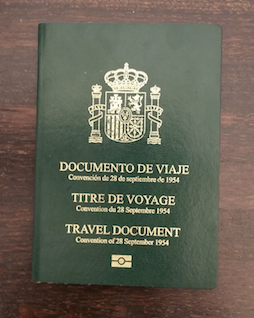
I wish everyone were as centered as this woman is. I guess it makes sense: When you have been deprived of any place on earth to call home, you learn to be highly grounded.
Biking in Paris
I’ve gone skydiving in Grenoble, I’ve traveled down the wild Amazon river, I’ve gone mano a mano with the peddlers in Mysore. So you could say I’ve been around.
But until today I had never bicycled in Paris. Let me tell you, it’s a heady experience.
First of all, yes, you are taking your life into your hands. French drivers do not fool around. To put it bluntly, your job as a cyclist is to stay out of their path.
Second of all, it’s great fun! There really is no place like Paris, and seeing it by bike is exhilarating. History rushes over you like the wind, and your soul drinks it all in.
Still, there is something about the sheer danger of cycling through the City of Lights that I find oddly appealing.
In particular, I greatly appreciate the appeal of a physical activiy whose allure rests largely on the opportunity to not get yourself killed.
404
For the last few years I have been spending some time each summer visiting the Centre for Digital Media in Vancouver. It’s great place, with lots of energy and very hard working and talented teachers and masters students.
The CDM folks generally put me up in room 404. It’s a beautiful suite, quiet and comfy and tucked away at the very end of a hallway.
I have always enjoyed the fact that my room number there is 404, because in computer lingo that number has special significance. It’s the HTML error code number returned when you try to surf to a web page that your browser cannot find.
In such cases, host sites have historically returned a variant on the message “Error 404: page not found” (some of them very creative). I love the idea that maybe I’ve been staying in a room that cannot be found.
And sure enough, I’ve never had a random person knocking on my door, bothering me or invading my privacy. Maybe the magic mojo of that room number has been protecting me.
It’s a little like having a superpower, except in this case the superpower works only in one place in Vancouver. I’ve sometimes thought how cool it would be if I could check into my “unfindable” room wherever I went.
Today I arrived in Paris for a short conference, and they handed me a room key for room 404 — a quiet room at the end of a hallway. Maybe this superpower is portable after all…
The non-linearity of time away from research
For me, summertime at NYU is a fun time. Classes are out, and my colleagues and I are mostly here working away on research projects.
It’s a time when I really want to be around to work with my students and research scientists. On the other hand, it’s also a time of year when going away for a conference is a lot easier, since research schedules are much more flexible than teaching schedules.
Still, a trip out of town in the middle of collaborative research can be problematic. Yet just how problematic turns out to be a highly non-linear function of time.
For example, a two week trip away can cause a major disruption when you’re working with other people. In a collaborative work schedule, fourteen days is a very long time. New things are always coming up, based on the results of ongoing experiments.
Only after those results are known can we then design our next set of experiments. If you are away from that process for too long, it starts to interfere with the flow.
But I am about to go on a one week trip, and I realize that such a relatively short time away is much easier to work into the research schedule. We can all simply agree on what we are going to work on during that week — some of us on the road and others back at the lab.
Then a week later we can reconvene and compare notes. Not only isn’t it a problem, it’s actually a useful design pattern that we can work off of.
One week seems to be just about the right amount of time to go away, get something done that might contribute to an ongoing collaboration, and then come back again, without really interrupting the flow of the research.
Stairway to Absurdity
I just heard a rumor that the estate of Randy Wolfe of the band Spirit is being sued. Lawyers representing the estate of George Harrison have pointed out that the intro to Wolfe’s song Taurus — a relative minor chord with a prominant descending baseline — is eerily similar to the intro to While My Guitar Gently Weeps.
There is another rumor that the estate of George Harrison of the band The Beatles is being sued by The Walt Disney Company on behalf of songwriter Richard Sherman. Laywers representing Disney have pointed out that the intro to Harrison’s song While My Guitar Gently Weeps — a relative minor chord with a prominant descending baseline — is eerily similar to the intro to Chim Chimney.
Rumor also has it that the whole seedy affair is blowing up into a major scandal, on a par with the Panama Papers. It seems that hundreds, and perhaps thousands, of songwriters have been blatantly stealing this musical structure from each other, in a major creative crimewave that has been going on for centuries.
Lawyers are very happy.
Sonic illusion
This morning, multitasking in my kitchen, I shut off the running water in the sink and then turned to switch off the blender behind me. But then a funny thing happened.
While I was looking at the blender, I realized I could still hear the water running in the sink. Figuring I had not managed to shut it off all the way, I turned back toward the sink.
But the moment I looked at the sink, two things happened simultaneously: (1) I saw that the water was no longer running, and (2) the sound of running water suddenly vanished. All I could now hear was the sound of the still-running blender.
Apparently the loud whirring of the blender had created a kind of sonic illusion. Somehow my ears had been tricked by the presence of that louder noise into continuing to “hear” the sound of water running.
Now I am wondering whether we can use such sonic illusions when designing immersive virtual realities. Rather than creating a literal sound for every activity in a simulated environment, we might be able to use sleight of hand to merely suggest the presence of some activities, and then use sonic masking (the equivalent of that running blender) to help sell the illusion.
Sounds like an interesting research project waiting to happen…