Maximum emotional fidelity

A colleague and I were discussing the possibilities for Future Reality. She said “wouldn’t it be nice if while I was talking with my husband, I could re-image him as a gorgeous twenty year old?” I expressed doubts that such a thing would really catch on.

My argument was simple: That might be entertaining for a while, but it would likely interfere with the the ability to communicate with maximum emotional fidelity. And when you are in an intimate relationship, maximizing emotional bandwith and minimizing misunderstandings tends to be a lot more important than mere entertainment.

After all, I pointed out, the technology already exists for us to see each other on Skype calls and Google Hangouts with “digital makeup” that would transform our facial features in arbitrary ways. It would be very easy to offer a commercial product that changes your loved ones into gorgeous models.

And yet nobody offers such a product. I think the reason is that there really is no demand for it. At the end of the day, people who care about each other want to see each other truthfully. Not necessarily in the sense of literal photo-realism, but certainly in the sense of maximum emotional fidelity.

That is going to remain true, no matter where our future technologies might lead us.
Reflections on a reunion

Nearly a week after my high school reunion, I find myself reflecting on what I learned. The major revelation I came away with was definitely a surprise.

If you think of the people you knew in high school, the ones you were close to, and those other ones you didn’t quite connect with, you can sketch out a kind of “distance function” between you and anyone else in your class.

Now let’s skip forward many years, and throw those same people together. One would think that time would be the great transformer of souls, the thing that forces up to level up, that tests us, that in the worst cases leaves us abandoned on the side of the road.

But that’s not at all what I found. I encountered the same people that I had known many years before, wieh the same essential energies and personalities. Those I had felt a strong connection with at sixteen, I still felt connected with now. And those who had seemed odd or slightly unfathomable to me, continued to feel that way even after all these years.

My take-away from this is that we all remain, throughout our lives, who we are. At our core we are the same person from early childhood until old age. The life long journey we embark upon, as exciting and varied as it is, does not, in any essential way, change this fundamental truth.

Gathering of the tribe

While our own “future reality” tribe was gathering this evening at our lab at NYU to do collaborative reesearch, a much larger tribe was gathering in Washington Square Park. This evening, it seems, was the big NYC rally for Bernie Sanders.

A number of students at our Wednesday evening research gathering were sporting “Bernie” stickers. Toward the end of our meeting they gathered together excitedly and announced that they were on their way to join the rally in the park.

But the tone of it all seemed a little odd to me. This didn’t feel exactly like a set of likeminded people getting together to discuss politics. It seemed more primal than that, like something almost religious in its fervor. As long as we’re talking about “tribes”, this felt like a much older definition of a tribe.

I knew I’d seen this kind of fervor before among left leaning arts-oriented young people, but at first I couldn’t quite place the connection. And then it hit me.

“Oh I get it,” I said, “You’re all going to Bernie Man.”

Neological

A visitor to our lab was trying out our Holojam untethered virtual reality system today. She was having a great time walking around in a virtual world, happily drawing in the air, as my students and I looked on.

At some point she said that she felt like a character in The Matrix. “It’s as though,” she said, “I’m inside The Matrix, and it’s really happening.”

“Do you know what it’s called,” I asked, “when you feel like the main character in The Matrix, but it’s really happening?”

“No,” she said. “What is it called?”

I was very pleased with my answer: “Neo-realism!”

To my great satisfaction, everyone in the room groaned at once. 🙂

Lesser of two evils

Yesterday I was discussing the Republican primary race with an old friend. We were both astonished and bemused that two such singular figures as Donald Trump and Ted Cruz have become the leading GOP choices for leader of this country.

In describing to my friend my impression of such a contest, I found myself drawing, for inspiration, on popular culture: “It’s as though the Joker from Batman is running for President of the United States,” I said, “and to stop him, people are getting together to support Lord Voldemort.”

Powers of 2

Today is April 8. If you express it numerically, it’s 4/8 (or 8/4, in some parts of Europe).

My sister Joan was born on this day in in 1964. Which means that she was born on 4/8/64.

Even better, she was born at 4:44 in the morning. And that’s the time written on her birth certificate.

I called Joan this morning to wish her a happy birthday. This is, after all, a special date, since today is 4/8/16. How cool is that?

Contact lenses

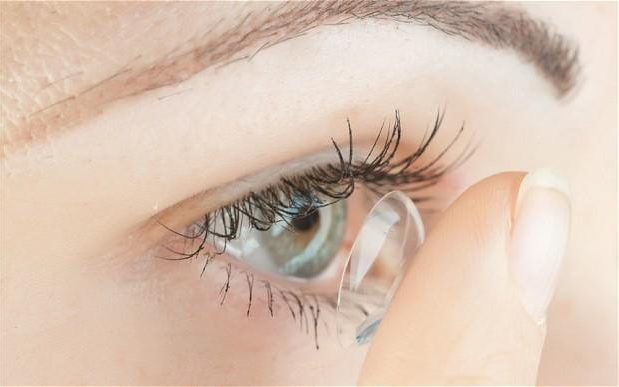
I’ve been waiting on those contact lenses for years — the ones that act as both cameras and displays. Rumor has had it that Google has been working on such a technology, and that makes perfect sense.

Now it’s Samsung’s turn. There are even photos:

I find this to be both exhilarating and scary.

It’s exhilarating because it validates the prototype systems our lab at NYU has been building all these years to test out “future reality” scenarios where people can draw in the air and their drawings come to life. A world in which Harold and the Purple Crayon meets Harry Potter is getting closer to being our everyday reality.

It’s scary for exactly the same reason.

Not seeing things

We tend to think of virtual and augmented realities in terms of the power we can get by seeing things that are not really there. In the VR community there has been lots of buzz about all the exotic new objects, creatures and worlds we will soon be able to interact with.

Yet much of the power of our technologically enabled world comes from things we do not see — and that we do not wish to see: The electrical wires in the walls of our houses, the air conditioning ducts running between floors in our office buildings, the miles and miles of plumbing that allow us to magically turn on a kitchen tap and get running water.

We have come to expect so many things to be there for us: The gasoline in our service stations, the package from Amazon, the magazine on the rack at our local newsstand. For the most part the means of delivery for these things remain hidden from our sight.

Our everyday lives in the future, after we have transitioned to living in a visually virtualized world, will contain many more such invisible mechanisms. We won’t think about those mechanisms because we won’t ever see them, even if they are right there in the room with us.

Of course, anybody looking around that room with their naked eyes would see all sorts of odd machines running about, busily creating the world that most people will take for granted: The objects that float through the air into your hand when you gesture for them, the food that mysteriously materializes when you are hungry, and vanishes again when you no longer want it.

On the other hand, eventually it will probably become illegal for unauthorized individuals to walk around seeing the world with their naked eyes. Most people will probably wonder why anybody would ever want to.