Procedural theater

People who do research into “serious” artificial intelligence generally turn their noses up at “game artificial intelligence” — the discipline of creating interactive computer game characters and worlds that convey the illusion of intelligence.

After all, academic A.I. researchers investigate hard problems such as problem solving, algorithmic reasoning, synthetic vision, navigation in unknown environments and data-driven machine learning.

Whereas game A.I. is just about making games more fun. You can practically see the noses go up in the air.

But this sort of hierarchical ranking misses something essential. Namely, that game A.I. is, at heart, a branch of the arts — an aesthetic form first and foremost.

And this means that game A.I. is something unique and exciting in our culture: It is the closest thing we have to a truly procedural theater.

Earth Day

One day, the usually oblivious humans looked down at their feet, and noticed a most curious thing. They were standing on something. “How odd,” one said. “How very unusual,” remarked another.

A wise person was consulted, who explained to one and all that the strange rocklike prominence beneath them was a largish spherical mass known as “Earth”.

At this delightful news, there was general rejoicing amongst the humans. “How marvelous!” said one. “How fantastical!” remarked another. A celebration was thrown in honor of the Earth. The Mayor issued a solemn proclamation, declaring that this day was henceforth to be known as “Earth Day”.

All the humans smiled, and professed loudly to each other how dearly they loved the Earth, each rushing to proclaim a desire only to cherish and to protect such a wonderful thing. Throughout the special marvelous day, a great time was had by all, and the humans felt balanced, and whole, and at peace.

Then the next day they forgot all about it.

Satisfying day

Today I set out to write a bit of programming that will allow people to create interesting sorts of responsive behaviors for my interactive animated characters (like the fish). In the computer game world, this would be called the “A.I.” (artificial intelligence) for the characters.

Creating such a tool is a tricky balance. You want to give people powerful ways to bring characters to life, but at the same time you need to make the tools simple and intuitive to use.

For the last few days I’ve been thinking about how to do this, trying various things and then abandoning them because either they weren’t powerful enough or they weren’t simple/intuitive enough. Then this morning I woke up, finally clear in my head about how I wanted to do it, and I just got it done. And I’m very happy with what I’ve ended up with.

Things don’t always work out this well, but when they do, boy does it feel good. 🙂

Others as narratives

I was having lunch today with an old friend, and the subject came up of how each of us, whether we want to or not, tends to create elaborate narratives about what is going on with other people.

It’s not that we really have a choice. Last time I checked, our species had still not developed mind reading technology. So we are stuck with nothing but the available evidence, plus our own theory of mind, to piece together the mystery of what thoughts are actually transpiring inside someone else’s skull.

What makes this far more difficult and interesting is that most people are themselves not quite aware of everything that goes on in their own brains. As I noted in a recent post, our selves are far from monolithic. Or as Whitman so elegantly put it: “I am large, I contain multitudes.”

Perhaps this is a good thing. After all, if it weren’t for the elaborate dance we must all do in the face of the unknowability of others, most literature as we know it would not exist.

A galaxy of friends

I did a little exercise today. I wrote down a list of people I consider friends, and then checked in with myself about the feeling each friendship evoked in me. In these evoked feelings, I was surprised to discover an enormous variety. Some people are sort of life-lines. If I’m in trouble, they are the ones I call. Others I can hang out with on the phone for hours, both of us happily talking until we are just too sleepy to go on. Still others I care about deeply, but this feeling is not associated at all with any sense that we would have a lot to say on the phone.

I wonder whether each of us creates around us a galaxy of diverse friendships that reflects, and in some sense maps out, divergent aspects of ourselves. We are each a highly complex bundle of opposing impulses, likes and desires, all of which get collectively labeled as a “self”, for want of a better word.

In this sense, the diversity of one’s friendships is not really about them, but about one’s own self. The part of me that connects to one friend may have very little do to with the part of me that connects to another friend.

This might go a long way toward explaining why we find, from time to time, that two of our closest friends cannot stand each other.

Driving by foot

I once spent a semester visiting Stanford University. Sometimes I walked the several miles from northern Mountain View to the campus in Palo Alto, sometimes I took a bike. For a few weeks I drove in a borrowed car. I was endlessly fascinated by how immensely different each of these experiences was from the other two.

Every time I walked, I would discover some new cool shop, eatery or bookstore. In months of walking those two miles, I was never bored. On the bike I was much more efficient (and was probably getting more exercise). But I never did stop the bike to check out anything on the way — it was pretty much a straight shot every time. In the car, I might as well have been on Mars. The trip was very quick and short, but there was no real consciousness at all of anything between my driveway and the campus parking lot.

Sally’s insightful scholarship that touches on Google’s Project Glass and self-driving cars (in her comments posted over the last few days) remind me of that comparative experience of walking/biking/driving.

It does indeed feel as though we are entering an era when many pedestrians are becoming ever more like car drivers. They are in touch with a rich information space, but that space rarely, if ever, includes the immediate physical world beneath their feet. Instead, the walk to work will be part of their work day. Morning meetings will start not when you reach the office, but when you start walking to work.

In a way this is sad, just as I found it sad at Stanford that people who only drove to campus may never have learned how wonderful and interestingly quirky was the neighborhood in which they lived.

On the other hand, “driving by foot” is probably healthier for you than driving by car. Assuming, of course, that the robot cars are smart enough not to run you down.

Gathering applets

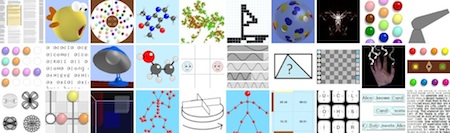
For the last few years I’ve been adding Java applets to this blog. At some point it began to bother me that these applets are separated from the ones on my NYU homepage, as though the two sets of applets belong to warring tribes. I hate to see my children fight.

So I’ve added a new section to my NYU homepage that specifically references these blog applets, with a nice little clickable icon for each. You can click on the image below to see how this all looks on my NYU homepage. Hopefully having all these links in one place will make for a more interesting and fun experience.


Poly-path algorithm

One of my Ph.D. students told me today that he is happy so many students are showing up to volunteer to work with us on our research. This allows us to ask each student to try an alternate way of doing things. If one approach doesn’t work out, then another one will.

I responded by telling him that once, when I was a child, our parents took us to the Hayden Planetarium, to see a show about how ancient peoples used the stars to navigate. In one part of the show that has stayed with me, I learned that the ancient Polynesians were able to travel by boat between islands that were separated by hundreds of miles. This is a very impressive feat, when you consider that even the slightest error in heading would lead to death at sea.

They did it like this: Any young man on an island could volunteer to pick a night of the year, and a star to follow. If, following that star, the intrepid youth made it safely to another island, then he could use the same star at the right time of year to find his way back. Most of these brave young men died at sea. But the few who had chosen the right path, and thereby returned safely, were highly celebrated, and assured of wealth, high status, and their choice of mate. Basically, they were set for life.

Over the course of hundreds of years, we were told, a huge number of routes were mapped out in this way.

That, I told my Ph.D. student, is what we’re doing by setting each student volunteer to trying an alternate approach. Although, I added, we are not actually killing any of them.

“Is there a name for this technique?” the Ph.D. student asked.

I had to think about that a moment. “I guess,” I said, thinking of the Polynesians, “we could call it the Poly-path algorithm.”

Project Glass and self-driving cars

I’ve seen a number of criticisms of Google’s Project Glass on the basis that while people are walking around on the streets gazing at their augmented version of reality, a car is liable to run them over.

What these critics fail to understand is that Google has a master plan, of which Project Glass is merely one facet.

By the time everyone is “wearing”, the Google financed initiative to develop smart cars that can drive themselves will also have reached maturity. At that point, automobile fatalities will drop precipitously, and the whole idea of humans doing something as dangerous as driving a car will be seen as quaint, not to say illegal.

Unlike cars with human drivers, robot driven cars will know better than to crash into an innocent pedestrian who is crossing the street while having a video chat with mom.

Becoming more sane

I have observed in myself, from time to time, the following two phase phenomenon in my own psyche:

(1) In a stressful situation I will find myself in an unexpected panic, and will act in a way that causes confusion, and sometimes dismay, in the people around me. “Why did he do/say that“, I imagine them thinking. I’m sure you’ve all been there at some point or other.

Of course this sort of thing is worrisome, not to say embarrassing. After such moments I tend to brood, to turn inward for a while, and usually I become more critical of myself. And then, sometimes weeks later, I usually arrive at the next phase:

(2) I remember something that happened years ago, something so traumatic that I had put it completely out of my mind, and which would have prompted my irrational reaction. I’m always surprised when I realized the magnitude of some of the memories I have repressed. In one case it was a teacher in high school who turned out to be a monster (you don’t even want to know). in another, it was the sudden death, over that first Christmas break, of the very first friend I met the year I went away to college.

When such a memory comes flooding back, I realize that my repression of that memory had planted a kind of bomb in my mind, ready to go off later — even many years later.

I’m not sure what I’m supposed to do about this. After all, the thing about a repressed memory is that it is repressed. You are not even consciously aware it is there, let alone what it is. The upside is that once one of these memories has come back, it seems to lose all power to act as an unconscious trigger.

One effect this has had is that I have learned to go easier on myself when I find myself becoming unexpectedly alarmed or upset or panicked. Now I realize it’s not something as simple as a personal failing. Rather, it is real life as a kind of ad hoc therapy, the outward sign of some unconscious trauma from my past working its way up to the surface.

So just remember, the next time somebody you know acts crazy. If they are even a little aware that they just acted crazy, then they have probably just taken a step toward becoming more sane.