The infinite revolution

Tucked away inside yesterday’s blog was one of the most important innovations in the entire history of mathematics — the ability to deal with infinitely small things. This innovation was independently developed by Newton and Leibniz in the mid-seventeenth century — the former working in England, the latter in Germany.

Infinity is a slippery thing, and naive questions like “What’s the value of one divided by zero” can just result in nonsense. What both Newton and Leibniz realized is that you can sneak up on infinity — by starting with two finite things, and then sending them both off to infinity together.

And that’s exactly what yesterday’s discussion about e was doing: A naive statement like “Something infinitely close to one raised to an infinitely big power” — would produce no sensible answer. So instead we put a throttle on both parts of this statement, by sending several finite things off to infinity and watching where the result heads off to.

It’s a little like sending a rocket ship into space. You can’t see the rocket ship after it has left the solar system, but if you know enough about its launch trajectory, you can predict where it will be in the sky even after it has become too small to see.

In the case of yesterday’s discussion, (1 + 1/n) gets closer and closer to 1, as n gets bigger. Meanwhile we are raising to a progressively higher power. The result (1 + 1/n)n indeed converges to a single number — e = 271828… — as n becomes ever larger, and our little rocket ship disappears into the night sky.

So many aspects of our modern life — the fruits of research into physics, biology, chemistry, electronics, economics, manufacturing, computers, vehicle design, and much more — depend on this astonishing innovation from over three hundred years ago. It really is a kind of infinite revolution.
Getting your grandmother’s interest

A colleague of mine once asked me if I knew of any way to give a simple intuition for the value of e, the base of the natural logarithms. He was teaching a class to non-technical students, and he said he had no problem giving them an intuition for the value of π. After all, π is just the ratio between circumference and diameter: How far it takes to travel around a circle (or around the rim of a glass of beer) divided by how far it takes to travel across the same circle (or the same glass of beer).

“I wish,” he said, “there were some way to explain the value of e that was so simple my grandmother could understand it.”

As it happens, I saw my friend Josh the next day, and posed the question to him. “So you want your grandmother to understand the value of e? No problem,” Josh said. “Here’s a way that’s guaranteed to work.”

“One thing grandmothers understand is saving their money in the bank,” he continued. “You tell your grandmother `Look Grandma, suppose you put a dollar into a bank at 100% interest. At the end of a year you will have two dollars.'”

Grandmothers, he assured me, understand this kind of thing.

Now suppose there’s another bank down the block that also gives 100% interest, but which compounds every six months. If you invest your dollar there, then at the end of six months you have $1.50, and at the end of a year you have 3/2 as much again, or $2.25. Chopping the year into two pieces definitely makes for a better investment.

Further down the block is another bank that offers to compound once a month, chopping the year into 12 pieces, giving you an even higher return. A fourth bank compounds every day, chopping the year into 365 little pieces, and the returns just keep getting better.

Finally, you come to a bank that compounds continually. At every moment it’s giving you (1 + 1/n) of your money, where the year is chopped into n vanishingly small pieces. That bank gives you the best value for your money. In fact, at the end of the year, your one U.S. dollar has turned into two dollars and 71.828183… cents, or e.

A formal definition of e is actually the limit of (1 + 1/n)n as n goes to infinity. And that’s what you just explained to your grandmother.

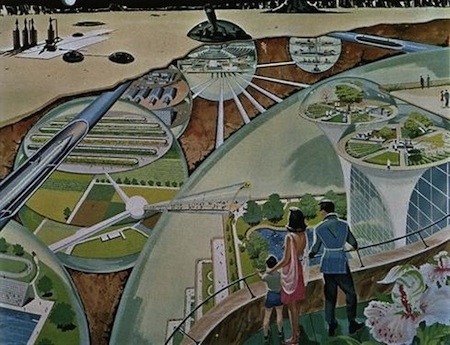
Rocket Punk

Every generation looks back several generations, mining earlier eras for cultural ideas to be reinvented in its own image. Such nostalgia+remixing tends to skip a generation. After all, in our youth we don’t follow the lead of our parents, because by definition they are not cool. But their parents’ culture is fair game for sampling.

This is probably why, say, the hip downtown bohemian New York poetry scene has reliably reemerged as a hot trend every forty years — first around 1922, then around 1962, then again around 2002. And why swing dance trends from the mid-1950s came back with a vengeance in the mid 1990s.

For some reason, trends that are about the future tend to reach further back in the past for source material. Steampunk, a vision of an alternate SciFi future, borrows from all the way back to the time of Jules Verne, who was writing his visions of tomorrow about 140 years ago.

In mid-20th century U.S.A, up until the early 1960s, there was another kind of optimistic vision of the future, exemplified by Walt Disney’s Tomorrowland and John F. Kennedy’s New Frontier, with their focus on the wonders of technology in the Atomic age, and on exploring the Universe (leading directly to Star Trek, which actually came out as this optimistic trend was already in its death throes).

I wonder whether there will be an attempt by some forthcoming youth generation to embrace that lost vision of a better tomorrow and “punk” it. That is, will future young people embrace America’s lost utopian futurism in order to recreate it as a kind of alternate fantasy vision of their own?

If such a trend were to emerge, I guess it could be called “Rocket Punk”.

Self-referential food

It would be interesting if food referenced itself, in a kind of meta way.

Yesterday I saw that a friend was eating little gummy bears made with gelatin, and I thought that this represented a missed opportunity.

After all, from a certain perspective, the ideal shape for gelatin candies would be cute little horses’ hooves.

This may not, in fact, be a marketable idea. 🙂

Talking about the future

Earlier this month I gave a talk at Google on the subject of one of my favorite places to visit — the future. I was invited to Google by my good friend Sharon, who often comments on this blog (thanks Sharon!!).

Today Google put the video up on YouTube. It has lots of embedded links to various cool research and resources, which I encourage you to check out.

Click on the evocative image below to see the video:


A measure of resistance

I was talking to two colleagues today. One was telling me he’d solved the mysterious problem in the electronic circuit he was designing. It turned out that the resistance was several times higher than he had thought.

For some reason I was in a philosophical mood. “I guess circuit is like kind of like a relationship,” I said. “The fewer mysteries the better.”

That got a laugh.

“Come to think of it,” I continued, “in both cases, it’s always better to know if the actual resistance is higher than you had thought.”

That got a much bigger laugh.

Length of novels, plays and movies

Why is a novel typically several hundred pages long, and a typical play or a movie around an hour and a half in duration?

Yes, there are many novels, plays and films that are longer or shorter, but there seems to be a remarkable adherence to this statistical norm.

My theory is that there is only a certain emotional bandwidth in any medium, and that these lengths represent the minimum informational budget required, using reasonable economy, to sketch out a certain kind of arc of human experience. In a short story or a half hour TV drama, there isn’t quite enough time to render a complete enough stand-alone portrait of a protagonist and his or her world to convey a powerfully transformational experience for reader or audience.

Disappointment insurance

More often than I would like, I get myself into situations where a positive outcome for me depends on some choice of action by someone else. We’ve all been there, sad to say: “If only you would do this, it would be so great for me.”

In an ideal world, an outcome good for me would also be good for the other person, and everybody would end up happy. Alas, we do not live in an ideal world. I cannot decide what is good for somebody else, and it’s certainly not up to me to try. So sometimes I just end up disappointed and sad.

When my spidey-sense tells me I might be entering into such a situation, I often arrange a side-deal — one that is just between me and myself. If the sought-for positive outcome doesn’t pan out, I stand ready to reward myself in some other way, as a kind of “disappointment insurance”. This reward doesn’t need to be elaborate. It could as simple as treating myself to a movie, or buying myself a particular kind of fancy chocolate.

When I do this, I adhere to two important principles: (1) I plan this insurance ahead of time, before I know what the outcome will be, and (2) if the positive outcome does occur, I don’t give myself the disappointment insurance.

The net effect of all of this is that I’m not as focused on whether things that depend on other people will work out. Because no matter what the outcome, I’ll get something nice out of it that I wouldn’t have gotten otherwise.

Take a moment to consider

I rarely comment on politics these days, but I’m really shaken up by what happened recently in Florida. A seventeen year old boy walking back home from a local candy store was shot dead by a man with a gun. The boy was unarmed. The man was not arrested for killing the boy.

The reason the man was not arrested was that he stated that he had felt threatened by the boy. It seems that under current Florida law, making such a statement is sufficient grounds to avoid being arrested for shooting, and killing, an unarmed boy or girl.

If you are reading this, and you have a son or daughter, you might take a moment to consider that there are places in the United States of America today where a stranger with a gun can legally shoot your child to death while your child is walking down the street, even right in your own neighborhood.

Until these last few days, I had not known that. I’m guessing you had not known that either.

A trail of flags

Upon traveling to a new land, it is traditional for an explorer to plant a flag in the soil (or, on occasion, moon dust), declaring, in essence “hey folks, I got here”.

A blog entry is a bit like a flag ceremony. You find a promising place in the rich virgin soil of a new day, and you plant your flag, in the form of a post. Whatever else your post signifies, you are also saying, one way or another, “here is where I was at this moment in my life.”

I have been planting such a flag into each day for well over four years. In a sense, I have been claiming a unique place in my life for each individual 24 hour period. When I think back on any of these little flags, I am reminded of where (and who) I was just then, and what was happening in the strange and ordinary happenstance of my life. Now, as I turn around to look behind me, I see that the trail spans a surprisingly long distance, stretching clear to the horizon.

It’s all good. As Proust understood, time examined is time better than time unexamined. Even now, going back to any individual post, my mind becomes filled with a flood of associations, sense memories, sweet precious moments of pride and regret.

Sometimes it’s good just to plant a flag.