Algorithmic audience genres

The insightful comments on yesterday’s post, together with Sharon’s link to CS Unplugged, made it abundantly clear that there is no one correct way to engage an audience in interactive activity. Even if you stick to one subject area, the nature of any given audience imposes its own constraints and presents its own opportunities.

For example, Manooh had the wonderful suggestion that I could have asked audience members to exchange seats. I had thought of that, but had decided it would not work with this crowd. We had little kids with their parents, and they would have been required to separate. Also, we had very old people, some of whom just can’t move all that fast. Yet if I had been giving the same talk to a crowd of ten year olds, I definitely would have had them physically change places.

Also, I decided to go with sorting because everybody in the audience understands immediately what the goal is. Various other ideas had come up, including Conway’s Game of Life, and having the audience emulate the bits in binary arithmetic. In each case there were two problems: (1) The question of “what are we doing and why are we doing this” would have been far more abstract, and (2) there are lots of places in most audiences where there are gaps between people. Most of these other ideas require a regular grid, so they just don’t work when there are empty seats.

The possibilities are probably inexhaustible. It would be interesting to look at audience participation not as one particular activity, but rather as an entire space of possibilities, a set of disparate artforms, connected to each other by their mutual reliance on an active audience.

Somebody really should write a thesis on algorithmic audience genres.
The algorithmic audience

Last night I gave a talk to a very diverse crowd, from little kids all the way up to quite older people. As part of the fun, I turned the entire audience into a computer (actually three computers, since the auditorium was divided into three sections, separated by two isles). First everybody wrote down their birthday on an index card (not the year, just the month and day, so as not to put anyone on the spot). Then a beach ball was handed to the person in the left seat of the front row of each section.

Each of the three sections was turned into one long linear “computer memory” by the following two rules:

  • If you are in an odd numbered row (rows 1,3,5,7,…) then your “next person” is the person on your right.
  • If you are in an even numbered row (rows 2,4,6,8,…) then your “next person” is the person on your left.
  • If you are at the right end of an odd row or left end of an even row, then your “next person” is sitting behind you.

We did a practice run, with each person handing the beach ball to their next person, zigzagging all the way to the back, just to get the order straight. Then the fun began.

I gave everyone the following instructions:

When you get the beach ball:

  • If your next person has a birthday that is after yours, then just hand them the beach ball
  • If your next person has a birthday that is not after yours, then you both stand up and exchange cards, hand them the ball, and then both sit down.

It took about five minutes for the ball to wend its way from the front to the back of each section. At the end of that time, the person in the very back was holding the ball, and also holding the card of whoever had the “highest” birthday (eg: Dec 28). Effectively, the audience had computed a “maximum” function.

Everyone understood that they could continue using this method to sort all their birthdays into ascending order — passing the beach ball through the crowd over and over again — but that doing so would take a really, really long time.

So instead, I turned them into a parallel computer — with every person in the audience now functioning as a CPU. Under the new rules, we ditched the beach ball, and followed pretty much the same rules as before, except that any audience member could follow these rules any time at all:

  • If your next person has a birthday that is after yours, don’t do anything
  • If your next person has a birthday that is not after yours, then you both stand up and exchange cards, then both sit down.

As soon as the three parallel computers (one for each section of the auditorium) started operating, there was a huge hubbub of activity. After a while, most of the activity was combined to the middle rows, with the front and back just occasionally coming to life as a ripple of cards exchanged forward or back. After about ten minutes, it was all over. The cards had been sorted.

Of about four hundred people in the room, only one woman ended up holding a card that was out of order. She was very embarrassed to be the only “bug in the computation”, but she took it very sportingly.

Interestingly, three people ended up holding a card with their own birthday written on it. What are the odds?

Hanging with the neighbors in Squaresville

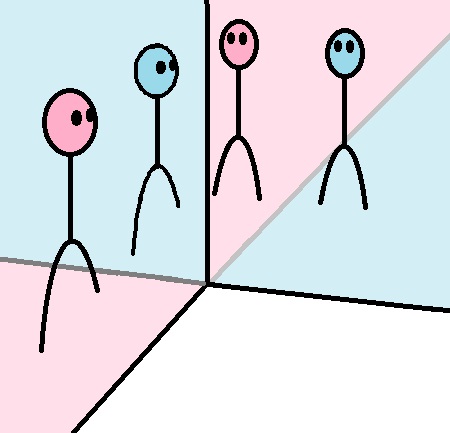
As I was saying, in Squaresville corners tend to act funny. The image below shows what happens when you check in on your neighbors to the northwest. Mr. Red, who lives to your west, is standing next to Mr. Blue, who lives to your north (his real name is Mr. Cyan, but he hates when people call him that). Because it takes only three turns to go around a corner, they are actually standing next to each other, side by side.

In the image below, you can see two distinct views of Mr. Red, and also two views of Mr. Blue, because that’s how light travels in Squaresville:


Squaresville

The example of a “tile world” in my post the other day was perhaps needlessly complicated. Let’s take a much simpler case — a world in which the inhabitants live within the surface of a cube.

These people don’t know they live in the surface of a cube, because they don’t think in three dimensions. When they cross the edge of the cube, going from one cube face to another, they don’t notice any change, because that edge is part of the surface of the cube.

Note that this world of a cube surface can be described as consisting of six plots of square land, with each plot of land adjoining four neighbors.

What makes life in this world strange is that at each corner of your plot of land you don’t have four neighbors, but rather only three. Since this world is a lot simpler than the sixty-plot world we were discussing the other day, it’s going to be a lot eisier to describe its strange properties.

More later.

On All Hallows Eve

On All Hallows Eve, when the moon has come out
The ghosts and the goblins will wander about
You lie awake cowering under your sheet
In your mind’s eye you see where the witches all meet
The Old Sister cackles her dark toothless grin
And summons the revels of night to begin
She traces a sign with one bony finger
And pity the soul who has chosen to linger
As midnight arrives, when the creatures of night
Those long ago fiends, come awake in delight
The ghouls and the demons and zombies arise
Some take to the road, some take to the skies
They head for the town, this terrible host
Demon and incubus, vampyre and ghost
You huddle in bed, you are quaking with fear
For soon all the creatures from hell will be here
They are just down the road, they are coming, it’s true,
And somehow you know they are coming for you
Now they’re downstairs, they have entered your door
You can hear ragged feet as they drag ‘cross the floor
They have caught you at home, in your bed unawares
Is there time to escape? Oh, they’ve come up the stairs
The bedroom door opens — you scream — it’s too late!
You wake up. It must have been something you ate.

Plots to take over the world

The topology of the puzzling shape I discussed in yesterday’s post is really fascinating. In some ways it acts like a square, but a very strange square.

Imagine that you lived in a house on a square plot of land. On all four sides you have neighbors, and when you step from your property onto an adjoining property, that neighboring yard seems like a perfectly normal square. So wherever you go, everything appears fine and undistorted.

But the rules for travel are a little interesting, because things act kind of funny at some of the corners. Your neighborhood to the southwest and northeast seems normal — each neighbor shares one other mutual neighbor between them.

But to the southeast things are a bit stranger. Your neighbors there share a border with each other — it takes only three border crossings and right-angle turns to get back into your own yard. And your neighbors to the northwest have two neighboring yards between them — around that shared corner, it takes five border crossings and right-angle turns to get back into your own yard:


As we already know from the posts of the last two days, the world you are living on consists of sixty plots of land, and the topology of that world is a sphere.

Puzzling planets

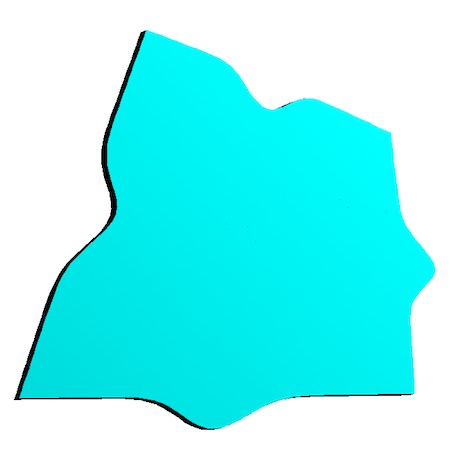
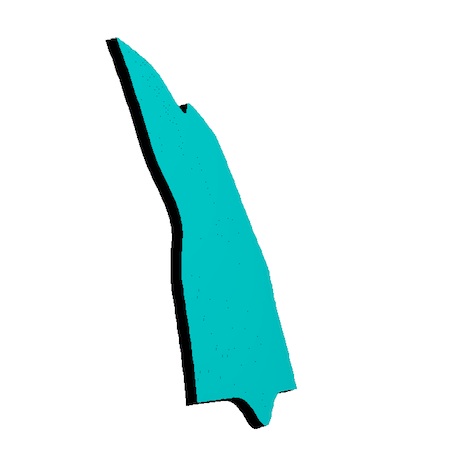
I would like to use my 3D printer to print the sort of patch-work sphere I talked about in yesterday’s post. The first step in doing that is to model the piece in computer software. Below are two views — a front view followed by a more edge-on view, of the software model:


It occurs to me that this would be a great kind of jigsaw puzzle — especially if I modify the edges to make them more interlocking. I did a bit of searching on-line last night to see whether anyone has taken this approach before to designing jigsaw puzzles on spheres, but all the spherical jigsaw puzzles I’ve found are build from a latitude/longitude grid — so the pieces get smaller toward the two poles. Of course the approach I’m describing might already be out there, and it’s just that I couldn’t find it.

If we’re making a jigsaw puzzle, the pieces could form some cool spherical image — the surface of a planet like Earth or Jupiter comes to mind — to distinguish the pieces from each other. Since every shape would be identical, the only way to solve such a puzzle would be through that image.

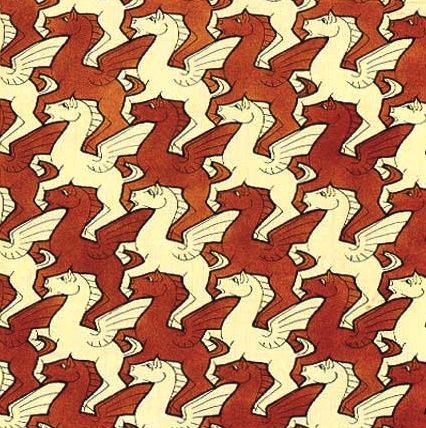
As M.C. Escher pointed out (as illustrated below in his wonderful 1959 work “Flying Horses”), you can change the edges of this sort of tiling — the only difference here is that we are doing this on a filing that covers a sphere:


It would really be fun to design a puzzle shape that matches the theme (eg: “planet earth” or “moon” or “jack-o-lantern”) of the jigsaw puzzle.

The portable sphere

Playing with an icosahedron, and thinking of it as a kind of sphere broken down into simple pieces, got me wondering what would be the smallest piece you could break a sphere down into, so that all the pieces were exactly the same size and shape. That way, if you wanted to assemble a big dome or sphere, you could just carry portable little pieces around with you.

By having all the pieces be identical, you wouldn’t need to worry about numbering or ordering them in any way. Of course you could make a sphere or dome by inflating something, which would also be cool, but I’m thinking of how to make a rigid sphere.

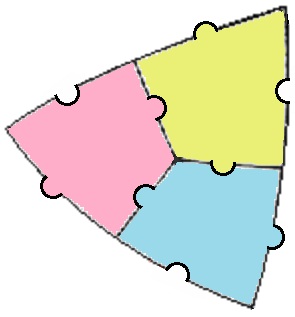
The best solution I’ve come up with is 60 little identical pieces. If you inflate an icosahedron out to a sphere, then you can divide each of its twenty now-curved triangles into three equal pieces, like so:


As you can see from the figure above, we can put little matching protrusions and notches into the edges of each piece, so that they will snap firmly together. Now we have a very compact way to “carry around” a rigid sphere as sixty identical little almost-flat pieces, and then assemble it together as needed. Of course if you only need a hemispherical dome (eg: as a portable planetarium) then you’d only need thirty pieces.

Unless somebody can think of a better solution.

Pipe cleaners

This week I was at a fancy dress-up event where they put things like cool flashing LED lights, watch batteries and pipe cleaners on the tables so all the guests could make stuff. It took me all of one minute to accidentally drop my watch battery, which promptly rolled somewhere far under the table, never to be found again. Which meant my cool flashing LED light would be useless.

And that left me with pipe cleaners. Fortunately, earlier that day I had been talking with Vi Hart, and I thought of her experiments in using household materials to make hyperbolic surfaces (seven equilateral triangles around a vertex instead of six, and you’re in business).

I started folding pipe cleaners into equilateral triangles, twisting them together so they wouldn’t fall apart. Except around every vertex I put five equilateral triangles. So instead of lying flat on a plane (which is what would happen if you placed six equilateral triangles around each vertex), the assembled triangles formed a slight curve.

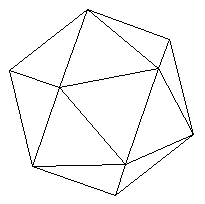
After I did this for ten minutes or so, gradually adding new triangles, my little sculpture did what any self-respecting collection of equilateral triangles with five triangles around each vertex would do — it formed an icosahedron:


I put my little pipe-cleaner icosahedron on the table, and people were very impressed. Various other guests picked it up, played with it, and turned it this way and that. I suspect they didn’t realize that a shape like that practically assembles itself if you follow the right simple rule. And I wasn’t about to tell them how easy it is to make one of these things. 🙂

I did ask people if they knew how many sides it had. I’m sure that you, dear reader, will get the correct answer right away. Of course the next day I found myself surfing the web learning all sorts of things about icosahedra that I hadn’t known before. And I came up with an idea for another little icosahedron related project. More on that tomorrow.

Reality versus fantasy

Thinking more about the issues that arise from the questionable promotion of the film “Anonymous”, I am struck by the complexity of the social, cultural, ethical and psychological relationship between reality and fantasy. Every society evolves a highly elaborate code dictating when and where everything should lie along this dialectic.

When we read a novel or watch a film, we happily and collectively indulge in a game of “what-if”. In a make-believe world many rules of propriety are suspended. We understand that well-wrought fiction will give us an enormous emotional payoff — a payoff we will pay good money to experience. In such experiences there is generally no confusion about what is reality and what is fantasy. For example, when we watch “Star Wars”, we understand that we are not actually watching an entire planet full of people getting blown up.

In fact, our rules dictating that fantasy experiences do not mix with reality experiences are very strict. For example, for many people in the U.S. it is perfectly ok to go into a restaurant and eat a serving of rabbit or cow. Yet if a real rabbit or cow were deliberately slaughtered to create a scene in a fiction movie, many of the same people would likely boycott the film for ethical reasons. On the other hand, it was generally considered OK for Michael Moore to portray the actual slaughter of rabbits in his film “Roger and Me” — because that was a documentary.

That’s just one example of many. I suspect we can follow the convoluted dance between our perceptions of “reality” and “fantasy” to illuminate all sorts of things just under the cultural surface.