Attic, part 66

Jenny circled around the bed, looking at her grandmother lying there. Although it seemed impossible that this was her grandmother. She recognized the face from the old photos, but her grandmother Amelia should have been old. This was a woman in her twenties.

“What do you think we should do?” Josh asked, unconsciously speaking low, as if he were in church. “Should we wake her up?”

“Oh, I don’t know,” Jenny said despairingly. For some reason, she felt like crying. “After all this time, and everything we’ve been through, I really don’t know how to reach her.”

“It may be easier than you think,” said Mr. Symarian. “One could say that you are practically staring the answer in the face.”

“Right in the face?” Jenny said, rolling her eyes. “What is this, some kind of riddle?”

“Well, yes,” said their teacher. “I believe it is.”

Animation as live theatre

Live theatre has something that film does not have — it is live. An audience seeing a play is in a unique moment in time, together with the actors up on the stage. If the mood of the audience changes, the performance itself will change, as the cast picks up on that changing mood and reflects it back across the footlights.

There is no equivalent in film. Every time you see Casablanca, or The Godfather, as magnificent as those films are, you will see exactly the same performances, the identical artistic choices. A film is a frozen artifact, a fixed point in aesthetic space, not an organic entity that interacts with its audience.

In this way, animation is of course like film. Every time you see Toy Story or Princess Mononoke, you are seeing exactly the same performances.

But what if animation could be more like theatre? What if the virtual actors could improvise, based on audience response? Would it still feel like watching an animated film, or would it start to feel more like live theatre?

Computer games do something vaguely similar, but they generally do not privilege deep and psychologically engaging characters. What if we wanted real-time animated performances, right on our computer screens, of stories about characters with emotional depth and resonance? As Janet Murray asked back in 1997, will we ever get Hamlet on the Holodeck?

Attic, part 65

Charlie and Sid were waiting nervously outside in the hall. Charlie was pacing up and down the hallway, and Sid was flying back and forth from wall to wall, looking very distraught.

“Do you think they’ll be ok?” Charlie asked.

“How the hell would I know,” Sid growled, “What am I, the answer demon?”

“Well, you don’t need to snap at me,” Charlie said.

“Sorry kid,” Sid said. “I get upset, I get nervous. It’s a thing with me. Don’t take it personal.”

“Yeah,” Charlies said, “I guess we’re all on edge. I mean, anything could happen now.”

“Sheesh, you’re tellin’ me,” Sid said. “people wandering around in too many dimensions, time tying itself into a pretzel. It’s enough to make your horns drop off.”

“Well,” Charlie said, “you know, that isn’t really so bad.”

Sid stared for a moment. “Oh right, I forget, I’m talkin’ to a guy who was one of those fake demons. Not that there’s, you know, anything wrong with that,” he added hastily. “I mean, no offense intended.”

“None taken,” Charlie said.

Aunt Sylvia

My aunt Sylvia passed away yesterday. She was 93 and had lived a full and glorious life. We are all rearranging our schedules to fly down to attend the funeral.

Some people change in radical ways as they get older, but my memories of aunt Sylvia from my earliest childhood are completely consistent with my sense of the person she continued to be to the end of her life. She was always smart, cheerful, outgoing, generous and full of joy, with a genuine and uncomplicated love of people. I know that sounds too good to be true, but in her case it is exactly true.

In recent times I have stood witness as too many people were taken from this earth in untimely ways. People who were in the middle of getting things done, who were far from having finished the mission they had set about to accomplish. Those cases of life interrupted are always deeply tragic. One comes away with a sense that something has been unfairly stolen.

But I get a different sense when I think about aunt Sylvia. I am sad for us, that we will no longer have the pleasure of her cheerful presence, yet I feel that she indeed got a chance to accomplish her mission. In a way it was a straightforward mission: To connect with people, to fully enjoy those connections, and to find joy in life and in loving the people around her.

It’s something that sounds so simple to say, yet many people have a hard time keeping hold of that joy. It was part of aunt Sylvia’s genius was that she never made that mistake. Even when my uncle passed away — her first and only love and inseparable companion for over sixty years — she managed to bounce back and throw herself into her love for her children and grandchildren.

Sometimes when life gets complicated, and I become distracted by the sheer amount of nonsense that a day can throw at me, I temporarily forget what a great privilege it is just to be here. In such times it’s good to think about a person who never lost sight of that simple and profound truth — my late wonderful aunt Sylvia.

Attic, part 64

Jenny was starting to get the hang of it. If you turned this way twice, it was the same as turning that way three times. There were patterns to moving in higher dimensions, even if it seemed crazy. She had the thought that it was a little like finding yourself in a strange new kind of Rubik’s cube. You didn’t really need to understand what each individual turn meant, as long as you learned the patterns.

Maybe, she thought, this is what magic incantations are all about. The reason an incantation doesn’t seem to make any sense is that we can’t see the space it works in — because it’s not the space we live in. An incantation is really a kind of map — each line, when spoke aloud, turns something in just the right way, and by the time it’s done, you’re there.

She never would have believed in magic incantations, of course, if she hadn’t seen them working with her own eyes. In a way it was reassuring to realize that magic is really just physics in a different world. In a way, she mused, it’s so much more comforting to think that there really are rules about these things. She thought of something she’d read in a comic book once, a line she’d really liked. Except now she’d say it differently: “With great power comes the need for a great sense of direction.”

She saw Josh and Mr. Symarian staring at her, and she realized she had said it aloud. But before she had time to be embarrassed, the teacher spoke up. “Yes, quite,” he said. “I believe you have caught the essence of it. And I am pleased to say,” he added, nodding toward Josh, “that our young friend here has an exceedingly fine sense of direction.”

It was only in that moment that Jenny realized that they were back again in normal three dimensions. They were standing in a small room, empty but for a very lovely queen size bed. And on that bed, apparently fast asleep, was her grandmother Amelia.

Attic, part 63

As the years went by, Amelia found it harder and harder to remember how to act “normal” about time. Although she always knew when it would happen, she found it unpleasant when her husband would catch her staring off into space, and she would see that look of vague fear upon his face.

It was easier with the children. They seemed to understand the hidden world that everyone keeps inside, and how different it is from that world created by grownups, of days and weeks, of time diced into meaningless little calendar boxes. There was a point when she began to wonder whether growing up is a kind of forgetting, an erasing of the ability to see how time is a sculpture, a world of beautiful shapes carved forever into the fabric of the Universe.

Sometimes she wished they could see what she saw — past and future twisting together, frozen moments stretching as far as the eye could see, like glistening stalactites in a beautifully wrought cave of ice. But there was no way to show anyone, nobody to tell who would have the slightest idea what she was talking about.

And so, as the years went by, she spent more time with the shadow, as she knew she would. Until one day, when the time came to make a choice.

Artist/Scientist

I was having dinner with some good friends this evening, and the subject came up of the question of the “artist” mindset versus the “scientist” mindset. Questions from that discussion are still rattling around in my head.

I’ll just say, right at the outset, that I don’t believe there are two different subspecies of human that can be labeled “artist” or “scientist”. Rather, such identities are part of a dialectic that operates within every individual mind. When you are thinking like a scientist, you are concerned with mechanism: “How does this work? What are the operating principles here? What do I need to build to get from here to there?”

In contrast, when you are thinking like an artist, you are focusing on the deeper meaning itself, and the mechanism is merely a tool to get you there.

The myth that the “artist” and “scientist” are different people is quite prevalent in our society. So much so, that many people are surprised when the myth is questioned. There are many social structures that reinforce this myth. Children are told, from the time they are little, that they need to self-define with a narrow identity. Academic and professional societies are structured in a way that forces a “scientist” to act in a particular way, and punishes professional behavior that seems too “artistic”. Science is not supposed to ask “why”. Yes, an individual scientist can be socially responsible — this is actually encouraged. But this concern with outcomes is not considered part of the process of science itself.

Similarly, to succeed in the art world, one needs not to be seen focusing on the means by which things are done, but rather on the larger purposes and meaning. Starting in the second half of the twentieth century, Clement Greenberg and other influential voices in the art world called upon a renunciation of “mere technique”, in favor of a concept of art that rises above technical means, and focuses rather on ideas expressed, independent of the means used to express those ideas.

And so art and science have formed themselves into two opposing ghettos, each trapped by its own self-imposed limitations.

In my view, “art” and “science” are really two sides of the same coin. Within any individual, the practice of each is impoverished without the practice of the other. Great artists tend to be inventors, and great scientists tend to be driven by a higher purpose that is somewhere on the spectrum from romantic to spiritual.

Frank Capra was constantly inventing new techniques on the set to express his films, which was not surprising, since he had a Ph.D. in Engineering. He self-defined primarily as an artist — which means he was more concerned with getting the shot, and capturing an emotion on film, than he was with how he got it done. Nonetheless, Capra was perfectly comfortable tapping into his scientist self to refine and improve upon the techniques of cinema. The artist within him did not squelch the scientist within him, and this was part of the reason for the great effectiveness of his films.

Albert Einstein and Richard Feynman, among other great physicists, were driven by a larger sense of purpose, of beauty, of intrinsic meaning in the universe around them. When they were identifying and communicating those ideals to others, they are being artists. When they are implementing those ideals by developing mathematical bridges to greater understanding of the workings of the Universe, they were being scientists.

Leonardo da Vinci was of course artist and scientist both, in a way that was so completely integrated that it is impossible to draw a line between those complementary aspects of his creative genius.

Wouldn’t it be wonderful if we had the courage to teach our children to follow in his footsteps?
Attic, part 62

At first Jenny wasn’t sure what was going on. The door was in front of them, and then suddenly it was, somehow, off to the side. But in a funny way, like it was squashed sideways. She saw that Josh, a little ways ahead of them, had a look of intense concentration on his face. Then, to her horror, Josh’s face became squashed too. Before she could shout or scream, she heard his voice, sounding shockingly normal.

“This way,” he said, and she felt Mr. Symarian take her arm, and somehow turn. As she turned to follow their teacher’s lead, Josh’s face seemed to change back to its normal shape. At that moment, she realized just how much she liked Josh’s face.

She realized she had been holding her breath. As Jenny took a deep breath, she was mildly surprised to find that the air seemed perfectly normal. Was there air in the fourth dimension, she wondered, or had they somehow taken it with them? In any case, she was very glad to find out that you could still breathe in the fourth dimension.

Very glad indeed.

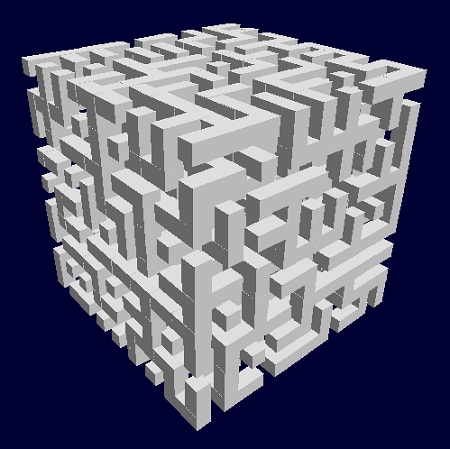
Invasion of the borg

Several years ago I became fascinated by 3D mazes. These are like the 2D mazes we’re all familiar with, except they form 3D paths within a cube, rather than 2D paths within a square. To explore these fascinating shapes (which look a lot like the Borg mothership), I created an interactive Java applet, which lets you create virtual objects that look like this:


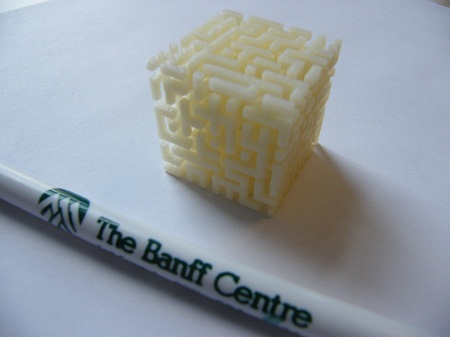
As long as I am at the Banff Centre, it seemed like a good idea to print one of these things out in the real world. So I modified the Java applet to create a file that the 3D printer can read. It seemed like a good idea to print out the first one very small — you never know how safe you are with the Borg. And this is the first thing that resulted:


There is something wonderful about having one of these out in the physical world, where I can touch it and hold it in my hand. It’s a much more visceral experience than merely looking at an image on a computer screen.

As usual, I’ve included the trusty Banff Centre pen, to give you a sense of scale. I must say I am rather pleased. Now I’m trying to decide which of my Java creations to next bring out into our physical world.

I am open to suggestions. 🙂