Looking for Marilyn

I was roaming around on YouTube today, as I often do, and I came upon a famous and rather iconic moment in U.S. cultural history: Marilyn Monroe singing “Happy Birthday Mr. President” to John F. Kennedy in 1962.

Watching her performance, it became clear to me that much of the wonderful humor Marilyn brought to that moment arose from the way she understood – and beautifully conveyed – that on some fundamental level JFK was as much of a sex symbol as she was.

Recall that the two preceding U.S. presidents had been Harry S. Truman and Dwight D. Eisenhower – both highly respected in their way, but definitely not sex symbols. Suddenly, along comes this handsome, charismatic and brilliantly articulate man, with warmth, humor, and a smile to die for. If we were to rank cold war era politicians the way we rank current movie stars, Kennedy would be roughly on a par with George Clooney.

And it struck me that the erotic charge of that moment finds a parallel in the kind of feeling that I sense toward Barack Obama within the popular culture. I’m not talking here about his particular policies – whether you think of him as a liberal or as a centrist. I’m talking about the man’s extreme charisma, his relaxed brilliance and ability to clearly communicate and discuss ideas without breaking a sweat. And of course the fact that he has a kind of lanky elegance, a comfort within his physical being, that we rarely associate with politicians.

Ronald Reagan had an equivalently powerful charisma. Even if you utterly disagreed with his policies, you realized that the man was completely comfortable within his own skin. Although, as a man of seventy even when first elected, he served as a father figure in the popular mind, rather than a sex symbol.

Bill Clinton had great charisma, but it was always a little complex – there was a feeling of conflict lurking just below the surface, even from the beginning – a sense of some kind of inner struggle beneath the poise and smooth southern charm, as though a part of him didn’t quite believe he deserved to be president.

But president Obama has that gracious quality, that lèse majesté of natural and confident leaders, which adds up to the kind of sex appeal that JFK brought to the office. There’s something about Obama that calls for a happy birthday song from Marilyn. And, like JFK, his response to such a tribute would gracefully convey the humor of the moment (in contrast, try to imagine either president Bush responding with easy humor to a winkingly sexy birthday song from Marilyn – such a moment wouldn’t make sense to them).

I’ve been trying to imagine that moment, Marilyn Monroe singing to the heart-throb president, transposed to today, to 2009. There’s only one thing I can’t quite figure out: If Barack Obama is – in the culturally iconic sense – the JFK of our time, then who is the Marilyn of our time? Do we even have one?
Party conversation

A friend is visiting from California this week. She told me yesterday that it’s great to be back in NY – she prefers our intellectual climate. It seems that topics of conversation in L.A. tend to be very different, and she has been growing weary of people at social gatherings starting out a conversaation by asking her: “Which one, Jennifer or Angelina?”

For those of you who cannot decode this mysterious question, it refers to which gal one would like a certain top movie star to end up with, in a romantic sense. Apparently you must be on either one side or the other on this issue. It’s kind of like that other question about the war in Iraq, with the difference that people take the Jennifer/Angelina question far more seriously.

Of course there are at least two issues that would come to my mind, were I to be confronted by such a conversational opener: (1) Is this really a good way to assess new people in your life? (2) Why is this question even any of our business?

But somehow, over the course of the day, the New Yorker in me has started worrying this question, trying to tie it in with my own world view. And I have caught myself continuing the conversation in my head, with an answer that goes roughly like this:

“I would say neither one of those. Most likely Johnny. This would leave Vanessa heartbroken back in Paris, but she’d salve her wounds by stealing away with Nicolas. Feeling snubbed, Carla would make a play for Angelina, but would somehow end up with Jennifer instead. Meanwhile Angelina, feeling literary, would secretly start seeing Salmon. Not to be outdone, Miley would begin to date Kazuo. This would encourage Woody to call up Natalie – not realizing that the film he’d just seen her in was from 1994.

Natalie, of course, would have scooped them all by dating Noam, but she would leave him for Benicio. Unfortunately for her, Benicio would soon leave her for Javier, while Sean and Josh would shock everyone by eloping, which makes perfect sense when you think about it.

All of this would inspire Anne to finally go back to Ellen. But Ellen, in a stunning turn of events, would suddenly opt for Brad, who would leave Johnny, which is ok, because Johnny would end up in a happy and satisfied ménage à trois with Geoffrey and Orlando, and they would all three be adopted by Tilda.”

That might just be the closest I can come to L.A. party conversation. Of course, the person who’d asked the question would probably have fled in alarm and confusion around the time I got to Nicolas and Carla. Which would probably be for the best.

Popular elegance

There are all different kinds of measures of elegance in science and mathematics – the shortest proof, the most all-encompassing theory, the equation that best fits the data, and so on. But there is another kind of elegance entirely, which is concerned with non-mathematicians and non-scientists – people outside the field.

To whit: What is the scientific or mathematical theory that best converts a subject which had formerly been arcane, obscure, approachable only by the well-prepared priesthood, into something that is understandable by anybody, with only the simplest of explanations.

This property of a theory might be called its “Popular elegance”.

My vote for the theory that most possesses this propery is the Feynman diagram. I can’t think of anything else that caused a subject so arcane, in one fell swoop, to become so much more clear.

Can anyone else think of worthy candidates?

Navigation

Dagmar raised an interesting question yesterday in her comment. We have all had the experience of thumbing through an old-fashioned paperback book and magically finding the spot we want. There is something about this physical medium – the way the book remembers those pages you’ve lingered on before, and then falls magically open to the right spot – that is incredibly appealing.

But suppose, just for a moment, that Amazon and SONY did not have a monopoly on the look-and-feel of their respective eReaders. Imagine an open marketplace for whatever cool software idea might be out there for navigating your way through an eBook.

My guess is that given a sufficiently open marketplace of ideas, people will converge on a paradigm for the different ways to read an eBook – skimming, marking pages, knowing how to make the book “fall open” to your favourite passage – that is every bit as compelling as the methods we currently use for finding our way within a paperback book.

It wouldn’t replace paper books, of course – it’s a different medium, and one medium rarely replaces another outright – but it would be a big improvement.

A techno-wish

The thing that keeps me away from the current crop of eBook readers is not that I think they are inherently bad, but I just don’t think they are ready yet. It’s not that I’m in love with paper per se, it’s that I’m in love with the fact that a book is such a transparent vehicle for connecting author and reader. There are no switches to fiddle with or keys to clutter your visual field – just those lovely words and thoughts, thoughts to soak up and enjoy whether you are on the subway, at the beach, or curled up in bed.

I find the little keyboard along the bottom of the Kindle II to be visually jarring. I want my eBook to be like a paperback – small enough to slip in my pocket, unobtrusive, portable as hell. I’m put off by the idea that I’m supposed to carry around this unnecessarily large brick, to make room for all those weird little buttons and switches and a built-in keyboard at the bottom that isn’t even pleasant or comfortable to use.

Of course that keyboard is temporary – in the next few years eBook readers will go over entirely to using multitouch screens (and then, somewhat later, a complete wrap-around multitouch skin), and then questions of the proper interface for page-flipping and other navigation, typing in titles, author searches, etc., will all move entirely into software, where they belong. If you prefer a particular gesture or method to turn the page, thumb through the index, or find a particular article in last week’s Times, sooner or later somebody will implement just what you want.

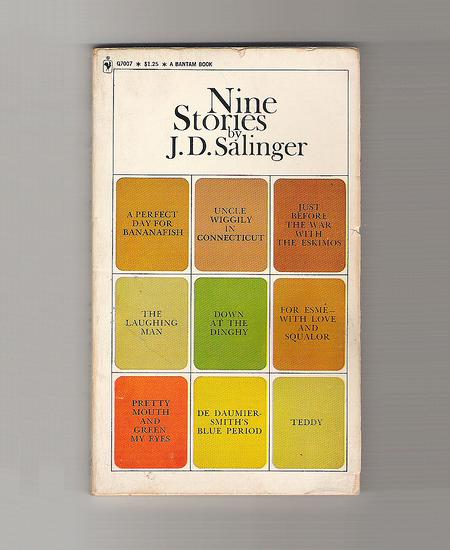
Rather than think about how to fix the current crop of eBook readers, I prefer to ignore them, and focus on what I really want – the paperback book I want to take with me everywhere. Here is one of my all-time favorite paperbacks:


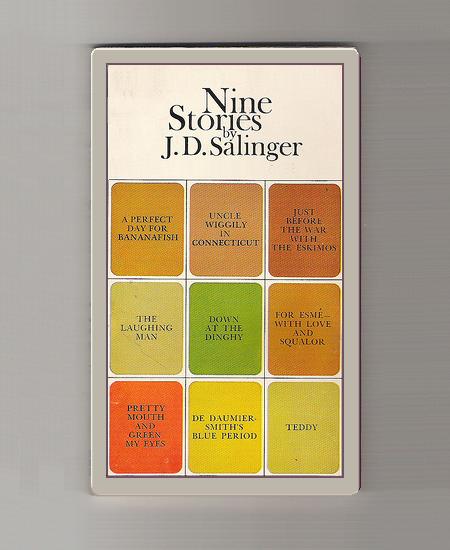
My techno-wish is that my eBook reader will be the exact size and shape as a paperback, with no buttons or knobs whatsoever, since all controls will be via intuitive multitouch gestures and soft keys on the front, sides or back of the book:


And when I finally get one of these, I’m going to back and reread Salinger.

The right taxi

I was having one of those far-ranging conversations with some friends this evening, the kind of talk, with an open bottle of wine on the table, that jumps from topic to topic, taking in philosophy and personal history, touches on politics, jumps back to shared times together, and then goes off on a tangent.

And I found myself relating to my friends the oddest little tidbit from my own life – something I hadn’t thought of for years. Some time around 1992, back when I was a heedless young guy who liked to roam around the world with little more than jeans, a tee shirt and a guitar, I was in a taxi coming back from the airport – I think from a visit to Brazil – and the cab driver said to me “You know, it’s funny, the fare before you was the actor River Phoenix. He was also coming from the airport with just a small bag and a guitar, dressed in jeans and a tee shirt.”

I remember musing about this on the way home, thinking that somehow I was in the wrong taxi – I had been just one taxi ride away from being a world famous movie star (at the time River Phoenix was at the top of his game – “My Own Private Idaho” had come out just the previous year). How strange, I thought – even as I realized the thought was absurd. It felt like being one number off from someone who had won the lottery.

A year later, of course, River Phoenix was gone – from an overdose of heroin and cocaine on Halloween 1993. In my mind, since that taxi ride, I had developed an odd feeling of connection with him – that other guy carrying his guitar in the taxicab, on his way from the airport.

And so, hearing the tragic news, I had a weird epiphany, about the craziness of fate, and the vagaries of chance and circumstance. I know it doesn’t make any rational sense, but there it was. I had indeed been one taxi ride away. But it turned out that I had been in the right taxi after all.

Cultural divide

This discussion we’ve been having – the ways that science and religion seem to become linked in peoples’ minds – could be said to come down to the difference between Star Wars and Star Trek. It’s interesting that both of these icons of scifi came out of the same general cultural era, and yet in a way they represent wildly different views of existence.

The world of Star Wars is, fundamentally, a religious one. Powerful beings are in touch with The Force, commanding the Universe itself to bend to their will. Much of the mysterious power we see is cloaked in symbolism and religious trappings – Jedi knights wear midieval cloaks and work their eerie magic while muttering mysterious incantations. Death only makes Obiwan more powerful. The old and wise Yoda, with his deceptive childlike qualities, is clearly modelled on a Buddhist monk of old, while his methods for training young Luke seem lifted right out of the pages of “Zen and the Art of Archery.” You can practically feel the infinite force flowing through the epic saga, echoing like passages read aloud from some biblical allegory of good versus evil.

Star Trek – I’m thinking here of Classic Trek, more than the endless spinoffs and variations that folowed – is quite the opposite. There are no deities to be found, merely nations at war or locked in a wary peace, and a very human science and technology straining against their limits. Klingons are not evil, merely obstreperous. There are no infinite beings here. As in science, the horizon of what is known is always expanding, but is always finite. We are witnessing the secular expansion of a curious young civilization.

Captain Kirk does not live in a world where religion holds any special power. Aliens who claim higher powers inevitably turn out, after all, to merely be our fellow travellers in a voyage through the galaxy.

Perhaps there is something in our culture that requires both of these archetypes, side by side. One could even say that taken together they represent our crazy, wonderful, contradictory culture – a culture built upon a divided self.

To Brooklyn or by bus?

When I was a teenager, whenever I would ask my dad a foolish question, he would reply: “Do you want to go to Brooklyn, or by bus?” Essentially, of course, he was telling me that I was assuming a false dichotomy, and so my question made no sense.

I think that’s what’s been going on with a few of the comments on yesterday’s post. “Science versus religion” is a false dichotomy. That’s what I was trying to say in the original post (and apparently saying badly). Science doesn’t speak to metaphysics, and science doesn’t speak to moral teachings – the two great subjects of religion.

Yes, Einstein was a great man, but his pacifism and spiritual beliefs did not come from his discovery of E=MC2 or quantum explanation for the photoelectric effect. It simply happens that a great physicist had other interesting dimensions as well. There have been plenty of great physicists who have not had such outsized political or spiritual dimensions.

We did not ask of Frank Sinatra that he answer questions about religion simply because he was a great singer of torch songs. We do not look to Meryl Streep for spiritual guidance, no matter how many Oscars she takes home for her acting.

Why do we try to misconstrue science as some sort of opposition force to religion? It seems to me that this is a misunderstanding of what science is.

Yes, I agree that we may ponder deep philosophical questions about hypothetical beings who have fundamentally greater intelligence than ourselves. These are great questions, but they are, quite literally (and specifically), outside of the bounds of scientific inquiry. That’s why they are called metaphysical questions.

Yes, feel free to explore these exciting and unanswerable mysteries. But please don’t claim that what you are talking about has anything to do with science. Or acting. Or singing torch songs.

A question about science

Today a very serious and intelligent fifteen year old asked me whether I thought that science is a form of religion. I was immediately wary – I didn’t know what form of rhetoric he had been listening to, and I worried that there might have been a political slant to his question of which even he himself was unaware.

I told him I thought that in some ways science is the opposite of religion, or at least the opposite of faith. If you’re doing science honestly, then you can’t be influenced by any pre-expectations of what you might find. If you drop a rock from a height and it falls, you need to report that. If next week the same rock hovers in mid air, you need to report that as well, no matter how emotionally disturbing you might find it.

Then the young man suggested that this view might also be a form of faith – a faith in science. I told him that he might be using “science” as a buzzword. In a sense science is just codifying what we all do every day, all the time. We look at what exists around us, and we react to what we actually see in the world.

What I meant by this was that when we walk we place our feet where there is firm ground, we choose to pass through doorways and not through solid walls, and we drink water but not gasoline. We simply form a model of everyday reality, by inferring from the evidence in front of us. Science starts there, and does not stray from that mentality.

Then he asked “But aren’t both science and religion a search for truth?” I responded that the problem here is that “truth” is an overloaded word, with multiple meanings, so a question like that doesn’t end up asking anything.

There are real and serious reasons that we try to find emotional sense in the world around us. We grapple with the enormity of birth and love and death, we try to come up with core principles to guide our relationships with each other, we see inequity and suffering in the world and try to understand what we should do about it. Religion helps many people to navigate these difficult and deep waters, although others try to navigate them without religion.

But science doesn’t deal with any of those issues. Scientists may, because they are human, and to be human is to grapple with metaphysical, moral and emotional questions. Scientists can be religious, just as they can be good citizens. But when scientists are engaging with these questions, that is not the “science” part of what they do. A scientist might be deeply motivated by a desire to alleviate suffering, but she cannot let those emotions replace an honest evaluation of what she is measuring, lest she find that she has merely engaged in pseudoscience, and has failed to help anyone.

Conducting science can be a scary business, because we may discover that the Universe doesn’t care a fig about us, that it is a cold and heartless place devoid of any meaning other than the emotional shadings that we ourselves provide. To engage in science means to be prepared to look honestly at the Universe, whatever the emotional distress one might feel at the outcome.

And then to keep looking.

The portable cathedral

Today I read an interpretation of the Jewish Sabbath, and a reason for its great importance in the culture, an interpretation that made more sense than any explanation I had ever heard. The gist of it was as follows.

The Jewish people have lived with uncertainty since the destruction of the second temple, around two thousand years ago. There has never been a time when they have been completely secure. As we have seen just from the last century, even the most culturally accepting host culture could turn, in a few years, into something quite the opposite.

Unlike many religious groups, for the last two millenia the Jewish people have not had their cathedral. No Notre Dame, no St. Peter’s, no Anghor Wat, Canterbury Cathedral, Mahabodhi or Great Mosque.

So, it is posited, they built a cathedral not of space but of time. A day of the week, one of every seven, that belongs not to the world but to the spirit. A temple can be defaced, torn down or set on fire, its rubble and ashes strewn over the uncaring countryside.

But a day of the week cannot be destroyed. It is a portable cathedral, packed in one’s bag when fleeing the Pogrom, carried in the heart like a secret, indestructable and serene, ready to serve as a place of worship anywhere in the world.

Thus we may see the brilliance of this cultural adaptation to adversity. So long as a single breath is drawn by those who wish to worship within its walls, so stands the Sabbath.