There is nothing here
We have not seen before now
And not much will change
A moment, some words
A ceremony perhaps
Maybe a few friends
What did we expect?
We are the same, you and I
That’s why it matters
Because the future has just started
There is nothing here
We have not seen before now
And not much will change
A moment, some words
A ceremony perhaps
Maybe a few friends
What did we expect?
We are the same, you and I
That’s why it matters
This evening over dinner the conversation turned to whether people are capable of visualizing in more than three dimensions, a topic that I have found endlessly fascinating for years. There are some four dimensional shapes that are very easy to think about intellectually, but nonetheless there is a gap between intellectual understanding to intuitive seeing. For example, it is very easy to think about a hypercube. Just as you can place two squares apart in a third dimension and draw four lines to connect them to make a cube, you can place two cubes apart in a fourth dimension and draw eight lines to connect them to make a hypercube. Very easy to describe and to understand, but understanding is not seeing.
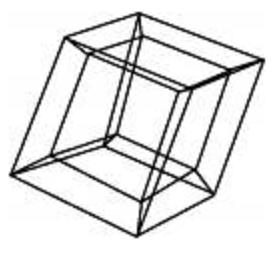
When I talk about understanding in four dimensions, I mean something very specific, which I can describe by analogy. If you were a character in Abbott’s novel Flatland, living your whole life within a two dimensional plane, you might develop a great facility for manipulating the ever-changing two dimensional shape formed by the shadow of a wire-frame cube onto your planar world. You could “rotate” these twelve lines that connect eight points into all kinds of shapes: a square within a square, two connected parallelograms, a hexagon surrounding a point, and so on.
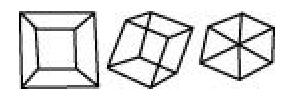
But you might play with this shape all day and never see it as a cube the way we think of a cube. For example, you might never be able to envision filling the cube with smaller boxes, stacking those little boxes up, laying them side by side, or other tasks that are quite easy to us three dimensional folks to visualize. But then again you might. It would be pretty easy to design a test to find out. I would argue that you could design a similar test to see whether somebody can really make their way around a four dimensional hypercube.
To me the question of whether people can visualize in four dimensions is intriguing because it’s really part of a larger question: Have our brains evolved through the millenia to deal specifically with three dimensional spaces, or have they evolved to be general purpose problem solvers, which only become attuned to three dimensional space after we are born, in response to the experiences of our senses? The answer to this question could shed light on just how general purpose are these problem solving devices we carry around in our skulls.
There have been studies that illustrate that our intuitive understanding of three dimensional space is a facility that we develop after having directly manipulated objects with our hands as infants. In fact, comparative studies have shown that children who are raised in orphanages where they are not given toys to play with will grow up with diminished capacity for three dimensional reasoning. Apparently, as with spoken language, there is a general window in our development during which we need to be exposed to certain experiences. If we are not exposed to those experiences during those windows, then we end up having diminished skills as adults.
Perhaps it would be possible for an eccentric uncle – or aunt – who happens to be an inventor, to give a toy to a young niece or nephew. You could hold this toy in your hand, manipulate it, turn it around in various ways, and it would behave exactly like a normal four dimensional object. I’m not saying I know how to do this, I’m just thinking out loud here. As we know, technology often ends up providing a way to do things once we know we want to do them. But first we need to think to ask.
I wonder whether that child would end up developing the sorts of physical intuitions about four dimensional space that we have about three dimensions. It would sure be interesting to try, wouldn’t it?
Today I travelled from Seattle down to Santa Cruz to visit my friend Ned in his house in the woods. In the evening we went to see a one-man-band – a guy who creates an entire musical experience out of nothing but his voice, a banjo, a tambourine strapped to his left foot, and a base drum that he plays by stepping on a pedal with his right foot. Out of these limited tools this one musician proceeded to create an entire musical world.
But I was also struck by how he was dressed. It was all very precisely calibrated. Brown shoes, black socks, brown slacks, a dark grey vest over a light colored button-down shirt with the sleeves rolled up. And to top it all off a porkpie hat. Everything about him said that we were back in the great American depression of seventy years ago, the vast dustbowl, and here was an iterant musician travelling through our little midwestern town, a young man fallen on hard times, but armed with a banjo and a fistful of tunes and tall tales. I suddenly realized how rich a tradition this is – how precise the image, and how powerful.
The Harlequin figure – God’s holy fool and trickster – has been merged over time with Pierrot the sad lover to create the endearingly seductive troubadour, and we recognize and welcome him wherever he goes. He shows up as Nanki Poo in Gilbert and Sullivan’s The Mikado playing his lute while singing “A wandering minstrel I — A thing of shreds and patches, Of ballads, songs and snatches…” Or as Jason Robards in A Thousand Clowns, porkpie hat fixed firmly on his head as he strums his banjo and sings Yes sir, that’s my baby to win the girl’s heart. Or practically any role played by Danny Kaye or by Jack Lemmon early in his career. Or as Ryan O’Neal in Paper Moon. Or as John Cussack in Say Anything, the harlequin outfit changed for a long coat, the lute/banjo replaced by a boombox held high over his head as he stands out in the rain to win the love of Ione Skye.
The one-two punch of Arthur Penn taking Warren Beatty from Mickey One to Bonnie and Clyde was all about exploring this character – the fast-talking joker in the porkpie hat as sympathetic antihero. We know he’s a loser, we don’t believe his patter for a moment, but we love him all the same, because we understand that beneath the fast talk is a sweet boy-man who is simply in need of love.
What’s fascinating to me about this character is the way he distills the archetype of the sensitive dreamer as romantic hero – the non-alpha male who invariably wins our hearts. Johnny Depp as Captain Jack Sparrow channels him, every Judd Apatow film is built around him, and Joss Whedon’s delightful new web-movie Dr. Horrible even dares to turn the evil arch-villain into the sensitive harlequin/peirrot figure, a complete reversal of genre roles which depends entirely for its success upon our automatic acceptance of this archetype.
I wrote recently about Heath Ledger’s deeply powerful and disturbing turn as The Joker. It is now clear to me that in this performance Ledger was playing this psychotic monster as depression-era troubadour – fast-talking, oddly endearing, the adorable one-man-band, but in this case transformed into your ultimate nightmare. And it is partly because of this archetype – because we recognize the vulnerable harlequin/peirrot archetype and automatically turn our full attention and love toward him – that Ledger was able to steal the film away from its ostensible hero. In the battle for our affections the Dark Knight never had a chance, for his nemesis was a harlequin in a porkpie hat.
Have you ever noticed that there is an odd sort of duality about a day? On the one hand, a day is quite short – sometimes it seems as though mere minutes have elapsed from the time you woke up in the morning until the evening when you find yourself getting ready for bed. And in moments like these, it can seem as though life itself is flitting by, the days blurring alarmingly together, one into the other.
On the other hand, so much can happen in a day. We have all seen that vast changes can occur in a moment, and individual encounters and experiences can take place that alter the course of your life. Taken minute by minute, the course of a day is an incredibly long and rich event.
Of course this is because we are talking about the same object seen from different points of view: Introspection tends to lead to Proustian discovery, and to look into one’s own experience of life is to uncover vast undiscovered uncharted spaces in even the smallest room. As Walt Whitman said “I am large. I contain multitudes.”
I have a cousin who meditates for an hour at the start of each day, as a spiritual practice. I think this helps him to realize the power of each moment that goes by, the importance of paying attention to each drawn breath, and to remain mindful not to take the moment of that breath for granted.
Keeping this blog helps me to do that. Perhaps it is a newfangled form of meditation.
Today I was talking to a group of people and I mentioned that my favorite melody was Somewhere Over the Rainbow. I then told them that when I was a child I used to love the fact that the great Harold Arlen (who composed the melody to Y.P. Harburg’s beautiful lyrics) was still listed in the Manhattan phone book under “Song Writers”. Presumably you could just call him up, should ever you need to hire someone to write you a song.
I never did call his number when I was a child, although I was tempted. Simply knowing that the great man was just a phone call away dazzled my young mind. And now of course it is far too late – he has gone somewhere over the rainbow, way up high.
I asked the group of people I was talking to whether anybody else had ever looked up the number of a famous person in the phone book when they were a kid. Nobody admitted it (I suspect some of them were holding out on me) except for one woman who said that when she was a child she had looked up Janet Jackson’s phone number, and sure enough there it had been, right there in the phone book. She said that she never actually called Janet up, but it was just great to know that she could, if she ever ireally needed to.
Has anybody else ever looked up the number of a famous person in the phone book and actually found it? And have you ever been tempted to call them up?
I guess I’m ready to start circling around to all of the issues that are raised by the loss of Randy. We are so used to dealing with very unimportant things, and telling ourselves that they are important – an argument we had, a concert we missed, some movie that disappointed us. Perhaps on some level this is all a way to avoid thinking about the things that actually matter to us – this life we are mysteriously living, and its fragility.
I remember exactly the moment I first realized that I was not immortal. I don’t mean intellectually, I mean emotionally, deep down in my gut. My dad was driving somewhere his car, I was sitting on the passenger side, and we were talking. He was telling me about the women he had dated before he met my mom. He told me there was one girl, when he was doing his military service, at an army camp down south. He really liked her, and they went on a few dates. But when he was discharged he went back home to New York, and they lost the connection, and eventually they lost touch.
I was completely fascinated, the way you’re always fascinated to discover some part of a parent’s life that you had never known about. As I sat there in my dad’s car, quietly mulling over the story of the girl before my mom, I experienced two thoughts in succession, separated by about a minute.
The first thought was the realization of how impossibly miraculous it was that I had ever been born. If my dad hadn’t broken up with that gal, he wouldn’t have started dating my mom. And then I realized that my birth was dependent on so many things, an infinity of little details that all needed to line up just right for that particular sperm to find that particular egg. If things had gone even ever so slightly differently, whoever showed up in this world wouldn’t have been me, and I simply would not exist.
I had this thought all at once, in a rush of understanding, and for the first time it occurred to me that the probability of my existence – before the fact – wasn’t just low. It was essentially zero. Whereas the probability of my existence after the fact was the opposite: identically one.
And that is when I came to realize, for the first time, what an astonishing gift it is to be alive. Amongst all the myriad of possible humans, potential lives so numerous that the mind cannot conceive of a number so vast, only we fortunate few, a mere six billion or so, have actually made it onto this earth. Every human on the planet is a uniquely miraculous event – we have each beaten impossible odds to be here.
And then, about a minute later, came the second thought: That this astonishing gift of life is not a gift at all, but merely a loan. For one day my life will come to an end, as all lives must. Infinite gain balanced by infinite loss.
And that was the moment I truly understood, for the first time, the meaning of mortality. From that day until this, I have looked at each day differently. Knowing that I have only so many days altogether in this life, I now see every one of those days as something infinitely precious, a cup to be savored, for it can never be refilled.
I showed some visiting scientists from India my favourite spot in our nation’s capital – Maya Lin’s Vietnam Memorial. Every time I walk through it I am once again overwhelmed and sobered, and so were they. Amid all of the kitschy triumphalist monuments, this is such a powerful work of art. When I walk its length, as difficult and sad as the experience is, I find myself proud to be part of a nation that is capable of asking itself such deep and difficult questions, of having the courage to choose a memorial that conveys the tragedy of so many having died so young.
I flew from Washington D.C. to Seattle Washington, marvelling that I could travel more than three thousand miles and arrive at a place with the same name.
The first thing I did in Seattle today was go with some friends on a hike up Mount Si (as in “sigh”). It was beautiful – a deep and lush mountain forest with winding streams and the air filled with swirling mists. The further up the mountain we went, the more it felt like we were entering Middle Earth. I half expected to see some hobbits walk by.
After the completely constructed world of D.C., the feeling of being away from civilization was simply delightful. At various points we would just stop and look around us, taking it all in. From time to time we would pass other travellers, and I imagined them all revelling in their blissful escape into nature, far from the cares of daily life.
At one point we came upon a man wearing a “Rochester” tee shirt. My friend Andy, who had just flown in from Rochester New York, was excited to see a fellow towns-man, so we started up a conversation. It turned out the man was actually from Rochester, Minnesota. So there it was again – two places, one name.
A little further up the mountain we passed two young women. A dog was happily running about their feet, clearly enjoying the mountain air. I remember at that moment thinking how lovely it was that these two women were spending the day, like us, away from the cares of the world below.
Just then one of the women, unexpectedly, shouted aloud. She turned to her friend and said: “He says he dreamed about me last night.” Her friend looked at her and said “Ew! Awkward?” The first woman nodded and replied “Awkward!”
It took me a moment to figure out that the first woman was reading a text message off her cell phone. Suddenly it occurred to me that perhaps not everybody up here on the mountain was looking for hobbits.
Thanks to everyone who sent me a supportive note yesterday. That was so lovely of you! Today’s post is a lot more upbeat.
I’ve written about riding on trains here before, but I never tire of train rides, or thinking about why I like them. One of the cool things about riding trains is the chance for little random encounters. The tension level these days is much lower on a train than on an airplane, for obvious reasons, so people are generally more relaxed and open. Also, the seats are roomy, nobody is in a great hurry, and most people seem to be having a great time watching the scenery go by.
Besides, you can alway go to the café car and start a conversation with the person behind the counter. These people generally seem to be upbeat and happy to see you, like Tom Hanks’ character in Polar Express, only without that whole creepy animated mannequin thing.
On the AMTRAK express train down from New York to Washington D.C. I ordered something from the jovial, if rather spaced out, woman behind the counter in the café car.
She looked nice, so I smiled. She smiled back. I gave her my order, she went to get the order. A moment later she turned and came back and asked me what I’d ordered. So I gave her my order again.
She smiled apologetically and said “I guess I’m in my own world”.
Then I said (I don’t know why – it just popped out) “Better to be in your own world than in somebody else’s world.”
She liked that so much she repeated it out loud to herself – twice – while she was getting my order ready.
I told her, truthfully, “I made that up just now, for you.”
She got very excited about that. “Really, you did?” she asked, “You should copyright that!”
Then I didn’t know what to say. So I wished the nice woman a great weekend and left her a good tip.
What else was I to do?
Randy Pausch passed away this morning, after a heroic battle with pancreatic cancer. Randy was a great man, with a beautiful soul, and he made the world a better place. He was also a really good friend of mine. I don’t have the heart to write anything else today.
A grad student told me today that he was really excited to hear about recent research in which scientists implanted about 100 tiny electrodes in a monkey’s brain, and used info obtained from reading those signals to get the monkey to control a robot arm. I’ve looked it up on the internet – you type monkey arm computer brain into Google and it comes right up – and I read through the recent article in The New York Times.
There were a lot of quotes from excited scientists saying how wonderful this research result is. The thing I couldn’t figure out – and they don’t really explain it in the article – is how they got the monkey’s informed consent, obviously something you’d need to do before sticking 100 electrodes in somebody’s brain and then making them have to learn to use a robotic arm if they want to feed themselves.
I’m trying to imagine that first meeting. Monkey walks in, is asked to sit down by a nice lab assistant. There’s probably a bowl of oranges on the table, so the monkey helps himself, looks around. Lots of fancy equipment, good furniture – real oak, not the cheap Ikea stuff some labs use – a row of bound volumes of Nature on the bookshelf. Clearly this is no fly by night lab. The monkey likes this; getting asked to be part of something important. Helps himself to another slice of orange.
A scientist enters the room, sits down, ignores the oranges, which is strange because they are really rather good. He explains to the monkey the basic idea, the set-up, what they hope to discover in this research about the workings of the brain.
The monkey is impressed. These guys clearly know their stuff. He also likes the fact that they are offering to compensate him for any days he’ll be away from the pack. Maybe he can get them to throw in a few dozen oranges. They hand him a pen, he signs.
The only issue I have with this scenario, as I play it over in my mind, is the language problem. I mean, how do they know the monkey really understands the details? English is not a language that monkeys generally speak, and I’m pretty sure (at least I’ve been told) that most neuroscientists do not have the skills or training to effectively communicate their ideas with an individual of another species. So how do the scientists know they have the monkey’s informed consent?
Then my mind flashes on the monkey’s point of view. One moment he was in a comfortable chair, having a serious chat with some earnest young scientists while polishing off a nice slice of orange, and the next thing he knows he’s strapped to a gurney.
The monkey’s mind races. He sees in a mirror that his head has been shaved. This will not go down well with the girlfriend. Even worse, a large circular piece has been carved out his skull, from which about a hundred wires are attached. Around now he’s thinking that this just can’t be good.
The monkey wracks his brain. How did he get here? He tries to reconstruct the sequence. Clearly there is some connection with the paper he signed. But he’d been given to understand that was some kind of loyalty oath. The humans are clearly a powerful species. They’ve got flying vehicles, wear artificial skins, and are rumored to have lethal nuclear weapons and deadly Jalepeño peppers. When a species like that invites you in to sign a loyalty oath, you don’t argue.
Sure they’d been jabbering on about something or other, but that was just human talk – nobody but another human can follow any of that. And now here he is, immobilized, strapped to a gurney with a big hole in his head, and about a hundred wires leading out of his skull to a big metal box. Holy Jesus!
The monkey tries to move his arm, and a robot arm starts to move instead. That’s when he gets it – they’ve got his brain controlling a robot. They’ve turned him into a frigging cyborg! This is most definitely not good. The next few days are not fun. His head hurts all the time, strange humans come in to prod and poke him unpleasantly, and the robot arm is a bitch to operate, although he’s getting the hang of it.
By the third day he’s using the arm to feed himself. Not bad for a duped conscript! He permits himself a virtual pat on the back. In any case, he’s getting good at moving the robot. Which is important, because he’s been practicing, and the very next time any human scientists come into range, he’s going use that hi-tech arm to throw his feces at them.
Wouldn’t you?