Tying things together

I’ve been working on different software projects lately, with the aim of combining them, so that everything will work together in the same place at the same time. One part of the puzzle is seen in those interactive diagrams I’ve been posting here lately.

Another part is seen my recent dragon planet and in the WebGL work I posted recently for my graphics class (both of which require you to enable WebGL in your browser). Yet another part consists of letting the text of web pages change in different ways, like the mutable story I talked about here in September.

In these pursuits I’ve been very much inspired by the work of Chaim Gingold, Bret Victor, Vi Hart, Steve Wittens and others. And of course the Gandalf of the bunch, Alan Kay.

Now it’s time to start pulling threads together so that all of the components I’ve been building can interoperate. The result will be something that’s one part responsive book, one part interactive lecture, and about two parts magic. The longer term playbook I’m working from might be a little hard to explain.

But hopefully it will be fun to see.
The fallacy of the shiny new toy

I like making new things, coming up with cool approaches to problems, “inventing the future” as Alan Kay would put it. It’s a heady experience to realize you have found a different and possibly better way to do something.

But that wonderful emotion can be a trap. A new thing that you have created is your baby, and we love our babies beyond all reason. The sheer exuberance of fresh discovery can cloud the mind. We believe the world needs our creation — partly because it may be true, but partly because we want to believe.

As difficult as it is for me, I’ve started putting more effort into trying to turn around my point of view, to see it from all sides. Instead of only asking “How can I make the world understand why it needs my beautiful creation”, I’m also trying to ask “What does the world need?” Sometimes it turns out not to be my shiny new toy after all.

And maybe that’s ok.

Another dimension

There was a great talk this evening by Marc ten Bosch about his four dimensional computer game Miegakure, which is still at the prototype stage.

In the examples of game play Marc showed, the fourth dimension was very abbreviated — much simpler than the other dimensions in the game. This limited much of the 4D gameplay to elementary (although still fun) scenarios. I strongly suspect that the full game will have a much richer and more extensive fourth dimension than did the prototype we saw this evening.

Still, my student Adam was disappointed at not having seen, in this prototype, a fourth dimension as large and complex as the other three dimensions. Trying to explain to me the sort of rich four dimensional world he’d like to see in a game, Adam said: “I want people living at right angles to me, and we never intersect.”

“That’s easy,” I told him, “just live in Manhattan.”

Space to dream

Having seen Gravity — on a gloriously large movie screen in 3D — I can’t help but mentally compare it to the space operas in those sixty-odd year old Sci Fi magazines I bought yesterday. The mid 20th century was a time when space travel was very much a fantasy of the future, one of those ultimate human dreams just tantalizingly beyond reach.

Now we live in a world in which space travel can seem almost quaint. After all, we managed to put people up on the moon well over forty years ago. Yet now, by virtue of a different revolution entirely — enormous advances in computer graphics — we can bring to life the visions of an earlier generation to an extent that would have thrilled and awed the readers of Fantasy and Science Fiction in its golden age.

In another sixty years our collective dreams will have evolved yet again, and the visions that awe us today will seem oddly old fashioned. Meanwhile, we will find a new space to dream. The future equivalent of today’s cutting edge computer graphics will probably be something beyond anything we can today imagine.

In that future era, how we will visualize our collective dreams? And what we will be dreaming about?

Used book shop

This evening I found myself outside one of my favorite used book shops. I love this place because I always find something completely different from anything I had ever thought I’d find. Some shops are magical like that.

This evening I walked in, feeling hopeful, but alas could find nothing of interest in any of the sections I usually frequent. I was on my way out when a display near the door caught my eye. There I saw an entire row of old science fiction magazines — a mix of Astounding Science Fiction and Fantasy and Science Fiction — from the mid 1940s through the early 1950s. Each issue had been carefully tucked into a clear plastic sleeve, and every one of them called out to my inner child.

They were all from well before I was born, and I realized I was looking at someone else’s childhood, at the poignant remains of somebody’s story of long ago innocence. That mystery just made them more compelling. I vowed to buy one, but which one? The cover art on each was delightful, in the Hugo Gernsback way that was so popular back then.

Then it dawned on me: One thing about being a grown-up is that you can do things you would never think to do as a child. Sometimes you actually get a chance to indulge a combination of childhood dreams and grown-up wherewithal. This was one of those times.

I bought them all.

A few more interactive diagrams

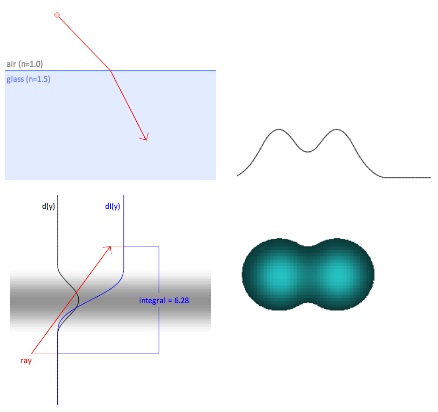
As our computer graphics class has gone on to cover some more advanced concepts of ray tracing, such as refraction, layered fog and blobby models, it seemed like a good idea to create a few more interactive diagrams to accompany the course notes, and to help bring the concepts to life.

If you click on the image below, you will get to the course notes pages, and then you can play with these interactive diagrams for yourself:


In the land of the blind

One evening at the recent user interface conference in St. Andrews I was walking to a restaurant with some colleagues. Since I didn’t have a SmartPhone, I had studied a paper map beforehand, so I’d know where the restaurant was. We first took a detour to one colleague’s hotel so he could drop off his computer bag, and then we started toward the restaurant. At the second intersection my two colleagues both seemed to become disoriented.

“I’m not sure if it’s this way or that way,” one of them said.

“It’s half a block this way,” I replied, “on the right.”

Neither of them was satisfied with this answer. One colleague took out his SmartPhone and started to navigate an on-line map, while the other waited anxiously for the results.

“Really,” I said, “it’s just over there, half a block from here on the right, a little before the intersection.”

Finally, after a bit of a wait, the colleague who’d been fiddling with his SmartPhone looked up. “We need to go a little this way, on the right.”

Exactly where I’d said it was.

And that’s when I realized that not having a SmartPhone had given me a sort of super power — the same super power nearly all humans have had until very recently.

As the old saying goes: In the land of the blind, the one eyed man is king.

Weapon of choice

I finally got around to seeing the 1984 film version of “Dune”. I had read the novel as a kid, and had loved it, so I was understandably skittish about seeing a film adaptation that had received such mixed reviews through the years — even if it was directed by David Lynch.

“Dune” turns out to be a very strange film, but in an interesting way. Lynch doesn’t seem to have set out to direct a movie, so much as a sort of religious ritual. The line readings, editing, camera placement and pacing all feel very stagy, but in a way that suggests it was all meant to be that way. It’s as though we are witnessing a kind of Passion Play — a solemn ritual enactment of the sacred rites of someone else’s religion.

And if you know “Dune” (the novel, I mean), you’ll agree that this approach, while unorthodox, makes a sort of sense.

One thing that thrilled me was when Paul of Atreides (Kyle MacLachlin) says “Walk without rhythm, and it won’t attract the worm”.

As many of you know, that is a line from “Weapon of Choice” by Fatboy Slim. The song, it turns out, is quoting the movie.

Which is very cool, except I now worry that whenever I think of the mighty sand worms of Arrakis, my mind is going to visualize Christopher Walken flying off a hotel balcony.

The toddler strategy

As I was traveling in Europe this past week, the one question I was asked most often was how our government could shut down. People there seemed genuinely flummoxed. It didn’t seem like the kind of thing that should happen in the United States of America.

They were also, needless to say, nervous. We came remarkably close to starting a world financial panic, the effects of which would easily have extended across the Atlantic and beyond.

When asked about the shutdown, I invariably responded that I was sure our more moderate Republicans leadership was working as hard as they could behind the scenes to come up with some graceful exit. The only available strategy for them, as far as I could see, would to be to get the Obama administration to cede some minor point of little consequence, so that the Republican leadership (which now clearly fears its own extreme wing) would have some face-saving way to declare “victory”.

This seems to be exactly what has happened, which is not surprising. But what seems most amazing to me is the thinking of the Republican extreme right in triggering the shutdown in the first place. As far as I can tell, they seemed to be following what might be called the toddler strategy: “If you don’t give me what I want, I’m going to hold my breath until I die. After I die, you’ll be sorry!”