Authorship

Playwrights can easily become well known, even immortal. For example, Shakespeare and Molière remain iconic, centuries after their deaths. But that doesn’t seem to happen with writers of screenplays. With very few exceptions (notably Charlie Kaufman and William Goldman) films are not associated with their screenwriters.

Even when you think of masterful examples of screenwriting, such as “Casablanca” or “Bringing up Baby”, you probably don’t think of Julius and Philip Epstein or Dudley Nichols and Hagar Wilde. If you are like most people, you probably haven’t ever even heard those names before. You are far more likely to have heard of those films’ directors — Michael Curtiz and Howard Hawks, respectively.

It occurs to me that screenwriters are hidden from our view, because they are obscured by the single bright shiny object that resulted from their work. Because there is only one such object — the movie that was produced — we associate the result with the production itself, and therefore with the film’s director.

In contrast, there is no one production of “Hamlet”, but rather countless thousands of productions, down through the centuries. “Hamlet” stagings form a vast cloud of produced objects. And the only thing all of those objects have in common is Shakespeare’s play in written form.

The extreme mutability of a play, or any authored work that can lead to many different creative artifacts (other examples are songs and musical symphonies) — gives it the ability to achieve a kind of transcendent cultural power, amplified rather than obscured by its many interpreters.
Musical bits

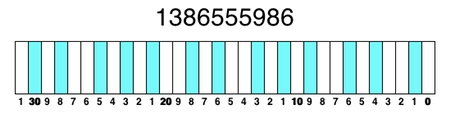
I was talking to some students about how a number that’s stored in a word of computer memory is made up of individual bits, where each bit is either on or off (ie: one or zero).

To make this easier to understand, I created a little Java applet, which you can play with by clicking on the image below:


But then as I started to play around with this applet, I found myself creating an image of a musical keyboard.

That suggests an intriguing way to link numbers to music. If we assign one bit of any number to each note on the piano — as suggested in the image above — then any number becomes a musical chord.

Perhaps certain mathematical progressions will produce better music than others.

Hmmm.

Love and telepathy

I’ve been thinking about what love might be like in a society of telepaths.

Our ability to show love for each other, at least in this Universe, is connected with our ability to choose to make choices that benefit the person we love. The person we love cannot see our thoughts directly — they can only see what we choose to say and do.

If we had the ability to read each others’ minds, would we still be able to show love for one another in this way? In some sense, it is this hidden staging area, this part of ourselves that only we know, which allows us to make these choices at all.

I am trying to envision what it would be like to care for another person in a world in which they know all of our thoughts as soon as we think those thoughts.

On the other hand, it could be that we are psychologically incapable of envisioning such a world. After all, our social development as individuals is entirely predicated on this ability to mediate between thought and action within a zone of absolute privacy.

If we were to encounter a truly telepathic race of people, perhaps our respective societies — and the way people relate to each other within those societies — might be a source of complete mutual bewilderment and incomprehension.

Just a little too fast

Somewhat quietly, in the midst of all the noise and hubbub of politics and pop culture, a news item has appeared reporting that neutrinos have been measured going too fast.

The speed of light in a vacuum — or more precisely, Einstein’s limit on how fast any information carrying event can travel through space — has been regarded for the last century or so as a universal absolute, a fundamental property of our Universe. The value of this constant been repeatedly verified by a large body of careful experimental observation through the years.

Yet these neutrinos were measured traveling from CERN near Geneva to the OPERA detector in Gran Sasso Italy just a bit faster than that. One part in 40,000 too fast, to be more precise. If this measurement turns out to be correct, it will turn much of what we thought we knew about the Universe on its head.

In a few months, this measurement will quite likely turn out to have been the result of some unaccounted for experimental error, as such things usually do.

But we can’t yet know that for sure. And meanwhile, isn’t it fun?

Consensual illusion

I’ve been thinking about how much of life is consensual illusion. I mean “illusion” in the sense of an invitation to make-believe.

When an illusion is well done, we don’t even think about it. In a good production of “Hamlet”, we don’t sit there thinking “this is all obviously fake”. We know it’s all fake, but we don’t care. The players have invited us into a make-believe world, and we gladly enter that world. We are deeply moved when Hamlet dies, even though we know it’s all a chimera created out of words and greasepaint.

If someone were to simply announce “Here is he death scene from Hamlet” and then flatly recite Shakespeare’s lines, we would be unmoved. And if an actual death transpired on-stage, most of us would be horrified, and perhaps deeply scarred by the experience. But that strange liminal space of consensual illusion, of willing suspension of disbelief, creates a safe conduit for the sharing of all sorts of deep and intense emotional experiences.

A great magician does not merely perform tricks, but rather creates an invitation for us to enter an entire illusory world. Similarly, J.K. Rowling never claims that Hogwarts actually exists. We know it doesn’t exist, and that gives us permission to happily go there and experience its reality. These invitations to enter the magic circle of shared illusion are so deeply woven into human nature that even small children immediately understand and accept them.

This principle also pertains in places where we might not think to look for it. For example, I would argue that that the business of Apple Computer these days is, precisely, creating and marketing consensual illusion. Other companies that find themselves unable to compete with Apple for consumer mind-share don’t seem to realize that this is what Apple is really up to. These rival companies appear to be under the impression that it’s all about technology.

Which of course it is not. Like most things that make people desperate to part with their money, it’s really about conjuring an irresistible world of magic.

The next day

Yesterday I wrote about “Taken”. By far the best performance in this mini-series was given by then eight year old Dakota Fanning. Her preternatural presence towered over all the other performances. I suspect Spielberg might have green-lighted this project precisely because he knew that for about a year or two he would have the perfect actor to play the pivotal child role in his epic fantasy.

“Taken” is a multigenerational saga. Actors playing characters we first see as children are then swapped out to play their young adult selves. Aging make-up is then gradually applied as they grow old, even as new generations of actors/characters appear. After watching a few episodes, you come to expect people to age dramatically, practically before your eyes, from one episode to the next.

I remember thinking last night, as I started to watch the ninth of ten episodes, that of course the mini-series would need to end soon, because Spielberg knew it would be impossible to find an adult actress who could match Fanning’s immense charisma and sense of presence.

Which is why I was taken aback today, as I took the elevator up to my office at NYU, to see Dakota Fanning riding in the elevator with me. Not the eight year old Dakota Fanning of 2002, but the seventeen year old version of today. Turns out she’s a student at NYU, where she takes courses in our building, just a few floors below our lab.

For just a moment I found myself in Spielberg’s world. “Of course she’s almost ten years older,” was my first thought. “It’s the next day.”

Taken with Taken

I’ve been watching Steven Spielberg’s 2002 mini-series “Taken”, ever since having recently stumbled across it on NetFlix. Somehow the existence of this miniseries had completely eluded me until now. Maybe because I don’t have a TV.

The wonderfully zany premise is that all the UFO stuff is true — Roswell, the abductions, the big Government cover-up — all of it. But with the following clever twist: It’s not treated as a big SciFi special effects extravaganza, but rather as a series of intimate small-scale stories of the generations of people whose lives have been affected by these events.

The confluence of these two opposite principles makes for wonderful fun. Take the most insanely ridiculous premise, and treat it with utmost seriousness in every way. No tongue-in-cheek self-referential winking (as in the X Files), or comic absurdity (as in Men in Black) or superhero wish-fulfilment fantasy (as in Green Lantern). Just straight carefully constructed human drama, focusing on families, relationships, human emotion, loneliness and connection, the everyday betrayals and small revelations that define character.

It all works spectacularly well as entertainment. And I find myself trying to think of another example of such a thing. An absolutely straight ahead serious and psychologically plausible treatment of a completely laughable premise.

So far I haven’t been able to think of any others.

Uses of GPS

I was in a car yesterday with my cousin, discussing how best to make use of a Global Positioning System. My cousin, who was driving, said that he liked to try to get places on his own. If he takes a wrong turn or finds himself getting lost, he can then turn on the GPS, and it will give him the advice he needs to get back on the right path.

I thought about my cousin’s philosophy for a bit, and then I told him, “I use a similar philosophy in my personal life, except that the GPS I end up turning to are my friends.”

Then, as we drove along, I thought about it a little longer, and I said: “Come to think of it, in my personal life I usually wait way too long before turning to the GPS.”

Snowclones considered harmful

To snowclone or not to snowclone, that is the question.

But what do I know? I’m a doctor, not a snowclone. Well actually, I’m not a snowclone, but I play one on TV.

Even so, I can tell you that the Eskimos have twenty words for snowclone. Snowclones are the new snowclone, and imitation is the sincerest form of snowclone.

Wait — is this a snowclone which I see before me? It is the snowclone from hell, not your father’s snowclone. It is the mother of all snowclones.

Oh where are the snowclones of yesteryear?

Now all the world’s a snowclone, so do not ask what your snowclone can do for you, but what you can do for your snowclone. For we are a snowclone nation, and it’s the snowclone, stupid.

I, for one, welcome our new snowclone overlords.

😉