Collaborative music

Today we’re taking things up a notch. This is the first collaborative applet I’ve posted that can be said to have a clearly defined goal.

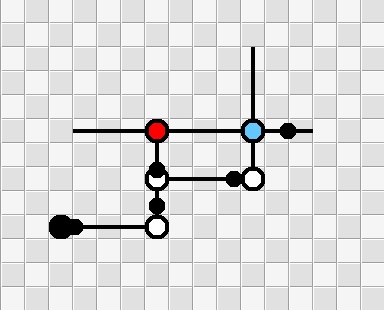
All I’ve really done is add candy button musical notes to a variation on the lines and circles world. But that’s enough to allow your network of lines to be used to compose original music.

Of course there are lots more interesting things still to add. For example, with just a few more ways to control the flow, I could let you make much more sophisticated procedural music. But this is a start.

As usual, click on the image below to link to the applet:


Anti-laser

I was very excited to read today in the New York Times about the invention of an anti-laser. Essentially, this is a device that reverses what a laser does — it absorbs coherent laser light rather than generate it.

Now that physicists have established a methodology for reversing such a fundamental technology, I am eager to see them apply the principle to other mechanisms of interest. Here are a few ideas which I am hoping will inspire any ambitious physicists out there looking for a worthy and interesting project:

  1. An anti-clock: When I am late for an appointment or meeting, this technology would allow me to reverse what a clock does — by absorbing time rather than generating it. Interestingly, there were several times just today when I could have used such a technology.
  2. An anti-Muzak: When you are trapped in your dentist’s waiting room, and you realize you are hearing the Soft Sounds of the 1000 Strings Orchestra version of of “Smells Like Teen Spirit” for the seventh time, that’s when you really need a physicist — someone who can invent a way to reverse such abominations, rather than generate them. Maybe, with any luck, if you play one of those things backwards you’ll hear the voice of Kurt Cobain.
  3. An anti-social-gaffe: I don’t know about you, but there have been times when I have plunged myself into complete social disaster through a single ill-conceived remark. I would be quite interested in a technology that would allow me to reverse such a social gaffe, rather than generate one. In fact, I really could have used one of these at that dinner party this past Sunday (sigh).

Does anyone else have any similar promising areas of research to propose? I really think we all owe it to our physicist friends to give them plenty of opportunities to build truly useful and groundbreaking anti-devices.

The public sphere

I got into a fierce conversation this evening with a very intelligent and thoughtful person about Julian Assange, the main spokesperson for Wikileaks. My conversant’s contention was, in essence, that Assange doesn’t pass the smell test. She felt that he is not motivated by a desire to make the world a better place for all, but rather by a kind of self-focused aggrandizement, a need for ego gratification.

My argument, which I suspect got lost in the heat of the rhetorical moment, was not that she was wrong, but rather that there is no way for us to know. The sheer noise, I claim, of the publicly received version of events has become so loud that the hype of media tropes drowns out niceties such as who any public figure really is and whether he is truth-teller or charlatan.

And that brings us around to a question: Is it even possible for the citizen, no matter how informed, educated, thoughtful, or outward looking, to evaluate the events and players in the public sphere? After all, we are, for the most part, dealing with consummate professionals in the business of spin, of polishing images, of crafting just the right sound byte to dominate the conversation.

Is it even possible for you or me to deploy a b.s. detector that will let us know whether what a public figure has just told us is sincere — or is merely highly crafted hokum?

Server side

The recent set of posts that allow people reading this blog to make persistent changes to my Java applets is making use of a capability provided by Murphy Stein — a Ph.D. student in the NYU Department of Computer Science.

Murphy wrote two computer programs that are sitting on my web-site (commonly referred to as the server side):

  1. a program that waits until a Java applet sends it some data, and then writes that data to a file on the web-site’s host computer;

  2. a program that waits until a Java applet asks for some data, and then retrieves the data from that same file.

It’s not very fancy, but it completely gets the job done. Basically, this allows each Java applet to keep its very own persistent record of what’s going on — like having your own locker at the gym.

Of course every Java applet uses its locker differently. Some might store little bits of text, while others store instructions about how to draw a picture.

But what they all have in common is that they allow people to make changes that will be remembered when somebody else visits the site. Which is very cool!

Collaborative animated painting

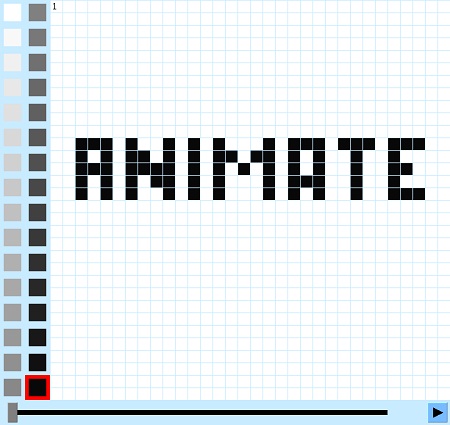
Today’s experiment is a collaborative animated painting program. This the most basic kind of animation — painting images one frame at a time — in this case to create a one minute long animation, at 10 frames per second.

The important thing is that anyone who visits the applet page can simultaneously collaborate to build the animation. I have no idea what you’re going to collectively create, but I’m very curious to find out.

As usual, you access the program by clicking on the image below:


The precipice

      (a response to seeing friends in crisis)

There are wounds that never heal
And fires within that burn the soul
We stand alone before the night
And keep our stories locked inside

I saw a man within a room
Thinking back on all he’d lost
He came upon a memory
And then he had to turn away

All those secrets they had shared
Except the ones they’d kept inside
She thought she knew him like herself
But he was never there at all

There are wounds that never heal
And fires within that burn the soul
We stand upon the precipice
And keep our stories locked inside

Electric train set

While he was working on Citizen Kane, Orson Welles called RKO studios “the biggest electric train set a boy ever had.”

But getting a bigger electric train set is a challenge as well as a blessing. As Spiderman’s uncle said “With great power comes great responsibility”. After years of building Java applets that were the same every time you ran them, I realize that this new direction I’ve been going in — procedural worlds that are continually changed in all sorts of ways by the people who play with them — adds up to a vastly bigger train set. In a way it’s as big as the Web itself, since you never know who is going to come along and do something amazing and unexpected with your little toy train pieces.

The challenge is to figure out ways to unleash all of that creative power. I’m probably going to make all sorts of mistakes as I try out various things, and I hope you will all bear with me. In any case, I’m sure it’s going to be an interesting ride!!

The tyranny of flexibility

I was having a conversation today with a friend about the possibilities of an eccescopic future. He was in the middle of describing the possibilities that are emerging as technology allows us to be ever more aware of the world around us — like the friend in town for just one day who happens to be in a cafe around the corner, or the rare book we’ve been looking for that just happens to be in a used book store one street over.

As our portable information devices increase in power, we will become used to being alerted to such happy accidents; they will come to seem normal. My friend was very enthusiastic about these possibilities.

But as he was speaking, a phrase popped into my head: “The tyranny of flexibility”. For even as technology allows our day-to-day options to grow, life has a way of incorporating that very flexibility to create some unpleasant surprises.

For example, there was a time — until about fifteen years ago — when you could make a plan to meet a friend at a coffee shop, and you knew, with great certainty, that you would see that friend. But then cellphones came into popular use, and it became possible to cancel plans at a moment’s notice. As people learned they could opportunistically juggle their various social possibilities, a certain civility seemed to become lost.

I’m not saying that the cellphone is bad, only that it was not the coming of a kind of Utopia that people living in an earlier era might have imagined it to be.

Similarly, once everyone knows that you are sitting in that cafe during your one day in town, new kinds of social obligations will emerge. And knowing that there is a store just one block out of your way that carries something your friend or spouse has been looking for might obligate you to take the detour to pick it up on your way home.

I’m not saying these particular things will happen. Frankly, I don’t know what will happen. But I do know that technological progress never actually leads to Utopia — it just leads to different day-to-day realities. We always end up being stuck with ourselves and with each other, in all of our particular, prickly, fascinating and sometimes exasperating humanness.
Collaborating with you (part 3)

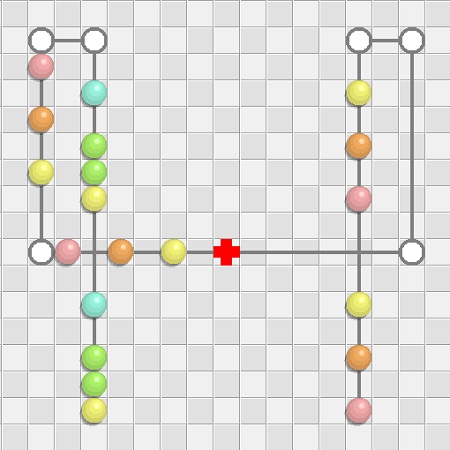
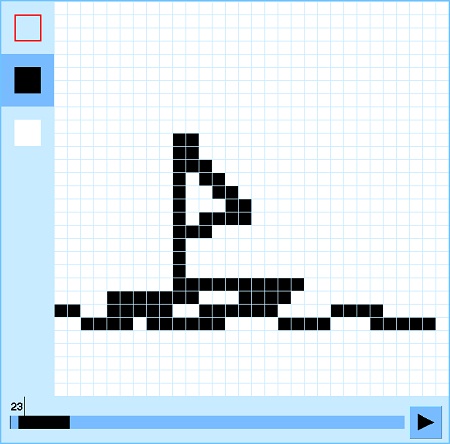
OK, here is the next iteration of community authored pattern worlds. I was very impressed with how quickly people jumped in and filled the space with fascinating patterns, and so I’ve expanded the size of the space. In this next version there are 24 separate worlds you can choose to contribute to.

Also, I’ve enhanced the pattern language. Now the objects in the world start to have state — which you can see as changing colors.

Still no music, but we’re getting there. 🙂