Jazz talk

Today I read an interview with Christopher Guest, who was talking about how he makes all of those delightful improvised films like “Waiting for Guffman” and “Best in Show”. He explained that the key is to work with people who understand how to improvise. In a Christopher Guest film, there is no rehearsal. The actors first read the plot outline and character sketches, which Mr. Guest and Eugene Levy have prepared beforehand. Then they just start filming, right out of the gate. In the interview, he likened the process to a Jazz ensemble. When you play with a band long enough, you intuitively pick up on the rhythm. You know what chords and riffs to reach for, and when to go for the solo.

Coincidentally, I had my own little jazz moment a few days ago. I was scheduled to give a talk at a small conference, and I didn’t want to give the same old talk, so I thought I’d try to shake things up a bit. Sitting in the back seat of a car on my way to the conference, I started pulling images from the internet that went with the general theme of what I wanted to talk about. When I had gathered enough images, I arranged them in what seemed like a nice order.

The whole process took maybe twenty minutes. The car got to the conference just as my talk was scheduled to start. I got up on stage and started speaking, with a slideshow of those newly found images as my visuals.

It turned out to be one of my more successful presentations. Afterward people seemed to think I had worked really hard to polish my talk. In fact, I suspect that it was lack of polish in the preparation that made it all work. I was actually forced to think while I was up there on stage, and I ended up making connections in a fresh way, rather than just repeating variations on things I’d already said at some other conference.

After reading the interview with Christopher Guest, I now wonder whether it might be a fun to try putting together this kind of “Jazz talk” as a group activity. Give people a general theme, and, say, twenty minutes to pull some images off the web and put them in some sort of order. Then each presenter needs to get up and give a talk, using those images as their visuals.

Better yet, switch it around: Have one person assemble the images, and a different person give the talk. The general hope is that the presenter will be surprised into saying something new, something even they hadn’t thought of before, as they find themselves talking their way through this novel visual landscape.

I suppose each presenter should get a few minutes to look over the sequence of images beforehand, so they can build a general story in their head before they get up to talk. We’d need to play around with it a bit, to find the sweet spot.

Anyway, it’s worth a try.
Local restaurant

I was having dinner with family earlier this evening, when suddenly I got a great idea for a blog post. Surreptitiously, as I often do these days, I pulled some business card or other from my wallet, and wrote down a key phrase on the back. The phrase, I see now, was “Local restaurants”. I was quite pleased with myself – the night was still young, and I had already settled upon a topic for today’s blog post.

When I checked later at home, the phrase was staring at me, just as I had written it, but I had no idea what it meant. Yes, I had indeed written the words “Local restaurant”, and there was little doubt that we had eaten at a local restaurant. After all, they are all local restaurants, aren’t they? I mean, if it weren’t a local restaurant, then it wouldn’t be, um, here, would it?

Not to put too fine a point on it.

I have gradually come to terms with all those other little business card backs with the little phrases scrawled on them, each one a two or three word hint that undoubtedly seemed to be a brilliant nugget for a blog post when I first wrote it down – and that now means nothing at all to me. “Frog judge”, “School lunch”, “Apple friends!!!” (I am faithfully transcribing those exclamation points). It’s like I’m visiting some foreign country, where they speak a different language. The language of Ken’s own incomprehensible ideas for blog posts. I hear the natives are quite friendly.

Speaking of which, it was indeed a local restaurant – the one where I had dinner with my family this evening. And it was quite nice. If I remember any more about that, I’ll let you know.

Gone but not gone

I was taking my usual walking route from home to lab this morning when I unexpectedly found myself thinking about a friend who died quite a few years ago. I can’t be sure, but I think the memory was provoked by two confluent circumstances: First, a stranger passed by me on the street who bore a passing resemblance to my old friend.

Second, as it happened, at that very moment I was just walking past the restaurant where my friend had explained to me, years ago, the regime of chemo- and hormonal therapy that he was undergoing in an attempt to arrest his spreading cancer. I remember that he had recounted this ordeal to me calmly, with no rancor. It was simply what was happening, and he was observing it all with a kind of intellectual grace.

How strange it is that each of us has all of these people in our heads. Some of these people are now passed on, yet they are still vividly alive to us. We know a thing or two about what they would say in a particular situation that is happening now – long after they are gone from this earth – or the kind of joke they would toss off, the particular way they would smile.

I am glad to have these fine people inside me, and to know I share them with others whose lives they also touched. In this way we are – each of us – never really gone. Our essence merely becomes disbursed into the minds of those who knew us, and those people are changed by this infusion. One day they may pass those little infusions of individual essence on to others.

Perhaps a hundred years from now somebody – someone I will never meet – will gesture in a certain way, or tell a joke with a particular spin, or laugh with just an exact kind of sardonic humor. And that will be a little bit of me, still echoing through time in the collective living memory.

Ruins

Different cultures seem to have wildly varying attitudes about the proper way to treat historical ruins. In Germany the government is busily rebuilding old buildings to their original glory. Not really surprising, considering how much of that nation’s historical architecture was reduced to rubble during a certain large war.

In marked contrast, I have learned that the English have an abhorrence for putting back up anything that has fallen down. They consider such acts to be a kind of sacrilege, a violation against history. If you ever find yourself in York, you can walk through the ruins of was once the extensive castle, built in 1069, by William the Conqueror, where today nothing remains but vague outlines of what were once magnificent buildings, and the occasional crumbling stone wall.

As far as the English are concerned, this state of affairs is just fine. To bring such buildings back would not occur to them. They would think such a project to be not so much architectural restoration as a kind of gross indecency, a displacement of the true historical reality by a sort of Disney-esque ersatz fantasy.

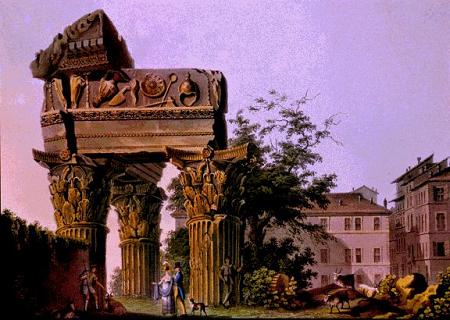
There is a seeming contradiction in this, for in England it has long been a favorite pasttime of the wealthy to erect “follies” – elaborate ruins consisting of crumbling old walls, pillars of ancient greek temples, the remains of an ancient Egyptian pyramid or obelisk – all completely and utterly fake.


Painting of a typical English “folly”


But after a little thought this makes perfect sense. To the English, the resurrection of a long-gone past falls firmly into the category of amusing fantasy. Indeed, there is a good reason these constructions are called “follies”. In a sense, the very artificiality of such projects, their deliberate absurdity, serves as a reminder that the past can never be recaptured.

Seen in this context, the refusal of the British to rebuild the walls of William the Conqueror’s castle, or any other artifacts of history, is a gesture of true respect.

Vim and vigor

Craig said in his comment on yesterday’s post that our discussion about the word “vim” had made him think of the film director “Vim Venders”, and he noted his surprise when, weirdly enough, the name of that august artiste showed up on this blog several days later.

When I first read Craig’s comment, I thought to myself “yes, that is quite a coincidence”. And suddenly I realized that my “Stealth ads” post was probably the result of my own subliminal word association from our earlier discussion.

Now I wonder how many of my posts – indeed how many things one ends up saying and doing in the course of a day – are just word associations tumbling forward. Perhaps we make decisions in life – even large decisions – based on random bits of half-remembered verbiage from conversations left over from earlier in the day or week.

We each think of ourselves as rational beings, and yet the human mind is probably more like a loosely connected soup of tendencies, a mental amoeba, floating through its little sea of immediate possibilities, extending its thousand tentative pseudopods of thought and action. When one of those pseudopods comes upon a tasty morsel, the entire organism will drift that way, seeking with renewed vigor the gradient that may lead to higher concentrations of mental nourishment.

It is not easy to see this happening, for the process generally goes on beneath our level of awareness. We find ourselves making decisions, and we rationalize those decisions, spinning complex and plausible stories for ourselves and for each other to explain the zigzag path of our own mental focus over the course of a day.

And so the mind, that ultimate amoeba, drifts ever toward its nourishment.

Owning the fourth dimension

I was at a conference today in which speakers were asked to combine topics of art and science. I was surprised by the number of speakers who focused on visualizing things in the fourth dimension, and the loving obsessiveness with which each would describe their work.

I was even more surprised to find, during the Q&A, that a number of these artists are highly protective of the fourth dimension. When asked about the work of others, some of the speakers would become dismissive, or otherwise shrug off the work of their peers. I felt as though I were getting a glimpse not just into the fourth dimension, but into a kind of higher dimensional school playground – an exotic place that had been frozen for decades into adolescence, with its own arcane rivalries and turf wars.

Perhaps this is one of the ironies of the fourth dimension. One would think it contains more room for multiple explorers than our paltry three. It could be that higher dimensional exploration is so fraught with the danger of becoming lost, that those who dare enter into its mysteries find themselves compelled to cling, even more firmly, to their limitations.

Stealth ads

I love the idea of stealth advertising campaigns – the kind that manage to reach their target audience without anybody else knowing quite what is going on. To me the classic was the 1950’s era ad for Smirnoff vodka: “It leaves your breathless”.

This ad was a clever shout-out to all those repressed post-war office drones who kept a bottle of something alcoholic hidden away in a bottom desk drawer. The tag line was a reminder to these potential customers that vodka does not leave much of a tell-tale odor on your breath. Nobody else really thought about these things, so the ad remained safely “unreadable” by the unsuspecting general population.

I’ve been told by Brazilian friends that the virile and good looking cowboy depicted in Marlboro ads down there (at least until recently, they still allowed smoking ads on Brazilian TV) is actually a gay icon. It seems a lot of cigarettes in Brazil are bought by gay men. It’s a message that speaks loud and clear to its intended audience, without ever quite reaching the level of awareness on the part of others.

In this spirit, I’ve long felt that if I were to open a shop of memorabilia for small, edgy, internationally produced art films, I should like to call it “Whim Vendors”. People in the know would be drawn to my shop like backward-speaking dwarves to a David Lynch movie.

And nobody else would even know why.

Vending machines in Osaka

In a recent post I talked about how much you can tell about the difference between various world cultures by the way pedestrians respond to red lights. Japan is at the extreme of civic obedience, New York is somewhere in the middle, and a pedestrian in Mumbai wouldn’t obey a traffic light if it conked him on the head, dragged him off into a dark corner and threatened to put him in a Danny Boyle film.

But here’s one that’s even more extreme: Vending machines in Japan sell you beer and sake. Think about this for a moment. We don’t sell the hard stuff in our vending machines. We just take it for granted that it wouldn’t work out, that our teenagers would use it as an opportunity to get drunk.

Give a sixteen year old unchaperoned access to booze, so goes the conventional wisdom in the West, and that kid will keep popping quarters into a beer vending machine until her or she is too drunk to operate the coin slot.

But in Japan you can buy your beer straight from a coin op vending machine, any time of the day or night. And, needless to say, Japanese kids are not running wild and drunk in the streets. Some things may look similar between New York and Osaka, but if you look just a little below the surface, they couldn’t be more different.

Metablog

I was talking with a friend today about my slowly dawning worry, after over four hundred consecutive blog posts, that I might inadvertently begin to repeat myself.

In my nightmare scenario I spring out of bed one morning, full of vim and enthusiasm, and blog about some cool topic or other that has brilliantly popped into my head overnight. Then about an hour or two later – or worse, a day later – some astute reader points out that I had already written a post on pretty much the same topic about eight or nine months earlier.

Perhaps then I would need to start worrying every day that this is merely the beginning of a pattern, some persistent failure of memory. Would I need to start obsessively reading over all previous posts, preemptively studying the oeuvre in its entirety to avoid such embarrassing and useless repetitions?

Today, when I expressed these dark thoughts to my friend, he told me that this concern of mine, whether legitimate or not, would make an excellent subject for a blog post. Well ok then, here it is.

But now I worry. This question about repeating myself seems vaguely familiar. Might I, perhaps, have posted it before….

Movies from the future

I talked the other day about the way that old movies look “different” to us – not so much because of lighting and fillm stock, but because the very posture of the actors is informed by a different sensibility.

But what about the other way? Would a movie of today make any sense to an audience of the 1930s? Or have we all collectively been evolving in our shared understanding of the language of film to the point where we are now in a fundamentally different place?

For example, would an audience used to “It Happened One Night” or “A Day at the Races” be able to understand “Momento” or even “Die Hard”. Coud they make sense of the layers of post-modern irony, the unreliable narrator, the rapid shifts in viewpoint informed by years of music videos?

And are there landmark films that we can point to which added to this shift in vocabulary, films that, in particular, educated either audiences or filmmakers (who then went on to educate audiences). Obvious candidates would be “Citizen Kane” or “Bonnie and Clyde”. But even George Roy Hill’s “Butch Cassidy and the Sundance Kid” arguably changed the way everybody looked at movies – the particular mix of reality and fantasy that is acceptable, and how we blend these together in our heads to accept the peculiar thing that is happening up there on the screen.

Would “Butch Cassidy” seem completely crazy to a Depression era audience? And how could we ever know?