Volunteering

A grad student told me today that he was really excited to hear about recent research in which scientists implanted about 100 tiny electrodes in a monkey’s brain, and used info obtained from reading those signals to get the monkey to control a robot arm. I’ve looked it up on the internet – you type monkey arm computer brain into Google and it comes right up – and I read through the recent article in The New York Times.

There were a lot of quotes from excited scientists saying how wonderful this research result is. The thing I couldn’t figure out – and they don’t really explain it in the article – is how they got the monkey’s informed consent, obviously something you’d need to do before sticking 100 electrodes in somebody’s brain and then making them have to learn to use a robotic arm if they want to feed themselves.

I’m trying to imagine that first meeting. Monkey walks in, is asked to sit down by a nice lab assistant. There’s probably a bowl of oranges on the table, so the monkey helps himself, looks around. Lots of fancy equipment, good furniture – real oak, not the cheap Ikea stuff some labs use – a row of bound volumes of Nature on the bookshelf. Clearly this is no fly by night lab. The monkey likes this; getting asked to be part of something important. Helps himself to another slice of orange.

A scientist enters the room, sits down, ignores the oranges, which is strange because they are really rather good. He explains to the monkey the basic idea, the set-up, what they hope to discover in this research about the workings of the brain.

The monkey is impressed. These guys clearly know their stuff. He also likes the fact that they are offering to compensate him for any days he’ll be away from the pack. Maybe he can get them to throw in a few dozen oranges. They hand him a pen, he signs.

The only issue I have with this scenario, as I play it over in my mind, is the language problem. I mean, how do they know the monkey really understands the details? English is not a language that monkeys generally speak, and I’m pretty sure (at least I’ve been told) that most neuroscientists do not have the skills or training to effectively communicate their ideas with an individual of another species. So how do the scientists know they have the monkey’s informed consent?

Then my mind flashes on the monkey’s point of view. One moment he was in a comfortable chair, having a serious chat with some earnest young scientists while polishing off a nice slice of orange, and the next thing he knows he’s strapped to a gurney.

The monkey’s mind races. He sees in a mirror that his head has been shaved. This will not go down well with the girlfriend. Even worse, a large circular piece has been carved out his skull, from which about a hundred wires are attached. Around now he’s thinking that this just can’t be good.

The monkey wracks his brain. How did he get here? He tries to reconstruct the sequence. Clearly there is some connection with the paper he signed. But he’d been given to understand that was some kind of loyalty oath. The humans are clearly a powerful species. They’ve got flying vehicles, wear artificial skins, and are rumored to have lethal nuclear weapons and deadly Jalepeño peppers. When a species like that invites you in to sign a loyalty oath, you don’t argue.

Sure they’d been jabbering on about something or other, but that was just human talk – nobody but another human can follow any of that. And now here he is, immobilized, strapped to a gurney with a big hole in his head, and about a hundred wires leading out of his skull to a big metal box. Holy Jesus!

The monkey tries to move his arm, and a robot arm starts to move instead. That’s when he gets it – they’ve got his brain controlling a robot. They’ve turned him into a frigging cyborg! This is most definitely not good. The next few days are not fun. His head hurts all the time, strange humans come in to prod and poke him unpleasantly, and the robot arm is a bitch to operate, although he’s getting the hang of it.

By the third day he’s using the arm to feed himself. Not bad for a duped conscript! He permits himself a virtual pat on the back. In any case, he’s getting good at moving the robot. Which is important, because he’s been practicing, and the very next time any human scientists come into range, he’s going use that hi-tech arm to throw his feces at them.

Wouldn’t you?
Sideways

Ok, I know it’s not cool to dig too far back into the past of popular culture. After all, it’s not popular culture if it’s not up-to-date, right? But a conversation this evening prompted me to reopen the case of the 2004 film Sideways.

Yes, yes, I know, it’s four years old, ancient history by pop-culture standards. But nonetheless there are some important lessons to be learned from this film. Please don’t read on if you have not seen it. What follows would only ruin the film for you – and you really don’t want that, trust me.

I am assuming that if you are still reading this, you have already seen the film. So you know that Paul Giamatti plays a man who spends his life running away from relationships, and somehow convinces himself that what he actually cares about in life is “wine tasting”.

I’m going to cut to the chase here. The single most important moment of this film is the point where Giamatti’s character sneaks up to his mother’s bedroom and steals her well-hidden stash of cash. Presumably this establishes him as a morally worthless (and therefore uninteresting) character. I know that this moment disturbed quite a few people.

But wait! There is more here than meets the eye. Why does his mother keep cash where he can find it and steal it? Isn’t it because she wants him to steal the money from him? I would argue that, at its core, this film is actually painting a portrait of a mother/son relationship that is so extremely disfunctional that the mother actually wants her son to take moral shortcuts that betray his core principles – so that he will remain emotionally dependent upon her.

We eventually see, in the main character’s interaction with his ex-wife, that he has unwittingly sabotaged that relationship – because he cannot see his former spouse as an equal, but only as an all-powerful mother figure. By the end of the film, when our hero has found a good woman and is trying to begin again, we are not told whether he lives happily ever after, or falls back on his old self-destructive ways. My guess is that the prognosis is not good.

So what we have here, in the guise of a frothy comedy, is a deeply gothic psychological melodrama, coming at us sideways. I would be curious to know whether people agree with my analysis.

Jokerman

Shedding off one more layer of skin,
Keeping one step ahead of the persecutor within

– Bob Dylan, Jokerman (1983)

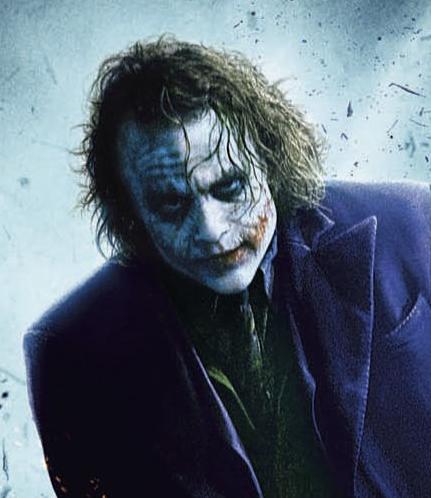
Yes, of course Christopher Nolan’s The Dark Knight is a wonderful movie, on many levels. The screenplay is excellent, the action and dark visual splendor true to both Bob Kane and Frank Miller, all the actors – Bale, Freeman, Eckhart, Caine, Oldman and Gyllenhaal – are pitch perfect. But, as you already know, I’m not writing this today to talk about that.

I’m writing to talk about Marlon Brando in A Streetcar Named Desire, Sally Field in Sybil, Humphrey Bogart in In a Lonely Place, Glenda Jackson in Marat/Sade. I’m here to talk about the performance that claws at your soul, rips your heart out and hands it to you still warm and dripping, and all you can think to do is dumbly take it and say thank you. There are a few performances in your life that clearly mark a before and an after. You remember the night you saw them, vividly, in the same detailed slow-motion way you remember that car crash where you thought you were about to die.

That’s what Heath Ledger’s Joker is. I don’t understand how a performance like this is even possible. It is clearly far, far better than the truly excellent movie containing it. When you watch the other characters up there on the screen, you understand that you are watching a movie – you see the strings being pulled, each performer hitting his/her marks, turning on the right shade of emotion here, the proper reaction there. All very well done, effective, professional. And then, there’s The Joker.


Ledger is no merely turning in a great performance here. He is channeling something truly disturbing. When you watch his portrayal of The Joker, you are seeing a man so far into the other side of insanity, so comfortable and at ease with his utter rejection of anything that could possibly redeem him, that he is in some ways no longer even recognizably human. The audience immediately senses that he has earned his insanity – that he is the way he is because he has survived some level of suffering that is beyond imagining. We are never clearly told what that suffering was, but this man has obviously been through Hell and has come back with demon blood.

And that makes The Joker, as played by Heath Ledger, into a sort of evil holy man. He is utterly fearless, for mere physical pain is nothing compared with the demons you sense are already inside his head.

I was struck by the difference between this Joker and the portrayal by Jack Nicholson in the Tim Burton version. That performance was magnificent, but it wasn’t dangerous. Nicholson’s Joker was still recognizably human – he was driven by pride, and he cared what people thought of him. In a sense that was his limitation, and inevitably, his downfall – ultimately he was trying to impress Batman.

Ledger’s Joker has no such easily definable motivations – he literally has nothing to lose – and therefore he can go anywhere and do anything. Of course he causes immense suffering with every action he takes, yet he never acts out of anger or venality or revenge. This Joker is far beyond such prosaic motivations. He burns a swath of destruction through the world merely as a byproduct of his tormented inner conversation.

And there lies the power of this performance: In spite of the pain he causes all around him, it is the tantalizing glimpse you are given into this man’s own tortured soul, the unspeakable suffering that you sense lies behind his mask of jaunty insoucience, which will haunt you and will stay with you forever.

Satiricom

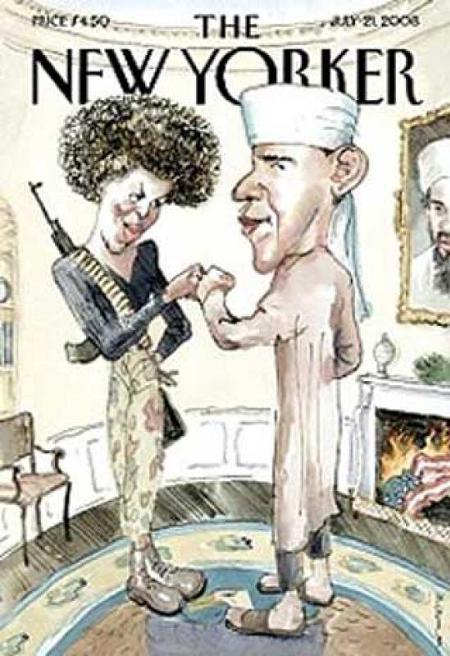
There has been much hand-wringing in the press about the current New Yorker magazine cover that shows Senator Obama in the Oval Office in full radical Muslim garb, sharing a fist bump with his wife Michelle, who is decked out like a 1980’s militant black panther, while an American flag burns in the fireplace and a portrait of Osama ben Laden hangs on the wall.

There was even an editorial in yesterday’s New York Times wondering, given the vociferous reaction, whether this cartoon was not proper satire. I beg to differ.

I would argue that the New Yorker cover has pushed so many buttons precisely because it is not only effective satire, but in fact constitutes a triumphal cry of “our side is going to win in November”. The underlying message is so strong that the political right is up in arms, and Obama himself is cautiously keeping his distance.


new-yorker-obama-cover.jpg

Let’s look at the context, starting with the actual target of the satire.

Fox News has always been, by design, in the business of being a class clown. Obviously what it does is not “news” in the way anybody would actually use that word, but a kind of extreme political editorial, a fairy-tale view of the world from the far right, dressed in the form of a parody of a news show. One could argue that the Fox brand of humor is, in a way, more outré than what Stephen Colbert does.

Colbert always lets on that he is merely pretending to be a doctrinaire idiot; he gives his audience clear signals that it’s all just an act. But the folks on Fox News are never permitted to drop the act. They have had to get on the air day after day and say the most inane things, often in direct contradiction to the facts already known to their viewers, while never being allowed to let on that they know they are looking and sounding like idiots.

This worked as an effective (if bizarre) form of political discourse as long as the administration they were supporting had a plausible story. People were traumatized by the attacks on the World Trade Center, were not sure about the Iraq war, were hoping that the Administration’s extreme brand of economic laissez faire and, um, unusual methods of prisoner rendition and interrogation were based on something substantial, some form of expertise.

But now so many of these things have been unravelling at the same time. The war, the economy, the interrogation techniques now found to have been unwittingly borrowed from cold war communist secret police, the out of control oil prices, mortgage-loan crisis and resulting housing panic, the simultaneous fall of the dollar and the Dow, all building to a crescendo, resulting in the most unpopular presidency in modern times.

Poor John McCain. He didn’t create this mess. Yet his talking points as the presumptive Republican candidate force him to reiterate the very positions on the war and the economy that have driven much of our population, Republicans and Democrats alike, into a state of fury at our current president.

And into all of this steps Obama. Serene, calm, oratorically brilliant – ok, yes, handsome – managing to look in complete command while maintaining a general tone of humility. Note how gracefully he pointed out during his trip to Afghanastan, when asked whether he had any advice for its leaders, that he was there to listen and to learn, and that any criticism of Kabul was the prerogative of the current U.S. president.

Obama talks about his Christian faith a lot, but he does it without seeming to brandish those beliefs as a military weapon. Contrast this with President Bush, who so often quotes the bible in order to justify beating plowshares into swords.

People are just feeling the normalcy of it all, a well-spoken, articulate and enthusiastic voice coming from the political center (not really the left, much to the disappointment of some).

And so Fox News made a mistake. Not realizing how much the ground had shifted under their feet, they did their usual clown act, playing up the idea that a fist bump between Michelle and Barack Obama was some sort of coded radical Islamic greeting. Even a few years ago, they might have gotten away with this, gotten people to play along – the way an entire nation had been willing to pretend to go insane, to fantasize that they had caught a glimpse of Janet Jackson’s nipple, and that the appalling sight, the unspeakable horror, of seeing a lovely young woman’s nipple, even if everyone was only pretending to have seen it, was the single important issue of the day. This bout of consensual make-believe insanity, with Fox News leading the way, had served to get everyone’s mind off the war, and of things like real people actually, well you know, killing and dying.

But that was back when the backdrop was an administration that was being somewhat effective in selling itself as a sternly potent father figure, at least to some of the population. Now that this dog won’t hunt (to quote our vice president), Fox News is in the unfortunate position of being a court jester without a king.

When the Fox News folks started to do their fist bump nonsense, they simply ended up looking like idiots. It didn’t reflect at all on Barack Obama or his wife in peoples’ minds. Instead, a lot of viewers who had been going along with the Fox joke in recent years were now left scratching their heads and saying “gee, I never noticed before just how idiotic those guys on Fox News are.”

And that is the subject of the New Yorker cover. As odd as it might sound, the cover actually has nothing whatever to do with Barack Obama. That is why it works, and that is why it has angered so many on the right.

The fact that the image on the New Yorker cover is so patently at odds with the Barack Obama who is actually out there running for president – and that voters know this – means that the Karl Rove machine isn’t going to have enough to work with to effectively swift-boat the coming election. Essentially, this New Yorker cover is a pure victory lap for the Democrats.

And that makes it a little too powerful a satire for some peoples’ tastes.

My cousin Ben

A relationship, I think, is like a shark, you know? It has to constantly move forward or it dies. And I think what we got on our hands is a dead shark.
– Woody Allen, Annie Hall (1977)

Visiting my cousin Ben for his wedding brings back to mind all kinds of fond memories of him through the years. Ben is the kind of person who can build anything, inventing as he goes along, with whatever materials are at hand. Back when Ben and I shared an apartment together in Manhattan, every year at Halloween he would make his own costume.

One year Ben outdid himself. He decided to go to a costume party as Jaws. Starting in the morning, he built a big armature out of wire coat hangers, covered that with oaktag, and then stretched gray plastic hefty bags over it. He drew hundreds of little black magic marker dots onto the plastic so it would look textured like sharkskin. By the evening, the costume was finished, and Ben slipped it over his head: A giant shark – just about seven feet tall – complete with a big foamcore fin in the back, and another piece of foamcore in front making a faceplate in the shape of the famous Jaws teeth, with an opening just big enough for Ben to look through.

To top the costume off, he mounted one of those little plastic swimmer toys, the kind you wind up. It was really cute – when he wound up the little plastic toy, it would look like it was trying frantically to swim away from the killer shark.

We had some trouble getting to the party. The only way to fit Ben – now in full costume – into the cab was lengthwise, kind of lying him down on the back seat, while I sat up in the front. The cab driver didn’t even blink. The was New York after all, and I’m sure he’d seen much stranger things. But we gave him an extra tip anyway.

When we got to the party Ben in his shark outfit was an absolute hit. People loved it! The only problem was that it was kind of difficult for him to get around. He’d sort of have to sidle slowly to get from one room to another. It was a little difficult, but Ben didn’t mind. He was enjoying the glow of his success. That is, until she showed up.

She was a woman who just decided that Ben in his shark outfit was the cutest thing. He wasn’t really into her, but she didn’t seem to care. Ben wasn’t very mobile, so he couldn’t easily excuse himself from the conversation. She started winding up his little plastic swimmer, going on about how adorable it was, and playfully pouring drinks down into his costume, like she was feeding the Jaws monster.

Finally Ben had had enough. He looked the woman square in the eye, from inside the mouth of his costume, and said to her “A shark is like a relationship. I has to keep moving, or it dies.” And then, shuffling around in a circle until he had done a full 180, my cousin slowly and regally moved off in his shark outfit.

A member of the wedding

Today, in Miami, I had the honor of being the best man at the wedding of my cousin Ben, who is a very handsome and virile fifty year old, and Stephanie, who is beautiful, sassy, Brazilian, and one of the nicest people I have ever met.

Oh, right, I almost forgot. She’s also eighteen.

They are a perfect couple. Completely in love, comfortable with each other, happy just to be together. You can tell that they “get” each other. I have spent a significant amount of time in their company, enough to realize that they are one of the great couples that I have met in my life.

Lots of people in our family flew down for the wedding, but not everyone in our family was up on all the details. There was a point when one of my relatives and I were talking, and he turned to me, watching Stephanie and all of her other beautiful young friends dancing, clearly trying to figure out what he was seeing. And then he said “she’s younger than he is, isn’t she?”

“Yes,” I replied, “she is younger than he is.”

He thought about this for a moment. Then he said “she’s younger than thirty, isn’t she?”

“Yes,” I said earnestly, “she is younger than thirty.”

I suppose, as people come to know them, everyone will learn the lovely and astonishing truth about Ben and his bride. But why rush things?

Patterns

On a midsummer night, when the moon is asleep
You may see for a moment, as though far away
A face from a time that was just yesterday
And the sound of your voice sounds far off and deep
Was it so long ago, it all seemed too soon
You remember that day, beyond the dark trees
The wind that would blow from the hill in the breeze
And a soft shadow cast by a wandering moon
You tried what you could, you did what you must
Though nothing has happened, how everything’s changed
For thoughts never spoken, in words unarranged
Are patterns you traced long ago in the dust

    But now it is late, and the breeze blown away
    You are left with the thought of a midsummer day

The secret power of restaurants

I took my friend Charles for his birthday to dinner at the Candle Cafe, one of the finest restaurants in this or any other city. Our conversation ranged widely, as it usually does. And then there came an odd moment toward the end of the meal, when we both realized that we were simultaneously and unwittingly listening to the strange story being told by a woman at the next table, about the time she had wrapped some sort of exotic headgear around her head.

The odd thing about this event was that neither of us was even slightly interested in her story, and until that moment none of the conversation from other tables had penetrated into the little world of ours.

I took the opportunity to tell Charles my long-standing theory about the secret power of restaurants.

Why do we go to restaurants? Yes, I know, we go there to eat. But we can also eat at home, with less expense and greater convenience. We go for company, but of course we can don’t need a restaurant in order to spend time with our friends. By the way, you have probably noticed that people rarely go to restaurants on their own. It’s generally something people do when they want to have a conversation with others.

So why go into an often crowded and noisy place, filled with strangers in close quarters, in order to pay far more for food than it would cost you to simply buy it at the market, invite your friends over, and eat in the comfort of your own home?

I think it’s precisely because of the phenomenon we witnessed when that woman described her turban wrap, except that in that moment something had gone terribly wrong – we had inadvertently caught a glimpse into the secret workings of a process that is supposed to remain unseen. Like in one of those stories by authors like Philip K. Dick where a woman discovers that those strange voices she’s been hearing actually belong to an artist and his model, and that she herself is but an image in an oil painting, or in which the hero realizes that the entire universe he lives in is contained in that odd little glass bottle sitting on his dining room table. I could go on, but you get the idea.

I think we’re not supposed to realize the hidden mechanism that makes restaurants so compelling, but I’m going to break the code and tell you.

My theory is that we go to restaurants because the constant chatter of strangers around us, which we consciously tune out, is actually continually infusing us with a subliminal stream of ideas, topics to discuss, words and phrases to use, imagery to invoke when making our next observation.

In other words, the atmosphere in a restaurant contains a built-in mechanism to give us the illusion that we are smarter, more clever, more interesting. And our dinner partner is transformed in the same flattering way.

Sure beats watching TV, doesn’t it?

Face the music

The evening started out going with Sophie to see Eh, Joe, the Samuel Beckett play. Liam Neeson plays the lead, but he has no dialog. Instead, Beckett has his hero do nothing but emote. You see a face without a voice, and you watch this man’s reactions as the disembodied voice of a woman, apparently a disgruntled ex-girlfriend, slowly and methodically proceeds to psychologically tear him to pieces.

Very Beckett.

The experience grabs you on two levels. On one level you are aware of the woman’s voice tearing away at the soul of a guilt-ridden man. She is most likely an imagining within his head, a product of his own guilt at the terrible account from his past that she slowly recounts. But in the end it doesn’t really matter: The man’s guilty soul is efficiently laid bare by the unfolding narrative this woman tells. His past sins are gradually revealed, until he is left naked, defenseless.

But on another, more literal, level, what you are watching is, in fact, a man’s face, even as his soul is rendered asunder. And in this performance it is no ordinary face – it is the face of Liam Neeson. And so Beckett’s high concept experiment of theatre circles around and lands in the most primal of places – our response to the features, the musculature, the expressiveness, the complex interplay of emotion on a single human face. In a way it is like a song, in which Beckett’s measured words are the lyrics, and Neeson’s face the music.

Sophie and I were both thrilled by this performance, and we excitedly discussed it afterward. I found my mind wandering, drawn to the essential mystery of it. There was something strangely familiar at work here: A disembodied woman’s voice, speaking calmly, in measured tones – quite likely a voice within someone’s head – leading into the living hell of a man’s past.

When I got home, I found myself searching YouTube, looking for parallels. I quickly ended up at the 1967 performance of Bobbie Gentry singing her magnificent song Ode To Billie Joe.

Here was something similar: the female voice, speaking slowly and calmly, gradually outlining a series of tragic events. She never raises her voice, and you are never allowed to learn exactly what has happened, yet the cumulative result, the sense of a man destroyed by a guilty secret, is devastating.

Is it possible that Bobbie Gentry was the Beckett of her genre?

Brad begins

I had never seen Spielberg’s Amazing Stories when it originally came out in 1985, so I thought it was an essential part of my pop-culture education to go back and find out what I’d missed all that time ago. Things got off to a wobbly start with the first episode Ghost Train, a fable about a ghostly train wreck, directed by the Stephen himself. All of the over-the-top sentimentality, telegraphed “drama”, needless underlining and pointless bombast that sometimes mars the man’s work is on display here in full swing. Remember that Monty Python skit where the giant cardboard hand of God comes down from the heavens? Seeing Ghost Train is like watching that, but in some alternate universe where Python aren’t actually trying to be funny, but are just trying to awe and impress you with a giant cardboard hand.

But then again, maybe it was all on purpose. Perhaps Spielberg was so evolved in his thinking, so flushed with the success of E.T. and the first two Indiana Jones films, that he deliberately decided to go all “meta” on us by opening up his new T.V. series with a train wreck of an episode. Now do you see it, the sheer subtle genius of the man? A train wreck!

OK, maybe not.

But the second episode of the series, well now that’s a whole ‘nother thing. It’s called The Main Attraction, and the lead character is an utterly self-absorbed high school guy, a preening narcissistic prom-king named Brad, who is about to get his comeuppance. The episode plays like a hyperkinetic, knowing cartoon, supercharged on adrenaline and suffused with a kind of hip hopped-up insider knowingness. Diametrically opposite in tone to the lugubrious first story, every frame of this episode, from start to finish, feels as though it has just escaped, laughing with maniacal glee, out of a Tex Avery cartoon.

We are used to this sort of thing now – from Malcolm in the Middle to those frenetically post-modern Saturday morning cartoons like Pinky and the Brain and its cousins, all clearly designed to turn innocent little children into hopeless cases of attention-deficit hyperactivity disorder (my theory is that these shows are secretly funded by the drug companies that make Ritalin).

But back in 1985 this was something unprecedented, a sharp new tone to things, which had never quite been seen before anywhere. Like Birth of a Nation or Bonnie and Clyde in their time, people were witnessing a new aesthetic at its moment of birth. And who was the author of this episode? None other than Brad Bird, in his very first published writing credit. Yes, that Brad Bird, of Iron Giant, The Incredibles and Ratatouille. But this was long before all that – fourteen years before Iron Giant.

I was enthralled. Here I was, with the clarity that comes only with hindsight, seeing how a young author, writing long before his time of fame and recognition, had planted a seed into a culture – a meme that might be called “knowing post-modern mania” – which would soon germinate in the minds of young writers-to-be, and through them would spawn a new kind of story telling, would in some sense even come to define the aesthetic of an era.

Isn’t that marvelous? Twenty three years ago an unknown young writer channeled his inner Edna Mode, and began the transformation of an entire medium. Even so, I doubt that Brad spends much time thinking about the seminal influence of his early work. As Edna herself once said: “I never look back, darling. It distracts from the now.”