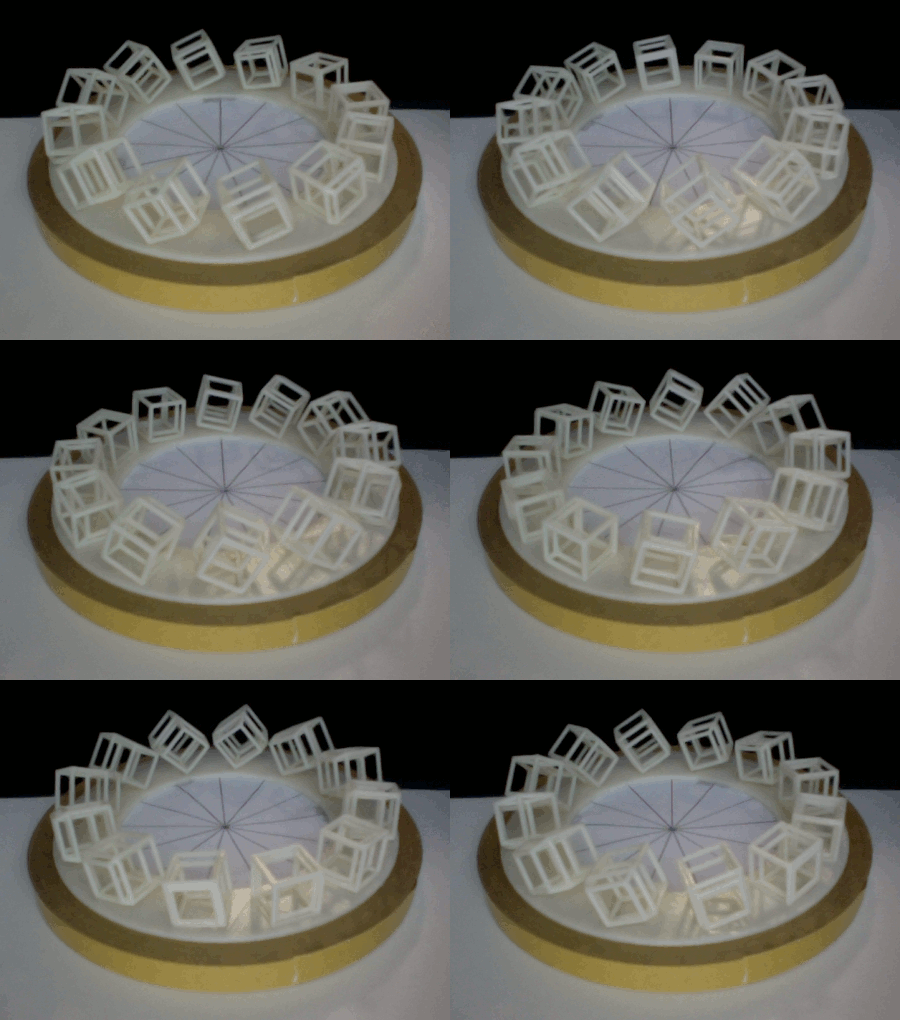
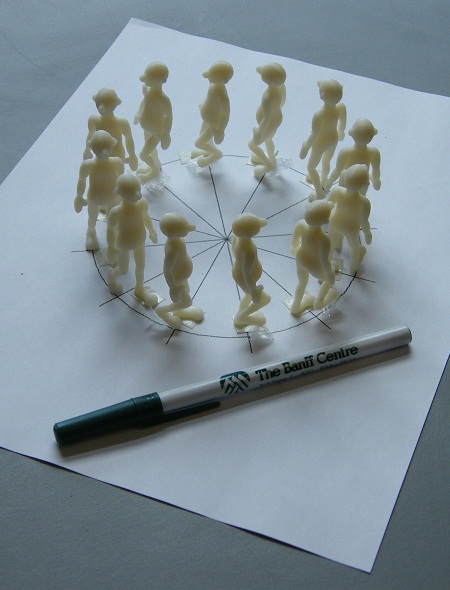
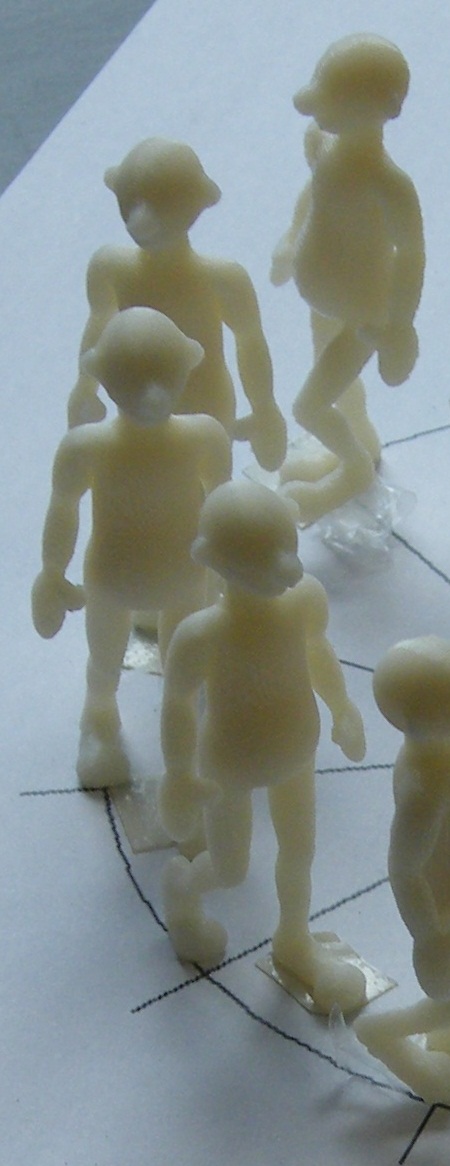
We’re still doing production on the little walking guy. But meanwhile my collaborator Eva Schindling and I managed to build a nice little working zoetrope of a tumbling hypercube.
For those of you who don’t know, a hypercube is something like a cube, only with four dimensions instead of three. As a cube is to a square, a hypercube is to a cube. I made a java applet some years back that lets you play with them.
Of course we don’t live in four dimensions, so it’s hard to get a feeling for what happens when you rotate four dimensional things. Eva and I thought that it would be cool, rather than looking at 4D things rotating on a computer screen, to create an animated sculpture of a rotating hypercube. That way you could look around it from all directions (at least, all 3D directions) as it does its weird 4D rotation.
Because a hypercube has four dimensions instead of three, it can rotate in some pretty fancy ways. A simple rotation only requires two dimensions. Since a hypercube has four dimensions, it can rotate one way in two of its dimensions, while rotating a different way in the other two dimensions.
In our zoetrope, we made our little hypercube tumble around a circular track (a movement that uses two dimensions), while also rotating a different way in the remaining two dimensions.
Now, this is not going to look very intuitive to us poor 3D humans. In fact, it looks as strange to us as, say, a rotating cube would look to a Flatland creature that lives its entire life in a two dimensional world.
Such a 2D creature couldn’t really see a cube — but it could see the shadow a cube makes if its silhouette is projected into the two dimensional world of Flatland:
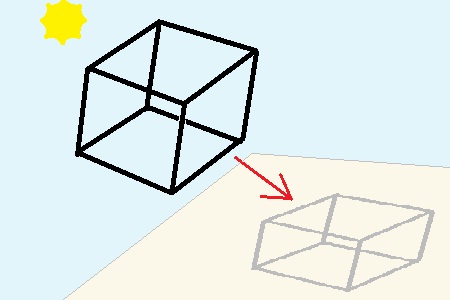
To the Flatland creature staring at the shadow, it wouldn’t look like something rotating so much as something becoming distorted in all sorts of weird ways.
And that’s pretty much what happens when you try to make sense of a rotating hypercube. As things rotate out of our little 3D world, they look like they are changing size and shape, rather than rotating.
But see for yourself: