Pure thought

I attended a talk recently by a scientist who implants sensors into the brains of “locked in” patients — people who are so severely paralyzed that they have no way of communicating. The implanted sensors contain thousands of tiny wires. When the patient thinks about, say, moving her arm, the neurons in her brain will produce a flurry of electrical impulses.

Even though the arm cannot physically move, nonetheless these minute electrical signals can be sensed and analyzed on a computer. By looking at the difference between the signals produced by different thoughts, such as “move arm to the left” or “move arm to the right”, the computer can then drive a robotic arm, which essentially becomes a brain-controlled puppet.

Right now the results are crude. People can use these techniques to move robot arms slowly and imperfectly. And of course the whole endeavor requires having a computer chip implanted in one’s head — not something most people would feel comfortable with.

Yet this is also the beginning of something entirely new in human history. For these first 200,000 or so years that Homo Sapiens has been in existence, the only way for a human to communicate has been brain→nerves→muscles. Without the ability to move one’s muscles (whether to speak, or walk or write or move the eyes), a brain is just an isolated blob of tissue, cut off from the world.

But if we imagine a future in which direct neural control becomes cheap and universally available — perhaps a future in which neural sensor implants are given immediately after birth as a standard procedure — then we can envision a time when the brain will become free of the constraints of moving muscles. We will then be able to create any mapping we want from thought to physical reality. We will be able to interact with the world through pure thought, our brains able to directly move machines, operate computers, or transmit our conscious thoughts to the minds of our fellow humans.

What will life be like when any thought we have can be expressed directly, and enacted in the world around us?

Attic, part 44

They were half way across the meadow, with Josh leading them confidently toward the mountain pass, when the first dark clouds appeared in the sky. The wind began to pick up, and Jenny started to notice a distinct drop in the weather. “Mr. Symarian?” she said.

“Yes Jenny.”

“How can there be weather inside a tower?”

“An interesting question,” Mr. Symarian replied. “Yes, a very interesting question indeed. One might as well ponder how there can be mountains inside a tower. ”

“What you said just there, I don’t think that’s an answer,” Sid pointed out helpfully.

Mr. Symarian was about to make a reply when the first drops of rain began to fall. He looked up into the now distinctly darker sky with a worried expression. Before them a dark cloud hovered in the air. Below this cloud the air was dark and roiling. It was clear that the storm was rapidly heading toward them.

“I’m pretty sure I know the way,” Josh said, pointing ahead, “but I’m not sure I can get us there in a storm like that.”

“I think I can help,” Charlie said. “At least, I used to be able to do this. It might still work.” The others all turned to look at him as his face assumed a look of concentration. Soon his golden skin began to glow with a warm inner light. Gradually the light expanded, until it was a translucent golden globe about ten feet in diameter, centered upon Charlie.

Sid was the first to break the awed silence. “I don’t know about you guys, but I’m gettin’ out from under the rain.”

Soon they were all gathered into the glowing aethereal sphere that surrounded Charlie. When they were all assembled within, safe and warm despite the howling winds outside, Josh suddenly realized he knew exactly where to go.

“We have to go this way,” he said. Confidently he began to walk, and the others followed.

Second experiment

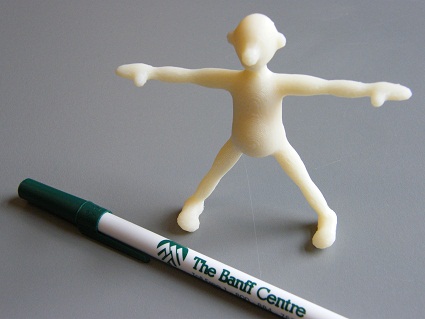
My second experiment with the solid printer was rather different. I’ve recently been creating little interactively animated characters. So rather than concentrate on creating more shapes and textures right away, I thought I would make a radical switch, and bring my little animated friends into the real world.

It just happened that I had — just this week — modeled my latest interactively animated guy, so I gave Travis Kirton the file to print him on the 3D printer. Here was the result, beautifully photographed by Travis:


Of course this is just the beginning. What I really want to do is animate this in the real world. To do that I will need to create an entire series of printed sculptures these little guys, each one in a different position, and spin them around while flashing a strobe light in sync, to make a 3D Zoetrope.

This was famously done a few years ago by Pixar, but sculptural Zoetropes date back for decades. One thing that intrigues me about all of this is the idea that you can print out the entire machine in a one shot — a single 3D print could contain all of the animated figures in their different poses, as well as the turntable that supports them.

That would be very cool.

Attic, part 43

He walked over to the table, and gazed down upon the miniature landscape — the tiny rolling mountains, miniature lakes and fields. Floating over all were the drifting white clouds, hovering in the air, perfectly formed in every detail. It all looked so serene, so untouched by time.

He held no illusions — time itself was his enemy. For time could so easily change everything, unless something were done. Slowly, delicately, he passed one hand over the table, speaking words in an ancient tongue as his fingers moved in an intricate pattern.

For a few moments nothing happened. Then the tiny clouds started to gather, to darken. The air beneath began to stir ominously. He gazed mournfully upon his handiwork for a long moment, until he could see the first tiny flashes of lightning.

Then he turned away.

Well, this changes everything

Here at the ART Lab at the Banff Centre they have a 3D printer, and I feel like a kid in a candy shop. If you don’t know, a 3D printer is a device that converts a computer graphic model into a real object. It works by building the object up in thin layers, one at slice at a time.

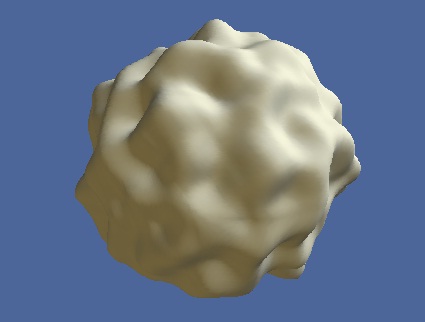
I was eager to try this, so I made a little computer graphics shape, wrote a program to write out in the file format that the 3D printer expects, and tried it out. The shape itself was really simple. I just created a sphere and used some procedural noise to vary the surface, so it would look nice and bumpy:


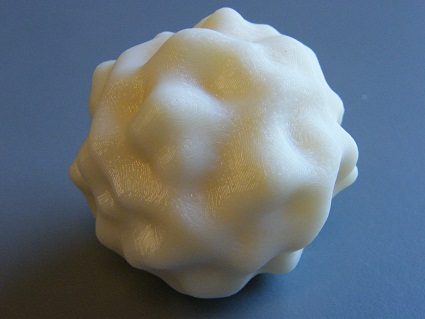
My new collaborator at the ART lab, Travis Kirton, who is a whiz at using the 3D printer, loaded in my data file, and several hours later the following wonderful object emerged:


The real object is so much more interesting than the computer graphic model. It’s got texture, translucency, weight (although not much). Unlike the computer graphic version, it’s got size — the ball is about two and a half inches in diameter. And best of all, you can hold it in your hand.

After years of creating things that existed only in a computer, it felt miraculous to be able to hold one of my creations in my hand, here on this side of the screen. The thought I had was something like “well, this changes everything”.

This afternoon I brought the little bumpy ball to a meeting, and I noticed a funny thing. Everyone seemed fascinated by it. People would pick it up, roll it around in one hand, explore it with their fingers, or just enjoy the feel of holding it. When one person would put it down, another would pick it up and start to play with it.

I’m not really sure why this is so, but I’d love to find out.

Attic, part 42

Jenny couldn’t stop staring. “Is it really still you Charlie?” she asked. Before her, instead of a demon, was a handsome young man who seemed to be made of pure gold.

Charlie looked down at his hands. His fingers were long and delicate and golden, they way they had once been. He smiled. “This is the way I really am — the way I was. And this is how my people look. Or at least, the way we used to look, before the change.”

“Ah yes,” said Mr. Symarian. “now that we are within its walls, the tower is protecting our companion against the enchantment. I this this may be a sign that we are nearing our goal.”

“I think it’s wonderful,” Jenny smiled at Charlie, suddenly feeling a little shy.

“Well, I think it’s a waste of time,” Josh said. “So now Charlie’s made of gold, get over it. Weren’t we supposed to be on a mssion here?”

Jenny looked at Josh with annoyance. “What’s your problem?”

Sid looked from Jenny to Josh, and ruffled his wings in amusement. “Call me crazy, but I got a feelin’ the kid’s jealous.”

Jenny realized that Josh was now blushing. She gave him a long hard look, and then she broke out in a grin. “Sid, I’ve got a feeling you’re right.” She leaned over and planted a kiss on Josh’s cheek. “And I think it’s sweet.”

For a moment Josh looked stunned. Then he smiled. “I guess, um, Charlie doesn’t look so bad in gold.”

Change of scenery

When first arriving at a new place — one that is calm — it takes a day or two to shed the busyness and everyday traffic in your own head. I arrived in Banff the evening before yesterday, and only today, over a full day later, is my mind beginning to accept that time is now different. Here my day is my own, and I can spend as many hours as I want concentrating on my creative work, without any obligation but to self.

And yet a funny thing happened today. Rather than focus inward, I began to connect with others here, to absorb the fascinating work of the people I am first meeting. I found myself reaching out, finding shared passions and ideas, instinctively beginning new collaborations.

I might just be tapping into the energy of being away from my daily routine. Or maybe the sense of freedom that comes with a different landscape.

In any case, I hope it lasts. At least for a while.

Attic, part 41

In her mind, Jenny had all kinds of ideas what to expect on the other side of the door. But nothing had prepared her for the sight that now greeted her. For inside the tower was an entire world. “Come and look!” she said.

One by one the others entered through the doorway, and stood spellbound, gazing in wonder upon the sight. There were green mountains, dappled with sunlight, with rivers flowing lazily down their slopes, and majestic trees rising into the sky. It was as though they had left the world of the city entirely, and had entered a different universe altogether.

“How is this possible?” Josh asked.

“In an enchanted world, all things are possible,” explained Mr. Symarian. “The physical extent of this place is bounded only by our own minds. I believe it was Albert Einstein who once observed that “Reality is merely an illusion, albeit a very persistent one….”

“Well I’ll be damned,” Sid interrupted.

Mr. Symarian began to shoot Sid a look of withering annoyance, but then turned to follow the gaze of the little demon, who was staring at Charlie in open-mouthed astonishment.

Jenny too was gazing at Charlie with wide eyes. For as soon as they had entered the tower walls, the spell upon Charlie had fallen away, and he now stood before them in his true form. “Charlie,” she said breathlessly, “You are so … beautiful!”

Independence day

Last night I went with some friends to see the magnificent fireworks over the Hudson River in New York City in celebration of Independence Day. There was a huge crowd of people, every one of whom had walked over to the extreme West Side of Manhattan. As the time of the free show approached, the crowd gradually grew in number until it formed a cheerful packed throng looking out over the river, joyful in expectation.

When the fireworks at last began, they were magnificent, spectacular, at some points merely beautiful and at other moments truly transcendent. The effects ran the gamut from a haunting ghostly weeping willow in the sky to a trick rocket that exploded into a huge, perfectly formed smiley face, like a Hallmark card from God.

The one odd note — to me at least — came with the realization that once the fireworks began I found myself surrounded by thousands upon thousands of upraised smart phones, all pointed at the sky, their owners staring intently into little screens that glowed in the dark like so many strangely rectangular fireflies.

Here we were, at an event whose sole purpose was to be immense, overwhelming, a physical expression of celebration in the open air, framed majestically by the vast overhead dome of night sky, and these people were all missing it. Instead of looking at the show itself, each of these people’s eyes were glued to a tiny screen, perhaps two by three inches, with a little washed out low resolution version of the awesome experience that was happening — really happening — all about them.

What was going on here? I found myself trying to figure this out. Perhaps each of these people loved some special person in another part of the world with such a depth of passion that they were willing to forego the wondrous experience of their own senses — this magnificent display of pyrotechnical wonder arrayed before them — just to send a crappy low res video of the event to their far away loved one.

But somehow I doubt that’s what was going on.

Or perhaps they were all acting out of a sense of personal civic responsibility. Perhaps, they thought, if they didn’t capture this moment, with their own tiny little cell phone cameras, then the memory of these fireworks would be lost to the world forever, and future generations would be denied knowledge of all that had transpired this night.

But somehow I doubt that one too.

So what the hell was going on here? What were all these people thinking? Have we really gotten to the point where people have become so dependent on their tiny cell phone screens that they can’t even see something as immediate and breathtaking as fireworks without them? Have we really lost all sense of wonder?

Attic, part 40

Somehow it was understood that Josh, as the path finder, would be the one to pick up the jar. The others watched as he unscrewed the lid and reached inside. He looked curiously at the perfectly ordinary looking brass doorknob he held in his hand. Walking over to Jenny, he handed it to her. “I think you should be the one to do this.”

Jenny took the doorknob from Josh and walked over to the doorway, trying to act like she knew what she was doing. She was aware that everyone was watching her. Feeling slightly silly, she put the doorknob into position, in roughly the place she imagined a real one would go.

For a long moment nothing happened. Then, almost imperceptibly, she felt the knob shift slightly in her hand, and from somewhere inside the door she could hear, or perhaps feel, a strange low hum. Experimentally, she tried taking her hand away from the doorknob. Instead of falling to the floor, the knob stayed in place, apparently stuck to the door. She turned to the others with a silly grin on her face. “There, did it.”

“Not yet, kid,” said Sid. “You still gotta open the door.”

“Oh, right,” she said, and tried rotating the doorknob to the left. It turned freely in her hand, and with a satisfying click, the door swung open.