Trees 2

All of us already knew the basics when we started our dinner conversation about where trees get their huge mass of cellulose. In particular, we knew that water comes up through the roots, and carbon dioxide comes in through the leaves. Photosynthesis uses these ingredients, together with energy from light, to make the simple sugar glucose — which the tree can then further process to make cellulose and other carbohydrates.

Because there is more oxygen in water and carbon dioxide than there is in glucose, photosynthesis has the nice side effect of releasing oxygen into the air (which is quite fortunate for those of us who like to breath the stuff).

We even all knew the formulas when we started talking:

      Water + Carbon Dioxide → Glucose + Oxygen

Or to be more precise:

      H2O + CO2 → C6H12O6 + O2

You’ve probably already noticed that there are a lot more atoms on the right side of that equation than on the left side. That’s why it actually takes six water molecules and six carbon dioxide molecules to produce a single molecule of glucose:

      6 H2O + 6 CO2 → C6H12O6 + 6 O2

Now everything adds up: Both sides of the equation have 12 hydrogen atoms, 18 oxygen atoms and 6 carbon atoms.

But now we were stumped. Clearly all of the carbon comes from the air, and all of the hydrogen comes from the ground water pulled in by the roots. But what about the oxygen? Does that come from the air, from the water, or some combination? Until we answer that question, we can’t really say how much of a tree’s cellulose mass comes from the air, and how much comes from ground water.

Maybe all of the oxygen comes from the water, and maybe all of the oxygen comes from the air, or maybe it’s some mixture of these. How can we definitely answer this?

More tomorrow.

Trees

Once again I am putting “Attic” temporarily on hiatus, as we ponder the dualism between dream and reality, the eternal struggle for meaning and connection, and why demons so often come in funny colors. Our intrepid friends will be back soon.

Meanwhile, I had an actual non-trivial discussion today about where a tree trunk comes from. In particular, when a tree grows, where does all that huge mass of cellulose in its trunk come from?

We all know that tree trunks are huge, massive things — think of the Amazon rainforest. But the vast weight of cellulose in their trunks comes from the most unlikely of places.

It’s an interesting question partly because so many people get it totally wrong, giving answers like “it comes from the soil”, or “sucked up from the roots”. It’s pretty easy to show that those answers are incorrect, but it’s somewhat trickier to work out the right answer in detail.

This is such an intriguing question that I’m going to hold off giving an answer until tomorrow, to give readers time to think about it.

Beset

As part of the research in our Games for Learning Institute my colleague Jan Plass and I have been batting around ideas for making games that do a good job of keeping track of what’s going on inside the mind of the player. The general idea is that as we create learning games, we want to be able to know whether the player is actually “getting it”, or is just clicking around randomly.

To this end, we’re looking at games that ask the player to understand and apply some kind of rule. To get some practice in making these sorts of games, we borrowed ideas from the wonderful card game Set, and combined them with other games like Bejeweled, to create various games where the player needs to understand and apply a rule.

This week I threw together a rough prototype. Since it combines ideas from the games Set and Bejeweled, I call it “Beset”. The game is probably going to change and get refined a lot, but this preliminary sketch is what I have so far.

On the screen you see 81 cards. Any given card can have one, two or three symbols, three possible shapes, three possible colors, and three possible textures. So, just like in the game of Set, there are 3 × 3 × 3 × 3 = 81 unique cards. The basic idea of the game is that you need to pick three cards that match a rule that’s shown at the top of the screen.

This rule will say that all three cards need to have either the same or all different (1) number of symbols, (2) symbol shape, (3) symbol color, and (4) symbol texture. For each of these four properties, the rule will either say the three cards need to be all the same or all different.

Whenever you successfully apply the rule to match three cards, smiley faces appear over those three cards — and then the rule changes. The goal is to get smiley faces over all 81 cards.

Toward the end of the game, when there are only a few cards left in play, it’s possible to get stuck with cards that don’t match any rule. For that reason I added a “slide smiley face over” feature. You can always slide a smiley face one square up, down, left or right, to bring a card back into play.

I know it sounds a little complicated, but it all makes sense once you start playing. You can try it HERE.

I’d love to know what people think.

Hint: for the first round, try clicking on the three cards that have green striped ovals.

Attic, part 36

There was a look of infinite sadness on his face. He gazed down upon her, sleeping so peacefully, and once again he was struck by the power of his feelings for her. He remembered back to the time, long before, when he had first set eyes upon her picture, this woman from another world — another universe — and in that moment his entire life had changed.

How can one explain the power of love? By any measure it is a single-minded and insane act of trust. But it was precisely this trust that sustained him, that kept him going. Thinking upon all this, he brushed a stray hair from her forehead.

How could there be such sadness, even in the presence of such beauty? “Amelia,” he whispered. “Amelia….”

Two paths

There are always two paths. You may not realize this, on any given day. It might very well seem as though the future is an unbroken road, stretching unto the horizon.

Nonetheless, two paths lie before you. The future continually bifurcates, offering challenges, disturbing any placid notions of what is possible and what is not.

Do not get me wrong — I can count upon the fingers of one hand the times that I have chosen that second path. It is not easy to answer the call of the road that leads even deeper into the woods. As soon as you make that turn, you hear the voices behind you start to retreat, to lessen, to fade away.

But what would we be without that call, that unknowable possibility, that moment of choice when the obvious is surpassed by the possible?

Attic, part 35

“I have a definite feeling about this city,” Josh said, as he took a right turn at the next corner. “I think if we can just take the correct path, then that thing — whatever it is — can’t get to us.”

“I sure hope you’re right,” Jenny said. She noticed that the turns were coming faster now, as they zigzagged their way along one dark and narrow street after another. Over the tops of the deserted houses, she could see that the tower was definitely nearer.

“The kid’s got a good track record so far,” Sid said. “If we wanna stay alive, we all better stick close to him.”

The angry growling now seemed to be consistently off to one side, as though the beast was tracking them, trying to find a way to get to them through the winding maze of streets.

“Can you think of anything that could shed light on the nature of the beast?” Mr. Symarian asked Jenny. “This city, in its current state, appears to reflect your grandmother’s memories in some peculiar way. Is there, perhaps, something you might remember about her that could provide some insight?”

Jenny thought hard, reaching back into her memories from childhood. “Well, grandma Amelia had a dog.”

“Aha, I knew it!” Sid said. “A great big slobbering beast, right? Some kinda guard dog or something. I’ll bet it was a real man-eater.”

“No, actually,” Jenny said, trying to think back. “It was quite a little thing. Very gentle and sweet. And completely devoted to my grandmother. They were inseparable.”

“Well, that blows my theory,” Sid said with a shrug. “Just out of curiosity, did this itty bitty dog have a name?”

“Yes,” Jenny said, suddenly remembering, “His name was Bruno.”

Arnold Schoenberg and Lily Allen

This morning, while tidying up the apartment, I realized that the two CDs sitting on top of my music collection were Schoenberg: The Piano Music and Alright, Still, the 2006 debut album by Lily Allen.


I listen to both of these albums a lot, and suddenly it occurred to me that in a cultural sense there is something slightly odd about that. If you think of music, in its infinite variety, as a landscape, then Arnold Schoenberg and Lily Allen seem to represent two points on that landscape about as vastly far apart from one another as any two points could be.

And yet I love both of these albums, I play both quite often, and both give me enormous pleasure. What is going on here? Am I actually multiple people trapped in the same body? Is Marvin Minsky’s “Society of Mind” so literally true as all that?

I occurs to me, upon further reflection, that there is actually one principle that unites Allen and Schoenberg, as different as they might seem. Both are deeply engaged in an inquiry into the tension between pattern and chaos, and the pleasures that can be found therein. Schoenberg uses seemingly random collections of notes, and creates great beauty by arranging them into startling chromatic patterns, runs of seemingly random and dissonant chords that form lovely clusters of sonic texture and movement. He creates a sensation of order from the very stuff of chaos.

Allen, of course, works with a much narrower musical palette. Her musical idiom is jazz inflected ska, swinging and brash, pure unapologetic pop. But her breezy vocals capture our attention not for their bright and lovely lilt (and her singing is indeed lovely), but for the things she chooses to sing about. This is happy, snappy music about alienation, contempt, love gone wrong, small random cruelties, and the unfairness of existence. She succeeds by setting up an extreme aesthetic tension between the simple surface joy of pop music and the despair within the average human heart.

I wonder whether I love both of these albums for the same reason: Both operate by keeping their listener on the knife edge between the comfort of an ordered universe, and the chaos of the formless void that lurks just beyond. This tension appeals to something about the way our human sensibility is wired. When we find ourselves walking the precipice that lies between order and chaos, we feel most intensely alive.

Attic, part 34

“So ok, are we waiting for some giant creature to appear out of the darkness and eat us?” Josh said. “Not to be, like, alarmist or anything.”

“It is a valid question,” Mr. Symarian said, “the answer to which would require information which, at present, we woefully lack.”

“Nice!” Charlie said.

The teacher looked puzzled. “What precisely is ‘nice’ about the possibility of being eaten?”

“No, I mean that great way you say things. Very nice. I could listen to you all day.”

“Yeah, me too Charlie,” Sid said. “Unless we get eaten first. Maybe we aughta focus here. What do we know?”

“Well,” Josh said, “Jenny said this place reminded her of the attic.”

“Yes,” Mr. Symarian said, looking thoughtful. “It would appear that everything we are witnessing here is, in some sense, a reflection of Jenny’s mind.”

“Or my grandmother’s mind,” Jenny said. The others all looked at her. “I mean, think about it. The attic is pretty much the same now as it was when she was a girl. And I’m not the one under some kind of spell, with demons and stuff.” She grinned apologetically at Sid and Charlie. “No offense intended.”

“None taken,” Sid said, a little too quickly.

Velocipedia

Continuing a thread I started last week in my post “ten dollar computer”. Or, to be more precise, providing some historical resonance on the subject…

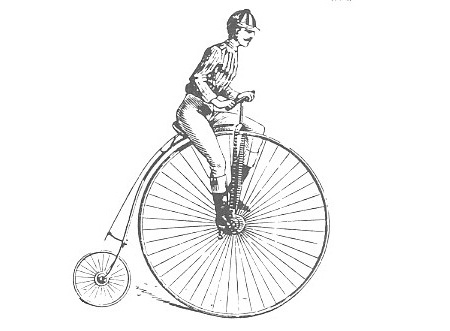
The velocipede was invented as a toy for the rich. Back in 1867 you needed real money to get your hands on one of these new-fangled luxury items, and so it became a mark of distinction among fashionable young gentlemen to have one. Possession of such a vehicle was a way to distinguish oneself from the riff-raff of the unmoneyed classes.


In the time that has passed from the late nineteenth century to the early twenty first century, modern manufacturing techniques have allowed such elitism to be democratized. Millions of people can partake in the game of purchasing a somewhat overpriced doo-dad, the possession of which qualifies one as a member of the “in” crowd.

The latest such doo-dad is the Apple iPad. Fully loaded, it can cost you almost $1000. This pricing is within reach of many consumers in some parts of the world, including the U.S. and Western Europe, but is hopelessly out of reach for most of the world’s population. In effect, the high priced consumer item is essentially elitism gone global.

This is not to say that a device with such a form factor need be inherently expensive. As I mentioned last week, there are computers in the marketplaces of Mumbai that you can buy for around $10. It is already clear that if you don’t need the fancy graphics, and other bells and whistles, a hand-held slate device could be sold for almost two orders of magnitude less than the price of an iPad.


Rather than maximize performance and cachet, the $10 computer emphasizes low cost and wide availability.

The time is right to be tracking such things, because the rise of the easy-to-use slate device marks a sea change in the use of computer-enabled information appliances. Apple is positioning its version of this game-changer as a status object — an expensive toy for the would-be elite.

In the long run, the invention of the velocipede led, in not all that many years, to the bicycle — the very epitome of low cost and widely available travel, economically accessible to the masses. The bicycle is now the backbone of local travel in many parts of the world where the cost of an automobile is prohibitive.

I see no reason why this new breed of consumer-friendly information appliances shouldn’t follow a similar trajectory.

Attic, part 33

It had started out as a friendly discussion, but now Charlie and Sid were locked in argument. Voices were raised. Sid would certainly have been red in the face by now, if his face were not already a bright shade of something very much like red.

Jenny and Josh were watching the back and forth, somewhat too stunned to do anything but listen. The voices of the two demons rang loudly in the eerie silence of the seemingly deserted space.

“I say it was a growl, like a wild animal!” Charlie was practically shouting. “There’s something out there.”

“I say it was just your big stomach growling,” said Sid, staring him down, “and I say you’re full of it.”

It was at this point that Mr. Symarian finally stepped in. “Sid,” he said, in his most reasonable tone. “I believe that I can offer a definitive refutation of your line of reasoning.”

Sid looked over at the teacher. He seemed to realize for the first time that he had been shouting. “OK teach,” he said, “I’m listening. After trying to talk sense to this big lug, I’m all for a fresh angle on things.”

“Very well,” Mr. Symarian proceeded. “If I understand correctly, you claim that the growling noise we heard earlier was the result of gastrointestinal activity on the part of this fellow over here,” he said, gesturing toward Charlie’s generous abdomen. “Yet it is well known, among those versed in the polydemonological sciences, that demons have no stomachs.”

There was a pause, and then Sid shrugged. “OK, you got me. I forgot about that. No stomach, no growling.” He turned to his considerably larger fellow demon. “Sorry Charlie, I get carried away sometimes.”

Charlie responded jovially. “Hey, no biggie. That’s why I like you.” The two demons grinned at each other.

“I hate to break up this love-fest,” Josh interjected. “But aren’t you all forgetting something?”

The others looked at him quizzically. “I think,” he continued, “it stands to reason that if somebody heard growling, and if it wasn’t Charlie’s stomach, then there’s something out there. It’s probably not friendly, and it might be really big.”

Together they all turned, and stared out into the darkness.