Watching the Watchmen

Actually watching “Watchmen” (in IMAX, I might add) was an odd experience, after having been immersed in the great written work by Alan Moore, upon which it is based. So many details are correct, so much loving care has gone into respecting the source. And yet while watching it I felt the strain – the attempt to suggest a vast and sweeping epic in the space of a mere 2½ hours. Of course it’s the same with all films that adopt novels – large chunks of what you loved about the original never make it to the screen – often some of the most compelling and powerful parts. We might call this the Tom Bombadil problem (if you don’t know what that refers to, you’ve been missing a truly great book).

But I thought the resonance was right (with the exception of one role that was miscast). You really feel the book, its rhythm and its crazy psychological logic, oozing out of the pores of the film, just as Horton Foote made you feel Harper Lee’s writing in his adaptation for the screen of “To Kill a Mockingbird”.

By streamlining down to essentials the book may in fact better serve Alan Moore’s intent than the book ever did. At heart, it’s a meditation on the strangeness of vigilante justice: The more focused you become on serving the greater good of humanity at any cost, the less you are able to focus on the value of a single life.

And at some point it all goes ‘pataphysical: the ultimate “good” superhero is the ultimate Nietzschean monster. “Watchmen” lays bare the choices: What kind of superhero do you want to be, and therefore which brand of insanity will you embrace?

Because the novel was so rich, and went into so many dimensions at once, both psychologically and aesthetically, this central point was sometimes hard to see. But in the movie it comes across loud and clear.

And that’s one of the great things about movies. You don’t really have any time to explain anything in detail – but instead you can insert a visual that tells the same thing on a gut emotional level. And visual images have a way of getting into our memory on a more primal level than mere words on a page. All part of the magic of cinema.

Whether that’s a good thing or not, I have no idea.
Dogs and cats

People in the U.S. and in much of the world don’t eat dogs and cats. But it goes beyond that. If you even mention the idea of eating dogs and cats, people will get very upset and try to change the subject. There is clearly some taboo here – something that goes beyond the rational.

On an emotional level, it’s as though dogs and cats have an intermediate place in our collective consciousness – somewhere between “human” and “animal” – and for this they get a free pass out of our food chain. It’s clearly not a free pass that we collectively extend to other animals. People are perfectly content to watch a film like “Babe” and then go home and cook up some pork chops, without batting an eye. But even the idea of somebody frying up Rover or little Tigger will send most people into a tizzy.

I was involved in a discussion last week about this, and somebody raised the theory that there is some co-evolution going on here. There are sound practical reasons for humans to cohabit with dogs and cats. Dogs were the first burgler alarms – their barking has probaby saved many a soul from hostile invaders over the millennia. Cats, of course, have historically been the main line of defense against disease-carrying competitors for human food sources, such as rats and mice.

If you gain a survival advantage from spending time in the company of another species, it probably furthers that advantage to develop an emotional attachment to members of that species. And this attachment will go both ways – humans can afford protection and a steady food supply to the dogs and cats in their company, and so dogs and cats would have co-evolved to want to hang out with us as well.

One glaring contradiction to this theory is that canine exceptionalism is not universal among humans. In the markets of Shanghai you can purchase a dog for the purpose of cooking and eating at home – a dog that looks very much like that cute stray many Americans and Europeans would welcome into a loving family.

So what is going on here? Why are pigs and cows – even those pigs and cows that people on a farm might bond with and feel affection for – suitable for eating upon their demise, whereas dogs and cats are not?

This is not a video

Sometime in the early 1990s I was visiting my friend Ephraim and his family. We went to the video store to rent a video, and on the way out the door Ephraim held up the box and said to me “this is not a videotape”.

I said “Of course it’s a videotape”. He said no, that’s just incidental. It’s actually a physical brick that video rental places distribute so that customers will understand that they are renting intellectual property. Customers need to bring the brick back to the store, thereby forcing them to acknowledge that they need to relinquish the intellectual property when they are done renting it.

Because concepts like “intellectual property” are somewhat abstract, a system was developed to make people carry around these bulky boxes with pictures on them. Ephraim went on to explain that the technology was already sufficiently developed that the videotapes were really unnecessary, but it wouldn’t serve the industry’s purpose to make them virtual. Without the boxes with tapes inside them, people might not understand that they were paying only for a temporary license to view a movie.

At the time I thought Ephraim’s comment was insightful yet a bit weird. Now of course – fifteen years later – the rest of the world has caught up with him. The boxes have indeed become virtual, and the very problems and misunderstandings he predicted are part of the fabric of our lives.

Because the music industry did a bad job explaining to people that a digital download is merely a limited license to intellectual property, rather than a transfer of ownership, the entire industry was brought to its knees.

The movie industry seems to be doing significantly better in making the transition, but the jury is still out. I would say that all in all there is now a greater awareness on the part of consumers – now that there is no physical brick to serve as a token – that they are actually paying for a limited license to intellectual property.

One thing is for certain: It sure is nice not to have to bring the brick back to the video store when you’re done watching the movie.

Useful responses

Another Friday the 13th (that makes two months in a row now!) and today I found out that somebody in a position of trust – authority actually – did something thoughtless which was quite hurtful both to me and to people I care about. And I also know they weren’t acting out of meanness or vindictiveness, but rather out of incompetence and perhaps a kind of dull unthinking stupidity.

Of course I went through all kinds of rage reactions in my head, but I already knew from long hard experience, even as various angry responses flooded my thoughts, that I had better filter out all of those reactions before saying or doing anything.

And instead, after I’d had time to contemplate the situation, I found myself formulating a plan. I resolved that rather than react to the action they had taken, I would try to understand what had led them to do it – what was the underlying structural problem they were dealing with so ineptly. And so, rather than respond directly, I’ve resolved to respond indirectly – by doing something good and generous, something that has the effect of helping and protecting the people I care about, and helping to make those people less vulnerable to thoughtless acts by those in positions of authority.

As you can tell, I’m not giving any specifics here. After all, this is a real situation involving real people, and therefore it is delicate. But the principle can be discussed: When somebody else’s stupidity makes your world a poorer place, don’t even bother with that person – there is nothing to be gained there. Instead, figure out the particular richness their carelessness has taken from the world, and find a way to put an even greater richness back. Do something which undeniably makes the universe a better place, and helps the people you love.

And, incidentally, this approach gives you something actually productive to do with all of that negative energy, rather than wasting it on useless arguments. I am reminded of Mark Twain’s wonderful quip: “Never try to teach a pig to sing. You’ll only waste your time, and annoy the pig.”

Microeconomies

The thoughtful responses to yesterday’s post really got me thinking. Why don’t we see more of the sorts of front-end + back-end consortia that would clearly serve everyone – such as the ability to add external database operations to the results of a Google search?

Google presents its search engine only through a monolithic access point. Unless you make a different business arrangement with Google, Inc., you can only access those powerful search algorithms through a relatively simplistic interface. I assume that this is because Google wants to remain a vertical monopoly – just one carefully branded route to its underlying search engine, unless you pay to become a business client for other uses of that engine.

But perhaps it might be in Google’s long-term interest to “let a thousand flowers bloom” – to allow others to try their hand at building alternate interfaces on top of the core search engine.

I’m not suggesting here that everyone program in SQL – any more than we would expect every consumer to implement an IPhone app. The key is to allow a vibrant community of people to do so, in a way that is of use to many more people. If Google were to allow more access to the underlying engine, then some people would start to come up with uses for the engine that Google couldn’t possible have thought of – because Google, as big as it is, and as smart as its employees are, cannot replace an entire economy of implementers.

There seems to be an underlying question here: How does a profit-oriented corporation make the best win-win arrangement with a peripheral group of folks who inhabit a more freewheeling microeconomic style of creation? Consumers in general are best served when those two forces combine to create a synthesis whereby everybody wins: (i) The corporation wins because ever new markets are found for its core engine (its greatest strength); (ii) The individual implementer community is able to do things that nobody would have done otherwise; (iii) The larger community of users wins because all these innovative, more-focused, easier-to-use, tailor-made interfaces start appearing in their lives, or at least become available at on-line check-out counters.

Maybe one way for U.S. industry to work its way out of the current economic malaise is to figure out how to harness our collective brainpower to foster new information microeconomies.

A searching question

I use Google all the time, as many people do. It is, more or less, the way I navigate around the vastness of the Web. But there is one obvious feature that seems to still be missing, a feature I would use constantly if only it existed. I’ve been waiting patiently for it to show up for years now, but still no luck.

Quite often when you’ve typed in a series of keywords, and you find yourself running down the list of responses, deciding which ones to click on, you suddenly realize that your search has become entangled by a “false positive” – a result you specifically weren’t looking for, but which returns lots of hits – hits which to you are just clutter. What you’d like to do is surgically remove this clutter from your results list, while keeping the rest of your list intact.

And as far as I can tell there is no way to use Google to do that.

For example, just today I was doing a search that contained the term “futuristic map”. After about three pages of results, I realized I was getting tripped up by the fact that there are so many copy-cat “this day in history” sites, all of which seem to have the following entry for January 25:

1942 Thailand declared war on the Allies.When war broke out in Europe in September 1939, Thailand declared its neutrality, much to the distress of France and England. Both European nations had colonies surrounding Thailand and hoped Thailand would support the Allied effort and prevent Japanese encroachment on their Pacific territory. But Thailand began moving in the opposite direction, creating a “friendship” with Japan and adding to its school textbooks a futuristic map of Thailand with a “Greater Thailand” encroaching on Chinese territory.

What I’d like to do is exclude references to Thailand from my search. But a search for “futuristic map” -Thailand won’t give me that. Instead, it gives me a completely new list, with all the results in a different order. So that promising result that I was thinking of going back to click on a minute ago in the old results list is not at a corresponding place in the new results list. Bummer.

What I really want is an option to cull the list I already have: Keep everything in my results list just the way it was a moment ago, but just don’t show me those entries which contain “Thailand”.

If I had something like this, I could start broad and gradually narrow down my search, while making use of my mental place memory to check back on interesting results I saw a few minutes ago.

I suppose I could write a program to do this for myself – get Google to give me a huge list of hits, and then do my own keyword filtering from that. But isn’t that the kind of thing my search engine should be doing for me?

Or am I asking for too much?

Saturday month

This month is a Saturday month.

Today, while talking about possible dates to schedule a meeting, I happened to mention this fact to a colleague, without really thinking about it. Then I realized that he couldn’t know what I was talking about. But it’s become so second nature to me to think in those terms that I sometimes forget.

Years ago, when I was still a teenager, I realized that it was just about impossible for me to remember the day of the week that corresponds to any given calendar date. I would be completely helpless until I could locate a calendar. If I need to know right away then I’d resort to counting up, month by month, from New Years or some other vividly remembered recent date, shifting two or three days in the week for each passing month while saying that little rhyme from childhood over and over to myself: “Thirty days has September, April June and November…”.

Clearly not a very good system.

So I came up with a better system. Since around the age of seventeen or so, I’ve gotten into the habit of telling myself “This is a Thursday month”, or “This is a Saturday month”. Or whatever day of the week falls on multiples of seven in that month’s calendar.

For example, this month is a Saturday month because March 7, March 14, March 21 and March 28 all fall on a Saturday. And once you know that, it only takes about a second to figure out the day of the week for any date in the same month.

I’ve internalized this system so thoroughly now that I rarely even think about it any more. Except of course when I find myself blurting out mysterious statements like “This is a Saturday month”.

I suppose these days I could take out an IPhone or some equivalent gadget and click on the calendar app. But this is still a lot easier. As soon as I had an actual system in place, that little rhyme from childhood became really useful. This year it tells me that April will be a Tuesday month, and May a Thursday month.

Now I’m all set until summer.

Phone interview

I was scheduled today for a phone interview, in which I was asked a series of questions about one of our research projects at NYU.

As it happened, my jet lag and general feeling of being under the weather conspired to keep me nodding off every few seconds, drifting momentarily to sleep, throughout the conversation.

I didn’t want to stop the interview and tell the interviewer to call back another time, since we’d already rescheduled this phone meeting once before. So I just stuck it out, answering the questions as they were asked.

And here’s what’s interesting: Being in this state made no difference at all to the conversation. He asked questions, I answered them. Admittedly, they were mostly questions I’d already been asked by others, so my answers were more of a cut-and-paste job from things I’d said before than an attempt at original thought.

Other than that, being in this near narcoleptic state just made me feel calm and centered. Emotionally it felt as though my answers were coming from a dream of acting in a play – a dream play in which I knew all the lines.

At some point in the conversation I realized that there was no way for the interviewer to know that I was nodding off at the end of his longer questions. As long as I didn’t actually drop the phone and start snoring – as long as I was coming back with good answers to his questions – we were fine.

I have no idea whether I could have done anything like this if someone had been asking me really hard questions – questions to which I didn’t already know the answers.

But still, it gives me pause. Perhaps we live much of our lives this way, without quite realizing it: Answering questions we’ve answered before, in a play within a dream.

Engineering

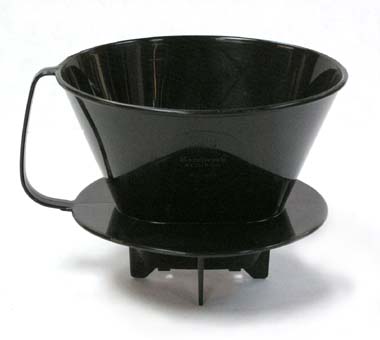
I’m sorry Dagmar – my description was incomplete. You place one of those metal-mesh reusable coffee filters from yesterday inside one of these plastic coffee cone brewer thingies (pictured below). The coffee cone is designed so that it will sit securely on top of your coffee mug:


The plastic coffee cone has holes in the bottom (you can see where they are by looking at the shadow on the floor). Hot water poured into the open top first passes through the metal mesh filter, into which you have (hopefully) added fresh coffee grinds. Then the coffee (but not the coffee grinds) passes through the metal mesh, runs down the inside walls of the plastic coffee cone, and ends up inside the waiting mug below.

That is, unless you somehow forgot to place the coffee cone on the mug before you poured in the hot water, in which case you get fresh hot delicious coffee all over your kitchen counter, your sink, your stove, and probably (as I can testify from first-hand experience) your floor. 🙂

Morning coffee

Ever since I got one of these cool metal mesh coffee makers, my life has settled into a happy morning ritual: Fill a cup to the brim with water, pop it in the microwave for three minutes. Meanwhile, rinse out the filter and yesterday’s coffee mug, put the now clean filter over the now clean mug, fill with coffee from the fridge – just in time for the microwave to beep. Pour water into filter, wait a minute, and voilá, fresh yummy coffee.


Wonderful, right? Well, not always. You see, by definition making coffee in the morning is something I do before I have had my morning coffee. At which time of day my brain cells are essentially useless. And there’s the rub.

I have lost count of the sheer number of ways in which my little ritual has gone awry in the few months that I have had this device. There was the time I did everything but fill the filter with coffee grinds. That morning I ended up with fresh steaming hot water.

Then there was the morning when I did everything right except actually turn on the microwave. It turns out that if you don’t do this, none of the other steps actually do any good.

One morning I put the cup in the microwave without any water, another day – after a particularly late evening – I successfully boiled the water, only to turn from the microwave oven to discover that I had left off the entire filter/coffee grinds part of the rigamarole.

The most dramatic morning was the one in which I got almost everything right – with one crucial step. I boiled the water, washed the filter and mug, poured just the right amount of fresh aromatic coffee grinds into the waiting clean metal mesh, thinking all the time about that great mug of fresh hot coffee that was only a minute away.

And I was still lost in my thoughts about that mug of steamy fresh coffee even as the dark stain began to spread over the countertop. Soon coffee was spilling and pouring everywhere – into the sink, onto the stove, down onto the floor.

It seems I have forgotten only one little detail – placing the filter on top of the mug. Darn.

But things could be worse, and I count my blessings. You see, this mesh filter has been my morning’s great savior. The proof is hiding in my cupboard, where I lock away my trophies of shame – all of the wonderful coffee makers, once sparkly and new, that now sit there charred, blackened useless, their once-shiny plastic handles melted off. So many coffee makers that I had promised to honor and to use with care, now betrayed, destroyed by my careless morning love.

But not my mesh metal filter. I think this one’s a keeper.