Let the right one in

Last night we went to see the wonderful Swedish independent film “Let the Right One In”. I don’t know how to talk about this film properly to anyone who has not yet seen it, so….

(1) If you haven’t seen this film, please stop reading right now, go out immediately and watch it, and then feel free to proceed on to the rest of this post.

(2) If you have already seen the film, by all means keep reading.


***


OK, I assume that if you’ve gotten this far you’ve seen the film, and that I won’t be spoiling it for you.

What struck me about this film is that it has the form of one tale and the content of a completely different one. On the surface it’s a tender coming-of-age romance, the story of a tentative adolescent relationship growing, like a delicate rose-petal, in the midst of a vampire movie. The sort of sweet and delicate romance between twelve year olds that we’ve seen before in “My Life as a Dog”, “A Little Romance” and similar films.

But if you really think about what you’ve seen, it’s not that at all. In fact it’s nothing like that. What’s actually going on is that an inhuman monster – powerful, ancient and bloodthirsty – is in need of a new human slave, its previous slave having reached the end of his useful lifespan. This monster sets about seducing a confused young boy, playing on the boy’s loneliness, nascent sexuality and innocent need for connection, into becoming its next slave. He should be good for another fifty years or so – then the monster will get another one.

This is not a new concept in vampire stories. “The Hunger” showed a similar master/slave dynamic between the two vampires, and of course this was also the defining relationship between Dracula and Renfield.

What’s intriguing about “Let the Right One In” is that this is all shown entirely from the point of view of the innocent twelve year old boy who is being drawn in by the monster to a life of slavery. We the audience find ourselves idealizing the monster just as he does – we are taken through the boy’s process of falling in love – even when (as it must) the monster reveals its true horrifying nature.

Objectively we are given all of the information we need to understand what is really happening here. We are shown, in painful detail, the tragic fate of the monster’s previous servant, and we are shown the monster’s complete lack of compunction about killing one innocent victim after another.

And yet at the end, when the boy has walked away from everyone he loves to enter into a lifetime of servitude to a ruthless and bloodthirsty vampire, the audience feels as though it has reached the happy ending of a romance. This in spite of the fact that the penultimate scene contains the single most bloodthirsty depiction of horror and atrocity against children that many of us will ever see on-screen. The film is so effective in controlling our point of view that by the time it sees these children brutally murdered, the audience is actually rooting for their death.

The film plays various tricks to keep us inside the boy’s head. For example, all of the adults around him are portrayed as ridiculous and/or self-absorbed fools. There is not a single adult he can turn to help counter the illusory reality that the monster is weaving around him.

And of course the title of the film is a brilliant reversal. Because this is a vampire film, we assume that the title is referring to the need to invite in only the right vampire – since a vampire cannot enter your home without being invited. But in fact it’s the other way around – the vampire has clearly been searching a long time for the right servant to replace the one it is about to discard. In the end, we see that it is the boy – merely the latest in a series of human servants the vampire will keep around for as long as they are useful – who is being let in.

It’s amazing what you can do when you know how to play around with genre expectations.
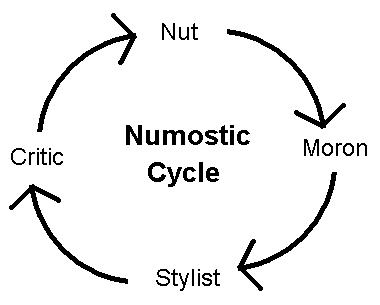
The Numostic cycle

When you look at Sontag’s progression, when describing a writer’s development, of nut → moron → stylist → critic (ie: passionate impetus → spewing forth → aesthetic shaping → deeper thought and purpose), it becomes clear that a mature writer will not experience a simple progression so much as a cycle:


As one becomes more clear in one’s thoughts and purpose, internal passions will change and evolve to reflect this. For example, an author might have started writing in response to the pain of a failed love affair, but the things she writes will open doors to new passions long after that love affair has receded to a distant – and even somewhat nostalgic – memory.

But the intellectual doors that writing can open, both in the writer’s mind and in her interactions with the world around her, will fire new passions, new questions and enthusiasms. And this is especially true of the mature writer, who has reached Sontag’s “critic” stage. Because such a writer is tackling real issues, she will find herself in a place that is rich with new doorways and passages, new questions to ponder and new nuts to crack.

The exhilaration of this process of endless enrichment that is one of the greatest rewards of writing.

Numostic theory

What fascinates me about Sontag’s theory of the writer as nut/moron/stylist/critic is that it really is a theory of how creativity works in general: Which aesthetic/expressive “muscles” need to be developed, and in what order. I love that she starts out with the “nut”. For any artist to be sufficiently motivated to reach others, there needs to be some initial governing passion. What I especially like about Sontag’s way of describing this is her intimation that this initial passion, while necessary, need not remain – a different nut can be swapped in, as the artist develops through the stylist and eventually to the critic stage: What first got you into writing, or painting, or dance, or composing music, might not be what keeps you there.

Just from this observation alone we can start to see ways of distinguishing between the arcs of careers in different corners of the arts. For example, there are very few Rock and Roll song writers who can create as relevant and passionate a song at age forty or fifty as they could when they were twenty three. The particular nut, or obsédé, that pulls you into rock and roll are tied up with youthful obsessions – sex, alienation, new love, rebellion, rejection of the status quo, together with an ability to see the strange world of adult life with the freshness of a newcomer.

People who in their teens discover a talent for expressing the emotions around such things can skyrocket quite quickly to stardom. But by the time they reach their late twenties, many of these things are no longer relevant to them. A writer of prose can more readily trade in a youthful nut for a different one, but that isn’t so easy to do in rock and roll – the audience for this genre isn’t very focused on issues of child rearing, career change or the onset of mid-life crisis.

More tomorrow.

Four writers

The journals of Susan Sontag have just been published. Here is one journal entry by late Susan Sontag. This was written when she was all of twenty eight years old:

The writer must be four people:

1) the nut, the obsédé

2) the moron

3) the stylist

4) the critic

1) supplies the material

2) lets it come out

3) is taste

4) is intelligence

a great writer has all 4 — but you can still be a good writer with only 1) and 2); they’re most important.

The more I think about Sontag’s NMSC (numostic?) model of writing, the more sense it makes. In fact I would say that the fundamental principles she outlines here apply to many forms of creative expression. Tomorrow I’m going to expand on this theme.

Scenes from the novel XIII

Clarissa and Emily had already walked quite a ways, hand in hand. After a while the scenes of devastation around them, appearing through the swirling mist, became like a sort of dream. From time to time there would be a subtle shift in the landscape, like a trick of the light. What Emily first took to be a mountain would turn out to be a bank of clouds, and then the clouds would be gone. The suffering faces peering so intently out at them were the worst – they seemed to be everywhere – but they were hard to bring into focus. Every time Emily would try to look at one directly, it would turn into a knot of wood, or a leaf, or something else. It was as though the faces didn’t want to be seen in their suffering – they just wanted you to know they were there.

Emily wanted to ask Clarissa where they were going, but she knew better. All she needed now was the constant touch of Clarissa’s warm firm hand, a reality that never wavered. The mist was beginning to grow thinner, and the landscape was changing far less often. Now they were on a long dirt road, and to the right and left appeared to be waving fields of wheat, stretching away as far as the eye could see. Even though the landscape was flat all around, there was something wrong with the horizon up ahead, like it was shaped wrong. Emily looked up questioningly, but Clarissa merely smiled a reassuring smile.

At last they came to it – the Great Precipice. Of course Emily had heard of it, in whispered stories and the occasional snatch of song, but she hadn’t really believed in it. The world can’t just stop, not just like that. In its way it was rather beautiful, the vast scale of it, on the other side of a razor-straight line at their feet where the road and the wheat fields abruptly ended – where everything ended.

“Now, my dear,” Clarissa spoke aloud for the first time since their journey had begun, “you mustn’t be alarmed. One expects to feel a certain sense of vertigo when encounting things of infinite proportion. Try to remember that we are merely at a door, and one door is very much like like any other. Some doors lead from the kitchen to the parlor, others from hallway to drawing room, whereas still others lead from one frame of existence to another. This doorway happens to be one of the latter kind. My dear, you must try to remember that a door is, in the end, merely a door.”

This speech, as intended, did much to reassure Emily. “I can deal with a door,” she thought to herself, “I’ve been opening doors all my life – including a few that were never supposed to be opened.” She smiled up at Clarissa, ready for whatever came next.

“Ok, I get it,” she said, “It’s a door. But where’s the doorknob?” Clarissa laughed in response, and waved a hand over the abyss. A shimmering white circle appeared at their feet, and even before they jumped, Emily could already smell a familiar scent – something between lilac and cinnamon, but not quite like either.

She smiled and took a deep breath, as she held on tight to Clarissa’s hand. This was going to be a fun year.

Villagers with torches

I had an odd experience recently. I was invited to a dinner at a nice restaurant, part of an awards event, with a number of fellow scientists – scientists from a variety of fields. It was the sort of thing where everybody puts on a jacket and tie or the equivalent.

There was nothing out of the ordinary about the evening until the moment when somebody heard me quietly conferring with the waiter about what vegan options there were. At that point one of my tablemates picked up on the fact that I was ordering vegan, and the next thing I knew it was the topic of conversation.

At first the questions were friendly, although it sort of weirded me out that what I eat would become such a focus of discussion. When asked why I was eating vegan, I explained that I would just as soon not cause suffering if I could avoid it. Soon the conversation became markedly less friendly, although the tone was always polite. There was a lot of focus on scallops. “Why don’t you eat scallops?” “Do you think scallops would mind?” And I remember thinking how strange it was that somebody would want me to eat scallops, just to make them feel better about what I eat.

At some point I realized that my simply being there, an outed vegan, was creating a kind of dissonance at the table, and it probably wouldn’t matter what I said. Eventually I managed to steer the topic of conversation to something else. But I was left with an odd feeling by the aggressiveness of it all. I hadn’t questioned anybody else’s eating choices. I was just sitting there minding my own business and trying to have dinner, and suddenly people I didn’t even know were trying to talk me into changing my ethical beliefs.

I feld a bit like a well meaning Frankenstein monster who had foolishly wandered out of the castle and into town, prompting the villagers to dutifully pick up their torches and give chase. Except that these particular villagers were fellow scientists.

Thinking about it afterward I was struck by some particular questions raised by the experience. If I had given one of a number of culturally acceptable non-answers, nobody would have thought to question anything I might say. For example, I could simply have said: “Of the eight sacred Sutras of the Patanjali, the first is Yama, which teaches to do no harm to one’s fellow creatures.” This would have identified me as a Buddhist, which would have protected me.

In other words, if you say you are doing something for religious reasons, unless you’re going around killing people or trying to have sex with their underage children, then you get a free pass. “Oh, you’re a Buddhist,” would be a typical response, whereupon everybody would nod thoughtfully and respectfully, while wondering whether they can still score tickets to the Dalai Lama’s talk next month.

And yet if I had said that, I wouldn’t have been giving a more substantive explanation – I would just have been adding that I’m a member of a recognized group. And so it occurs to me that we are putting ourselves in a kind of danger when we build our ethics from individually thought-through conviction. Identifying yourself with a large and powerful spiritual tribe, such as “Christian” or “Buddhist” or “Southern Baptist” confers upon you a measure of protection from angry villagers with torches.

The situation is somewhat analogous to the way large corporations like IBM, Microsoft and Apple accumulate patent portfolios. Because they have each built these extensive Intellectual Property shields around themselves, they don’t need to worry about getting sued by each other. But if you, dear reader, try to go up against any of these giants as an individual inventor with nothing but one clever patent to your name, they can shut you down like a book.

What I’m talking about here is not one specific ethical choice, but rather any ethical choice that has led you to wander away from received wisdom after you’ve worked some things through in your head. If you don’t have an army to back you up, you’re not always going to have an easy time of it.

But I don’t care, I prefer doing things this way. And I’m not about to let a few pesky torches keep me out of yonder village.

Benjamin Button

I expect many things from big Hollywood blockbuster films with A-list actors. Cool special effects, wonderful charisma from the stars, hopefully a story that hangs together. What I don’t expect is true profundity. I don’t expect literature.

But last night I saw “The Curious Case of Benjamin Button”, and I was completely unprepared for its emotional and philosophical depths. The conceit, based on a short story by F. Scott Fitzgerald, is simple (I’m sure you’ve heard it by now ad nauseum): A man is born old, and goes through his life growing progressively younger. Along the way he meets his great love, a woman who ages through life normally.

One would think that this would be a great opportunity for some neat set pieces and some cool computer graphics effects, and one would be right. This film has all that. The computer graphics are even almost good enough – which is quite a trick, given that 2008 is still a little early, tech-wise, to try pulling this kind of thing off seamlessly.

But the film, as written by Eric Roth and Robin Swicord, and directed by David Fincher, ends up not really being about any of that. It’s a truly heartbreaking meditation on mortality, the limits of love, and the inevitable space between human beings. Starting with the simple trick of a main character who goes through life the wrong way around, the film continually forces us to address very difficult questions about life that we have all become very good at ignoring.

I find now, a day after having seen it, that the more I think about this film, the more questions it raises in my mind. For one thing, it illuminates the great twin mysteries of childhood and old age. We generally deal with these mysteries through euphemisms – our culture routinely puts children and old people into reductive categories that fail to capture the enormous enigma of those states of being. The mind and personality of a child come from seemingly out of nowhere, as the child gradually grows, before our eyes, into a fully unique individual, unlike any other on the planet. And then at the end of one’s life this process is strangely reversed – the gifts of life gradually taken from us a little at a time, until the day when birth itself is bookended by its opposite.

We develop entire religions, as well as elaborate taboos and tricks of language, to avoid looking at the terrifying power of this process full in the face, and yet it is the central mystery of our lives – along with the elaborate dance in which adults find themselves between these two bookends, as our sexuality draws us together to participate in this connection with the infinite.

We are so used to seeing all this that we no longer see it – it all devolves into a set of symbols so ubiquitous that they have become reflexive icons – love songs and slow dances, baby clothes and wheelchairs, trappings of this strange arc that we simply take for granted.

But the genius of “Benjamin Button” is that it forces us to look at this process – really look at it – the way René Magritte forced us to look at everyday objects as though seeing them for the first time.

And once we are made to look in this direction, we begin to see things. For example, we see that from his early twenties until his early sixties a man is a member of a club – he is accepted into that great society known as adulthood. He can take a job, have sexual partners, take responsibility for children and find within himself a way to create meaning from his life. But the time before this and after this are out of bounds – they are the bookends. Society does not look at the boy or the old man as a member of this club. Privileges and freedoms that are taken for granted by the adult in his long prime are not granted to those who fall outside of this roughly forty year window.

Yes, technically a man in his seventies has all of the rights as a man in his forties or fifties, but there are subtle differences – and others that are not so subtle. In most cases he is not seen as relevant in the same way, not perceived as an agent within the world. Rather, he is gently shunted aside, somewhat the way society shunts aside its children, with the message “you are not one whose place it is to act upon the world, but one whose place it is to be taken care of.”

And like adult life itself, love too has its bookends. Mysteriously we fall in love, and just as mysteriously we may fall out of love. We have no idea how long we have, only that our love has experienced a birth and a gradual maturing, and that at some point it might become lost to us. In the day-to-day we tend to forget that each day of being alive and in love is a miracle, a miracle that we can hold in our grasp for only a measure of time, before it must be relinquished.

I have found all these thoughts and many more rolling around in my head since having seen this film. And isn’t that what good literature is for?

Aesthetic flow

People enjoy looking at things that have symmetry and order – but not too much. Beauty requires an interplay between pattern and chaos. I touched briefly upon this in my October 10 post about a misguided use of computer software to “beautify” the human face by making its features more regular (and therefore more bland).

But I wonder, as I look at a snowflake, or a leaf or sunset or candle flame, or in fact, the face of someone I find lovely to behold, are there principles at work here? Just as Mihaly Csíkszentmihályi spoke of humans being happiest when in a state of “flow” in which things are neither too easy (ie: boring) nor too difficult (ie: frustrating), perhaps there is an equivalent state of aesthetic flow, in which the things we perceive are neither too regular/symmetric nor too chaotic/asymmetric.

There is plentiful evidence that people respond positively to artful assymmetry within a symmetric structure. The genius of great composers from Bach to the Beatles is clearly entwined with their ability to surprise us, to bring a melody or harmonic progression to some wholy unexpected place, while somehow making it all sound right.

Case in point: the second Beatles song that Paul McCartney ever wrote was “I’ll Follow the Sun” (the first was “When I’m Sixty Four” – he composed both songs when he was only sixteen). By the third note of the melody – the flattened E atop an F7 chord (at the word “you’ll” in the lyric “One day you’ll look”) – he has already broken the rules. Right off the bat the melody jumps clean out of the key of C to god only knows where. But he then uses the momentum from that crazily asymmetric choice to launch a lovely and unforgettable tune that ends up sounding not just right but inevitable.

It’s one of those moments that heralds a new kid on the block, a fresh new talent, like Bobby Fischer at the tender age of thirteen sacrificing his queen in his famous game against Donald Byrne – and thereby ensuring a stunning upset victory. That game was outstandingly beautiful because it was outstandingly unexpected, in addition to being brilliant.

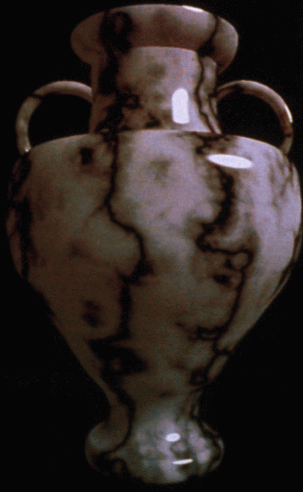
On a much more humble scale, I embedded controlled chaos in one of the first computer graphic objects I ever synthesized – a marble vase. I was drawn to the sense of capturing a raging storm within the placid curved surface of a classically sculpted form, and I developed a whole set of techniques that would allow me to express such controlled chaos:


I wonder whether there is any way to calibrate this relationship – to find some formal measure of chaos versus symmetry in any given situation, and then use that ratio to predict a rough measure of potential beauty?

Proustipedia

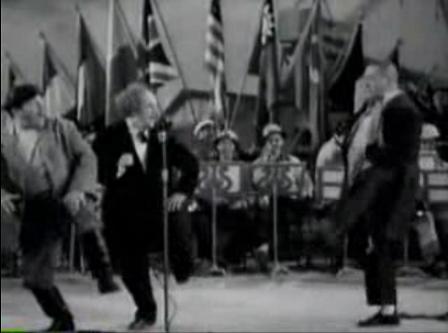
For some reason this morning I remembered a snatch of a phrase I had not thought about since childhood – “Niagara Falls. Slowly I turn. Step by step, inch by inch…” Some of you will recognize this as a line from very funny scene in an old Three Stooges film.

The humor of the Three Stooges was squarely aimed at little kids, with a precisely calibrated transgressiveness rivaled only by “Mad Magazine”, that sublime liberator of curious young minds. There was a point in my early childhood when the humor of the Three Stooges, endlessly repeated on daytime TV, could hold me completely rapt. I realized even then that their brand of take-no-prisoners slapstick was not at all the sort of thing responsible parents would want a kid like me to watch. Which of course made it twice as much fun.

I remember that when I was about six years old and my brother was eight, one of us had merely to utter the words “Niagara Falls” for both of us to collapse helplessly into a paroxysm of hysterical giggles.

This being the twenty first century, I responded to this memory as would almost any normal modern citizen: I googled it. Turns out it was from a 1944 Stooges episode called “Gents Without Cents”. The sketch was originally written and performed by the great Joey Faye – you may also have seen it done by Abbott and Costello.

But what really strikes me about this is how many people have contributed on-line to the minutiae of this and other obscure long-ago artifacts of pop culture. For example, a great many commenters have noted that Larry Fein flubbed a line during the “Niagara Falls” sketch, at one point saying “inch by inch, step by step”, rather than the other way around.

But you can also see that for yourself – just click on the image below to watch it on YouTube (and I dare you to try not to giggle):


Taken all together it’s astonishing how much the internet has become an enabler for learned Talmudic commentaries about the Three Stooges, “Knight Rider”, “My Mother the Car”, “December Bride”, old toilet paper commercials with Mr. Whipple, Chevrolet ads with Dinah Shore, and so many other artifacts of our shared history of popular culture that were intended in their own time to be no more than entertaining ephemera.

It seems that we are collectively digging deeper and deeper into the arcana of this last half century or so of commercial entertainment, laying everything bare, putting it all on YouTube and Wikipedia, hungry to know everything there is to know about everything.

As we collectively rub away at pop cultural history with a scrub brush, we seem to trying to be more Proustian than Marcel Proust.

Perhaps, as technology advances, our reach will go further and further. New forms of reconstructive spatio-temporal imaging will emerge, and then everything that has ever happened in our culture can go up on the Web.

You’ll be able to look up exactly who attended your ex-lover’s birthday party that time in 1994, or what your mother had for lunch on the day that your dad proposed.

You’ll be able to do a simple search to see all the outtakes from all the Beatles songs, whilst zooming in to study McCartney’s fingering on that tricky bass guitar part.

You will even be able to find out what Bill Murray whispered to Scarlett Johansson.

And then perhaps technology will advance even further, when we finally perfect forensic extracranial neural holography. Then you’ll be able to look up exactly what O.J. was thinking while he was trying on the white glove, or what thoughts flitted through Lee Harvey Oswald’s mind the moment he pulled the trigger.

You’ll be able to find out whether that pesky little bulging box taped to George W. Bush’s back under his suit jacket during the 2004 debates was making him uncomfortable, or whether he was just annoyed by that voice in his ear telling him what to say.

Don’t get me wrong. I am glad that I can find out where to go to relive my moments of childhood glee when watching Moe, Larry and Curly doing “Niagara Falls”. But I wonder how far we will go. Or rather, how far we are willing to go.

And I wonder whether Marcel Proust, wherever he is, is laughing or weeping.