Days when I’m jet lagged
Are longer than others, yet
Go by in a daze
Leave to come back
I am sorry to be leaving Paris. But I met wonderful people here, and discovered many new opportunities for collaboration, so I know that I will return soon.
I am reminded of a time I visited Rio de Janeiro many years ago. The parents of a colleague invited me over for a generous and delicious dinner.
After a long and wonderful evening, it was time for me to go. I told my hostess how sad I was to be leaving.
“It’s ok,” she told me, “there is an old and happy Brazilian saying.” Then she said something in Portuguese which I could not understood (I learned Portuguese only later).
“What does that mean?” I asked.
“It means,” she said, “you need to leave to come back.”
Joie de vivre
There is a definite feeling of Joie de vivre here in Paris, a feeling of optimism, of excitement about the future. I sense this strongly, in spite of the recent terrorist attacks.
I sense it in the academy, and in the start-up community. People here clearly believe that Paris is a place where things are happening, where the future is being created.
I think two recent events have influenced this change of mood, although I don’t think people here would be so gauche as to openly agree with me. The first was Brexit, and the second was the recent American election.
For many years there has been a sort of economic rivalry between London and Paris. Now that enterprises in London will no longer have the powerful backing of the European Union, forces of innovation are gradually shifting more toward Paris. Public / private partnerships are a large engine of change here in Europe, and private enterprise in the U.K. has just lost the E.U. as a potential partner.
The other event, of course, was the outcome of the recent U.S. election. It’s hard to overstate the psychological role Barack Obama has played in Europe in recent years. He has been seen as a level headed economic partner, a thoughtful intellectual leader, a force for moderation and greater international cooperation. His considerable influence effectively tilted economic power in the West toward America.
But now, from the perspective of Europe, America has just considerably diminished itself. The incoming administration does not seem interested in forming a cohesive trade policy, or, from what anyone can tell, in engaging in international economic strategy or partnerships of any meaningful kind.
All of which means that the importance of Paris to the economy of the West is significantly larger than it was a year ago. This city is now one of the few places in the West where international forces can still meaningfully converge, and where the future is being created.
Catachresis
In Paris yesterday, at a seminar to which I had been invited as a visiting examiner, one of the students displayed the word “catachresis”, and then asked whether people knew what it meant. There was no response.
His talk was actually about his ongoing research into the best way to scaffold teaching, and he was using this word as an example of a word that students generally don’t know. The problem he was working on was how to introduce new vocabulary to students in a way that will best help them to learn and remember these new and unfamiliar words.
He then explained that catachresis (pronounced KAT-A-KREE-SIS) means something that is used incorrectly. For example, he said, if you use your TV remote control as a hammer, that is an example of catachresis.
One of the seminar attendees then mentioned that the most common use of the word is in the context of language: Catachresis usually refers to a word that is used incorrectly in speech or writing.
Since I was the native English speaker in the room, I felt a responsibility to chime in. “For example,” I offered helpfully, “if you keep giving your cat too much food, then your catachresis.”
Petition
I am fascinated by the phenomenon of the Change.org Petition. This petition, signed so far by nearly 5,000,000 people, urges members of the electoral college to change their vote on December 19 (four days from now), so that Hillary Clinton becomes the next U.S. president.
I had known about the petition, but hadn’t really thought about it, until the recent news about Russia having had so much success in hacking our recent election. I now find myself wondering what the members of the electoral college are thinking about that.
It must be intriguing for them to contemplate the outsized influence that a hostile nation has had on the electoral vote. Does it this “election hacking” lead them to question the validity of the outcome? Does it lessen, for some of them, the meaningfulness of that outcome?
Ultimately, I guess, their thinking may be influenced by how many people sign the petition. If lots of Americans think that it stinks that Russia gets such a large say in who becomes our next U.S. president, then I guess those Americans should sign this petition.
There might be other people who have different reasons for being unhappy with the outcome. “Hey,” the leaders of China might be thinking right now, “How come Russia gets to choose the next U.S. president? That is so unfair. Maybe we should get to choose the next one.”
And the leaders of North Korea might be thinking something very similar. I wonder whether they are negotiating with China right now about which of those two nations will get to choose the United States president in 2020.
Part of me is hoping that North Korea wins the negotiation. After all, you don’t want to get those guys angry. You wouldn’t like them when they’re angry.
The best view
There is exactly one skyscraper in Paris, the Tour Montparnasse. From wherever you are in Paris, you can see it looming against the sky, an extremely large, aggressive and un-Parisien exception to the thoughtfully composed architecture of this city.
At the moment I am visiting a research institute in Paris, which is located in this tower. A joke I have heard several times from Parisiens is that the great thing about being in Tour Montparnasse is that it is the only place in Paris where you can’t see Tour Montparnasse.
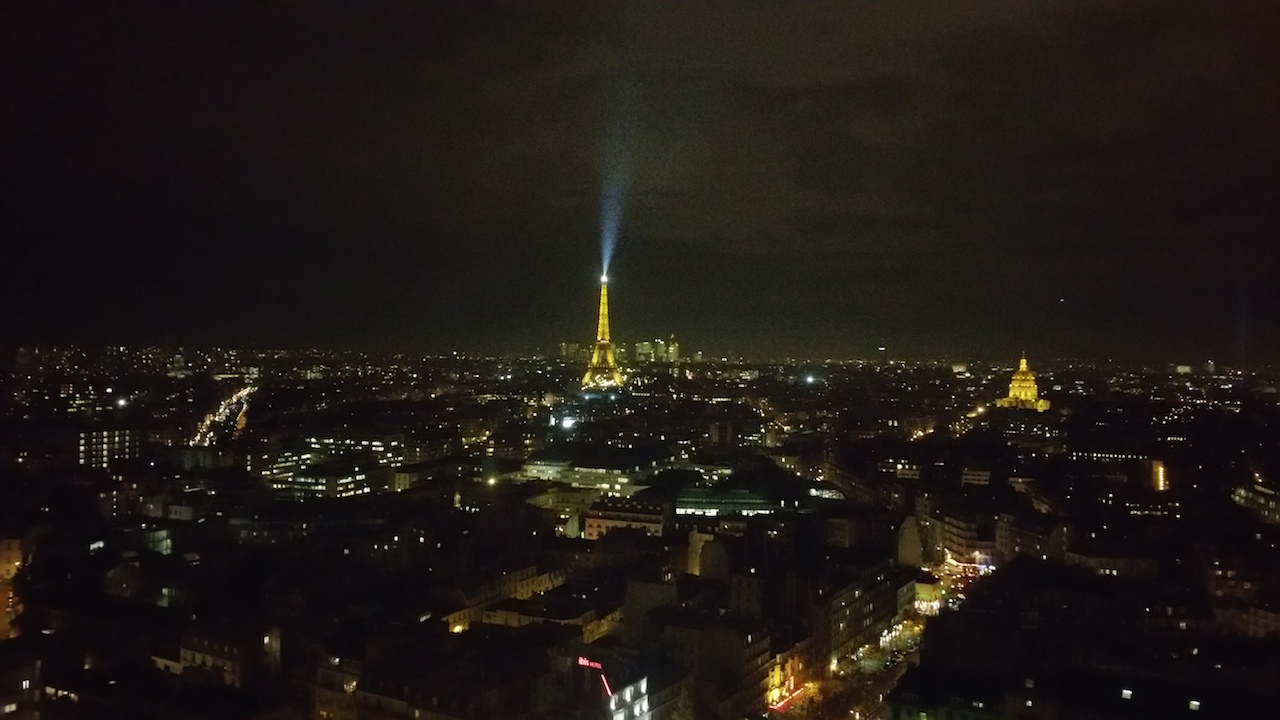
Another great thing is that it does indeed give you a spectacular view of the rest of Paris. Here is a photo I took with my phone, a night view of the City of Light.
Not jazz or improv
Jazz and Improv theater have a lot in common. Both are examples of an art form where the parameters of the content are deliberately narrowed so that performers can freely create new work within those narrowed bounds.
A jazz improvisation will never have the depth and complexity of a well written symphony, just as an improvised sketch will never have the depth and complexity of a well written play. Yet the tradeoff is worth it, because this narrowing of writerly scope is accompanied by the thrilling feeling of new material being created right before an audience’s eyes (and ears).
Today I was having a discussion about my Chalktalk interactive drawing program in this context. Philosophically it has much in common with Jazz or Improv, since it focuses on supporting real time improvisory performance.
Chalktalk will never be able to support the visual complexity of a well animated film, nor should it. In its current incarnation, Chalktalk is meant to be roughly the equivalent of Jazz or Improv: a tool designed to be used by experts to communicate to an audience a real time improvisatory performance.
But what do we call this forthcoming field of “drawing based improvisation”. It’s not Jazz, and it’s not Improv.
Maybe we could just call it a Sketch. 🙂
The talk after the talk
This evening I gave a talk about the future to a really interesting group of scientists, students and animators in Paris. The talk went well, but even better was the talk after the talk.
A group of us headed out to a local bar and discussed all of the larger topics, the cultural threads that connected with what I had talked about in my presentation. As you might expect, the conversation was far freer and more far reaching than what had come up in the seminar room.
There is something about sitting in a bar and having a beer that gives people permission to speak freely, to bring up their craziest and most interesting theories. It’s not something that can ever happen in a formal setting.
At one point somebody asked me what I would have predicted in 1996 about where media technology would be in 2016. It was a very good question.
After some thought, I told him that I probably would have predicted that we would end up with something like the world we have now — people using their phones to surf the Web and do pretty much everything else. The only thing I think I might not have predicted was the commoditization of graphics processors, because that didn’t really start to happen until the end of the 1990s.
But I might well have predicted that too. After all, my first rule of thumb when thinking about this kind of thing is to assume that Moore’s Law will continue, and then, from that, look at what will become affordable.
Definitely a good sort of conversation to have over a beer in Paris.
In Paris
When you’re in Paris
You just need to stop and say
“Hey, I’m in Paris!”
First World problems
feral roving packs
of drunken naughty santas
on the prowl today