Secular rapture

Today I participated in a performance piece by Noemie Lafrance. In fact, everyone in the “audience” was a performer. I had heard about Noemie’s wonderful work, but had not experienced it myself. It’s quite wonderful.

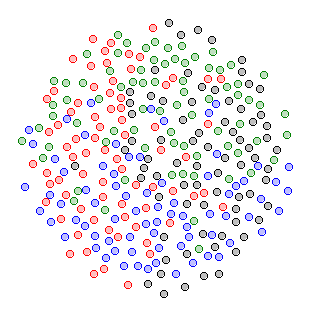
There is a long tradition of social dances in which participants are also performers, from disco to ballroom to square dance to waltz to tango to samba and beyond, stretching back to antiquity. What Noemie does is gather very large groups of people in a room that is divided into 2’&#215’2′ squares, and give them instructions on how to move between those squares. These instructions are, in a sense, programs to collectively execute. The result is two-fold: (1) the aggregate group of people forms fascinating and ever-changing patterns, and (2) each individual participant has an incredibly good time.

I can tell you first-hand that there’s something enormously joyful about the experience. After you’ve been doing it for a while, you start to get into a flow with all of these strangers, from the sheer pleasure of forming intricate patterns together. It becomes a kind of secular rapture.

As computers have enabled new forms of social networks, it is delightful to be able to experience an algorithmically enabled social network that doesn’t need a computer — just a big room full of people having a great time.

A Journey through Jabberwocky

Today I was playing around with zooming as a design element, one of my old favorites. Wanting to do something different, I thought it would be interesting if a continual zoom were to take you back to where you started.

As it happens, this “journey that ends back to its beginning” is exactly the structure of one of my favorite poems — Lewis Carroll’s Jabberwocky, so I decided to put design element and content together.

Somehow it just seemed like a good way to tell this wonderful tale. You can see the result by clicking on the image below:


Our flag

I was having a conversation with a friend about how the image of the U.S. flag has, in recent times, become more associated with the political right than the political left. People who “proudly display the flag” are more likely to be Republican, to have hawkish views on war, to be against stricter gun control, and in general to align with conservative positions. This is not to say that liberals never display the flag — but there is a tendency at work here.


I suspect the history of this is intimately tied to our nation’s recent wars in Vietnam, Afghanistan and Iraq. The flag became the symbol of “we are right to be here, doing this”. Liberals started to feel wary of the flag as indicating an attitude of “my country right or wrong”, while conservatives (who were more likely to support military interventions) took the opposite view.

Of course this rift started even earlier. During the McCarthy era, a decade before the U.S. presence in Vietnam began to escalate, the words “under God” were inserted into the pledge of allegiance, as a hostile message to godless communists (that is, to the spectral vision of the liberal run amok).

Wouldn’t it be nice if the U.S. flag could be reclaimed by liberal ideals? Perhaps then liberals could proudly display it to symbolize a nation that believes:

in the right to a good education, no matter what family a child comes from (and a nation that understands this is also good business sense);

that people with different metaphysics, ethnicity, gender or gender preference from ours are entitled to equal respect and legal protection;

that we are diminished as a nation whenever we do not actively seek to end poverty, illiteracy and disease around the world;

that war should be the very last resort of a nation state, not the first.

Wouldn’t it be cool to be able to wave the flag proudly for those American ideals?

Sumware Over the Rainbow

Today in my graduate computer games class I asked students to design a game (which they will then need to implement) which has the following two constraints:

Constraint 1: Playing the game should be an artistic act. The player can be composing music, creating a drawing, making a sculpture or writing a poem — there are many possibilities. But the game must give the player some way to explore their own artistic muse.

Constraint 2: The game should be educational. It could be a way of learning math, or geography, or physics, or history. The educational goal could be anything generally considered useful or worthwhile.

The idea is that providing two constraints pushes the designer to think outside the box, rather than fall back on a variant of a game they already know (which students often do without even realizing they are doing so).

I created a little sketch of a game for them as an example of the general idea. I made sure not to add any fancy art direction — I want them focusing on game play.

You play the game by creating your own original melodies (constraint 1), and as you play, you learn arithmetic sums (constraint 2).

Also, I couldn’t resist the title. 🙂 Click on the image below to try it.

11

I had been wondering why this anniversary of the attack on the World Trade Center seems particularly intense to me. One would think that the tenth anniversary, just last year, would be more “significant”, whatever that might mean.

Then I realized that the number 11 itself reminds me of the towers. There had long been a connection in my mind between the image of those towers, which loomed over the city I love for much of my life, and the day of the month when they, and so many innocent people, were horrifically destroyed.

The image of two tall figures, standing side by side, is compelling. Artemis and Apollo, Castor and Pollux, Romulus and Remus — there is power and comfort in the very idea of twin identity, of strength and solidarity in the connection between oneself and another.

And so on this, the eleventh anniversary, I realize that one of the casualties of that tragic day was a peculiarly American idea — perhaps foolish and naive, but nonetheless worth thinking — that if only we could figure out our differences, the people of the world might one day be able to stand in solidarity, side by side.

Grace notes (annotated)


Grace notes

(The girl has got an eagle eye)

That Ginger snaps

(Gilligan’s Island is gripped with fear!)

While Cherry blossoms

(I’ve heard she’s even grown an inch)

When Destiny calls

(Using free minutes, i might add.)


And Lily pads

(Accounting has called the FBI)

As Scarlett letters

(Her penmanship is lovely, so I hear)

But Rosemary leaves

(Poor poor Pierpont Finch)

When Victoria falls

(Can England be saved? It’s all too sad.)

Watching Jessica Stein

More than a decade after its release, I finally saw “Kissing Jessica Stein”, thanks to the wonders of streaming Netflix. I am still reeling from the sheer brilliance of this movie. Co-written by its two stars — Heather Juergensen and Jennifer Westfeldt — this movie captures subtle shifts in emotions and relationship dynamics that I’ve rarely seen in films made in this country. It’s also incredibly clever and funny.

Like many romances, the film trades on a complicit pact with its audience, in that it posits a privileged universe in which the main characters (and we, the viewers) “get it”, in a world in which most people don’t. But in this case, this complicity plays out through sparkling wordplay reminiscent of the best of Preston Sturges. Yet unlike the old screwball comedies, this wordplay is delivered by believable and highly layered characters, as they travel through the complicated landscape of real relationships. And by relationships, I mean *all* the relationships on screen, including those between family, friends and coworkers.

The supporting cast is also awesome. Jackie Hoffman steals every scene she’s in, while Scott Cohen, in a very subtle performance, deepens the picture in surprising ways as a man trying desperately to hide his emotional vulnerability — not realizing that it’s his best asset. And it doesn’t hurt that Westfeldt deploys her personal WMD (weapon of mass distraction), Jon Hamm, with whom she’s been in a relationship since 1998. She later used Mr. Hamm to equally brilliant effect in her film “Ira and Abby”.

Why oh why don’t they make more movies like this?

Monsters and food issues

The “Twilight” saga, as some of you know, centers around a young woman who is being courted by both a vampire and a werewolf. Pop culture has visited similar themes before. For example, the Buffyverse led several women I know to ponder the question “Would you rather date Oz or Spike?”

Seen as archetypes, werewolves and vampires form a nice opposing dialectic. A vampire is seemingly a creature of energy more than of flesh, ethereal and wraithlike. In Bram Stoker’s original conception, the vampire had the ability to read and control minds, become weightless, or transform at will into a bat or even into fog. He was not so much an actual creature, as an idea of a creature, the monster conceived as a kind of dark version of Ariel.

The werewolf on the other hand, is a heady mix of human and beast. When the moon is full he grows hirsute, longs to consume flesh, becomes a slave to his own feral emotions. This is monster as Caliban.

It seems to me that which of these monsters one is drawn to comes down to food issues. Are you the kind of person who finds bodily functions distasteful, or who fantasizes about the Dinner at a country inn scene from Tom Jones?

Let’s put it another way. If you were an architect designing an office building only for vampires, you probably would not need to bother with such details as kitchens and bathrooms. Hell, you wouldn’t even need windows.

On the other hand, if you got the commission to design the werewolf office park, you had better pay attention to the earthly details. For example, all your restrooms would need to have extremely good air flow. If, um, you see what I mean. 🙂

It runs in families

It always fascinates me when somebody who does something remarkable in the world has a child who does a completely different remarkable thing in the world. It’s much more interesting than when any one field, be it acting, or science, or politics, runs in families. For when a child achieves something completely different from their parent’s contribution, it speaks to a more fluid and mysterious kind of inheritance — a spark of excellence that mutates freely as it passes between generations.

See if you can match up these achievements of parent:

(A)

Inventor of Liquid Paper

(B)

Academy Award winning actress whose career spanned 68 years.

(C)

Co-founder of the American Temperance Society

(D)

Inventor of Spin Art

with the achievements of the child:

(1)

Actor who played the young Kwai Chang Caine

(2)

Accomplished songwriter, musician, philanthropist and one-time teen idol

(3)

Internet pioneer, inventor of the hyperlink

(4)

Writer of, arguably, the most politically influential book in American history

Sometimes it gets even more interesting, when the same person is famous for having done at least two completely different things. See if you can match a particular person’s achievement:

(A)

Hollywood actress once known as “the most beautiful woman in the world”

(B)

Writer of the lyrics to one of the world’s most beloved songs

(C)

Legendary rock and roll guitar god

(D)

Renowned ventriloquist

with another notable achievement by the same person:

(1)

Inventor of the world’s first artificial heart

(2)

Astrophysicist who contributed to our understanding of the science of interstellar dust clouds

(3)

Co-inventor of spread-spectrum, the underlying technology for cell phone communication

(4)

Inventor of the stereoscopic technology used in many 3D movies today

A world without limits

Posit, for the sake of argument, that we get to the point where technology is not the bottleneck. Whether it turns out to be nanobots, the Holodeck, or just Ray Kurtzweil tapping into our cyber-transcribed brain circuits to say “I told you so” in his singular way.

In any case, suppose we can do anything — transport ourselves instantly, acquire unlimited possessions, live forever, read each others’ minds if we wish. What would we, as humans, do with all this?

Would we be able to live in a world utterly without limitations? Or would such a reality simply fry our brains, being the very opposite of the sorts of situations that human minds evolved to cope with?

Perhaps we would inevitably rebuild all of the problems humanity currently faces — war, famine, crime, prejudice, disease — simply because that is the only sort of reality in which our human need to solve problems makes any sense. It may be the only sort of reality in which we feel sane.

You can ask this question for yourself: Would you want to live in a world without limits?