Revealing thoughts

Today a friend asked me the following question:

“Blogs are a very public way of revealing thoughts. Did/does it make you uncomfortable at times?”

A very good question. The more I thought about it, the more I realized that the answer is non-trivial. The best analogy I can think of is with driving a car – a wonderfully efficient way to cause death, dismemberment and general public mayhem. When you drive, you have complete freedom at all times to kill yourself and others. All it takes is a simple turn of the wheel and you are toast.
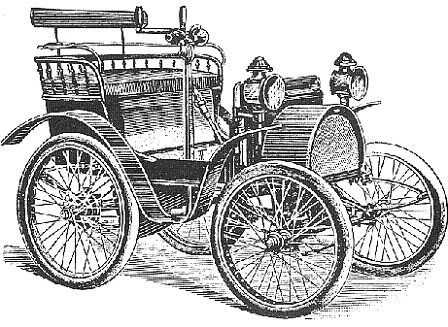


And yet millions of people drive cars every day, for the most part without mishap. The only thing protecting them from certain death is their own highly developed sense of self-preservation.

Putting your thoughts and emotions out there in a blog is something like that. Theoretically at any moment you could say something that would inappropriately confuse public and private knowledge, betray a friend’s trust, or in some other way be the equivalent of pulling your pants down in public (with or without that second pair of pants underneath). And then of course there is always the danger of being found guilty of BWI (blogging while intoxicated).

So many perils.

And yet the moment you put your hands on that wheel, step on the accelarator and pull out into traffic, a wonderful thing happens. You realize that you really do value your life, a certain circle of privacy, the trust of your friends, the line between sane and insane. It is perfectly ok to discuss thoughts and emotions in public, to look at the ways that powerful encounters with other people, both positive and negative, have pulled upon your heart, transformed you, made you see the world in a new way. People talking about those things together can be an exhilarating, therapeutic, community building experience.

But it is not ok to use any of that as an excuse to go on a destructive tear.

And so I find that I am never tempted to just spin the steering wheel randomly, cause a ten car pile-up, find out what a head-on collision feels like, or what would happen if I just drove this sucker off that bridge.

After all, I’ve got places to go, and these thoughts and emotions are just the vehicle to get me there. So I’m going to put the top down, gun that accelarator, and go for a ride with whatever friends care to go along with me.

Scenes from the novel

It had now been a full three weeks since they’d ridden into the low country. Cloud capped mountains ranged over the horizon on all sides, and the sun hung high in the morning air. Blossom was off nibbling on some sage down by the stream, which was fine with him. She’d been going since sunrise, and flecks of dewy sweat still glistened on her flanks. He figured the old girl could use a little rest after the hard riding of the last three hours. Besides, this was as good a spot as any to take the valley’s measure.

He turned the metal cylinder over in his hand. Squinting his eyes against the sun’s glare, he tried once again to read the marks engraved on its side. He couldn’t make head nor tails of it. Some sort of writing, but sure as heck like nothing he’d ever seen. Oh well, it didn’t hardly matter anyways. Carefully he pointed the cylinder toward the cloud above the mountain ridge up ahead. Just like before, the cool metal surface heated up slightly in his hand, and he could hear the faintest click. The cloud over the ridge winked out and was gone, leaving nothing but pure blue sky.

He counted off six, seven seconds before the boom came. He nodded to himself and adjusted the brim of his hat. A little over a mile left to go. He gave a low whistle and Blossom trotted over. With the grace of long practice he swung up and eased his lanky frame into the worn leather saddle. It was time to settle some scores.

Answer, in depth

In answer to Sally’s question, a friend of mine got married. It was one of those “let’s sneak off to the Justice of the Peace, just the two of us, and only tell everyone afterward” deals. I was sure they were going to wed at some point, but nobody knew it was going to happen quite so soon. Took a lot of people quite by surprise. But it’s very happy news.

And that’s not all! Today I bought a magical gadget that lets you draw in 3D. In one handy dandy kit you get two colored pencils (one red and one blue), a little adjustable holder thingie that looks like a drawing compass so you can draw your red and blue lines side by side, and a pair of magic red/blue 3D glasses, to make it all jump out into the third dimension. The whole thing set me back all of seven dollars. Pretty reasonable, if you ask me.

And on top of all that, it never runs out of batteries!! Although you do need to sharpen the pencils from time to time.

And I also bought new shoes. So I guess it’s happy news all around.

On South Beach

South Beach in Miami is another world, a world that contains mysteries, a tangled mashup of opulence and seediness, of beautiful young people just starting out and old folks barely holding on. Teenage models saunter to their next shoot, oblivious of the crazy old ‘Nam vet staggering along Ocean Drive muttering to himself. Overweight tourists from the midwest gape in confusion as two beautiful young men share a passionate embrace on their way home from the Palace bar. The lovely Casa Casuarina (the former Versace mansion) is only steps away from sad little old boarded up Deco-style hotels awaiting their final doom. Here everything seems to find its opposite.

Looking at the rows of boarded up buildings, I sense an uneasy turmoil lurking just behind the image of happy sun kissed throngs sipping their afternoon drinks by the ocean. The recent real estate crash is turning things upside down, the reality of the approaching recession starting to creep into a place that prides itself on being disconnected from anything as mundane as mere reality.

South Beach has become such a jewel ever since Michael Mann’s TV fantasy of Sonny Crockett’s world caused the real place to become revitalized, transformed into its own fabulous television image. A dream brought to life. I hope South Beach manages to hold on to that dream.

Speechless

For the first time in years I am speechless. Utterly speechless. Sometimes you hear something, some news, that you cannot even begin to process. And today…

Well, yes. today.

All I can say is congratulations. Perhaps tomorrow I will find my voice again.

Did I say congratulations?

Standing on one foot

As I mentioned the other day, I am at a Microsoft sponsored conference that is being held on a cruise ship. There is something unique about being surrounded by computer scientists in an enclosed space for five days. For some reason it reminds me of one of my most vivid memories from the SIGGRAPH computer graphics conference.

It was a number of years ago, and I was having a really interesting discussion with one of my colleagues about how difficult it is to get a good research paper published in the SIGGRAPH conference. One of the problems is that because space is so tight, they rarely accept papers that are longer than eight pages (which is much less space than you get in the usual scientific journal article).

We were both bemoaning how tough it was to compress all of our brilliant ideas down to such a small number of pages, when I told my colleague something that Chekov had once said: “One should write as if standing on one foot, and then edit as if sitting in a comfortable chair.” He just looked at me for a long moment, and then he said “I never really watched Star Trek.”

That was the point in the conversation where I decided to change the subject…

Leap days


Perhaps one day we notice
That time is streaming past
It doesn't even see us
As we stand upon its shore

But we don't really care
After having caught a glimpse
In a few and scattered moments
That everything had changed

Oh sure we'll talk about it
Some time later over coffee
Show our memories like scars
And act so nonchalant

But we've really only lived
In those remembered stolen moments
When we'd crashed together only
To fly again apart

So we try to catch our breath
To pretend our little stories
Are only idle tales
We had told ourselves one day

But yet, we keep our secrets
And on leap days we remember
When we stole a page from time
And life was truly lived

Cruising with Microsoft

I know this is going to sound insane, but I am writing this from a cruise ship, courtesy of a Microsoft conference on games and computer science. I am currently on the $100 wireless internet plan – you spend $100 and then when you’ve used up all your minutes you get to spend another $100, unless you forget to click logout, in which case they continue to charge you even while you sleep. All thanks to the miracle of the internet!

As I type this there is a comedian next door in the “Celebrity Theatre” making bad cruise-themed jokes. He is so bad he’s good. Well, ok, that’s not really accurate. He’s so bad he’s bad. Meanwhile, today I gave my talk on the topics of inexpensive interfaces for science-education games, procedurally animated virtual actors and universal programming languages. The usual. People seemed to like it.

Oh my god, the comedian is now making bad jokes about Hurricane Katrina. Words cannot begin… He just made a joke about the antisemitism down in New Orleans after the hurricane – it seems they were all against the Levis… OK, you had to be there.

I’m going to be on this ship for four days. Rumor has it we are headed to Cazumel. Sigh. The things I do for computer science….

Yes, but why?

In Mashhuda’s comment from my blog entry the other day about universal programming literacy, she contrasts the chair made by a skilled carpenter with the pre-fab kit that the consumer buys from IKEA and assembles at home. I think this might be a misleading analogy to bring to the question of “consumer level” programming.

The major factor missing from the IKEA-assembling consumer’s experience is not technical expertise or deep knowledge of the tools of the trade, but rather any sort of design process. The IKEA chair kit is deliberately designed to avoid any design decisions on the part of the consumer. And we can argue – as Bill Buxton has, consistently and articulately – that the major hurdle to learning good programming is not the mastery of the technical tools, but rather an effective knowledge of design process.

I think a better analogy is with cooking. Millions of home cooks do a reasonable job of making good and original recipes. Often they start with a recipe that they learned from a book or neighbor, and then they iteratively refine this recipe over time, often creating something fresh and original.

To anyone who knows both programming and cooking, it is clear that both involve algorithmic thinking – the ability to produce a well defined result from a series of procedural steps. The major difference is that cooking requires direct action, whereas programming requires instructing the computer to perform actions by proxy.

When I described the UPL question to my colleague Natalie Jeremijenko, she quite sensible asked me “Why will people be doing it? What purpose will it serve them?” And I think she was exactly right. After all, Bill Buxton’s questions about design process are not primarily about the tool, but about the purpose – design begins not by picking up your tools but looking at the problem you aim to solve.

By this reasoning, the tools that allow millions of people to program in a powerful way are going to be those that allow those people to achieve goals which really matter to them. For example, very many people are motivated to create recipes and to compose original music, and in both cases many of those people become quite good at cooking or composing. The populations that can do these things well is much larger than is the population that can program.

I suspect that the reason for this is not that either creating recipes or composing music is an inherently easier task than programming, but rather that each is a communicative task, understood to be a direct way for one person to emotionally connect and bond with another. I think we are going to see a kind of programming tool effectively embraced by large parts of the population only when that tool is shown to be effective in allowing emotional connection and bonding between people.

What is in a name?

Today I am spending the day in Miami, at the house of my cousin Ben. At the moment I am hanging out with Ben’s big friendly dog Sasha. Jast as I typed those words, Sasha let out a deep and soulful sigh, as though she knew I was writing about her. I suspect she is wondering why I am typing on this stupid computer rather than running around the house like a reasonable human should, throwing a bone for her to fetch over and over again.

One of my first encounters with Russian names was the time I read Dostoevsky’s great last novel The Brothers Karamazov. It’s an amazing book, full of powerful ideas, larger than life characters and intense emotions, spiritual struggles and debates about belief and the limits of free will. It took a while for me to get through the whole thing. I remember that one weekend I was reading it while alternately watching successive films in the Hellraiser series, where some cable station was running them back to back in a marathon. I can’t really explain why, but the two experiences went together extremely well.

But if you’re going to read it (with or without Clive barker movies), here is a friendly warning: I remember I was on about page one hundred and sixty before I suddenly realized that Alexei was the same person as Lyosha. I’ve just now looked it up on Wikipedia, and it seems that at different times this character is variously referred to as Alyosha, Alyoshechka, Alyoshenka, Alexeichik, Lyosha, and Lyoshenka. There’s a similar kind of deal going on with the other characters. No wonder it took me a while to realize that there were four brothers.

For weeks after reading the novel, my head was filled with all the ideas to be found between its covers. In fact, it became somewhat difficult to concentrate on the here and now. What finally cured me of my Karamazosis was the simple act of renting and sitting down to watch the 1958 Hollywood film version. Yul Brynner did a perfect job of capturing the powerful and smoldering Dmitri, but William Shatner as Alexei was – how to say this delicately – unfortunate. Kind of killed the mood. Well, the good new was that after weeks of wandering in a haze of Dostoevesky’s powerful thoughts, I managed to snap out of it in under two hours, thanks to the magic of Hollywood.