The thread of today
Weaves a pattern we can’t see
Until tomorrow
Author: admin
Irony
I hosted a panel today at a major new media conference. Roughly speaking, it was a panel about “Visions for the future”.
I managed to get some very high level people as panelists, from such places as ILM, Google and Valve Software. During the lunch meeting before the panel, there was some great energy flowing, with rousing arguments for every side of the issue.
But then when it came to the panel itself, those same people were quite subdued. No fiery answers, no bold conjectures, just a sort of pleasant chitchat.
And I realized that I was probably dealing with people who would rather not go on record in public with their real thoughts, because it might cause some problem for their company down the line.
So there’s the irony: audiences are drawn to a panel partly because of the big names of the companies its panelists work for, yet that very state of employment may stop those panelists from truly speaking their minds.
Obvious
I was having a conversation today with some colleagues, and one of them described his experience taking courses at the NYU film school. It was very expensive, he said, and they worked you incrediby hard.
“You’re basically paying NYU this huge amount of money,” he explained, “to make you work your ass off from morning till night.”
“But was it worth it?” I asked.
Oh yes, he said, it was very much worth it. He’d learned an enormous amount, and still uses what he learned in his work today, many years later.
Then I noted that there was a general principle at work here: “If you want people to give you money, make them suffer.”
One of my other colleagues got very excited about this. He insisted that we write this statement down and that I sign it.
I was flattered, but a bit confused. “Of course that’s how you get people to give you money,” I said, “isn’t that just obvious?”
Two flights
two flights in one day
(came home just to leave again)
is one too many
William Shakespeare
Shall I compare thee to a summer’s day?
Thy art is far more lovely and more sweet.
Rough winds do shake the darling buds of May,
And summer’s lease doth bring the summer heat.
However brightly poet’s pens may rhyme,
Perforce they find their inspiration dimmed;
For fairest art unfairly fades with time,
By chance, or culture’s changing course, untrimmed;
But thy eternal genius shall not fade,
Nor lose possession of that life it brings,
Nor shall death brag thou wand’rest in his shade,
When in eternal lines thy wisdom sings.
So long as hearts can beat and souls can soar,
The Bard of Avon lives forevermore.
In a fair fight
I was hanging out with family at my brother’s house last night. Some of us had just flown in that very evening, so at some point the conversation came around to airport security, as it often does these days. The threat of terrorism is of course very real and very serious, but sometimes the steps taken to deal with it can seem a little mysterious.
My mother said that she recalled a time, many years ago, when she and my dad had carried a circular saw onto an airplane. “I doubt,” she said, “that they’d let me do something like that today.”
It was pointed out that a circular saw on a flight is less of a threat than one might think (at least on domestic routes), because there’s no place to plug it in.
“Yes,” I agreed, seeking to add some perspective to the issue. “In a fair fight, a terrorist on a plane with a circular saw would totally lose to a terrorist with nail clippers.”
Pass / fail exam
Because of the holiday travel, I nearly missed my flight today. And that might have resulted in a cascade of problems.
But I didn’t miss my flight. I ended up getting on the plane, and arriving at my destination just fine. It was a sort of pass / fail exam, and in the end I passed it. Which got me thinking about pass / fail exams in general.
So much of life is a pass/fail exam, isn’t it? You either catch the plane or you don’t, metaphorically speaking. The difference in your actions can be slight (or in some cases non-existent), but the consequences of passing or failing can be enormous.
I think we instinctively understand this. At certain moments of our lives, we push ourselves to get over a finish line, knowing that getting to the other side of that finish line is the entire battle. We don’t always try for the “best possible” performance, but rather for the one that will allow us to keep going.
But what about life itself? Isn’t that the ultimate pass / fail exam? Some people emight say that in this particular game, you always fail in the end. After all, no matter what you do, sooner or later the Grim Reaper wins.
But maybe maybe this is one case where you get a passing grade just by showing up for the test. 🙂
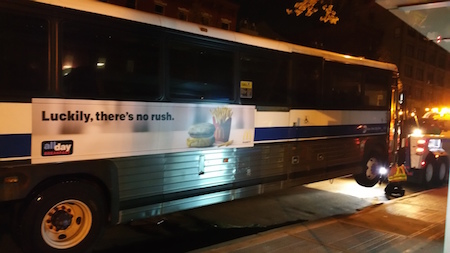
Luckily, there’s no rush
Speaking of signage, I was walking up Sixth Avenue this evening and I came upon a sight that you see every once in a while in a big city like New York: A large bus, having broken down, was in the process of getting towed. When I got there the tow truck had just hitched up the front of the bus, and was about to cart it off.
But the detail that caught my eye was the McDonalds ad on the side of the bus. It’s a perfect example of the wonderfully unpredictable chaos of the physical world.
In the future, when all signage becomes virtual, such events will most likely be removed from our sight just as soon as they show up. So enjoy it while you can.
Future signage and its implications
I made a claim here a while back that eventually, when everyone is wearing cyberlenses, it might be illegal to walk around a modern city without such lenses. I argued, essentially, that people will come to expect to be publicly seen with their digital make-up on, and to see them in public without that make-up might be seen as an invasion of privacy.
Today somebody asked me about that assertion, as part of a larger discussion about the eventual social and cultural ramifications of such a “Rainbows End”-like future reality. I had already pointed out that buses will no longer have signs telling you which bus to take. Subways entrances won’t have signs, and neither will restaurants, traffic control, convenience stores or any other places or services in the public sphere.
After all, everybody will be able to know know far more just by looking with their own cyber-enhanced eyes than any static sign could ever tell them. We will no longer need physical signs, any more than New York City any longer needs a way to feed the horses that used to draw carriages through its cobblestoned streets.
Today you are perfectly welcome to stay in your own apartment in a state of helplessness. You can go all day at home without clothing or any form of spending money. But the moment you walk out into the streets of Manhattan, neither of those options is viable. If you are naked, you will be picked up for public indecency. If you travel without money or credit cards, you can be arrested for vagrancy. The public sphere does not tolerate people walking around in a state of deliberate helplessness.
One day, to walk around the streets of a major city without your cyberlenses will be to be in a similar state of deliberate helplessness. Don’t expect it to be legal.
Great idea for a message T-shirt
|
|
|
|