Ideas are brilliant
Alas, the world really needs
Deliverables
Author: admin
My blue hawaii
Walking along Commercial Street this morning in East Vancouver, on my rounds to shop for various necessaries, I found myself drawn to a little guitar shop. Walking in, I got a sudden urge to buy a ukelele.
Since I don’t play the ukelele, it didn’t seem like a good idea to get a fancy one. It turns out that there is a little beginner model for around $40 that comes in all sorts of vibrant colors. The store owner told me that his girlfriend, who is a professional musician, uses the pink one in her stage performances.
Somehow the phrase “blue hawaii” rang in my head, and I realized I just had to get the blue one. Which I did.
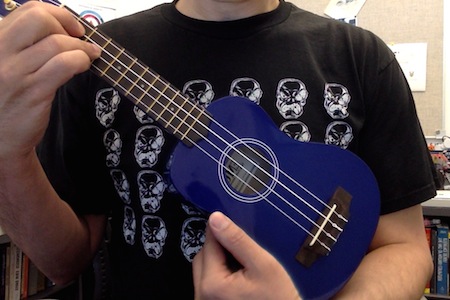
You can see my shiny new toy in the photo below, in the arms of its proud owner. My blue ukelele has a delightful sound, and I’m having tremendous fun learning all the chords I can make with just those four G,C,E and A strings.
And unlike my computer, it will never need batteries!
New month
I started to get very wary
Somewhere back in January.
It really made my eyebrows arch,
When February turned to March.
Then time piled up from day to day
And April somehow led to May,
When suddenly, and all too soon
It seemed to be the month of June!
Now here we are, don’t ask me why,
How quickly does the time go by!
Toaster
Today, on the long walk back from my successful quest to find and procure the ideal two-slot toaster for my temporary digs in Vancouver, I amused myself by singing songs aloud as I strolled along on this perfect summer’s day, down E 7th Avenue and across Main Street, past the Gene Cafe and the Antisocial Skateboard Shop.
There was plenty of time during my journey to exercise a varied and culturally diverse vocal repertoire. This being Canada, I made sure that Neil Young and Leonard Cohen were generously represented. Yet I freely admit that the Beatles were, as usual, the most fun to sing.
I wonder now, thinking back on the day, whether any of the natives were at all non-plussed at the sight of a strange man walking down their street while belting out the chorus of “Yellow Submarine”, a brand new toaster tucked securely under one arm.
Then again, I’m sure they understood.
Return on investment
After watching a world cup game today with some Latin American friends, I mentioned a theory I had formed years ago, on the day I first attended a soccer game at Rio de Janeiro’s famed Maracanã Stadium.
Seeing more than a hundred thousand testosterone fueled young men venting their energy at once, I had theorized that spectator sports may have developed as a way to channel the rage of young men — an emotion which can be so useful when a tribe is at war, but which can, if not redirected, become so destructive at other times.
One of my Latin American friends said that she thought my theory made a lot of sense. “It’s too bad,” she continued, “that the U.S. does not embrace soccer. If it did, your country might be less inclined to go to war.”
If my friend’s theory is correct, imagine how much money our government could save by investing a few million dollars each year in promoting soccer proficiency among children and young people. If we could one day assemble a team that would be truly competitive in the World Cup, our interest in waging war might decrease.
And if our government were less inclined to declare wars based on questionable evidence and logic, we might be able to reduce our national defense spending by billions of dollars per year.
That sounds like a pretty good return on investment.
100 years ago today
Gavrilo Princip
Starts nine million deaths using
Only two bullets
A delicate situation
A friend told me today that she had gotten into a very unfortunate conversation with a guy. He had given unmistakeable signals that he was attracted to her, so she had sent him an email saying that those feelings weren’t reciprocated.
What ensued was a big blow-up. He denied ever having sent her those signals in the first place, and they got into a big argument about it. She asked me for advice.
I told her that the most emotionally evolved person I know has a great way of dealing with these things: She never suggests that she knows what anybody else is thinking. Rather, she makes sure to be clear about what she is thinking, and assumes that everyone else will take similar responsibility for themselves.
Applied to this situation, what my friend should have done was simply tell the guy that she was not interested in anything beyond a friendship, without suggesting that the guy is into her.
Of course this is not so easy to do. The very fact that she is raising the subject could be seen as implying that the guy is into her. So the wording needs to be delicate.
But the principle is clear: When you are dealing with a person who is in an emotionally vulnerable position, do not ever act as though you can read their mind (even if you can). They’ll just get angry at you.
Especially if you’re right.
Up to date photo
Today an acquaintance of mine, who recently got his hair cut, showed me his photo id. In the photo he has a big head of hair and a large bushy beard.
Whereas nowadays, post-haircut, he is close-shaven and quite beardless, so the photo in his id now looks like a different person entirely.
In this modern electronic era, it might be interesting to have a photo ID with an automatic “Update from self”, so your photo would would always reflect your actual appearance. If you were to get a haircut, lose a little weight or dye your hair, your official photo would automatically update to reflect that.
Putting aside questions of technical feasibility, I wonder whether this would be a good thing.
Pre-deadline superpower
Tomorrow evening I’ll be giving a fairly important talk. Not because a huge number of people will be there, but because I am using it as an opportunity to try out our latest interactive research software. Of course the software could fail miserably, and then I will end up looking foolish, but that’s part of the fun.
Over the last week I’ve been gradually pulling the pieces together for this talk, but today those efforts increased exponentially. It’s not exactly that I had been waiting until the last minute, but rather that I was preparing for the last minute.
It seems that just before a deadline, one can attain a kind of superpower — an enormous increase in ability to focus, coupled with a combination of tirelessness and tenaciousness that is usually very hard to come by.
So there is no point in trying to fake it several days earlier, to pretend that you already possess that superpower. The best strategy is to get things ready, line everything up, lay out the tools and the weaponry, and be prepared for the arrival of the superhero that you will ever so briefly become.
Two narratives
The responses to yesterday’s post were fascinating. On the subject of what the founding fathers meant by ‘a well regulated militia’, the nature of the word ‘right’ in this context, the definition of ‘arms’, and just who (or what) is ‘the people’, there is clearly a wide range of opinion.
That the words were certainly written down, and by highly educated and intelligent authors, there is no doubt. Yet two hundred twenty five years and countless political shifts have created a sort of fog around the entire matter.
I wonder how many other indisputable historical facts have created such a wide split in their interpretation. Religion and patriotism aside (those are too easy), what other cases are there where a unquestionably true historical event has been met with the creation of two entirely divergent narratives?