The desolation of slog

Since “American Hustle” was sold out, my friend and I went today to see “The Desolation of Smaug”, the second film in Peter Jackson’s new Hobbit trilogy.

The first thing you need to understand is that this film is about seventeen hours long. I’m counting in subjective time. In actual clock time it’s a little shorter.

Yet in all that time, nothing actually happens. The genius of Peter Jackson is that even though nothing is actually happening, we still get to see lots of monsters, and fights, and water rushing, and plenty of really lovely views of New Zealand. I mean, um, Middle Earth.

All nicely intercut with endless scenes of dwarves walking. These scenes are very good for children, because they go on for so long that kids will have plenty of time to escape into their own heads and make up games to pass the time. For example, during one of those endless walking scenes, I was able to count the individual hairs on the head of the person sitting directly in front of me.

Twice.

Another thing that’s kid friendly about this film is the way it portrays Orcs. Now, those of you who have a passing familiarity with Tolkien might be under the misconception that Orcs are fearsome creatures, savage and malevolent warriors with no purpose in life other than to be perfect and efficient killing machines.

But I learned from this film that no dwarf or hobbit can ever be killed by an Orc. In battle after battle, the cute and cuddly little guys manage to avoid any casualties. Ever. The dwarves even have time for funny and adorable antics in battle that somehow always result in the mighty and musclebound Orcs getting mowed down by the dozen.

It’s all very magical and sweet, if you like that sort of thing. I kept expecting Walt Disney himself to come out in a cameo and invite us to the gift shop afterwards.

There is even a love story of sorts. When an appealing and proud young soldier is wounded in battle, a hot chick with pointy ears from some alien race — who is nearly twice as tall as he is — comes to his rescue, fighting off bad guys with bow and arrow to save her tiny lover. Eventually I realized that I was watching early tests for “Avatar”, so I knew that sooner or later there would be flying dragons.

Speaking of dragons, another thing I learned from this movie is that dwarves and hobbits also cannot be harmed by three hundred foot tall fire breathing dragons. Ever. This is something I had not known.

It’s amazing how much you can learn at the movies.
Varieties of enchantment

This morning I watched the first half of Peter Hall’s 1968 film version of “A Midsummer Night’s Dream” on DVD. Then I attended a matinee performance of Julie Taymor’s current off-Broadway production (I went all alone — it was my holiday treat to self). Then I went back home and watched the second half of the film.

I hadn’t wanted to see either one before the other, so as not to taint either of the two experiences. So I split the difference by watching the film in two parts, which worked out splendidly.

It’s a bit unfair to compare the performances. The 1968 film had the great British actors Helen Mirren, David Warner, Judi Dench, Ian Holm, Diana Rigg, Ian Richardson and others, all at the top of their game.

In contrast, some of the acting in the Taymor version was a bit uneven (alas, the young man who played Lysander was in way over his head), although many of the cast were quite wonderful, and Max Casella as Bottom the Weaver was actually better than Paul Rogers from the 1968 film.

But of course we don’t go to a Julie Taymor production just for the words, even when the words are by William Shakespeare. This fantastical story was a perfect fit for Taymor’s brand of theatrical magic. The scenes of the woodland faerie world at night were breathtaking in their beauty and visual wit — for much of the play the entire audience was lost in rapture.

There were moments during the film, such as after a particularly lovely speech by Helen Mirren or Judi Dench, that I thought the poetry of Shakespeare’s words, beautifully delivered, to be all that mattered. And also many moments in the theater when I was in thrall to the power of Taymor’s visual magic. At such moments I would ask myself, which is the better variety of enchantment?

Fortunately we don’t need to choose. The Peter Hall film and the Julie Taymor theatrical production can each be enjoyed for what they are.

Sometimes both in the same day. 🙂

Pride, prejudice and preconceptions

For the last eight years, despite — or perhaps because of — my extended love affair with Jane Austen, I have avoided the 2005 Hollywood film Pride & Prejudice.

In that time I have read the book several more times (it gets better with each reading), created various interactive multimedia projects around the text, purchased “Pride and Prejudice and Zombies” as a birthday gift for an old friend, given quite a few public research talks which prominently mention the classic novel, revisited the 1995 miniseries, and watched the BBC spoof “Lost in Austen” with gleeful abandon. Twice.

Yet I stayed away from the post-millennial film version, mainly out of a deep and abiding distrust of Hollywood’s ability to do justice to the subtlety of Austen’s work, and a fear that commercial imperatives would dull the razor sharp edges of her masterpiece.

Furthermore, I thought Kiera Knightley to be far to obviously beautiful to play Elizabeth Bennet. I may also have been put off by that pesky ampersand in the title.

I am happy to report that I was wrong. Knightley rises to the occasion splendidly. Also, Donald Sutherland is perfectly pitched as Mr. Bennet, and Brenda Blethyn as Mrs. Bennet is a hoot.

It is true that Matthew Macfadyen, in his role as Mr. Darcy, is distressingly wooden (although always very pretty), Rupert Friend doesn’t have the charm required for Mr. Wickham, and Tom Hollander, although quite good, isn’t nearly funny enough as the dread Mr. Collins.

But with Judi Dench playing Lady Catherine, it’s hard to quibble. This lady can do anything (she once played a fabulous Sally Bowles on the London stage). And it’s fun to see a pre-discovered Carey Mulligan (don’t blink).

In the end, it all comes down to the character of Lizzie. And Ms. Knightley acquits herself extremely well, transmuting the inner fire and steel of Elizabeth Bennet into pure Hollywood charisma.

To be clear, this isn’t the book. In fact it differs from the book in fundamental ways, and this is not the Regency England that Austen knew and wrote about. I suspect she would have been confounded by the sight of lovers meeting alone half dressed and gentlemen wandering into ladies’ bedrooms. And that ampersand in the title is very descriptive, given that many key elements of the novel have simply been dropped.

Yet on its own abbreviated and modernist terms, P&P is a very enjoyable film. But to finally see it, I needed to overcome my own pride and prejudice.

Two step program

From time to time each of us vows to shake off some inconvenient habit or other. For me this has happened on a number of occasions, including an unfortunate tendency to have just “one more” shot of espresso at work.

As the new year approaches, we may resolve to swear off one or more of these habits. The problem isn’t making the resolution, but rather sticking to it.

I have noticed that when trying to walk the virtuous path, I find myself in one of two mental states in the course of a day. Either I am (1) finding it easy, or (2) finding it really, really difficult.

So here’s the thing. When you’re in mental state (1) it’s easy. But when you’re in mental state (2), you’ve got to ask yourself: Isn’t that the problem right there? Anything you crave so desperately is sure to be bad for you.

I mean, who wants to turn into Gollum muttering about his “Precious”? He may have a high polygon count, but that guy is seriously nuts.

The trick is to turn your craving on its head. Use its very intensity as a clear reminder of why you ditched your annoying habit in the first place.

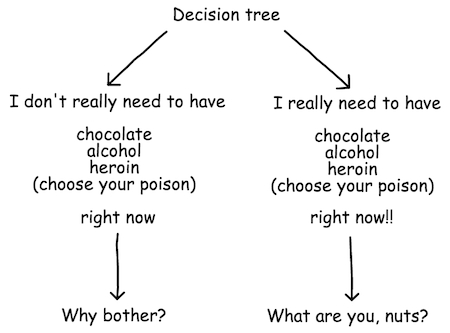
I’ve taken the liberty of creating a handy diagram that replicates my own internal mental process, which I call my “two step program”. For me it has worked like a charm:

The delicate balance of explanations

Yesterday I talked about (and linked to) Vi Hart’s masterful explanation of logarithms. By coincidence, today I found myself in a deep discussion about visual explanations with someone who creates them for a living (she builds interactive graphical explanations of financial trends for a major newspaper).

We ended up talking about the delicate balance of explanations. If you focus only on making things accessible, you run the risk of oversimplifying. People who watch your explanation may feel good about themselves, but they haven’t really learned something in a useful way. By “useful” I mean understanding something well enough to apply that understanding in new and different situations.

On the other hand, if you try too hard to be comprehensive, you might end up drowning your viewers in detail. When people are subjected to information overload, they are likely to walk away before having learned anything really useful.

And so, as with any narrative art, teaching with visual explanations is a process of opening doors for people at just the right rate, so that viewers can have the pleasure of truly absorbing something new, and then building on what they have just learned, in a series of satisfying steps.

It is an art at which Vi Hart excels, which is why I study her videos with such fervor and delight. Every time I watch the “Logarithms” video I learn something new about how to teach.

1 + 1 + 1

I have been spending the last few days simply in awe of this video:

How I Feel About Logarithms

Vi has done something here that I’ve never seen anyone do before: She has made logarithms completely clear and fun and accessible to everyone — not just to people who are already into math.

Why should you care? Well, the pitch and volume of every sound you have ever heard, the color and intensity of everything you have ever seen, how things feel when you touch them, and just about every other sensation by which your brain receives the world — all of it is on a logarithmic scale.

Considering that your entire experience of reality is best measured by logarithms, really understanding them is quite a big deal.

And Vi has singlehandedly, through this one lovely video, done away with all the formulaic misinformation and useless crap that so many people “learned” in school. In their place she has given us a perfectly intuitive and elegant explanation that is as easy as 1 + 1 + 1.

Music

This evening I was fortunate enough to attend one of those little parties where a number of the guests (as well as the host) were highly talented musicians. At some point in the evening the party drifted away from the food and toward the piano room, where people took turns performing.

A number of instruments were heard from, including clarinet and ukelele, in addition to our host’s magnificent grand piano. But what really struck me was not the variety of instruments, but rather the variety of musical genres, and the unique way that each genre communicated.

The choice of music was highly eclectic. There were folk songs in abundance, from Bob Dylan to Oscar Brand to that old standby Anonymous, for obscure ditties whose origins have been lost in antiquity. There was Dave Brubeck and Cab Callaway, and various selections from the Great American Song Book.

But one work in particular was quite different — a piano piece by Brahms. This was from another world entirely. Whereas the songs required you to focus on their lyrics, to be present in a very worldly way, the Brahms took us all to a place beyond mere thought, beyond language, a place of pure emotion — a sublime region of the human soul for which there simply are no words.

I am left marveling at the sheer range of all the wondrous things we call music.

Turks and Indians

A colleague told me today that he relies on Amazon’s Mechanical Turk for his academic user interface research.

For those of you who don’t know, this is a facility that allows people to sign up anonymously to take simple tests on-line. They get paid small amounts for taking these tests. In the words of Wikipedia, it is:

“…a crowdsourcing Internet marketplace that enables individuals or businesses (known as Requesters) to co-ordinate the use of human intelligence to perform tasks that computers are currently unable to do.”

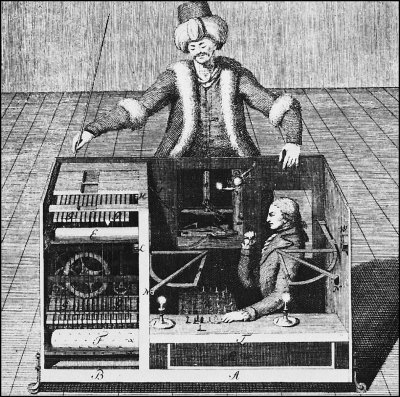
The term “Mechanical Turk” was inspired by Wolfgang von Kempelen’s famous 18th century chess playing robot, known as “The Turk”, which turned out to be a hoax — there was actually a chess-playing human cleverly hidden inside the robot’s housing.


If you’re doing market research, or trying to understand whether a new kind of software interface is better than the old one, Mechanical Turk can be an effective way to get lots of people to try things out for you, at modest cost.

During my colleague’s description of the process, he mentioned that the great majority of the people who answer these questions are located in India.

Which is when the following thought occurred to me: As computer interface design studies come to rely ever more on Mechanical Turk, perhaps the interfaces we use will become increasingly optimized for use by people in India.

I’m not entirely sure whether this is a good thing or a bad thing.

Seven of nine

As many have pointed out, Star Wars and Star Trek represent opposite ends of an American pop-cultural dialectic. Whereas Star Wars is serious, Star Trek is jokey. Whereas Star Wars is fundamentally religious, Star Trek is decidedly secular. One could create a long list of such oppositions.

But only this week did it occur to me that these differences are embedded in the very names of the characters. Here are a few names from each, together with notes on likely influences or meanings:


Star Wars:

Name:

Suggests:

Luke Skywalker

One who strolls among the stars

Leia

Lei + Geia (Hawaiian princess as earth goddess)

Han Solo

Exotic loner

Yoda

Yoga + Buddha


Star Trek:

Name:

Suggests:

McCoy

“The real McCoy” — an honest guy

Scotty

A guy from Scotland

Chekov

A guy from Russia

Uhura

A gal from Africa

Spock

An guy from Outer Space


As you can see, Star Wars names are all about exotic mysticism, whereas Star Trek names are about a bunch of regular folks hanging out and getting along, despite their ethnic diversity.

On the other hand, the original meaning of “Kirk” is “Church”, so I could be wrong about all this. Besides, it’s not as though the same person will ever direct a movie in each of these fictional worlds. One human being could never be permitted to have that much power.

In any case, if there were another Star Wars movie, it would be seven of nine, which everyone knows is part of the Star Trek universe.

Peter O’Toole


“He looked like a beautiful, emaciated secretary bird … his voice had a crack like a whip … most important of all you couldn’t take your eyes off him … acting is usually regarded as a craft and I claim it to be nothing more except in the hands of the odd few men and women who, once or twice in a lifetime, elevate it into something odd and mystical and deeply disturbing. I believe Peter O’Toole to have this strange quality.”

— Richard Burton