Too much time away
I missed my coffee maker
I know it missed me
Newspapers, unread,
Wait patiently at the door
They all missed me too
Because the future has just started
Too much time away
I missed my coffee maker
I know it missed me
Newspapers, unread,
Wait patiently at the door
They all missed me too
This week at a graphics conference I saw a nice little talk about crowd simulation. As I watched the presentation, it occurred to me that unless one does exhaustive measurements of real crowds, this is one of those situations where “success” just means that things look right: If people look at your simulation and believe they are seeing real crowd behavior, then you’re good.
So I decided to try my hand at crowd simulation, to figure out the simplest approach that would visually appear to act like actual crowds. It was surprisingly simple to do — within half an hour I had something reasonable, and then after another hour or so of tweaking, I was quite happy with the final result.
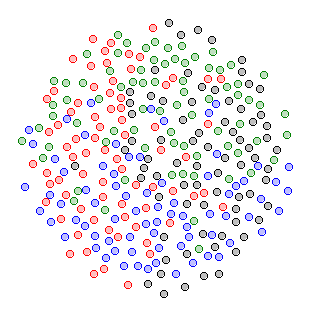
Taking my cue from the paper presentation I’d seen, my “test” was four different crowds of people trying to swap places — a crowd to the East swaps places with one to the West, while at the same time a crowd to the North swaps places with one the South.
As you may imagine, things can get chaotic. The simulation needs to convey a sense that people are streaming past each other intelligently, without bumping into one another.
For a first try I think I did pretty well. You can see the result by clicking on the below image.
 |
I was hanging out this evening with a group of top researchers in the fields of augmented and virtual reality. The conversation ranged from opinions about Google Glass to assessments of the Oculus Rift to various speculations about possible directions for augmented human perception.
It occurred to me at some point in the conversation that while just about everyone around the table was carrying a SmartPhone, nobody was looking at their phone. We were all too busy sitting around with a drink in our hand, while having a grand old time discussing the future.
So at some point I lifted my glass, and I said “We will know that augmented reality has truly arrived when we can experience it while sharing a beer.”
There was a thoughtful pause, as people weighed this thought in their minds. After all, you can’t really share a drink with a friend while you’re staring down at a little glowing rectangle in your hand.
Which is all just fine with me. For now, and perhaps for a while to come, the world is safe for non-augmented social drinking.
I had the oddest dream today.
I dreamt I was plunging to earth from a great height while holding onto something, and the only thing that could save my life during the long plunge was to keep holding on, without loosening my grip even once before I had reached the ground.
The dream was so vivid that I woke with a start as soon as my dream self had made it safely to the ground. Upon awakening, I found myself in a state of agitation.
Of course the dream doesn’t make any literal sense. But as a metaphor it’s pretty intense. I’m not sure I agree with the underlying philosophy it seems to represent.
Yet clearly deep down inside me, something is taking it very seriously.
In the various tales of vampires, there is a common tradition about inviting them inside: Once you have welcomed vampires into your home, they are then free to enter your home any time.
Like many mythological ideas, this one is grounded in truth: Before agreeing to something, it is wise to understand not just what we are agreeing to, but whom we are dealing with.
Continuing yesterday’s theme (today being the 10th anniversary of the American war in Iraq), the following open letter from Tomas Young to George W. Bush and Dick Cheney provides a searing reminder of this truth. The letter is from a young man who is currently dying from injuries sustained during his service in Iraq.
In the letter, he points out that he had enlisted two days after the destruction of the World Trade Center, to fight those who had attacked the U.S.
Now, as he spends his last days in a hospice bed, he is processing the fact that his enlistment gave our government the legal right to send him to fight any war it wished — even a war that had nothing at all to do with those attacks against the U.S..
A sad reminder that once you invited vampires in, you no longer have power against them. Alas, the vampires at your door can appear very presentable.
Sometimes they even wear nice suits.
At the end of the day today, it will have been exactly ten years since the United States started the ongoing “short war” in Iraq.
Which might be a good time to take stock as to how things are going so far.
On the plus side, Saddam Hussein is no longer in the picture.
On the minus side, hundreds of thousands of Iraqi lives have been either ended or disrupted, tens of thousands of American men and women have either lost their lives or have had their lives and health irrevocably damaged, and the total cost to the American taxpayer over the coming decades is estimated by various experts to come to approximately six trillion dollars.
You never know what will come out of a short war.
It is fortunate indeed that we didn’t plan a long war.
A friend and I were having a conversation today about the nature of cultural upheaval in the U.S., and my friend pointed to the apparent calm of our own time.
We do not, on the surface, seem to be in an era of radical cultural change. Discourse today has nothing equivalent in urgency to hippies rejecting the Eisenhower post-war culture, or to punks declaring war on the middle class.
In fact, retro is in. Young people are mining the past for cultural influence, reaching back to the 1960s, or 1950s, or even the 1920s for inspiration.
But after talking it through a bit, we both concluded that this apparent calm is deceptive. The very nature of the cultural conversation is changing. The entire apparatus of passive consumer culture is being questioned by a generation less interested in pure consumption than in remix and collage.
For a growing number of young people, TV and movies are no longer the be-all and end-all of cultural experience. They’re just source material.
Maybe, my friend said, things seem calm because the new generation is still in the process of absorbing the past, assimilating it, gathering data.
As this generation grows into its power, and starts letting loose with a new kind of cultural production, one that is far more participatory than anything seen before, the change is going to be radical indeed.
Today I was invited to a “boxing aerobics” class. I hadn’t even known there was such a thing, and I found it quite fun and interesting. For part of the class we put on boxing gloves and took punches at large free-standing punching bags.
The instructor also gave us some really good lessons in technique. In addition to getting a workout, I learned the basics of the sweet science, including jabs, crosses, uppercuts, and effective ways to do combinations.
Just as the class was starting, my friend gave me a suggestion: He pointed to a spot at eye level on the punching bag and told me, essentially, to imagine the face of somebody I am mad at. “The next time you see that guy,” he said, “you’ll be totally cool and calm.”
I appreciated the suggestion, but as the class went on I found it difficult to think of anyone whose face I really wanted to punch. The whole energy just wasn’t working for me.
Then at some point I had an insight, and after that it all got a lot easier. I imagined my own face up there. Suddenly my jabs started to hit with precision, my uppercuts landed solidly, my right crosses connected with real power.
When it was all over, I was completely relaxed and loose — tired but happy, and ready to hit the shower. It had been a great workout, and I felt wonderful for the rest of the day.
And the next time I see that guy, I’ll be totally cool and calm.
Today I had a fascinating conversation that touched on how art and craftsmanship change as new technology allows an artistic process to evolve from manual techniques to more “instantaneous” and automated alternatives.
For example, when a film is shot on location, happy accidents can arise from the very difficulty of framing your shot in the real world. Perhaps there is an unexpected car or lamppost in the scene that must be shot around, or else incorporated into the frame. This very challenge can lead to new ideas.
If the set were computer simulated, and the lighting designed in post-production (two options that are becoming ever more readily available), such happy accidents might never occur. The argument could be made that convenient “improvements” in process can actually impoverish the outcome.
A counterargument could be made based on the following observation: A novelist experiences no such production hurdles. Yet the author, upon writing part of a scene one morning, might later that day have a random conversation or encounter which provides, the very next day, a new insight into how to complete her scene.
So perhaps we do not need to fear that evolving technologies will debase our art. The happy accidents that lead us to discover our best artistic impulses come not from the complication of dealing with the world around us, but rather from our own complicated human responses to that world.
As a break from work (the more work there is to do, the more I seem to need such breaks) I have been joyfully wandering through YouTube watching old performances, many I’d never seen before, by Sid Caesar, Victor Borge, Vera-Ellen, Ernie Kovacks and other greats from more or less sixty years ago.
It was an astonishingly rich world, and you can become totally pulled into it. Traveling through it is a bit like having your own time machine.
To take just one example, there has never been comedy before or since quite like the Nairobi Trio. In fact, it deserves a link.