Focus

I’ve begun to pay far more attention recently to the preconditions for getting done the things that we want to do. It seems that it’s not the world around us so much that affects how much we are able to keep our focus, but the world we create around us.

The human brain is always running on multiple tracks — it’s the way we are constructed. While part of our mind is focused on whatever task is at hand, another is thinking back to that argument we had last week, or the restaurant we’ve been meaning to check out, or perhaps a dimly remembered moment from when we were five years old.

Alas, it is all too easy to become distracted. Before we know it, our train of thought has jumped from one track to the next. Perhaps part of the pleasure of seeing a good movie or reading a great novel is the way it lets your mind luxuriate within a single track, without the constant decisions and shuffling of priorities you encounter in your real life.

This may also be a reason that intense and highly focused situations, like mountain climbing or white water rafting, lead to powerfully positive memories and feelings of bonding. They force our minds to be in one place for an extended period of time, something most of us don’t get to experience all that often.

But we can’t always be climbing a mountain or rafting down wild rivers. So how can we improve focus, and increase our ability to stay in the moment, in our everyday life? I’m open to suggestions. 🙂
“Breaking Bad” as superhero narrative

I confess, right off the bat, that I’m only in the middle of the first season, so there may be fundamental elements I’m missing. But even from what I’ve seen so far, “Breaking Bad” is incredibly exciting from a formal perspective. It has many of the elements of a superhero narrative, but from there everything is twisted just about as far as it possible can be.

The main character is unquestionably an individual with superpowers. Specifically, he has an astonishing mind, capable of seeing patterns in the world around him and instantly creating new inventions in response. And he doesn’t do this the way MacGyver would, by making a fetish of an ability to improvise around household items. No, his innovations are instantaneous, innate, done with no more effort than it would take to punch in a phone number. He hardly seems to notice them. We’re talking serious superpower here.

And yet our hero is as dysfunctional as it is possible to be. His life is careening off-course, and he is in deep psychological denial about everything, even about being in deep psychological denial.

Best of all, the emotional scale is operatic, immense. The emotional range we experience through the eyes of this man is insane, grandiose, wildly overwrought, tripping in a single beat from elation to the knife edge of despair. We’re not talking Columbo or House or Monk, reliably working out the crime or disease of the week. We’re talking Puccini and Wagner, Macbeth and Othello, only somehow magically transposed to the suburbs of middle American.

Make no mistake, this is a superhero narrative par excellence (albeit a new kind of superhero narrative). A protagonist with godlike supernatural powers in a struggle for Truth, desperately trying to hold onto his moral compass in the face of overwhelming odds. We don’t know how it will turn out, for him or for his world. So we tune in — breathless, appalled, delighted, and utterly transfixed.

Dysfunctional superheroes

Superman has never an easy superhero for the modern age. Unlike the classic Joseph Campbell hero, he has no conflict, no real journey to embark upon. Batman, on the other hand, is perfect for the modern era of conflicted, dysfunctional heroes. His entire quest to rid the world of evil is arguably a quixotic — and by definition impossible — attempt to right the terrible wrong that was done to his own parents. *

Still, Batman is highly traditional in certain ways. Unquestionably the boy tormented by tragedy has grown into a kind of uber-man — an unapologetic vigilante who believes thoroughly in himself and in his own brand of frontier justice.

Even when the hero is dark, these comic books were pure wish-fulfilment fantasy. Even the most insecure teenager could project themselves into a fantasy version of adulthood — an individual who has overcome doubts and fears to be the modern version of a knight of old.

Spiderman represents a far more radical evolution. Peter Parker is not Billy Batson being swapped out into Captain Marvel when danger comes calling. No, Spiderman the super hero is still a lonely lost boy, his self-doubt and insecurity highly visible, to the point of being a badge of identity. Stan Lee’s brilliant innovation was to project the insecurity of the reader onto the superhero himself.

By now we take such ideas for granted. Buffy is a good example of a modern superhero. We watch not to see her defeat vampires and demons (something she can do with ease), but for her far more interesting and difficult battles against her own inner demons. To quote Berlin artist’s Marcus Wittmers’ brilliant work Superman Crashing: “Auch Helden haben schlechte Tage!”

Which brings us to the inevitable next evolution in the superhero — “Breaking Bad.” More tomorrow.

* Yes, Superman’s parents — and, in fact, his entire planet — were annihilated, but as a child he didn’t have to deal with that, and it never seems to have really bothered him.

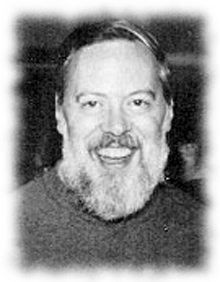
Dennis Ritchie


Sometimes something is so obvious that you can forget how important it is. Without air or water we would die. Without love and human contact, our souls would shrivel down to nothing.

And without Dennis Ritchie, so much that we take for granted today would not exist. The idea that a computer program can be a thing of beauty and elegance, the seamless mixture of artistry and technology that we take for granted in everything from Google to the iPad to Kinect, the very language with which our modern world was built.

It’s astonishing to realize how much we owe to the mind of one quietly brilliant man.

Dennis Ritchie passed away on October 12, 2011. He will be missed.

Draper Monogatari

When I was in college I read (in English translation) Genji Monogarati, or “The Tale of Genji”, a wonderful novel of imperial Japanese court intrigue written in the 11th century by Murasaki Shikibu. Her literary masterpiece was arguably the first novel, and it is completely absorbing not for what happens, but rather for the psychological insights and subtle shifts of power reflected in even the smallest conversations.

It also takes place in a highly refined world, where any deviation from social convention is verboten. Not that people don’t act inappropriately, but rather it is dangerous to appear to act inappropriately.

I am now watching Mad Men, and am struck by the similarities. There is enormous psychological conflict and tension beneath a veneer of absolute conformity to convention. Customs, manners, style of dress, social hierarchies, all are carefully adhered to, while just beneath the surface each character tries to reconcile this beautiful social prison with his or her own deep (and usually unmet) psychological needs.

Here we are, in 21st century America, essentially experiencing “The Tale of Genji”, with the stylized world of 1960 Madison Avenue standing in for the high court in Edo.

It would seem that the novel has gone full circle.

Ten superpowers for grownups

People contacted me privately about yesterday’s post, which I suppose was a very grownup thing to do. Here is a list of ten suggestions generated since yesterday for “superpowers for grownups”:

  • You can create an extra day between today and tomorrow
  • You never ever get sick
  • You know a magic incantation that can summon your lost house keys
  • After someone tells you how the movie will end, you are able to instantly forget what they said
  • You possess “Laser eyes” that can clean all your bathroom surfaces with merely a glance
  • You always find a parking space
  • You lose a little weight every time you eat dessert
  • When you meet people you’ve met before, you invariably remember their name
  • You can understand announcements on the NYC subway
  • When people tell you you look younger, they actually mean it

Superpowers for grownups

Today in the U.S., because NYU had no classes either Monday or Tuesday, in honor of Columbus Day, I effectively had a four day weekend. For us, the official “work week” doesn’t really kick in this week until Wednesday.

My students and I have been working intensely on a project, so we were all around this past weekend, getting things done. As noted in my previous post, yesterday was my magic “clean the office” day. Which left today — an entire extra extra day, giving me time to get more things done before everything starts up again tomorrow.

The feeling has been wonderful — a sense of extreme temporal luxury, as though some metaphysical intervention had granted me an extra day.

It occurs to me that a kind of superpower, quite different from the kinds of superpowers in all the Marvel and D.C. comics, would just be the ability to summon an extra day, between today and tomorrow.

I realized this doesn’t sound as flashy as super strength, incredible speed, effortless flight, invisibility, telekinesis, conjuring fire or ice, or any of those other amazing abilities that excite the imagination of your inner twelve year old.

Yet the more you experience of life, the more you realize that there is one fundamental element in the Universe more powerful and terrifying than all the rest — the element of time. So when you think about it, conjuring up that extra day would be a kind of superpower for grownups.

Come to think of it, can anyone think of any other good superpowers for grownups?

All clean and shiny

Sometimes an office can get out of control. One day you innocently put down a piece of paper on the nearest surface, then another piece of paper, and before you know it you’ve run out of surfaces. Soon the piles of paper have begun migrating to the floor. Eventually your little corner of the world has turned into something that would send H. P. Lovecraft fleeing to the world of the Elder Gods.

My office had gotten to the point where nobody, including me, wanted to walk through the door. There might as well have been a sign at the entrance proclaiming “Here be Dragons”. Even the piles of paper were covered in piles of paper.

So today I enlisted the help of two hearty and intrepid (and clearly very loyal) friends. Together we battled the beast to the ground, fighting a long and mighty war against endless legions of old reports, expired receipts, announcements for events from 2003, and an alarming variety of random bric-a-brac. Bravely did we enter the fray, we few, we happy few, tossing aside fearsome mountains of paper like so much — well — paper.

Now I sit in an office all clean and shiny. My desk is clear, and so, I dare say, is my mind. My uncluttered soul, no longer ensnarled by an endless labyrinth of insidious mess, feels clean and alive, soaring on wings of a new found freedom. I face the future, proudly and unafraid.

But first, I’m just going to put down this one piece of paper…

Revisited

This evening I saw a violin performance by my friend Mari Kimura, which she had set to my butterfly animation from last December. The combined violin+animation performance is called “Voyage Apollonian” (a name Mari and I had decided on together).

I had seen Mari perform this piece before, soon after she had composed the music. Yet somehow this time — hearing and seeing this again after most of a year had elapsed — it seemed like a far deeper experience. I’m not sure whether this is more because Mari has had months to work through the piece, or because my own distance from the animation now allows me to more clearly experience the combined performance.

In any case, it’s fun to see one’s own work with fresh eyes.

And of course, it doesn’t hurt to have great collaborators. 🙂

All that jazz

In an earlier post on Computer programming as performance, I raised the possibility of writing computer software as an act of performance in front of a live audience. More recently, in discussions with colleagues, I’ve come to realize that this is just one example of a much more general idea.

First, consider the distinction between “composition” and “performance”. Composition is generally done in solitude, without the constraints of immediate results. A play, a symphony, a novel, a 3D CG model, these are generally created “at leisure”. In contrast, a performance often takes place in front of a live audience. Acting on stage, playing a musical instrument or manipulating a puppet fall into this category. “Rehearsal” provides a bridge between these two modes, by providing a way for the performer to study and develop best ways to translate composition into performance.

All compositions are built from some sort of system of grammatical rules that are mutually understood between author and audience. Those rules may be musical, linguistic, cultural or other. Things get more interesting when such constructions happen not at composition time, but at performance time.

A few kinds of performance, such as jazz improvisation and improv comedy, involve creating novel grammatical constructions. In such cases, the performers are generally well practiced experts, and the grammatical variations are constrained and very well understood (eg: in jazz, “12 bar blues”, or in Improv comedy, “A man walks into a psychiatrist’s office with a chicken on his head”).

It would be interesting, in the context of any type of performance, to consider how to support new grammatical constructions during the course of a performance for a live audience. For example, are there meta-rules for such constructive performances? Do jazz and improv comedy have some underlying structural similarities with each other, simply because both allow the performer, during a live performance, to improvize new work?