Here in Kyoto
An old temple smiles, as youth
Plays in its shadow
Author: admin
The story in your eyes
The PAD (pleasure / arousal / dominance) scale by Mehrabian et al provides a nice simple three axis model for classifying all sorts of emotional states, including Anxiety, Depression, Panic, Empathy, Achievement, Extroversion, Arousal Seeking, Loneliness, Emotional Stability, Dependency, Aggressiveness, and Fidgeting.
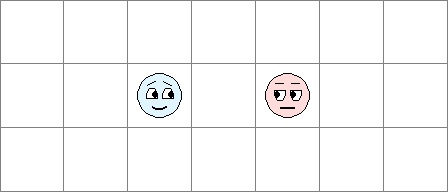
In my recent post about using simple face-only characters to create a story, I used only two of these three dimensions: eyebrows up/down for varying dominance, and mouth frown/smile for varying pleasure. After seeing a lecture today by Marc Cavazza in which he discussed the PAD scale, I realized that it’s easy to add the third (arousal) axis, simply by changing the shape of the eyes.
So I’ve created another version of this program in which I replaced the winking and blinking with eye shapes that evoke different levels of arousal: interested→neutral→bored. I also added a time-line! You can play with the new version by clicking on the image below:
Five percent
Several years ago I was on the phone with a program officer at the National Science Foundation, and I was describing a possible approach to a topic I’ve discussed here before — “universal programming literacy” — the possibility of everyone learning how to program a computer.
Her response was interesting. She referred to the “five percent who are the math kids”. Basically, she argued, about five percent of the population is interested in how things work, in a way that makes those individuals disposed to become mathematicians or scientists. The other ninety five are just not highly drawn to that way of thinking.
I suppose this idea is analogous to similar ideas about other fields. For example, most of us are exposed to some form of classes about music or art when we are kids. Yet only a small percentage love creating music or art, to the extent that they grow up holding a guitar or a paint brush in their hands, and thereby find their life passion and vocation.
Just in the last day I heard somebody else repeat the phrase “the five percent” in exactly this context, and now I wonder whether it is a given that this is the way things work — that some small percentage of the population are predisposed to becoming scientists, another small percentage are predisposed to becoming musicians, etc. (even in that scenario of course, there will be cross-overs, such as Brian May, who is both lead guitarist for the rock group Queen and an astrophysicist).
We all know examples of siblings who were raised in the same household by the same parents, with essentially the same cultural influences, yet one sibling falls in love with science and the other with, say, literature. This tends to support the “five percent” theory, does it not?
Millipedes conquer the world
Finding myself today on a long flight overseas without access to the internet, I started wondering what it would take to make a robot that moved like a millipede. My thought was that a robot millipede could move not merely forward and back, but in any direction.
The first thing I came up with works like the following, when seen in profile:
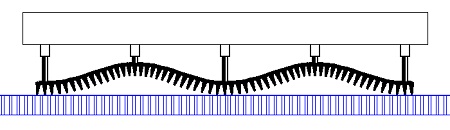
If you click on the above image you can play with the interactive applet. The basic idea is that as the surface undulates, the little “hairs” on the bottom spread out and come back together in such a way that they grip the floor and pull the robot along.
I was thinking that these “waves” of undulation could go in any direction, so at any moment the robot can move itself along the floor in any direction. One possibility is to put a regular arrangement of up/down actuators on the underside of the robot, like this:
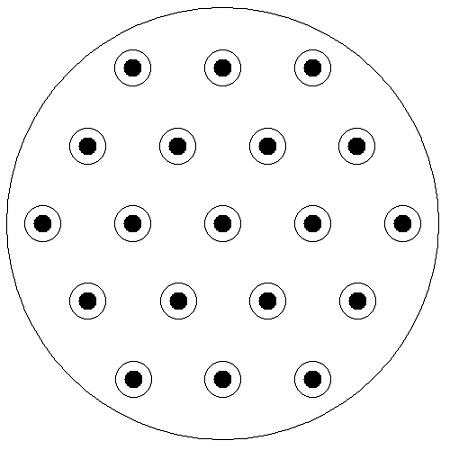
Then it occurred to me that rather than make this a vehicle, one could cover an entire floor or table with this kind of thing. Then any object you put on the surface could be moved along under computer control. This is reminiscent of some wonderful work done by Dan Resnick a while back, in which he cleverly vibrated a table to make it move multiple objects at the same time. One problem with Dan’s approach was that the more objects you wanted to control, the slower everything moved. The millipede surface wouldn’t have that problem.
Of course it will come down to questions like “How cheap can you make an actuator that just moves slightly up and down?” Should you use solenoids, memory metals, piezoelectrics, or something else entirely? The whole thing can be scaled down to very small sizes and still work, so the answer might just come down to finding a mechanism that comes in a really low cost per unit area when the actuators are at some optimal scale.
Perhaps eventually there will be a nano-tech solution, and these things will become as cheap as wallpaper. Imagine the desk that can arrange your papers or bring you your coffee cup — or a floor that could rearrange your furniture for you. That would be very cool.
Doodling movement
I was very excited when Doug shared with me the fact that his brother Mike’s math doodle has been posted on Vi Hart’s page. One person doing these things is already wonderful. Two people starts to look like a movement.
In this era of slick iPads and Flash and glossy screens, there is something immensely appealing about going back to telling animated stories with nothing but pencil and paper — albeit transformed by the relatively recent availability of digital video recording and internet sharing.
Also, this is a creative form that I can see children learning to do, to express their own original thoughts and ideas. Not only wouldn’t it require them to go through the intermediate step of learning some commercial software package or other, but it’s also more expressive. In fact, on a certain measure of expressiveness, it could be argued that there is nothing more powerful than the combination of human voice and drawing with pencil on paper.
Maybe the future has just become a little friendlier.
Hyperbolic apple slices
Doug pointed out, in response to yesterday’s post, that there are many possible surfaces with hyperbolic curvature in them here or there. This actually follows from my recent conversation with Vi. Even solid space itself can be curved, for as Einstein pointed out in his General Theory of Relativity, when a big object (like a planet or a star) gravitationally attracts things, it’s actually creating a complex distortion in the fabric of space-time in the vicinity of that planet or star.
So at different places in our own 3D universe, “flat” areas of space can actually have a slight curvature. Some places might look round, like a Reiman sphere, whereas others might be hyperbolic. It would be great to create a software design tool that lets you “dial in” a desired curvature at any point in space — creating a new kind of shape whose curvature changes from neighborhood to neighborhood of space.
If we had the freedom to play with this, imagine what kinds of virtual environments and architectures we could create!
Continuing to dry an apple slice
What Vi pointed out to me the other day was that an apple slice is exactly the opposite of blowing a bubble in the following way: When you start to blow a bubble, say through one of those little plastic bubble blower rings, the ring itself doesn’t change size, but the soap film gets bigger (because of all that air pressure you’re adding on one side).
What happens of course is that the soap film bulges out, and starts to form part of a sphere. The harder you blow, the bigger part of a sphere you get. So you see, when you increase the area of a soap film, but not the size of its perimeter, it starts to go from flat to spherical.
But what is going on with a dried apple slice? Vi pointed out to me that the area of the apple slice starts to shrink as it loses water. But the perimeter of the apple slice doesn’t go down by as much. So it’s the opposite of a soap bubble — instead of a surface with too much area for its perimeter, we have a surface with too little area for its perimeter.
So if a too-much-area-for-its-perimeter shape is a section of a sphere, what is a too-little-area-for-its-perimeter shape?
Vi gave a wonderful answer to this last week at the annual Joint Mathematics Meeting, which you can see in this video.
The Passion of Sarah
I was going to continue talking about some cool math stuff, but I realize that today it is more important to speak out about an astounding act of bravery that we have all witnessed in the last week. I am referring, of course, to Sarah Palin’s speech in response to the tragic shootings in Tucson last weekend.
While our president has become distracted by irrelevant niceties such as honoring the dead, mourning the tragedy, calling for solidarity among Americans, and asking us all to rise to our better natures, Sarah Palin has been tackling the real evil here. Namely, the Blood Libel against the former governor of Alaska.
Let me say at the outset that there is absolutely no evidence that Ms. Palin has engaged in arcane Cabalistic rituals involving the innocent blood of murdered Christian children. There are no photographs, no tell-tale emails, no paper trail. Even Wiki-leaks has not found anything concrete to link Palin to the ritualistic slaughter of young Christian boys and girls.
Yet apparently the rumors are out there. Why else would a public figure of her stature use this occasion to deny Blood Libel, rather than talk about, say, the little nine year old girl who was shot to death because she was caught in the gunman’s crosshairs (oops, sorry Sarah, I know “crosshairs” is a sensitive word).
It take a person of immense courage and fortitude to stand up to the liberal media, to speak not about the federal judge who was tragically murdered by a madman, or the U.S. Congresswoman who lies in critical condition with a bullet through her brain, but rather to forcefully deny, once and for all, having used the blood of murdered children in one’s secret religious rituals.
After all, should history be any judge, then if people believe the Blood Libal against Palin, they will rise up and storm her village, massacrng her entire tribe down to every last man, woman and child. So Sarah is right to focus attention on the real danger that such a tragedy might occur, no matter how much the “mainstream media” annoyingly insists on talking about some dead nine year old brat who can claim credit for nothing more than having been at the wrong place at the wrong time in Tucson.
Sarah knows that all true Americans support her, because we know that she is the real victim here, and it’s important not to let the haters win.
Besides, the Blood Libel against Sarah Palin couldn’t possibly be true. After all, she’s not, um, you know, Jewish.
Drying an apple slice
Yesterday I had a conversation with Vi Hart in which she made me see that drying an apple slice is exactly the opposite of blowing a bubble.
You probably think I’m speaking in hyperbole. Well, actually I am, but only on the surface. Tomorrow I will explain.
Mood dialing
I had a fascinating discussion with a friend the other day about mood regulation. If we actually develop a reliable capacity to regulate our moods at all times, would life be better or worse? Ted Selker presented a wonderful speculative paper a few months back on the idea that perhaps 20 years in the future we might each have a constant feed drip that would automatically pump the optimal hormones and other chemicals into our blood stream as we go through our day, all under computer control. He didn’t weigh in on whether this was a good thing or a bad thing — he merely pointed out that it is going to be a possible thing.
Frankly, I think we’re going to have the technical capability to do this, on a widespread consumer level, in far less time than twenty years. And when we do, what kind of a world will it be? Will there be less violence, because peoples’ regulators will automatically calm them down before they get too worked up, sort of like a personal cruise-control?
Or might it go the other way? My friend was concerned that individuals fall get into dangerous positive feedback loops, in which an off-kilter mood adjustment might lead to bad judgement, which could cause a spiraling out of control. And so, will self-mood-regulation be seen as a privilege rather than a right (much like a driver’s license), and will your license to regulate your own mood be revoked if you abuse it?
Will the artistic impulse begin to wither away and die, as would-be artists find themselves perfectly content, with no angst to work out or express through their work? And if this happens, will anybody care? Will we gradually degenerate into a society of placid lotus eaters?
Or will we, after an initial period of adjustment, learn how to use these new capabilities constructively — to exercise more, eat better, do our work with greater enthusiasm and vigor, be kinder to our friends and family, get in touch with our sexuality, find more joy in life and in each other?
Of course in the worst case things could all go horribly wrong. And if they do, will we still have the capacity to care?