A question for the ages

Is it possible for two people to be connected across the gulf of differing times of life? I have friends who are at various stages in their lives, different from my own. Some are younger, others older. Let us acknowledge right up front that people are concerned with different things at different stages of their lives. Yes, there is enormous individual variation, but a life has an arc, and in the various stages of life, from birth to coming of age to mating to death, we don’t generally have the life arc of Martians – any more than we have three eyes in our head – we have the life arc of humans.

Of course we can connect with someone whose age differs greatly from our own, up to a point. if the older person channels that part of their being that still remembers their younger self. But can we get beyond such trickery? Can there be a true meeting of souls that defies the conventions of age and chronological caste?

I would love to know other peoples’ opinions on this.

Scenes from the novel XI

Clarissa enjoyed her walks. She considered herself to be a sociable creature, yet she was acutely aware that this amiable quality was, paradoxically, wholy contingent upon frequent access to opportunities to be unsociable. As she walked along, feeling the gentle breeze from the river upon her parasol, she mused to herself how delicate is the quality of tolerance amongst one’s fellows. There were many who regularly sought out her company, in fact craved it. Yet she was quite certain that, without her long walks, and the opportunities they afforded for quiet thoughts and inward reflection, she would quickly cease to project that pleasant persona which was assumed by those of her general acquaintance to accurately mirror her inner nature.

Clarissa was acutely aware that her “inner nature” was far more turbulent and dark than was generally suspected. She smiled ruefully to contemplate what might transpire were some unfortunate soul, seeking the uninterrupted pleasure of her company, to be granted his wish. That inner fire within her bosom which others could but dimly perceive, which in fact unfailingly drew the attention of ordinary mortals as the flame draws the moth, and the true nature of which she rather artfully deflected from the eyes of man, nonetheless burned with a heat that was perhaps not best suited for providing warmth and comfort to others.

The calm of the river, the coolness of the midafternoon breeze, the soft firmness of the earthen ground beneath her feet, these were her balms, the silken threads from which she would oft return to refashion her disguise. Three elements of nature, the power of air, earth and water taken together, could conquer the fourth – for a time.

Of all the mortals she had known, it was a continual source of surprise and delight to Clarissa that there was one whose company she did not feel any need to ration. For it happens that from time to time fire will find itself in the company of steel. Upon those happy occasions the former will serve, not to destroy, but merely to temper and to strengthen the latter. For the flame, weary of the danger that it might immolate all in its path, these are happy occasions indeed. To dance and burn brightly, to be a thing of beauty rather than of pain and despair, what spirit would not be heartened by such moments?

She was lost in these thoughts, her eyes cast downward toward the earthen path before her, when she saw a second shadow upon the ground, joining that of her parasol. Somewhat startled, she looked up, and found herself staring into a familiar pair of steel gray eyes. At the sight of those eyes Clarissa broke into a broad grin. For the first time in days she felt a truly untroubled gladness.

“Howdy ma’am, sorry if I startled you,” he said, tipping his wide brimmed hat. “There’s a little matter that I’ve been meanin’ to talk over.” He gazed down for a long moment, as if searching for his thoughts within the shadows on the dappled path. Then he squared his shoulders, and looked back toward Clarissa with a shy smile. “Guess I just been tryin’ to work up the courage.”

My puppet friends

Today I got together with a group of people and we made puppets. People generally brought materials they had around the house. I happened to have a big bag of wiggly eyes that I had bought years ago, mostly because I had been hoping that one day somebody would ask me to help make puppets (really). I also brought various pieces of felt and assorted unmatched socks, which was no problem, because my socks are all cannibals (once they are in my dresser drawer it is clear that they eat only their own kind) so I have lots of unmatched one-offs. And I even brought a glue stick, a portable sewing kit, and a little package of Krazy glue.

Somebody else brought pipe cleaners, and yet another person brought Elmer’s glue, and so forth. Between us we were very well equipped.

Cleverly I had worn a sweatshirt today with a big pocket in the front, so I could stuff everything into that as I rode the subway to the event with dozens of craft items stuffed in my pocket pouch, feeling quite the marsupial.

I was also feeling very generous, handing out extra socks to other puppet-making friends in need. There is something wonderful about knowing that somebody will be bringing to life something that you used to wear on your feet. Well, maybe you had to be there.

Actually one woman there was afraid of socks – some kind of phobia, she explained – so she turned down my gracious offer for a sock upon which to build a puppet. Neither she nor we knew what to call this syndrome. We realized that there may not be an Ancient Greek word for “sock”, as the odds are quite strong that socks were not worn with togas (somebody please correct me if I’m wrong on this score).

Once we were all settled in, we proceeded to build, chatting away and generally having a marvelous time. The next time we get together we will be creating a film starring the puppets. We have not yet worked out the details of the script, but we already agree that a Creation Myth for our group is called for: The heartfelt saga of how a group of people got together to do things like make puppets that can star in movies about how a group of people got together to do things like make puppets…

So now we have all our lovely sock puppets all assembled (as well as one paper plate puppet, from the woman who suffers from sockaphobia). I am feeling quite pleased about the whole thing. I think I’ll go Krazy glue some wiggly eyes onto something.

Is it you or me?

If I miss you, is that “you” you?
If you miss me, is that me too?
Who am I to you today,
And how is that me anyway?
If I were someone else instead
Would he be me inside your head?
I guess then he would be your me
This other person that I’d be.
And what if you were she, not you!
Is it to her I would be true?
    Well then, perhaps they would be we
    And we could just be you and me.

Holm for Mother’s Day

As I said yesterday, Gentleman’s Agreement is ostensibly a film about fighting the evils of antisemitism. It comes complete with a subplot involving John Garfield as an actual Jew who is far more heroic than Gregory Peck’s make-believe one.


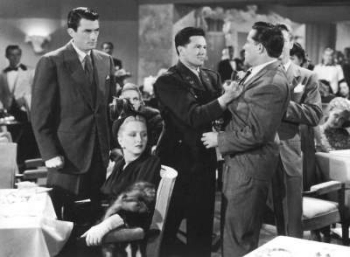
John Garfield fighting antisemitism;
Gregory Peck and Celeste Holm look on

But it is also something Hollywood takes far more seriously: a romance. There are strict rules governing Hollywood romances, and Gentleman’s Agreement was, in addition to its heavyhanded political message, a Hollywood romance. Moss Hart’s screenplay went by the book: three acts, with each act serving a very particular purpose. In the first act, the Hero meets the Girl, and they both intuitively understand that they are destined to be together. In the second act, a conflict (ideally arising from character flaws) gets the better of them, and by the end of this act the hero and his love are separated.

This moment in a film is generally filled with despair: it could be anything from George Bailey (Jimmy Stewart) stuck in the alternate universe where his wife doesn’t know him in It’s a Wonderful Life to Alex Fletcher (Hugh Grant) trying to pretend his character still makes a lick of sense after the idiotic plot twist that has separated him from his lyricist love interest (Drew Barrymore) in Music and Lyrics (audiences generally know when their intelligence is being insulted by lazy applications of the formula).

Finally in the third act the couple is reunited, wiser and stronger for having weathered their conflict. They and the audience now know that the two lovebirds will have what it takes to raise happy and well-adjusted children together, which is what all the fuss was really about, down there in the subtext.

As written by Moss Hart and directed by Elia Kazan, Gregory Peck’s character of Philip Green finds his dreamgirl in Dorothy McGuire’s character of Kathy Lacy. Although she is a sheltered girl-woman without any interesting thoughts or ideas, and no real sense of the world around her, Kathy has the qualities that post-War Hollywood knew were essential to being a good match for the alpha male: she is really, really pretty, and it is clear that there is no chance at all that she could ever symbolically emasculate Philip by being his intellectual equal.

In a formal sense of screenplay structure, the entire supposed theme of the film – the problem of American antisemitism – is merely a McGuffin to separate the guy and the gal at the end of the second act: Kathy uwittingly reveals that she herself harbors antisemitism. Until she shows that she can overcome this problem, the couple will not be able to get happily together again to start making those babies.

The rules say that this low point in the film needs to be signaled by an event that is utterly catastrophic to the hero’s psychic well-being. In the case of It’s a Wonderful Life, the (very effective) signal is George Bailey turning into a raving violent maniac. In Music and Lyrics the signal is Alex Fletcher betraying Sophie (Barrymore) in a way that is both ludicrous and wildly incompatible with everything the audience has learned about his character in the preceding hour (which is why it’s a terrible movie).

In Gentleman’s Agreement the evil appears in the form of Celeste Holm. Now, it’s important at this point to emphasize that Celeste Holm’s character, Anne Dettrey, is by far the most delightful person we meet in the film. As I said yesterday, she is brilliant, witty, gracious, has a wonderful sense of humor and is enormously perceptive and self-aware.

And yet, as written and directed, the second act slump – the emotional low point in the film, the terrifying pit of ultimate horror from which, once fallen, our hero can never escape, is the moment when Philip, left bereft by his apparent loss of Kathy, agrees to go out on a date with Anne.


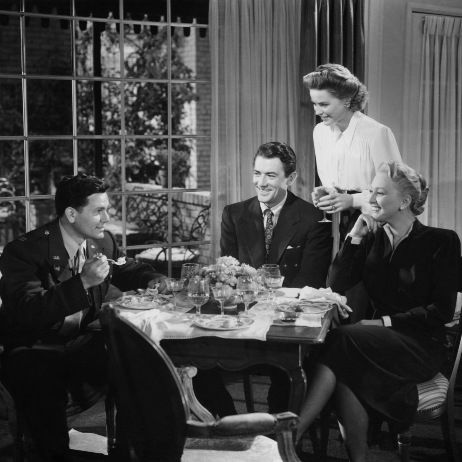
Philip Green (Gregory Peck) with his two women

One would think that this turn of events would be a cause for celebration: Philip seems like a sensible fellow, and now he has finally gotten away from that wet blanket Kathy and found himself with a far more interesting woman. Yet the scene is played the opposite way: The independent career gal, brilliant, witty, good natured, fun and self-aware, is shown as the Enemy, the great destroyer, “She Who must be Slain”.

As far as I can make out, this is because she is supposed to be a spinster – a woman who is somehow past her prime, living for a career but secretly desperate for a man. And this makes her damaged goods.

There are so many ironies here. One of them is that Celeste Holm was actually a year younger than Dorothy McGuire when this film was made. Another is that a film which is so proudly and self-consciously focused on exposing the insidiousness of prejudice, is itself the embodiment of an especially snarky and destructive prejudice of its own – a prejudice against women.

There is a positive note to sound here, which is this: A movie that made this particular set of choices would make far less sense to today’s audiences. The enormous struggle by women to be valued as something more than pretty baby-making machines has been very successful – although of course there is a long way yet to go. In this age of the Internet, smart, independent and accomplished women are highly valued, and are recognized as sexy women.

So isn’t it wonderful that a great early feminist icon, the character of Anne Dettrey, was played by none other than the mother of the father of the internet?

When audiences responded to the sheer force of Celeste Holm’s sparkle and wonderfulness in the midst of an otherwise dreary and tendentious film, and the Academy rewarded her performance with a well deserved Oscar, perhaps that was the moment when the cultural tide started to turn. If so, what a wonderful Mother’s Day gift Ms. Holm has given to the world.

Gentleman’s agreements

As I was saying… Ted Nelson’s mother happens to be Celeste Holm, one of the greatest actors of stage and screen in the twentieth century. The film for which she won an Academy Award – for best supporting actress – was Gentleman’s Agreement.

This film iteslf was a polemic about antisemitism. (a “gentleman’s agreement” is an unspoken pact – in this case the unspoken agreement in much of WWII-era America not to allow Jews into housing, social clubs, restaurants, etc.). The set-up was quite simple: Gregory Peck plays a reporter who has just moved to New York and is asked to do a story about antisemitism in America. To get the inside scoop, he poses as a Jew. As Peck’s character experiences antisemitism first-hand, he (and the audience) gets a raised consciousness. The lesson he learns is quite specific: The real enemy is not the obvious racist, but rather the ordinary “good citizen” who goes along with racism.


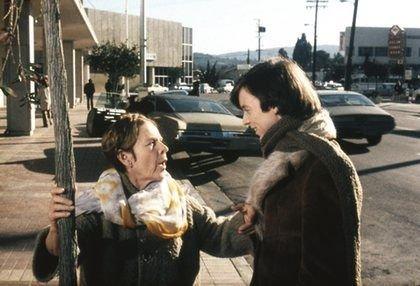
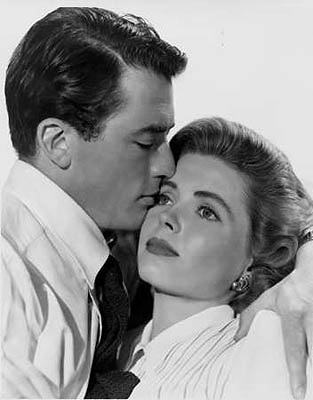
Peck and McGuire share a moment

The timing of the film couldn’t have been more fortuitous: It was released in 1947 – just two years after the end of World War II. As America learned just what had been done to European Jews in the war, the nation was in a mood to be sympathetic toward Jews, even though antisemitism was still rampant in the U.S.. The film won three Oscars and was nominated for another five.

There are several women in the film, and therein lies today’s tale. Peck’s main love interest was played by Dorothy McGuire, a beautiful actress who radiated a kind of youthful femininity. Another woman he encounters, played by the aforementioned Celeste Holm (Ted Nelson’s mom), is perhaps the only character with whom we in the twenty first century can immediately like and sympathize. Not just as written, but also as played by Ms. Holm, she is enormously self-aware, open-minded, brilliant, with a gracious wit and a wry and subtle sense of irony that one associates not with characters in films of the post-war era, but more perhaps with the characters of Joss Whedon and Candace Bushnell.

The reason I think her character is so important is that the film’s explicit plot of unspoken antisemitism laid bare is accompanied by a secondary conflict: The film plays Dorothy McGuire’s beautiful and sheltered heiress Dorothy McGuire against Celeste Holm’s brilliant, fun and independent minded career gal, to an effect that speaks deeply to the theme of the story, but in a way that I’m guessing was not intended by the film’s creators.

We conclude tomorrow on, appropriately, Mother’s Day.

Ted’s mom

There was an evening, some years ago, when I found myself having drinks with Ted Nelson. For those of you who don’t know, Ted Nelson is the person who first came up with the idea of the hyperlink – the basis of the internet: The idea that you can simply click on a piece of text in a document, and you are instantly taken to another document, which may be stored anywhere in the world. Sure, it sounds obvious now, but until Ted Nelson came up with this beautiful and elegant concept, nobody had ever thought of such a thing.

As you might well imagine, I was in complete awe of him. Here I was, slowly getting drunk with one of the premiere gods of the information age. Of course, there are gods and there are gods. And let’s face it, after you’ve had enough to drink, the only god you worship is Bacchus. Which is how it happened that, at a particular moment in the evening, I turned to my hero and said to him “You know, as much as I am in awe of your contribution to society, I am more impressed by your mom.”

There are at least two things that are interesting about this moment. One is the fact that I actually knew who Ted Nelson’s mom was. The other is that he completely agreed with me, and that he graciously ceded the point.

To put it bluntly, to me Ted Nelson’s mom is the unsung hero of proto-feminism. Long before Gloria Steinem or Betty Friedan, Ted’s mom created a cultural image that threw all our most insidious antifeminist prejudices back into our collective American face.

And although she was awarded for her pains what may very well be our culture’s most coveted honor, the true meaning of what she conveyed was so far ahead of its time that it would be decades before anybody could begin to understand its true significance.

More on this tomorrow.

Beam me up, Harry

Much of the world is currently going through a phase in which people are spending more and more time typing on keyboards, moving mice around on their desktops, and staring at computer screens (like I am now). It’s possible that we’ll be spending more and more time doing this kind of thing in the coming decades.

But as Nintendo recently showed with their WiiMote, other paths are possible. Perhaps we are just in a transition period. Arthur C. Clarke famously said that “Any sufficiently advanced technology is indistinguishable from magic.” And I think that J. K. Rowling was getting at something very similar in her Harry Potter books.

Magic took the role of technology in Harry’s world. And all of the magical gizmos in that world had the sort of comfortable homey feeling of old England: People in newpaper photos waved to you, but they were still printed in black and white. Maps showed you the locations of anybody who was transgressing – but the map was printed on old parchment and you could roll it up and slip it in your pocket. People transported instantaneously between one place and another not in a shimmering beam of light but from the platform of an old London train station.

In a sense Rowling was presenting a very forward conception for the future of Human Computer Interfaces (HCI). Why shouldn’t HCI simply be what we want? Rather than people needing to retrain themselves to conform to whatever are the current limits of technology, why not envision a future in which technology conforms itself to precisely what makes us humans the most comfortable, to whatever best supports our social interactions with each other? That future would most likely entail the sorts of face-to-face personal interactions that our brains and bodies have evolved to be so good at.

If you really take Clarke’s dictum to heart (and I do) then there is a strong case that the long term path for interface technology – the way that will lead to information appliances really doing “what we want” – is likely to lead not to Star Fleet Academy, but to Hogwarts.

Scenes from the novel X

All that summer the children kept their secret. It wasn’t exactly that they didn’t want to tell their parents about the thing in the cave. They agreed that their parents wouldn’t have been believed them anyway, so it was ok. Each day they would trudge through the woods, past the old McLeary barn, over the creek and through the hole in the fence behind the abandoned dairy. It wasn’t exactly dishonest, keeping it to themselves. After all, nobody had even asked them about it, and if somebody doesn’t ask you about a thing, then it’s not lying if you don’t talk about it.

The most exciting discovery was that the thing could talk to them. At first both Jenny and Peter each thought that the voice was something inside their own head, like if you had a dream and you start to remember parts of it the next day. Then, when they discovered that the voice was saying the same thing to both of them, they began to understand that the thing was talking, in its way.

They would bring it little presents, sometimes scraps of food smuggled from dinner, which it would noisily devour. It didn’t have very good table manners, but that’s to be expected from a thing you find in a cave. Then it would go right back to building its contraption, tinkering, hammering, moving things here and there in what seemed like random order.

One day Peter brought it a little spool of copper wire from dad’s shop. He just knew that was what it needed, although he couldn’t have said how he knew. That was an exciting day for the creature. It turned the spool over and over in its long bony fingers, peering at it every which way, before starting to bite off short lengths of wire and place them here and there in the contraption, winding the ends around some of the little knobs that stuck out everywhere. In their heads the children could hear that their little friend was almost done, and they were very excited to see what would happen next.

By the end of the summer Jenny and Peter had gotten much better at silent talk, and they could even do it when their new friend wasn’t around. They would wordlessly tell each other jokes over dinner for practice. Sometimes they would both giggle out loud at the same time, and their parents would give each other worried looks. But Jenny and Peter knew there was no reason to worry. Soon there would be nothing for anybody anywhere to worry about. Not anymore.

A Mark of distinction

We’re not quite done with the seven dwarves. There is still the question of how to decide which dwarves can reach the nine button and which can only reach the eight button (the digits need to alternate in the right pattern for things to average out properly), but we can come back to that another time.

This evening I went with a friend to see the revival of the farce Boeing Boeing (in a translation by Beverley Cross of Marc Camoletti’s french original) on Broadway. I mostly went to see Mark Rylance, who is quite possibly the finest english speaking actor of his generation. He is a legend in the U.K., but virtually unknown here. I had been fortunate enough to see a number of productions that he had directed and acted in when he was the Artistic Director of the Globe Theatre in London. The sheer range of this man’s acting talent is bewildering – from Shakespearean tragedy to modern farce, he holds the audience completely in the palm of his hand at all times. Imagine what it might be like to play pick-up basketball with Michael Jordan: He might play down near your level to keep it fun, but the immense coiled strength and skill is always there, waiting to be unleashed in an instant.

At the Globe I had especially liked Rylance’s conception of Twelfth Night, the one where Viola dresses like a man, impersonating her twin brother Sebastian (whom she believes is dead). Duke Orsino, having fallen in love with the Lady Olivia, hires this comely young “man” as a go-between, whereupon Lady Olivia falls for Viola (whom she thinks is Sebastian) and Viola falls for Orsino – which is also awkward, because the Duke thinks she’s a man. Then of course the real Sebastian turns up, and everything goes pear shaped (a wonderful British phrase taught to me by a young lady from London).

Rylance went back to the custom of Shakespeare’s day, whereby all the parts are played by men. Of course in the 21st Century this makes for quite a different impression. Rylance cast himself as the Lady Olivia. Imagine if you will a man playing a woman tormented by her love for what she thinks is a young man, but who is actually a woman, who is also played by a man. Meanwhile, this second young man playing a woman playing a man is in love with the Duke, a man who is in love with the first woman being played by a man.

Got that?

Well, it worked splendidly, and the audience was able to follow every moment of it, largely because Rylance directed and played the part of Olivia with absolute conviction. In lesser hands this conceit could have been a complete mess, but Rylance’s powerful direction and performance ended up bringing out the strengths of Shakespeare’s immortal comedy of errors.

In Boeing Boeing Rylance plays a man from Wisconsin, and he slips into a flawless midwestern accent – most audience members will assume he’s from somewhere near Madison. The entire farce is a delight, a complete success, and much of the comedy rests on Rylance’s uncanny ability to channel the extreme emotions of farce, from shy sobriety to hysteria to uncontrollable lust, either switching between one and the next at the instant, or, on occasion, managing to convey all three at once.

The evening was lovely, and the audience very happy. At the end Christine Baranski, who plays a french servant eerily like Edna ‘E’ Mode (the fierce if diminutive fashion designer created, directed and played by Brad Bird in The Incredibles), flung her cigarette out to the audience, and it landed in my lap. I shall treasure it always.