Off the deep end

I have been following the comments on yesterday’s post, and I think Lisa and Manooh have both made very thoughtful points – but from completely different philosophical perspectives. It was interesting for me to watch Lisa work through this difficult terrain, trying to be thoughful and intellectually honest about it, while wrestling with points of view that clearly seemed very foreign to her. The only aspect of Lisa’s comments that I didn’t follow was the connection between admiring red poll cows and eating red poll cows. These seem to be two quite separate issues – if you find something beautiful, that’s reason enough to work to preserve its existence, isn’t it? For example, we like having squirrels in our parks, and we don’t need to justify their existence by eating them.

I was completely thrown for a loop by Sally’s comment that I am going off the deep end. I’m not sure what it means to be off the deep end in this context. My opinion is simple: I don’t want to kill any fellow being that has a subjective experience of existence, so given the choice, I choose not to. I understand that this is a minority opinion, but so is being Jewish or Quaker.

I don’t tell people that they are off the deep end because they kill to eat. My objection to The Times editorial was that it implied that there is some kind of mutual sentimental bond between people and the creatures that people kill – a sort of pleasant inter-species friendship. On the face of it isn’t that a contradction? Clearly I am not the friend of what I kill. It might be in my self interest, but it is never in the interest of the other. The fact that The Times felt the need to say something so inherently self-contradictory seemed interesting and worth talking about. If pointing this out constitutes being off the deep end, then what doesn’t?
A more measured approach

Yesterday The New York Times published an editorial about the one million dollar prize that PETA is offering for the “first person to come up with a method to produce commercially viable quantities of in vitro meat at competitive prices by 2012.” The Times’ response was interesting:

“We prefer a more measured approach. Ensure the least possible cruelty to animals, by all means, and raise them in ways that are both ethical and environmentally sound. But also treasure the cultural and historical bond between humans and domesticated animals. Historically speaking, they exist only because of the uses we have found for them, and preserving their existence means, in most cases, preserving the uses we have made for them. It will be a barren world if the herds and flocks disappear in favor of meat grown in a laboratory tank.”

By changing just a few words of the above paragraph, we can apply this interesting logic to other contexts:

“We prefer a more measured approach. Ensure the least possible cruelty to slaves, by all means, and raise them in ways that are both ethical and environmentally sound. But also treasure the cultural and historical bond between us and our slaves. Historically speaking, they exist only because of the uses we have found for them, and preserving their existence means, in most cases, preserving the uses we have made for them. It will be a barren world if the happy slaves singing in the fields disappear in favor of crops harvested by machines.”

Scenes from the novel VIII

Emily inched her way around the house. She looked carefully where she placed her feet, trying not to step on any twigs. She could hear voices from inside. The voices sounded pretty close, but if she was very quiet, maybe they wouldn’t hear her. She knew that her footsteps were leaving impressions in the muddy ground, and so they’d be able to tell that she’d been here. But by then it shouldn’t matter anyway, since she’d already be gone.

She inched along the wall, trying really hard to be quiet, not even to breathe too much. When she was sure of the next footstep she would look up at the mural along the side of the house. She could tell from the pictures that she was getting there, slowly but steadily. The voices inside were even louder now. It sounded like an argument.

Finally she found it – the painting of the two white chickens – a hen and a rooster, a girl chicken and boy chicken. It was the same funny picture she’d seen in the book, with the chickens looking into each other’s eyes, like they were on their honeymoon. She wondered whether chickens have honeymoons. And if they do, where do they go? Maybe there’s a resort somewhere just for chickens in love. For a moment she saw an image in her mind of the girl chicken wearing a two piece bathing suit, and she felt herself starting to giggle.

Quickly she stopped herself, wondering if the people in the house had heard. This was a really bad time to get silly. Focus, think, what was next? The wheel barrow turned out to be right where Grob had said it would be, hidden just behind the azalea bushes. It was still wet from the morning’s rainfall. The once shiny red paint was rusting off in places, but she could tell it had been really pretty once.

Something was funny about it though, and she tried to figure out what it was. Then she realized – there was no water inside the barrow. That shouldn’t have been possible, so soon after the rain. And that’s when she knew everything was ok. Carefully she climbed in, being careful not to tip it over. Some of the wed mud clinging to the outside of the barrow got onto her skirt, but there was nothing she could do about that. It was only as she sat down, steadying herself, that she became aware that the voices had stopped. She tried not to think about that now. She focused, like she’d practiced, looking up at the picture of the two chickens, focusing on it, thinking about the book like she was supposed to.

Then there were voices again, but now they were much clearer, outside the house. Steps running toward her, angry, shouting, getting closer. She held on tightly to the wet sides of the wheel barrow, resolutely looking only at the picture, putting everything out of her mind except the two white chickens. And then everything went shimmery, and she was back in the library.

Appreciating the gesture

Human natural languages (ie: languages that children can learn without needing to be explicitly taught) are roughly divided into two kinds: oral and gestural. For the most part, hearing people rely on oral language, and deaf people rely on gestural language (unless they were forced to do otherwise as children). There are great similarities in the grammatical underpinnings of oral and gestural natural languages. In fact the two modalities are complementary, particularly during early years of language development, as has been shown by many researchers, including Susan Goldin-Meadow and David McNeill. Structurally the similarities are greater than the differences.

It is interesting to ponder whether it might be possible to combine the best of each. Suppose you and I had a face to face conversation that made use of a well structured combination of oral speech and hand gestures, to create a form of person-to-person verbal communication richer and more detailed in meaning than is achievable through oral communication alone.

Just describing such a scenario raises so many questions. For example, does the scenario even make sense? Would the brain be able to make effective use of an entire complementary channel of communication, above and beyond the sort of language processing that most people employ now? What sorts of things would this extra channel be used for? Even if we knew that, would such a skill be learnable by most people?

I am starting to think about how one might design simple experiments to take steps in this direction. Perhaps people could be asked to describe certain scenarios that are not readily described with verbal speech alone, but that become much easier to described when enhanced by a complementary grammar of hand gestures.

Does anyone know whether questions or experiments like this have been explored before?

Moments

      for a song

And so one night you stop and think
Of all the times before
You settle down and pour a drink
And total up the score
Was there a moment when you knew
The tide had turned away?
You would have told her, wouldn’t you?
The time, the place – the day

The heart had spoken, as it must
To tell me I must go
And all those secrets turned to dust
Those secrets that I know
The moments when I saw, but oh
Those moments fade to gray
I’d tell her this, I would, I know
If it were yesterday.

We only get a moment’s chance
Not time to wonder why
The music starts, we rise, we dance
And moments? They slip by…
I never told her when I could
I never thought to say
Or tell her what I knew. I would
If it were yesterday.

Having gone there…

Having gone there, I guess I should complete the thought.

I think the danger to the Obama candidacy of his recent statement is that he has revealed himself to be, at heart, a pacifist. On the surface this sounds like a positive thing. It’s certainly something that I support. And yet I suspect that deep down our nation’s citizens recoil away from pacifists, although most people wouldn’t put it that way. We are an odd amalgam – a culture that professes a love of peace, and yet which has derived enormous economic leverage from our outsized ability to wage war.

When I was an undergrad at Harvard, we were visited by representatives from the CIA, who were there to fish for recruits among the intellectual elite. One rep was quite frank with us. Since he was trying to recruit us, it behooved him to be frank. He explained that the major utility of our military might its role in keeping the hearts and minds of our nation-state clients around the world. In this way we achieve favorable trade status, and assert control of the international economic agenda. I suspect that the CIA would have been much less frank with the Press in going over these talking points.

Notice the first thing that Senator Clinton did when Obama appeared to say something negative about Americans and their guns: She reminisced fondly about her girlhood as a hunter. Cannily, she was positioning herself as a warrior. After all, the U.S. president is also referred to, respectfully, as “The Commander in Chief”, which is very much a military characterization.

I suspect that this strategy will not work for Clinton – the cost she is paying in looking ever more like a mean spirited attack dog is simply too high. But by amplifying the perception among general voters, implied by Obama’s recent words, that he may not be a proper gun-toting American, ready and eager to kill (although nobody ever puts it that way), Senator Clinton might succeed in getting John McCain into the White House.

Isn’t it ironic? Obama makes the mistake – which might cost him the nomination – of revealing that he may have a distaste for killing innocent fellow sentient beings in cold blood, something Americans do just because, [irony on] well you know, because it’s really fun to kill. What could be more empowering, more of an adrenaline rush, than that terrified look in their eyes, that heady mix of fear and confusion and pain, just before the moment of death? And it’s all perfectly legal! [irony off]

Obama’s rhetorical slip creates an implication – immediately exploited by his Democratic opponent – that he might not have the heart to arrange for the killing of large numbers of fellow humans. And that therefore he may not be qualified to represent our great nation and its values.

Wow. This is the liberal party! What kind of a country are we?

Should I go there?

Should I go there? I’ve been debating this to myself for several days now. It’s been so tempting, but those fires burn hot, and who knows which way the flames will blow.

OK, I’ll go there.

I have been marvelling (I think that “marvelling” is the right word here) at the odd spectacle of Senator Hillary Clinton, in her argument as to why she is the rightful heir to the throne (oops, I meant presidency), pointing out to the American people that Barack Obama is unelectable.

No, not for that reason, the one people are not allowed to actually say out loud (here’s a hint: a word that rhymes with “grace”). No, it’s because he has finally crossed the line by saying the unthinkable.

I’m not talking about something trivial or unimportant here, like making up out of whole cloth – and repeating for months – a self-serving fib about having been in the line of fire in Bosnia. No, that’s really ok. We want our politicians to be practiced liars, to say untrue things that give us plausible deniability. Isn’t that kind of the point, in fact what we’re paying them to do? Isn’t that exactly the job that George W. Bush has been doing for the last seven years?

A country like America, whose citizenry consumes at a level vastly out of proportion to its population, is by definition built upon exploitation. The clothes we wear, the energy we burn, it’s all based on an artificial economy, one in which we arrange not to see where things really come from, and under what conditions. We could not exist any other way at our current rate of consumption. And if we were forced to look at the situation squarely, without pretense, we would likely go mad. The trick, as a culture, is to not look at things squarely. We pay our politicians to say all the right things, so we never have to blame ourselves.

So when Clinton lied about Bosnia, that was ok. It just meant that she knew the score.

But Obama did something far worse. He did the unforgiveable: He suggested that America’s love of guns and hunting is a product of bitterness. Yes, he quickly took it back, realizing his strategic mistake. Both Obama and Clinton have been falling all over themselves this past week to assure America that killing for fun is really quite nice.

But the damage has been done.

I’m going to continue this tomorrow. But meanwhile, try to keep in mind the image that Senator Clinton herself cheerfully put in our heads several days ago to prove why she, unlike her rival, is electable: It is an image of a young Hillary Rodham back when she was a girl, gleefully picking a rifle and setting out to the woods to go hunting.

Bambi’s mom avenged

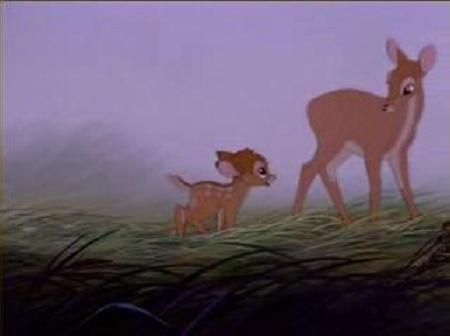
At long last the man who killed Bambi’s mom has left this earth. It is not a cause for celebration, but for quiet reflection and deep appreciation of a life well lived. Ollie Johnston, who passed away on April 14 at the age of 95, was the last of the “nine old men” – the original crew of great Disney animators. But Mr. Johnston in particular was quite important. It’s not that he killed Bambi’s mom. It’s the way he did it.


An unsuspecting Bambi and his mom

Traditionally, American character animation is constructed “pose-to-pose”: A character’s behavior through time is built out from a succession of carefully planned “hero” poses, which are then “in-betweened” to create the illusion of continuous movement. This approach provides a reliable way for the audience to get inside the character’s head: Because each successive pose distills a precisely delineated moment of thought or intention, an audience finds it very easy to visually read a character’s intentions.

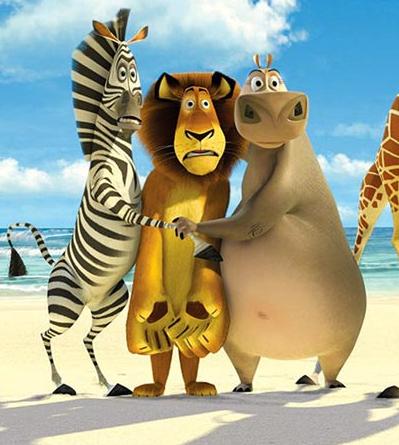
On the other hand, pose-to-pose can lead to a kind of emotional distancing. On a subliminal level you are continually being cued in that you are watching something that is not really happening. This generally works quite well for comedy, but can tend to limit the emotional impact of drama. One recent example of comic use of pose-to-pose style is found in Madagascar from DreamWorks Animation:


Striking a pose

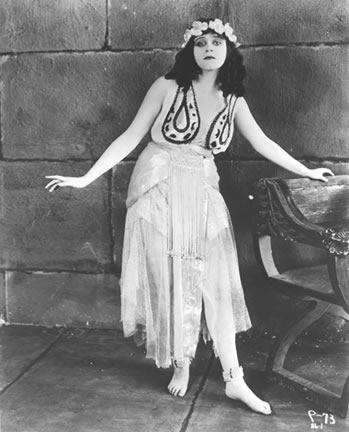
Animation students are often taught to develop their character by starting with a set of hero poses, and then proceeding from there. This way of thinking about animation has much in common with the style of much nineteenth century American stage acting, the influence of which could still be seen in many films of the silent era. This stylized approach to acting quickly passed out of favor in live action films with the advent of talkies. A silent-era performance by Pola Negri or Theda Bara that was highly acclaimed in its time will now come across, to modern audiences, as stilted and overly melodramatic:


Theda acting

Ollie Johnston was always a force away from from pose-to-pose animation and toward a deeper – and much more difficult to master – approach, in which all action must come from continuous shifts in the underlying thoughts and motivations of the character, as well as the emotional dynamic between characters in a scene.

I think this is one reason that the death of Bambi’s mom was such a powerful and even pivotal moment in the history of American character animation. Audiences who were watching Bambi in that scene were not seeing a pose-to-pose style. Rather, they were seeing a tragedy acted out, in an uncommonly subtle and naturalistic way, and therefore were not positioned at a safe distance from that tragedy. To this day, that scene can make people break into tears.

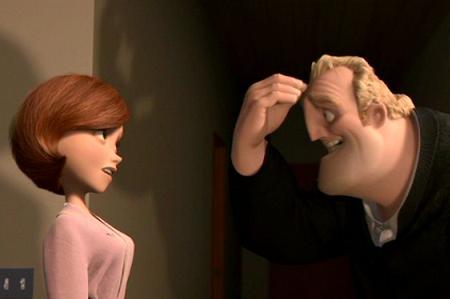
In modern American character animation I think that the natural heir to Johnston is Brad Bird. Yes, of course The Incredibles is a great film. But perhaps the greatest scene in that film, certainly the most stylistically transgressive scene, for my money, is the one in which we first see Mr. and Mrs. Incredible having a serious argument. This is the first point at which the audience becomes aware of the depth of the emotional cracks in their marriage, of the possibility that they may not survive as a couple:


A relationship on trial

There are no special effects in this scene, no super powers, gorgeous painted backdrops or fancy camera moves. Just rich characters, subtle shades of emotion, and carefully observed acting and directing. And that, my friends, is part of the legacy of the late great Ollie Johnston.

Scenes from the novel VII

It had taken only seconds for everything to change. One moment they had been holding hands, walking together on a beautiful cloudless evening, under the full moon. She had just needed to run in to pick up her prescription. And then he had found himself staring at an abyss where the drugstore had been. The street sign was gone, as well as exactly half of the car on the side nearest to the fire hydrant, as though a giant blade had sliced into the world. Which, in a sense, it had.

He stared down at his empty hands, acutely aware that they were indeed empty. He suddenly felt so useless, so … extraneous. He had known for some time that there were forces here at work, forces that could change everything. He had felt so sure of himself, certain he had read the portents, had followed the signs. He had thought he had been prepared for the maelstrom, had been ready for the moment when the winds of change would once again flow through him, guiding him. But it seemed that these forces were not flowing through him after all, but rather around him, as a stream will flow around a useless rock within its path.

He remembered once again the poem from when he was a boy. It had always been the same poem. He could not remember whether he had learned it or had heard it in a dream. Probably a dream, as if that made any difference now. In any case, there it was again, running through his head. And then he realized it had been running through his head over and over, for the last several minutes, all the while that he had been standing there staring stupidly. He tried to concentrate now, to make out the words. The poem had played in his mind many times down through the years, but it had been so very long since he had really paid attention to the words.


    And then she will be gone away
    And all will dance, and all will dance
    In moonlight, break his supper bread
    The song will play within your head
    And we will dance again

    One day the burning wall be broke
    From far away, from far away
    So clean the blade, so quick the slice
    Then he shall come and circle thrice
    And we will dance again

He shivered, and pulled his coat more tightly around his shoulders. It was a stupid child’s rhyme, that’s all. Just a coincidence. That summer by the lake when he was seven. “The summer of the dreams” they had called it. That was when he had caught the fever. He could remember his mother’s haunted eyes looking down at him, while she pressed cold compresses against his forehead, her hands trembling. Soon after that he had first come into his powers. But that couldn’t have anything to do with this. Not with this.