A perfect object

Recently I bought a toy for a friend of mine. I know you’re supposed to buy toys for children, and this friend is a grown-up, but I just felt she really needed this toy. It is called a Flower Cube, and in some ways it is, I think, a perfect object – a confluence of design, technology and spirit that hits the mark. It was made by the Japanese company Takara Co. Ltd, the same folks who brought you the toys known in the U.S. as Transformers.

The Flower Cube is quite simple really. A plastic flower toy that you put in a window sill, at which point sunlight hits a little solar cell and the flower responds by swaying. Which it will continue to do forever, as long as there is a Sun; no batteries required. Nothing fancy here – just a simple whimsical statement of joy and happiness. This is what it looks like:


Like all perfect things, the Flower Cube has a tragic side. After all, perfection without a tragic side would be intolerable – it would call into question so many things. In this case the tragedy is that the Takara Co., Ltd. was merged on March 1, 2006 with the Tomy Co., Ltd., a giant Japanese toy manufacturer. It was the beginning of the end. The Flower Cube has been discontinued, although you can still locate a few stragglers in select toy shops, if you look carefully and you’re lucky. That’s how I found the one for my friend.

There should be more perfect objects in our lives. Not fancy, overwhelming, commanding objects, which demand that we bow down before their magnificence. No, merely perfect objects that remind us that life is, at its best, a symphony composed of a million small pleasures and delights.

Does anybody else have a perfect object?

The Galaxy Quest Scale

There are a lot of lists of “the 100 best [fill in the blank] of all time” and other such nonsense. For example, the American Film Institute has famously published a list of the 100 greatest American Movies of all time. How good is this list? Allow me simply to point out that Cabaret appears nowhere on it. Enough said.

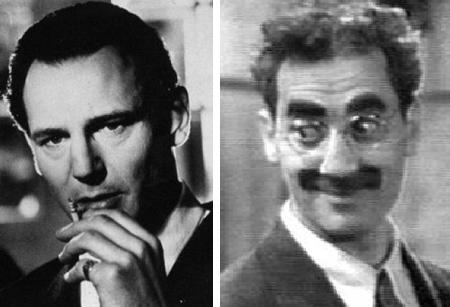
It seems rather nonsensical to try to choose between, say, Schindler’s List and Duck Soup, and perhaps unfair. For one thing, Liam Neeson dresses a lot more nattily than Groucho Marx. Although, on the other hand, both films are about problems created by the crazy antics of dictators… But I digress. The underlying flaw in the entire enterprise is that the goals of different movies are so wildly disparate that it makes no sense at all to compare them directly.


He wants his shirt


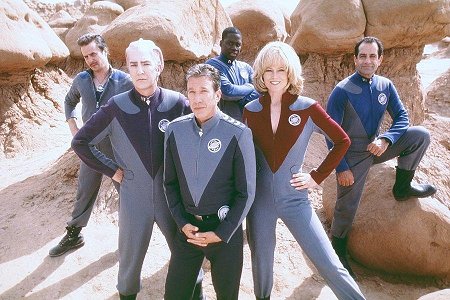
It seems to me that it would be far more interesting to twist the game a little, mix it up, maybe make things more interesting. To this end, I propose a new scale for measuring movie greatness, based on the 1999 film Galaxy Quest. According to my scale, this modest little comic homage to Star Trek fandom is perhaps the greatest film ever made. Allow me to explain.

When you enter a movie theatre, you arrive with certain expectations. Maybe you’ve read a positive review of the movie, or a friend has told you they liked it, or perhaps you’ve only heard what folks in Hollywood like to call the “high concept”. This is where the entire film is reduced to a single phrase, ideally one you can blurt out to a potential funder over hors d’oeuvres at the Chateau Marmont in less time than it takes the poor bastard to escape, once he’s realized that you crashed the party just to pitch your screenplay. An actual example of high concept: “Three Jews on a Dude Ranch”. See? Now you don’t even need to see City Slickers. You have just experienced the entire movie in six words.

But what if you arrive with no expectations? What if you know the film is going to be atrocious, an utter waste of your time? Your decision to see it has merely been a clever ruse for getting out of the house on Christmas day, while trying to find someplace, any place, where you can get away from those annoying Christmas carols. You are walking into this one with your eyes wide open, knowing full well what perilous fate awaits you. All of the ominous signs are there: It stars Tim Allen, it’s some sort of Star Trek parody, and the previews have led you to expect that it will be painfully cheesy. On the other hand, it does have Alan Rickman, and that’s promising, although you remember that in the trailer he was wearing some kind of alien thing on his head that made him look vaguely like a turtle, which can’t be good.


But you go anyway, settle down with your jumbo sized popcorn and strawberry Twizzlers, and prepare for the worst.

One hundred and two minutes later you emerge, amazed, enthralled, reeling with disbelief. It was funny and clever and actually had a plot with parallel character arcs that really worked and theme and back story and timing and great comic performances and just the right rueful sense of irony and Rickman was in utterly top form and even Tim Allen somehow got the whole “yes, I may be William Shatner but it’s ok because I know I’m William Shatner” thing and …. which is about the point where you realize you are hyperventilating and you go to find a chair in the lobby and sit down to think.

And that’s about the time, to make sense of what has just happened, you are going to need a little thing that I call the Galaxy Quest Scale (GQS). It is a rating system for movies that works like this: You assess your expectation going in of how good a particular movie could possibly be, given what you know. And then you assess your opinion of the movie after you’ve seen it. Divide the first number into the second number, and voila, you have computed that film’s GQS. It’s really that easy. Below is a simple diagram that explains the somewhat arcane mathematics involved:


how good the movie is
GQS =
how good you expected it to be


Does anyone else have a film that they feel rates a particularly high (or low) GQS?

History, Part III

On April 13 2003 the libraries burned.

Among the burned and looted books and documents dating back almost two thousand years were eight million documents in the Iraqi National Library and Archive, 45000 books and rare texts from the Central al-Awqaf library, all the documents in the “House of Wisdom” library, including rare holy books dating back to the 9th century and documents about the Jewish community in Baghdad, all of the 175,000 books and manuscripts at the library of the University of Baghdad’s College of Arts, the entire principal library of the University of Basra, as well as the entire contents of dozens of libraries across Iraq.

What was destroyed, while the occupying forces stood by, was the documentation of the Mesopotamian cradle of Western civilization, the basis of our own culture, our heritage, the roots of Judeo-Christian culture.


***

I love my country. I believe in the great American experiment, and I believe myself to be a patriot. The noble and daring idea that each of us is entitled to “life, liberty, and the pursuit of happiness” was the central philosophical premise that informed my childhood.

But how is any of that compatible with what happened five years ago today? Where is the love of learning, of human advancement, the belief that we are here on this Earth for a purpose?

In ten thousand years, when future peoples think back on our era, and they hear the phrase “The United States of America”, what will be the first thing they think of? History remembers, above all else, the destruction of history. Particular noble ideals of this nation or that may recede into the mists of time, but events such as the destruction of the great library of Alexandria are forever.

My worry is that all of our nation’s great accomplishments might end up being subsumed by this unnecessary fire. Lincoln, Kennedy, Roosevelt, Twain, Poe, Dreiser and Dickenson, all of these may become forgotten. But George W. Bush may be remembered, throughout all eternity.

As horrific as it was for me personally, and for those I love, the eleventh of September 2001 might one day be seen, through the long lens of history, merely as a prelude, as a point along a short and tragic line stretching from March 1, 2001, when the great Buddhas fell, to April 13, 2003, the day the libraries burned.

It is possible that of all Americans, only George W. Bush will achieve immortality. When people think back on our great nation, and ponder the arc of its rise and fall, all they may remember of us, in the end, is that one of our leaders presided over the destruction of History itself.

History, Part II

And so it continued, the taking of Baghdad, five years ago today. On April 11 the ransacking of the museum had begun, an act of fury wrought by mobs of people who had been oppressed by Saddam Hussein. On April 12 the museum was still being burned and pillaged. Desperate curators pleaded with the U.S. military to scare off the looters, but the military had no time for such things (they did cordon off and defend one public building – the oil ministry). Thousands of years of history gone, lost, scattered to the winds. U.S. Secretary of State Donald Rumsfeld’s response was – these are his precise words: “Stuff happens.”

I do think the invaders meant well. We honestly believed we were doing good, helping a people to fight against tyranny. But here’s a question: If somebody came to save our own country from an evil tyrant, someone who truly cared for us, for our democracy, our civilization, our history and its dignity, how would we feel if they then looked on, unconcerned, as the original copies of the Declaration of Independence and U.S. Constitution were torn out from their cases and ripped into pieces, the Lincoln Memorial razed, the Statue of Liberty toppled (with pieces of the torch made available to a black market of the curious)? What if the Smithsonian Museum were ransacked, and everything scattered or destroyed, from the Wright brothers’ airplane to Mr. Rogers’ orange sweater?

We might try to get inside the mind of our well meaning friends who were idly standing by, watching, while such things happened, these helpful foreign saviors with their guns and serious expressions. Perhaps we’d ask ourselves “What could they be thinking? Aren’t they even curious about us, this nation of people they wish to save? What is it about our culture, exactly, that they value?” And we might not be able to find any answers.

And yet this was all a prelude. In a sense it was a warning, a lead up to the following day, a kind of test to see whether the U.S. actually valued the culture it was attempting to liberate, or whether it was, in fact, even paying attention. The following day would be worse.

I am reminded of Yeats’ poem The Second Coming, which he was moved to write in the wake of the devastation wrought by World War I:


    Turning and turning in the widening gyre
    The falcon cannot hear the falconer;
    Things fall apart; the centre cannot hold;
    Mere anarchy is loosed upon the world,
    The blood-dimmed tide is loosed, and everywhere
    The ceremony of innocence is drowned;
    The best lack all conviction, while the worst
    Are full of passionate intensity.

    Surely some revelation is at hand;
    Surely the Second Coming is at hand.
    The Second Coming! Hardly are those words out
    When a vast image out of Spiritus Mundi
    Troubles my sight: somewhere in sands of the desert
    A shape with lion body and the head of a man,
    A gaze blank and pitiless as the sun,
    Is moving its slow thighs, while all about it
    Reel shadows of the indignant desert birds.
    The darkness drops again; but now I know
    That twenty centuries of stony sleep
    Were vexed to nightmare by a rocking cradle,
    And what rough beast, its hour come round at last,
    Slouches towards Bethlehem to be born? 

History, Part I

Why do I write these words every day? Why does anybody write anything? Presumably we wish our words to connect with other people, a larger purpose, or even history itself. Just as there is really no such thing, in any meaningful way, as a human being living in isolation from other human beings, it is clear that there is something about us, about humans, that only comes into its full dimension within the flow of history: Personal history, history of our community, of our tribe, a sense of our particular time and place on this planet.

When I think back on what I consider the most significant lives lived, the lives that for me have done the most to break through the bounds of mortality and echo down through the centuries, inspiring those that came after, I think of those who have broken through time and space, by virtue of the sheer power of their words and their ideas.

To name only a few among many, each in their unique way: Shakespeare, Goethe, Austen, Chaucer, Cervantes, Siddhartha, Aristotle. Do these individuals not represent the very promise of humanity? They remind us, by the example of their ideas, that we may create something out of these extraordinary minds of ours, and then pass that creation down to others. One more lamp lit against the darkness to make sense out of life. Why else are we here? What other sense does any of it make?

What would be the greatest of tragedies to us as humans? Not so much the loss of our lives, for aren’t we, each of us, destined to leave the planet soon enough anyway? No, I think far worse would be the loss of our legacy, of that hard-fought cumulative birthright of knowledge and wisdom that we have been gradually building, brick by brick, and handing down to each other through the generations. This is why, so many centuries later, the loss of the Library of Alexandria is still seen by scholars as a tragedy of almost unimaginable proportions.

And so we come to April 11, the beginning of our own very strange modern tragedy, a tragedy that unfolded over several days, that should have been averted, and that may very well come to define us, to define even our era in history.

I think that the specific events that led to this tragedy began somewhat earlier, on Thursday, March 1, 2001, in Kabul. That was the day that the Taliban militia began to carry out the edict that their supreme leader Mulla Mohammad Omar had handed down to systematically destroy the giant statues of Buddha which had stood for two thousand years in Afghanistan.

I remember being puzzled, at the time, that there was not a greater outcry from the United States. Of course there were diplomatic words of bafflement, of disappointment, but there was no sense of emergency. And yet it was clear that something unprecedented was happening. History itself was being destroyed deliberately, systematically. Cultural memory was being wiped out on purpose.

On that day, I remember feeling that a line had been crossed. Somehow I had naively thought that the United States would step in when it came to the destruction of history itself, that the United States would understand that this signaled a new kind of malignancy loose upon the world, unlike any that had come before.

But I was wrong. The U.S. was completely oblivious. And that is how we came, gradually, through a series of unspeakable events, to April 11, and then April 12, and even then it was not too late. But the day after that it would be.

More on this tomorrow.

Petrushka

Tonight at Lincoln Center I saw Basil Twist’s riveting and brilliant puppet version of Igor Stravinsky’s Petrushka. Thinking to learn more about it, I ended up surfing on-line to wiki.answers.com. There I found a page entitled “Questions with ‘Stravinsky: Le Sacre du Printemps; Petruchka; Firebird; Apollon Musagete'”. On that page I learned all kinds of things about the great composer, such as when was his birthday, how many sisters he had, and what year he composed Petrushka (1910). But I think my favorite question of all was: “Will the same method for removing the water pump on a 1992 Firebird work for a 93 or 94 Firebird?” I suspect that this question would have given even Stravinsky pause.

One thing that struck me, listening to the wonderful music this time, was a feeling that the first melody in its final scene was rather shamelessly borrowed by Cole Porter for the song “Tom, Dick or Harry” in Kiss Me Kate. Does anybody else hear this, or is it just me? According to Wikipedia (so it has to be true, right?) Stravinsky himself adopted this melody from an old folk tune called “Down the Petersky Road”, which suggests that I might just be carping about honor among thieves.

Speaking of honor, another thing that struck me was the strange dramatic resonance of the death of Petrushka, which is in some ways an inquiry into the nature of free will. It could be said that he died for honor, and yet at the same time he died as a puppet, his fate decided from above by a puppeteer’s hands. And that reminded me of an odd conversation I had the other day with a woman I know.

She was absolutely convinced that the guys that she and her boyfriend had recently been talking to in a New York City bar were with the Black Ops – those shadowy elite government forces that we never hear about (although sometimes The New York Times publishes articles about their nifty arm patches).

I asked her what made her think such a thing. She said that all of them were very big and burly, and they kept sprinkling their conversation with references to their trip to Burma and other exotic places. But then, when her boyfriend asked them what they did for a living, they all got mysteriously quiet.

I asked her whether she would really have wanted to know if she was hanging out with an elite squad of professionals trained to go on suicide missions. She thought about it and said no, probably not. But still, she felt that even if they were a secret government suicide squad, they should at least have some reasonable response ready, in case somebody should happen to ask them what they do.

I tried to think of something that they could say, under the circumstances. The only thing I could come up with was: “Well, I could tell you, but then of course I’d have to kill myself.”

Scenes from the novel VI

For ten thousand years the box had lain at the bottom of the lake. Entire civilizations had risen and fallen since that long ago time, countless stories told and then forgotten. Once, in other days, there had been legends, outlandish tales, stories told to frighten children. But many centuries had now passed since the box – and what it contained – had last been spoken of within the world of men.

And yet in recent days, in the sleepy town that now bordered the lake, there had been an unease. At first only the children were having the dreams. And at first their parents were not alarmed. Parents know that moods and crazy notions can sometimes jump and catch like chickenpox between children. But the dreams persisted and deepened, grew in detail.

And then the grownups started to have them too.

People began to talk out loud about their dreams, to compare notes. How could it be that each of them was seeing the same things, having the same dream? And such strange things they were seeing! For there were no words to describe these visions. Their forms and colors were like something from out of time.

Something needed to be done. A town meeting was called, debates held, resolutions were promptly passed. A declaration was prepared and duly signed. And so the people went back to their homes, secure in the knowledge that they had met the situation head-on.

But the thing in the box did not care about the people in the village or their resolutions. Its message had not been for them, but for another. And then one day, from far off, it received its answer in a dim and tenuous whisper, a promise delivered in a language that was somehow not language.

It was a promise that would take some time to breat fruit. But the thing at the bottom of the lake was in no hurry. It had waited for ten thousand years, and it could wait a little longer. Meanwhile it turned the thought over and over in its ancient mind, the thought that had been whispered from so far away. It savored the words that were not words: “We are coming.”

Why I like birthdays

Today is my sister Joan’s birthday. Like a lot of families, we always telephone each other on birthdays. When I called her this morning the first words out of her mouth were “I was thinking this morning, while I was brushing my teeth, how nice it is that there is at least one day when I get to talk with everyone in the family.”

Because Joan is my younger sister – five and a half years younger – her birthday constitutes one of my first memories of feeling grown-up. You see, my memories of my own early birthdays are rather inchoate and mysterious, coming from somewhere deep within the foggy mists of my personal development, mixed up somewhere in there with my first word and beginning to walk upright. Like something out of Darwin, or perhaps that deleted scene from the beginning of 2001, A Space Odyssey where the Monolith teaches the very first ape how to blow out all the candles.


I was presented with my first candle to blow out long before I had any clear understanding of what “birthday” meant, and I have no memory of that candle, nor the second or third. But there did come a day, I think when I turned five, when I suddenly became aware of The Birthday as a fixture in life, the great Ritual that always was and had always been.

But my sister’s birthday was different. See, by the time she came around I was already in on the action, right from the beginning. I knew what was happening, what it all meant. This time I was playing on the big kids’ team.

I especially remember that for Joan’s second birthday my parents got her a HUGE blue stuffed teddy bear. That bear was to become known, with great affection, as Big Bluie. Only now, as I write this, do I finally realize that this strange name was actually a riff on the name of my Mom’s youngest brother Louie (formally “Louis”, but I have never, even once, heard him referred to by that name). Such are the ways of family ritual.

After a few years Bluie lost first one eye, then the other, and at some point began to look distinctly raggedy. But Joan’s loyalty to her Big Bluie was something fierce. For a while she carried him around with her everywhere, which no doubt contributed to his ocular troubles. It was a great love while it lasted, as early loves go.

When parents introduce their children to the magic of birthdays, I suppose they must think back on their own childhoods, their own unique rituals. It’s like introducing a new generation to The Wizard of Oz, only you get to skip the scary flying monkeys.

In a way a birthday is the great secular religion, isn’t it? It’s the one personal rite of passage that is universally recognized, understood by all races and creeds. Indeed, it is the one occasion in life when, as Woody Allen might have put it, you get to be honored just for showing up.

Maybe that’s why I like birthdays.

Don’t go chasing waterfalls

Recently I’ve been getting into the habit of renting old films that have something in common. Sometimes they share a common director, or a particular actor, or they just share a particular obsession, such as “time travelling star-crossed romances”. It’s amazing how many TTSCRs have been released, and even more amazing how awful and silly most of them are. I mean, if Sandra really wanted to find out whatever became of Keanu, couldn’t she just have Googled him? Oh, don’t even get me started…

Several months back I took in the films of Visconti (see The Leopard – it will change your life), and that led me to late-period Dirk Bogarde, which in turn led to Julie Christie (by virtue of their shared turn in Darling). And so it turned out that I somehow managed to watch Death in Venice and Don’t Look Now back to back, two films that both try really hard to convince you that it’s a very, very bad idea to go to Venice, if you value your life.

Fortunately, I had already been to Venice, and had managed to make it out alive and healthy, thank you. I highly recommend it. But I wouldn’t go swimming in the canals, if I were you.

Last month I raced through the career of Montgomery Clift, from the beautiful young man he was in A Place in the Son to the ruined and immobile countenance he tried valiantly to act through a mere eight years later, post-accident, in Suddenly, Last Summer. Although even the young and intact Mr. Clift may not have fared all that well, since Katherine Hepburn’s take-no-prisoners performance steals that film in a walk, while leaving no scenery unchewed.

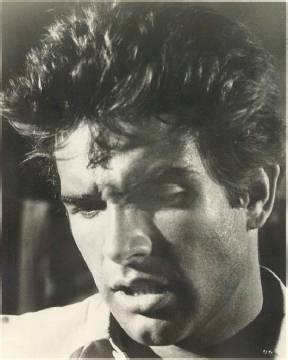
Now I’m on to early Warren Beatty. Which led me to the oddest experience. First I saw him in his very first starring role in Splendor in the Grass (1961), opposite the impossibly luminous Natalie Wood as a beautiful young woman in love with him who literally goes crazy trying to sublimate her unconsumated sexual desire toward the sexy but inarticulate Mr. Beatty, and who therefore tries to end it all by throwing herself into a swirling waterfall. Lots of shots of swirling waterfalls.


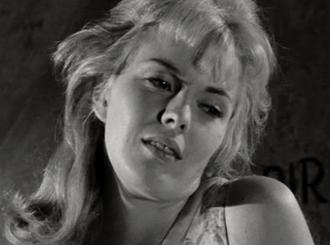
Then the very next day I saw Lilith (1964), in which the impossibly luminous Jean Seberg plays a beautiful young woman literally insane with sublimated sexual desire for the sexy but inarticulate Mr. Beatty, which leads her to contemplate throwing herself to her death into a swirling waterfall. Many more shots of swirling waterfalls.

Ok, what on earth is going on here? Did the mere presence of the virile (if inarticulate) young Mr. Beatty cause an entire generation of filmmakers to go mad? Or was it just something in the water?

If somebody can explain it to me, please do.

Angelic tendencies

I’d like to talk more about The Counterfeiters today, and how it is put together dramatically. If you haven’t seen it yet, you may want to do so before reading on.

It’s interesting to examine The Counterfeiters from the point of view of what drives its main character. Basically we are handed a protean individual – he is presented as neither good nor bad, but rather complex, intelligent, unpredictable, enormously charismatic, a seducer and a survivor, a force for both order and chaos. And then he is put through the ringer, severely “leveled up” as they say in computer game parlance – thrown into a whole new dynamic and faced with circumstances more challenging than any he has ever before encountered.

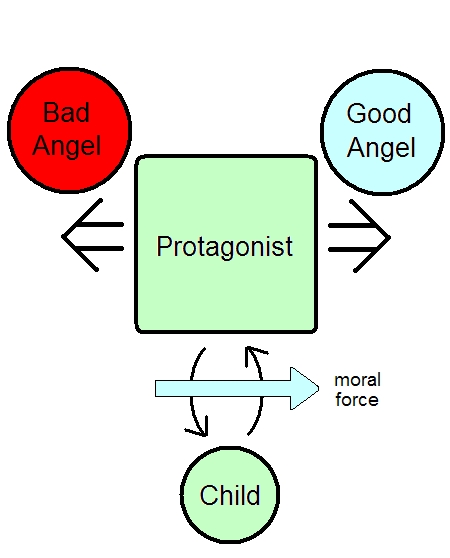
Just as this is happening, we are introduced to two new characters. One serves as a kind of bad angel. This character is suave, charming, in control, seeming to hold all the cards. The bad angel entices our hero to give in to old ways of thinking, to choose seductive moral shortcuts and selfish survival strategies that have worked in the past.

In contrast, the other character – the good angel – is seemingly humorless, an idealist preaching self-sacrifice, representing the pain and difficulty of making the leap to a more grown-up and responsible view of the world.

It is made screamingly obvious to the audience that both of these characters represent aspects of our hero himself. In these two opposing external forces pulling on him we – and he – recognize the two halves of his inner self, battling for supremacy.

And then, in the midst of this war over our protagonist’s soul, a third character starts to emerge. This character is really a child, passive, innocent, dependent, needing only to be nurtured. Not so much a fully fleshed out character as the symbol of one. The protagonist gradually embraces the opportunity to nurture this child, and starts to see survival not merely in terms of taking care of one’s own self, but rather as taking care of the future, of those who need us. The basic set-up is shown in this diagram:


Over time, the protagonist is changed by embracing his role as a nurturer. He realizes that being able to grow, to take care of another, is the way to true survival. This requires rejecting the easy answers of the seductive bad angel, and embracing the more difficult path.

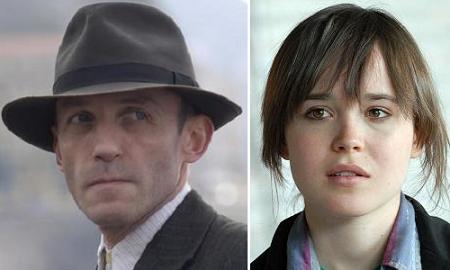
So why does all of this seem so familiar? Perhaps because I’ve just described Juno. It wouldn’t seem that there would be much in common between the story of a womanizing counterfeiter trying to survive a Nazi concentration camp and a sixteen year old pregnant teenage girl in a small town in Minnesota. But in fact both are driven by pretty much the same character engine.


Separated at birth?

In a sense, these two are really the same character, the unformed hero who recognizes the path to spiritual survival only when called upon to be a nurturer. I guess what this shows is not all that surprising: If you start with a solid foundation in how you drive and motivate your characters, you can build a hell of a great story.

By the way, I was only joking yesterday about Americans not telling great stories about outwitting Nazis. Of course there is a long history of American films built upon just this premise, including, among many others, Casablanca, To Be or Not to Be, The Great Escape, and Schindler’s List.

If you’ve never seen the original Ernst Lubitsch version of To Be or Not to Be with Jack Benny and Carole Lombard, do yourself a favor and run out and rent it. See if you can spot the line of dialog from which Woody Allen shamelessly stole one of the best jokes in Annie Hall.