Printing a snowflake

Continuing from yesterday…

My first experiment was to 3D-print a Koch snowflake. The Koch snowflake is a lovely fractal, which is made by following this very simple recipe:

  1. Start with a triangle.
  2. Glue a 1/3 scale version of the original shape onto the middle of each edge.
  3. Repeat step (2) with the new smaller edges, until you either get bored or die of exhaustion.

You can see the first few steps of the progression here:
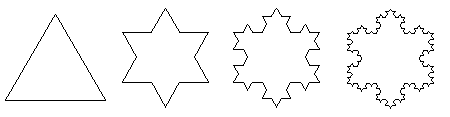


As you can see, it rather quickly turns into something that looks like a snowflake. I wrote a computer program to craft one of these babies in a format that would print onto my little home PP3DP printer. The result looked like this:
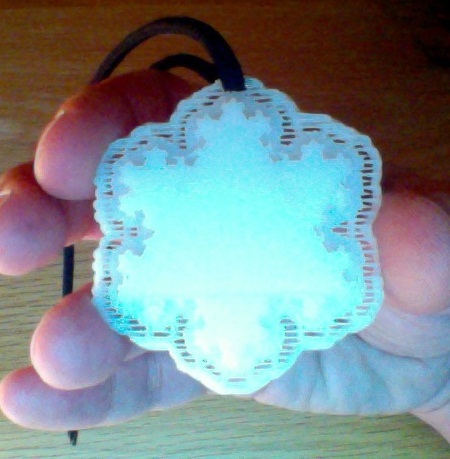


Actually, not everything in the decoration you see in that photo comes from the Koch snowflake itself. The PP3DP printer, like many 3D printers, builds things by adding them in layers, from bottom to top. To make sure things don’t collapse, it starts with a loose backing, which you can later peel off. You can get a better sense of this by looking at the printer in the act of printing a snowflake (that’s my couch in the background):
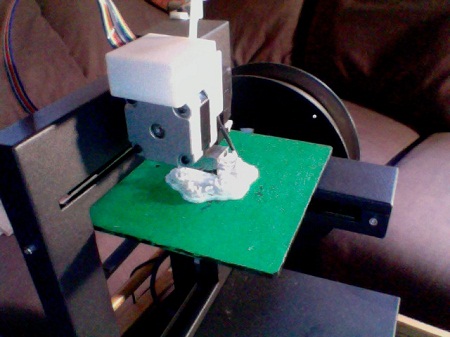


I decided to keep the backing on, because I like the way it visually framed the fractal, and also because it gave me an easy place to attach a string, for hanging each snowflake onto the tree.

To give the decoration more of that nice wispiness that helps make snowflakes so lovely, I decided to replace each of the triangles with a Sierpinski triangle. Like the Koch snowflake, the Sierpinski triangle can also be made by following a very simple recipe:

  1. Start with a triangle.
  2. Replace all triangles with three 1/2 scale triangles, each tucked into one of the bigger triangle’s vertices.
  3. Repeat step (2) with the new smaller triangles, until you either get bored or die of exhaustion.

You can see the first few steps of the progression here:



When I replaced each triangle of the Koch snowflake with a Sierpinski triangle, this is the first version that came out of the 3D printer:
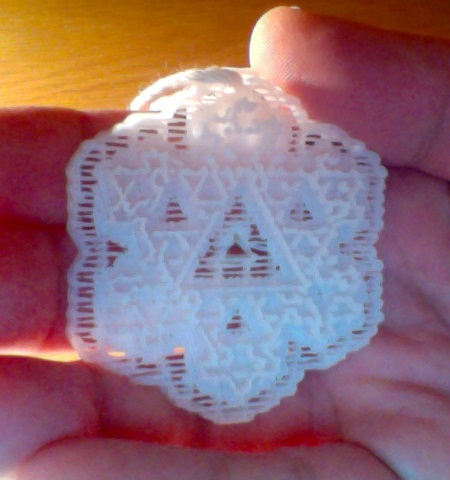


At this point I realized that there was a bug in my program, which was causing many parts of the fractal to be left out (although I think it still looks cool). I fixed the bug before heading to the party, but alas, in my excitement I forgot to take another photo before I left.

I can assure you there is now a lovely Sierpinski-Koch snowflake dangling from the festive tree in my friends’ house. But if you want to see it in person, you might just need to get yourself invited to their party next year. 🙂
Fractal decorations

Today I was invited to a holiday party where the hosts asked us to bring not food nor drink but rather decorations for their tree.

I took this as a challenge. I have a 3D printer, damn it, said I to myself, and I plan to use it. I spent much of the day writing various Java programs, trying this or that, running experiments on my 3D printer, until I hit upon a strategy that would produce a truly good holiday tree decoration.

And after all, what use is a 3D printer, this technology of the future, this glimpse at things that may yet be, if not for printing cool holiday decorations to be draped upon trees?

Eventually, after many false starts, I found inspiration from the Koch Curve and the Sierpinsky Gasket — two venerable fractal shapes that never fail to surprise and delight.

If you’ve never heard of these things — or if you just want to see the cool 3D fractal shapes I created for this party — tune in tomorrow.

Reader annotated

There were a number of interesting suggestions in response to the butterfly-to-fractal animation I posted the other day. One of them was an offer by a composer to create an accompanying score — I’m very excited about that!!

Another idea, since the piece is semi-nonfigurative and somewhat mysterious in places (several people described it as an “animated Rorschach test”), was to open it up to audience annotation.

This is an intriguing notion — create a base piece, and then use that original work merely as the starting point for an entire community to layer meaning over it. Eventually, these annotations might start to form conversations with each other, building meanings and mutual interactions far beyond any ideas contained in the original work.

The question comes up of how best to structure such a community-building enterprise. What would the result look like? An animation? A storybook? An evolving 3D landscape?

At this point I don’t have answers to these questions. If you do, I welcome any and all ideas!

Candy buttons musical palindrome machine

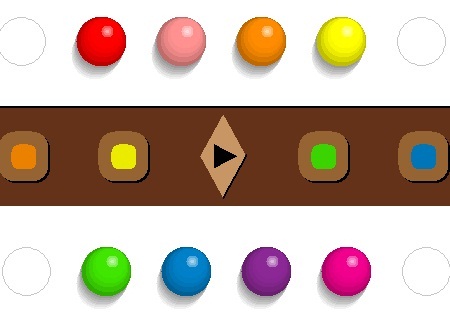
Inspired by both the MirrorFugue research of Xiao Xiao and the various explorations by Vi Hart into everything from mathemusical palindromic canons to candy button musical instrumentals, today I decided to create a virtual machine to help you compose musical palindromes.

In particular, I thought it would be an interesting constraint to incorporate elements of time reversal (eg: palindromes), instruments controlled by scores on paper tape, and candy buttons. Putting this all together, I ended up with a virtual player piano controlled by two copies of a candy button strip. The two strips get played together in reverse order to create a palindromic score.

Since these are virtual candy buttons, I took the liberty of expanding on the three classic flavors of cherry, lemon and lime, replacing them with a full palette consisting of, respectively, cherry, peach, orange, lemon, lime, blueberry, plum and raspberry. It turns out that when you bring these particular eight flavors into the virtual world, each one corresponds exactly to a note on the musical scale. Which makes them very easy to work with in making musical scores.

In addition to being incredibly delicious.


The American version

The recent buzz around Harry Potter has reminded me of an odd experience I had back when the series was new. It was sometime after the launch of the first book in the series, well before “Harry Potter” had become a household name and a record breaking best seller. A guy who worked in a bookstore in Seattle recommended that I get this new book by an unknown British author, which, he said, was starting to fly off the shelves [no, dear reader, not literally].

I bought the book — “Harry Potter and the Sorcerer’s Stone” — took it home and read it, almost in one sitting. I was soon so smitten with all things Harry that I was practically speaking Parseltongue (not to be confused with Python, another language capable of casting wondrous magic spells).

As I read this delightful book, the only thing that bothered me was the eponymous phrase “Sorcerer’s Stone”. As this magical object was described in the book, I couldn’t help but notice that it sounded awfully familiar. In fact it was — in every way I could think of — an exact description of the famed Philosopher’s Stone, the long sought after rock that could turn lead into gold and allow its alchemic possessor to achieve immortality.

“Why,” I asked myself, “is this author, J. K. Rowling, going through all of this trouble to write about something everybody knows about, and then giving it the wrong name?” After all, the Philosopher’s Stone already had a wonderfully resonant name, richly steeped in history and lore. Calling it something as ridiculous as “The Sorcerer’s Stone” just made it sound, well, dumb.

It wasn’t until later that I found out that that actual title of the book, as it was originally published in England, was indeed “Harry Potter and the Philosopher’s Stone”. When the book made its way across the Atlantic, American book publishers insisted that the name be changed from its perfectly good proper title to this perversely idiotic American variant.

The reasoning, apparently, was twofold: (1) no American could possibly have heard of the “Philosopher’s Stone”, and (2) a big word like “Philosopher” in the title of a book for our children would scare off us monosyllabic knuckle-dragging Yanks.

Harrumph. It’s a wonder those publishers even considered us capable of the arcane act of reading words on paper.

It makes perfect sense that Rowling subsequently demanded so much control over the film versions, given that she now knew she was dealing with idiots and lunatics. Ever since this incident, I’ve found myself wondering how many other perfectly good books from overseas may have been damaged in “translation” by overly patronizing American book publishers.

Here are some other “American” versions I’m glad we never had to see in bookstores:

  • “A Story about Two Towns”, by C. Dickens
  • “Frank’s Stone,” by M. Shelley
  • “The Study that Somebody Painted Red”, by A. C. Doyle
  • “Loud Winds in High Places”, by E. Bronte
  • “Sense and, um, Sensing,” by J. Austen

Perhaps you can think of one or two more.

Journeys in dreams are never finished

Inspired by Vi Hart’s post about 3D printing an Apollonian gasket, I started to wonder whether it would be possible to get to that deeply Apollonian form through something more, well, Dionysian.

After Xiao mentioned Zhuangzi’s lovely dream of the butterfly yesterday, I started thinking about the relationship (which has been discussed by many philosophers) between Dionysus, the god of beautiful chaos, and Apollo, the god of rational beauty.

And I decided I would take a butterfly on a journey to attain a state of Apollonian perfection, but only after it has traveled through the chaos of dreams.

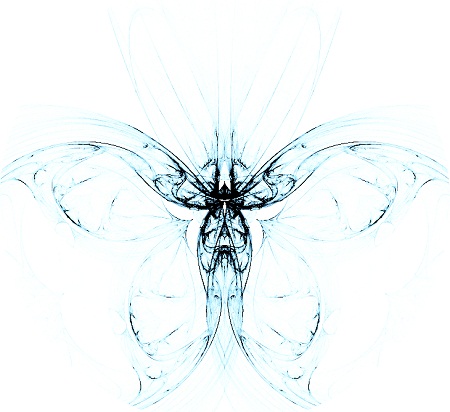
After playing around with some fractal programming, I found a suitable way to create and transform a mathematically defined butterfly (click on the image below to see the result). The cycle repeats endlessly because, of course, journeys in dreams are never finished.


Two levels down

For the first time I can ever remember, last night I had a dream about having a dream.

I didn’t remember this when I first awoke. Rather, it was only when, after becoming really awake (at least, I hope I’m now really awake), I found myself in a situation that reminded me of my nested dream. Then it all came rushing back to me. The interesting thing is that I can remember the dream within the dream in vivid detail — obviously it made an impression on me. So much so, that I felt moved to describe it, moment by moment. to my dream friends, who were all greatly amused.

I have no idea who those dream friends were supposed to be — generic stand-ins, I supposed, for the “group of people I know who are listening to me recount a dream.” Very pleasant people they were, though admittedly a little blurry around the edges.

I realize this will all remind most people reading this of Christopher Nolan’s recent film Inception. It certainly reminds me of Inception. Except of course that Nolan wasn’t really describing dreams, but rather “lucid dreams”, in which you know you are dreaming, and can utilize all of your waking free-will.

This wasn’t like that at all. At each level of my dream, I can recall being quite convinced that I was awake — a particularly ironic state of mind to be in while dreaming you are describing a dream. My experience was very much like a series of one-way mirrors, since each of my dream states could be seen into from the outside, but not out of from the inside.

This of course raises the usual philosophical questions: Was I having a dream within a dream, or just a dream? Is Hamlet’s play within a play more fictional than Hamlet himself, with characters who are somehow “less real”? I haven’t the faintest idea, and I wouldn’t dream of trying to guess.

Or maybe I would.

Intermezzo

There is a moment, before you have actually met, when all you know is the work, the external manifestation of another’s genius.

You might stand in awe, poised between knowing and not knowing, on the knife edge of possibility.

There are so many possible futures, so many ways that ideas can come to life, in a conversation about to begin. You find yourself captured by a narrative, a fractal, a story sketched in second person singular.

It is — how shall I say it — camels, all the way down.

Research clients

Those of us in research create things for many reasons. For some it is the sheer love of discovery, for others a kind of aesthetic journey for Truth. And for many it is mainly about that delicious feeling of striking out on one’s own, of finding some new path within the universe that has never before been traveled. I suspect it is usually a mix of all of these reasons, in one proportion or another.

But what about our clients — the rest of the world that uses our discoveries? What is it that motivates them, that draws them to drink from the well of some new creation? I’ve been thinking about this, and I think I can see three different kinds of motivations behind those who would make use of research, of new discoveries and methods of doing things.

First there are, for want of a better word, the capitalists — those who are in it for the money. These are people who are continually monitoring what the world wants — or at least what the world is willing to pay for — and are looking for a way to fulfill that need so that they can take a piece of the action. The contradictory thing about this group is that they can often help to make new discoveries possible by providing funding, but they may not care about the research itself on any intrinsic level. All discovery tends to become flattened to the one dimension of its monetary potential. This can create some odd misunderstandings between researcher and capitalist.

Second are the artists. These are the people who are perpetually in a dialog with beauty, with balance, with harmony, with bold statements about the human condition. For such people, a new research discovery is a beautiful agent for new aesthetic possibility, for human expression that takes our minds to new places.

Finally, there are the social activists. These are the people who are always asking the fundamental question “How can I make the world a better place? How can I reduce the suffering of the world’s poor, or diminish the vast inequities of wealth within society?”

Of course this is not a mutually exclusive set of traits. For example, the iPad — an integration of years of technological and design research by many people (not all of them at Apple Computer) — is a commercial creation, driven by the profit motive, with all of that motive’s attendant social power and baggage. Yet the iPad is also an object of aesthetic contemplation, a successful work of visual proportion and tactile responsiveness that is quite lovely and elegant in its way.

In an analogous vein, the fruits of some medical research can lead to great public good at the same that they are creating the potential for enormous corporate profit (as well as enormous financial risk). In this case, given the huge amount of capital that may be required to fund research in the first place, it’s not a choice between profit and helping the world, but rather a system in which one is entangled with the other.

I imagine there must be cases where the same research discovery leads to all three kinds of clientele — to the money makers, the artists and the social reformers, all at once. At the moment I can’t think of any such discoveries. But perhaps you might be able to think of one.