Gender specific wish fulfillment

When you look at pop-cultural offerings, whether they be films, novels, or popular songs, there seems to be a specific gap between the primary wish fulfillment fantasy directed at men and the one directed at women.

There is definite overlap, for nothing here is in black and white. Generally the young hero or heroine, after going through suitable trials and tribulations, is given two essential rewards: (1) the optimal mate, and (2) the optimal position in society.

The gender difference creeps in when we look more closely at these two rewards. For women, the optimal mate is presented as the primary reward, and the position in society (eg: the perfect/fulfilling job) is merely a subsidiary reward, which is mainly present to verify that our plucky young heroine has nabbed herself the right guy.

Yet in a male-oriented fantasy it’s generally the other way around. The primary goal for the young hero is to find his proper place in society. He’s got to step up, assume the mantle of prince, take responsibility, befriend the dragon, become the man he’s been holding back from being. And if he fulfills these goals, then the love of the right woman will be thrown his way as a signal that he has indeed made the proper choices.

But the love of this woman is not the primary achievement. It’s merely an auxiliary verification that he has made those right choices and has come out on top.

I am left wondering whether this difference — for gals the big reward being get the guy, whereas for guys the big reward being to level up in society — is based on an intrinsic difference between men and women, or is a culturally imposed mandate, one that artificially separates men and women from each other, and that broadens the gulf of understanding between them.

Attic, part 32

Mists rose up in her vision, and formed themselves into shapes almost familiar, only to change into something altogether different. Some part of Amelia’s tumbling thoughts tried to remember, to fit the pieces together, to find the elusive pattern. But every time a picture began to emerge, something within her mind cried out in warning, and the darkness once again descended.

She remembered a little dog — Bruno. He was small, but full of life, her joy, her greatest delight. There had been a room, a bed, the little table with keepsakes, an impression of a framed picture, of someone she had once known. All of these were part of the vision, but only Bruno was distinct.

She remembered the moment it had all changed, the fear and anger congealing into something — something beyond understanding. It was all so unclear. Still she knew that Bruno had tried to defend her, to stand in the way of danger. And now he was changed, changed beyond recognition. Yet he remained her guardian, her protector, and nobody could reach her while he stood watch.

Out in the lonely deserted streets, a massive beast pricked up his ears. He had caught a stray thought, no more than a thread woven from a dream, but it was enough. In her way she was calling out to him, and he would let nothing disturb her slumber. With a low growl, he shifted upon his massive haunches, and with slow and inexorable force began to move to intercept the invaders.

Mountain

The best vacation I ever had was spent doing some serious mountain climbing. Sure, I’d had the vacations on the beach — surf, sand and Pina Colada, cool breeze off the ocean, sweet sun pouring down, smile from an island girl and everything’s just fine.

But none of those were the vacation I remember. No, it was the week of the long slow tropical hike, week spent climbing up one mountain after another, sandwiches and water bottle packed in the morning, and hours slogging through a jungle thicket with room for nothing in my head but to figure out where I’m supposed to place that next foot so I won’t fall down and do some serious damage.

Hour after hour of nothing but sweat and focus, then back down the mountain for a shower that night, pass out exhausted, and get up at dawn to do it all again.

Even now, years later, I remember that as the best week of my life. After the first two days all my little city neuroses had burned away, leaving nothing but hard sweat and single purpose, simple and clean. When I was in the middle of it, I had no idea I was having a good time. But looking back now, it is one of my life’s sweetest memories.

Attic, part 31

Now that she knew the connection, Jenny was seeing the city with new eyes. “Do you realize,” she said, “that just about every building we’re passing has something about it that connects to the attic in my house?”

“Could you maybe give a fer-instance?” Sid asked.

“Well, look at that tree,” she said, pointing. “It’s the same tree that’s in the picture you see right when you walk up the stairs to the attic. And that old car right there — in that driveway — it’s exactly the same model as the toy car on the window sill.”

“Wait,” Josh said, “how can you remember so many details about what’s in your attic?”

“The attic has always been my get-away place”, Jenny explained, the words suddenly coming out all in a rush. “After Dad was gone, things were never the same, and I really just needed some place to hide. The attic was the one place in the world I knew I could go to be alone, especially when Mom was in one of her moods. She would never go up those stairs — ever. It’s like she was scared of something. So when I was little, and even after I wasn’t so little, I would spend whole days up there by myself, exploring, looking in all the drawers and on the closet shelves, finding stuff. There was always something new. It was kind of like a treasure hunt on my own private island. I always thought it was just the most completely unique place…”

All at once she stopped herself. She realized her companions were all staring at her.

“I mean,” she added, looking around, “until now.”

Fake journalism

Most people assume that when they read a news account, they are reading a more or less faithful representation of reality. This illusion is quickly shattered when you happen to know the story behind the story.

Case in point. My colleague Daphne Bavelier, in some rather brilliant and groundbreaking research, has discovered that playing action games (computer games that involve rapid real-time response by the player) greatly improves the human brain’s ability to track multiple objects at once and to make rapid and accurate decisions in real time. Research by her and her colleagues has shown that in a very real sense, playing action games over time makes our brains work better (much as physical exercise makes our bodies work better).

It’s important to point out at this juncture, given what will come later, that we’re not talking about violent video games in particular. Some action games happen to have a violent narrative wrapped around them, but Bavelier’s research has shown that the narrative is irrelevant — driving games or games involving only abstract objects will benefit brain development just as much as an action game framed in a violent narrative (like shooting aliens or zombies).

Bavelier gave a talk on her research the other day at a little workshop on Games for Learning at New York University. In a funny moment during the Q&A, an audience member asked the following question: Since girls don’t like violent games as much as boys, how can we get girls to play them? Bavelier, who had already made it very clear that actions games are not the same as violent games, responded with the sardonic (and somewhat exasperated) suggestion that maybe a game could “use, for example, a princess which has a magic wand and whenever she touches something, it turns into a butterfly and sparkles”, which got a big laugh from the audience.

All well and good, until you read the Associated Press article by Karen Matthews that came out the next day. Matthews wrote the article as though Daphne Bavelier had deliberately advocated for violence in video games. The article ended by quoting Bavelier’s response about girls and butterflies as though it were a serious suggestion.

You can judge for yourself by reading the article, which is rather absurdly entitled Violent video games touted as learning tool.

Matthew’s article claims that Bevalier is promoting violent computer games, yet nowhere is there a quote in the article where Bevalier says any such thing (because she never would say such a thing). Rather, quotes by others and misdirection are used to warp the point of the talk.

It’s clear, to anyone who was present at Bavelier’s talk, that Matthews’ article is pure sensationalism — a deliberate misrepresentation designed simply to drum up fears about games (and, I suspect, to sell newspapers).

It’s chilling to realize the nasty and cynical game that Matthews is up to here. How much of the “news” we read is actually garbage like this? How often does useful and important research get obscured by shoddy and dishonest reporting? And how often do we happen to have the background knowledge to know that the news article we are reading is, essentially, fake journalism?

Attic, part 30

Josh moved purposefully through the dark streets, and the others followed. He seemed to know the way now, almost as though he’d been here before. Jenny saw a look of grim concentration on her friend’s face. It wasn’t a look she remembered ever seeing before — at school Josh had always seemed so unserious. “How well do we know anyone?” she mused.

But at that moment Jenny’s thoughts were interrupted when Josh stopped abruptly in his tracks.

“What is it?” Mr. Symarian said.

Josh just stood silently for a moment. His eyes seemed to refocus, to come back to the here and now. “I don’t really know. It just feels like I’m supposed to stop.”

Suddenly Jenny gasped out loud. “This buildling,” she said, pointing to the building they had stopped in front of, “look at it. Josh, what do you see?”

“Looks like a building to me,” he said, looking puzzled.

“I’ll second that,” Sid said. “Definitely a building. Tall, square, kinda rococo, not really my thing.”

“Shhh!,” Jenny said. “Sid, be quiet. This is important. Josh, haven’t you seen this somewhere before?”

Josh stared at the building for a good long while. Then recognition dawned. “It looks just like your music box — the one from the attic. Only bigger. And there’s no ballerina on top.”

Elmo with broccoli

I heard a delightful talk yesterday by Michael Levine, a wonderful man and an important innovator in educational media technologies for young children. One thing he spoke about was the great power of characters that children love. This power can actually be measured — and is. For example, at one point in his talk he reported:

“Elmo when paired with broccoli beats a neutral character when paired with chocolate.”

I found this to be a particularly powerful statement in what it says about how much children like Elmo. Particularly given that I really, really don’t like Elmo. Of course I’m not the target demographic here. I was talking to a colleague after the talk, and she and I agreed that, much as we both love chocolate, our version of it might be:

“A neutral character when paired with broccoli beats Elmo when paired with chocolate.”

I love this entire analogical approach to things, and I wonder how far you can take this way of thinking. Does Darth Vader when paired with Oreo cookies beat Han Solo when paired with stinky tofu?

Does Josef Stalin when paired with Princess Leia beat Mahatma Gandhi when paired with Jar Jar Binks? These are difficult questions, not to be decided lightly.

And of course, the question that just had to be asked: Does Paris Hilton when paired with the 1975 Cincinatti Reds beat the Buddha when paired with the 1962 Mets?

Guess that might depend on whether you’re a baseball fan.

Attic, part 29

The central tower of the city was now in sight, directly in front of them. All the travellers needed to do was proceed forward, and they would surely arrive at their destination. “I think we’re nearly there,” Jenny said in relief. She couldn’t even say how long they had been travelling, and her feet ached terribly.

“No,” said Josh, “we have to turn here.” He pointed down a narrow dimly lit side street — really more of an alley than a street.

“What do you mean?” Jenny said, exasperated. “The tower is right there in front of us. I can see it!”

Josh just shook his head. “That way doesn’t work. Look, I’m sorry, I don’t know how I know, but I just know. If we go that way, we’ll die.”

Jenny was about to say something in response, something she was sure would have been cutting and clever, when Sid interjected. “He’s the path finder, remember? Whatever he says, goes.”

“Oh right,” she said. She looked at Mr. Symarian and Charlie, and they all nodded in agreement. She came to her senses. If Josh said it wasn’t safe, then it wasn’t safe.

The travellers turned into the alley, just in time to miss he low grumble of a sound far, far down the main road — the path they had not taken. It sounded like nothing so much as a deep growling, the kind a dog might make if strangers approached.

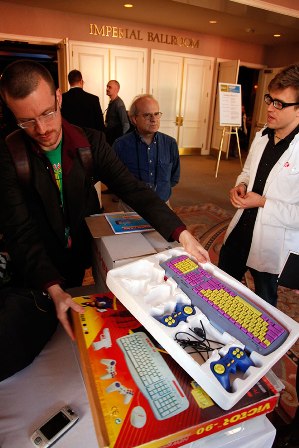
ten dollar computer

I learned this week that there is a movement around building things for a ten dollar computer (playpower.org). The existence of these computers, which can be found, for example, in marketplaces in Mumbai, came about due to a combination of two things: patents running out on old 6502 processing chips from the 1970s, and the propensity of small manufacturers in China to throw things together quickly and cheaply, if they see a market.

Given all the hype about the iPad and other relatively expensive devices, it’s intriguing that there is a computer inexpensive enough to be in the hands of a fairly large proportion of the world’s population — and in particular, the world’s children. Educational games made for such a platform (assuming they are well made) could easily reach a far higher proportion of children around the globe than anything we are currently doing that aims at a higher end platform.

There is something immensely appealing about the idea that illiteracy — one of the key contributors to endemic poverty — might be battled by enlisting the technological power of old video games.

Attic, part 28

Bruno sensed something new in the air. Softly he growled. Since time before time, he had been standing watch over his mistress, guarding the way to the castle spire where she slept. In all that time, none had dare cross his path. The mere sight of his fearsome visage had turned away even the hardiest of souls.

But now strangers approached. He did not know how he knew this — he just knew. He rose slowly, unaccustomed to movement. It had been so long since the last time he had needed to awaken from his eternal vigil.

But now he was fully awake, and his senses were alert. He sniffed the air, seeking a clue to the identity of the invaders. They seemed strange, with a scent in may ways unlike that of the villagers. Above all, these travellers seemed not to have the smell of fear about them.

At least not yet.