Six limbs

Today I saw a wonderful talk about how the anatomical structure of the dragons in the animated Dreamworks film “How to Train your Dragon”. The talk was given by Stuart Sumida, who is a paleontologist and anatomy specialist. Animation studios turn to him when faced with tough questions like how to design a plausible dragon.

The last question from the audience was about whether there are any animals in real life with both wings and four legs (like the dragon Toothless in the film). Dr. Sumida first pointed out that the answer is certainly yes, in the insect world. But in the world of mammals and their cousins (like birds and pterodactyls) the answer is no. Wings are an adaptation of forelimbs. So birds, bats and pterosaurs all have just two wings and two hindlegs. All winged vertebrates evolved as variations of the same four limbed structure.

At which point it occurred to me, why don’t we see dragons as monstrous, the way we see, say, space aliens? After all, dragons like Toothless breaking one of the fundamental constraints of creatures near to us in the evolutionary graph — that they have four limbs:
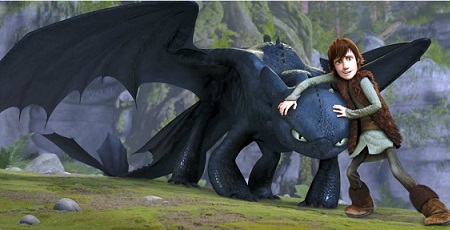


Dragons are not the only example of this. We don’t run screaming from pictures of Pegasus, the winged horse from Greek mythology:



Similarly, most people find centaurs to be distinctly attractive. Heroic even:



So what’s going on here? Logic tells me that anything with six limbs growing out of its spinal cord should fall squarely into Freud’s theory of the uncanny. It should freak the hell out of us. And yet we are charmed by distinctly the unatomical bodies of our various mythical six limbed friends.

I find this very mysterious.

Revelation

Hands clutch close upon the throat of fate.
She gasps in one expired breath, and at last
Utters the curse that will change the course of nations.
There are secrets here indeed, dark tales untold.
They who have been warned should have known.
Perhaps it would have been better if nothing
had ever been revealed, if that first moment
Had never arrived.

And yet, here we are. How can you turn back the tide
Of generations reaching for fulfillment, millions of voices
Demanding to be heard? Perhaps there is not justice,
No power beyond, nothing but the endless sound of awakening.
For what are we but their progeny, their voice willed into being?
If I have ever loved, if any one of us has ever loved, is this not merely
The lightning struck down from a fate beyond our reckoning?

Only one who has seen, has held witness, has heard
In the dying sight of that single moment,
Can speak of the unbearable sorrow of those voices,
That within their darkness enfold the light of revelation.

Mayday

Shifting away from gently ironic discussions of deliberate political amnesia, today I celebrate something apparently quite the opposite — intercultural connectedness.

This evening I was taken by some wonderful friends to see “The Marriage of Figaro”. It is one of my favorite operas, and this was a lovely production all around. As I sat there in the Stuttgart opera house, letting the sheer joy and intricate brilliance of Mozart’s music wash over me, it occurred to me that here was true cultural cross-pollination at work. I, an American, was in a German opera house, listening to music composed by an Austrian, set to a libretto written in Italian, adapted from a French play. There is something immensely satisfying about so many cultures meshing together to create such a perfect experience.

Ironically, “The Marriage of Figaro” is in its way actually an act of deliberate political amnesia. Lorenzo Da Ponte’s libretto was an adaptation of a highly political play by Beaumarchais which was essentially an incisive indictment of the nobility. The original play was at first banned by King Louis XVI, although it was finally shown, to universal acclaim, after Marie-Antoinette championed it. Little did the arts-loving queen suspect that only a few years later criticism of the nobility in France would become considerably more, ah, incisive.

Mozart and Da Ponte knew that the odds of getting an opera on such a delicate subject approved (and paid for) by Emperor Joseph II of Austria was just about nil. So Da Ponte converted all of the speeches criticizing royalty into arias that complain about fickle lovers. The result certainly stands on its own terms, but Beaumarchais, being french, might very well have cried Mayday. 🙂

† Thanks Guzman!

May day

May day has multiple meanings here in Germany where I am visiting. There is the traditional meaning of the celebration of Spring (whence “around the may pole”). It is also the time of the beer fest, which is a kind of cousin to Ockoberfest, with the key and all-important difference that in this festival everyone drinks too much beer in May, as opposed to drinking too much beer in October — a very important distinction indeed.

In addition, May first is the day they celebrate worker’s rights throughout Europe. We don’t have this kind of thing in the U.S. Where I come from the idea that one should celebrate the solidarity of common working men and women, those ordinary citizens who put in a day’s work for a day’s pay, would be seen as a form of Communism. To view the people who sweat day in and day out to make a country function as heroic figures would, in America, be pretty much tantamount to hoisting a red flag and handing over the keys of the country to Josef Stalin. As Sarah Palin would say, “You betcha.”

In the U.S. we’ve always had a problematic relationship with unions, with collective bargaining, with the whole idea that workers should have the right to organize and look out for each other, and that companies might consequently benefit from a situation in which their employees feel that they are all protected by a uniform code of justice. In America that’s considered Commie talk. But this side of the Atlantic it seems to be perfectly normal. On May day, all the politicians here, of every political stripe, make speeches declaring their fervent and undying belief in the humble Worker. It’s actually rather sweet.

Yet more than any of this, I learned that May day has yet another meaning here in Stuttgart, one that is higher, more exalted, more fervently worshiped and followed than all of these other meanings. It is the thing that can get huge throngs of people out in the streets, to worship something that really matters, to forget their daily troubles and put aside this sacred day for something truly important.

I’m speaking, of course, of the May 1 as the day when the local regional team here in Stuttgart plays its opponent in soccer.

Attic, part 24

At last the weary travellers, now five in number, came to the end of the long tunnel. They had finally traversed the great wall.

Jenny gasped at what she saw. For stretched out before them under the emerald sky, as far as the eye could see, was a city of gold.

“Somewhere here,” she told her companions, “I will find her”.

Charlie turned to her in wonder. “You mean the one who sleeps?” he asked.

The others looked him. “What do you know?” Jenny asked.

He shook his head. “I get it now. You’re here to fulfill the prophecy. All I know is it’s been a long time since she came, since … since they took her. There, in the castle.” They looked to where he was pointing and saw that there was a single tall golden spire, graceful and gleaming, that rose above the skyline.

“Won’t be easy,” he continued. “At least not according to the prophecy. They say that all the world will change when Amelia awakes.”

Jenny and Josh looked at each other. She repeated the words to herself. “When Amelia awakes.”


End of Volume One

The book will go on haitus, and will return soon.

Gift giving

Three years ago a new friend had a reaction to something, in a completely unguarded moment, that started a chain reaction in my mind which led me to switch to a vegan diet. Today in Vienna I saw this same friend and told him, for the first time, how profoundly that moment had affected me. He seemed both surprised and deeply gratified, as though I had given him a wonderful gift. And I suppose I had, although I was simply describing something he had given to me.

It is at moments like this that I suspect that the effect people have upon each other is never primarily intellectual, as much as we would like to believe it is. We pick up emotions from each other, passions and deeply held convictions. And if those passions and convictions resonate within us — if they cause an emotional ring of truth to stir within our own heart — only then do we fill out the story on an intellectual level.

I see now that I do something similar in my teaching. I don’t merely show my students the intellectual beauty of the subject I am teaching. Rather, I always let the class see how I myself am moved by it. I let my own sheer wonder and enthusiasm come through, without trying to cover it with a veneer of professional disinterest.

The best gift that one can give as a teacher is genuine enthusiasm. I sincerely believe that students are moved to put in the necessary work not because their teacher has told them that a subject is interesting and exciting, but because their teacher is, himself, interested and excited by it.

Attic, part 23

Jenny was getting impatient. Sid and his friend Charlie had been talking for what seemed like hours. They were catching up on old times from long ago, and she gradually realized that “long ago” in this case might mean really, really long ago, as in centuries. Sid had conjured up cigars for the occasion, and he and his fellow demon were puffing away like fiends. Which was only fair, she had to admit — after all, they were fiends.

After several hours it finally occurred to her that waiting them out might not be the best strategy. The two demons might very well continue swapping stories for years, quite literally. She turned to Mr Symarian. “Is there anything you can do?”

Mr. Symarian stepped up to the giant guardian demon and cleared his throat. “Charles,” he said, rather formally. “I should like to remind you that we are engaged in a serious quest, and your, ah, reunion, although quite lovely in its own right, is interfering with our mission.”

Sid looked cross at the interruption, while the giant demon, who had been in the middle of relating a rollicking and rather off-color tale concerning a night in Brooklyn with two she-demons, stared down at their teacher with a peculiar look. Jenny was afraid the big demon was going to become violent.

Instead, he started to cry. “You don’t know what it’s like, hanging out in this stupid wall for ages. This is the first fun I’ve had in forever.” he said through big sobs. Mr. Symarian looked very uncomfortable. He offered a handkerchief, which the giant demon tearfully accepted, dabbing his eyes daintily and then blowing his nose with a loud honk.

The demon offered to return the handkerchief. “Please keep it,” the teacher said hastily.

“Thanks,” Charlie said, sniffling. Jenny wondered what was going to happen now. Then she had an inspiration.

“Why don’t you come with us?”

Conservation of misery

I was having dinner with some friends last night here in Berlin and the conversation touched on the whole dynamic of consumer societies and the effects of advertising. I floated a theory (it is easy to float theories when they have very little weight) to the effect that there might be a conservation law of consumer satisfaction. Or more accurately, of consumer misery.

In order to sell things in a consumer economy, you need to create dissatisfaction. For example, you hire impossibly slender fourteen year old fashion models to sell clothing to grown women, thereby accentuating your customers’ insecurities about their own bodies.

This strategy only works up to a point. For it seems to me that if you get people too depressed about themselves, then they will lose heart in general, after which they’ll start to lose all self confidence and appetite for life, and your consumer economy will start to sag.

So a consumer economy needs to keep people at just the right level of being unhappy. In other words, there is a conservation law at work, according to which there is some optimal constant for the sum of desire and misery.

Attic, part 22

By the soft bluish light of the fire demons’ glow, they finally reached the other end of the winding tunnel. Against the cave walls, they could now see daylight from around the next bend. Unfortunately, directly in their path and blocking their way, was a rather fearsome looking statue of a giant demon.

“Oh, great,” Jenny said. “There’s no way we’re going to get around this thing.”

Sid shrugged. “It could be worse.”

Josh chimed in. “The way is completely blocked. How could it be worse?”

Just then the statue came to life. Standing before them now, rather than a mere statue of stone, was a living, breathing demon. At the sight of the four travellers he gave out a roar of anger.

“Like I was saying…,” Sid said.

Josh glared at him. “If you say `I told you so’, I swear I’m going to kill you before that big ugly demon does.”

The demon glared at them and bared his giant teeth. “You have disturbed my slumber. Perhaps you will be my next meal.” He took one fearsome step toward them, and the four travellers cowered back in fear.

Then his eyes alighted on Sid, and his monstrous face broke out into an enormous grin. “Sid?”

For a moment Sid looked nonplussed. Then he too broke out into a grin. “Charlie, is that you? You’re kinda, well, big.”

The big demon let out a laugh, and the deep rumbling sound echoed through the tunnel. “Yeah, needed to be big for this gig. You’re one to talk. You’re kinda, um, orange, if you don’t mind my sayin’.”

“Dammit Charlie, you gotta rub it in? You know I don’t get to pick the color. Comes with the job.”

Mr. Symarian, who had been quietly watching this exchange, at last spoke up. “I take it you two know each other?”

Berlin

There is a saying that in Europe, a hundred miles is a long distance, whereas in America, a hundred years is a long time.

Arriving today in Berlin I am reminded that things are a little more complicated than that. Yes, it is true that parts of this city date back to before the sixteenth century (and some buildings date back to the thirteenth). This is a city with a long and storied history, possessed of the kind of unbroken cultural narrative from antiquity to the present that is simply absent from the American experience.

Yet the primary impression you get when you walk around Berlin is that the city is young. It is filled with people in their early twenties. They are on the streets, in the metro, hanging out in the parks and the restaurants. This is so much a city of youth, of bounding energy, of brash young hearts that swell with the belief in their own infinite possibility.

You can sense it in the faces, in the easy laughter, in the joyous sense of play between lovers and friends. It is that feeling of immortality known only to the very young or the very mad.