Attic, part 21

There was a change in the pattern of dreams, a dischordant note that did not fit with the dark and endless music. A feeling of rising to the surface, of unwanted light, memories threatening to intrude unbidden upon the cold stillness.

Amelia’s eyes opened. Aroused from her timeless slumber, she found herself lying in a bedchamber. Her eyes, unaccustomed to the light, made no attempt to discern the still hazy details of the dimly lit room. Instead, they were drawn to the floating patterns that danced in the air above her.

The fire demons, small and delicate, had come bearing news. Weaving their fine tracery of light upon the air, they told of a change, an intrusion upon the darkness.

Amelia’s face slowly assumed first a look of surprise, then a cold mask of fury. With change came the threat of memory reawakening, and with memory would come pain.

This could not be permitted.

Delighted

There is a code in the movie biz that says that if you have the makings of a great film, with a brilliant script based on a truly daring concept, and your movie has any sort of significant budget, then highly paid people wearing suits will show up on your set and proceed to destroy your film. They won’t know they are destroying it. Rather, they will be “helping”.

They will tell you to shave down the offensive bits, to dumb down those parts that assume the audience is intelligent, to replace your highly resonant character-driven narrative by a mechanical wind-up plot that they think will sell better.

Somehow, miraculously, none of these things were done to “Kick Ass”, which I just saw this evening. In defiance of every rule of big budget filmmaking, this one somehow got out alive, with all of its beauty, humor, violence and glorious insanity left entirely intact.

The real hero here is the film’s creator, Matthew Vaughn, who refused studio financing when every studio he approached insisted on changing the film to make it more “normal”. He went the far more difficult route of raising money independently.

The result is one of the best films I’ve seen in years — perhaps ever. Go see it as soon as it comes to your part of the world.

By the way, in a film filled with great performances, eleven year old ChloĆ« Grace Moretz is simply astonishing, in a role which breaks rules that haven’t even been written yet. If your heart does not sing with sheer rapturous delight every moment she is on screen, then there is something seriously wrong with you.

Attic, part 20

The passageway was dark, and smelled vaguely of damp earth. As they made their way through the tunnel they gradually became conscious of a strange bluish glow that seemed to be lighting their way.

Jenny wondered where the light could be coming from. The door they had come through was far behind them by now. On a whim she looked up, and gasped at the sight.

“Look,” she said, pointing up. “Fireflies. They are so beautiful!” She gazed up in wonder. The small glowing creatures were flying in intricate paths overhead, weaving in and out as though tracing some sort of delicate pattern in the air. She was sure they must be intelligent. She was vaguely conscious of Josh and Mr. Symarian at her side, also looking up.

“Fascinating,” said their teacher. “Actual fire demons. I’ve read of them, but only as legend. I certainly never thought I would have the opportunity to study these magnificent creatures at such close range.”

“Do you think they are friendly,” Josh asked.

“Yep, no doubt about it,” Sid chimed in. “These here are definitely friendly little guys.”

Surprised at his confident tone, Jenny turned to look at the little demon where he was perched on Mr. Symarian’s shoulder. “How can you know for sure?”

“Easy,” Sid explained with a shrug, “If they weren’t friendly, they would have eaten us by now.”

On faith

In response to my DNA post the other day, Cadabra commented with the following question:

“Ken, in some fantastic situation, if you had to provide an illustration of existence of god and divine creation, what would it be?”

This seemed like a very good question, deserving of thought. At first I took it as a challenge, and started trying to come up with a plausible answer. But then I found that the more I thought about it, the more elusive it became.

The basic difficulty, in a nutshell, is this: Science and religion are not actually two opposing views of the same issue. In fact they deal with wildly different issues. At its core, science asks how things work and how they came about. It’s all about cause and effect.

Religion asks how we can live a life that does not feel spiritually empty. And the answer it comes up with is faith. The very focus on faith automatically precludes discussions of cause and effect. If you could find a scientific solution to these spiritual questions, faith would not be required.

If our science were to actually find some all-powerful guy up in the heavens who created us, that wouldn’t be God. That would just be some large space alien with a long white flowing beard. The moment you start to refer to the nuts and bolts of evidence and logical causality, you’ve shifted out of the realm of faith.

So to address Cadabra’s question, I believe that “an illustration of existence of god and divine creation” would be, by definition, impossible.

Scientific discussion aims to move things from the realm of the unknown to the realm of the known. Faith is not concerned with the unknown, but rather with the unknowable. And you cannot illustrate the existence of something that is unknowable.

Attic, part 19

For a while they just stared at the wall in silence.

“Maybe if we get closer we can figure something out,” Josh suggested. He started walking forward, and they followed.

The wall was farther away than they had thought. As they walked toward it, they began for the first time to understand its true scale. The pieces that made up the wall, which they had at first taken for mere rocks, were actually giant boulders, each easily twice as tall as a person. When they had at last reached the giant construction, it loomed far above them. The rocks at the top of the wall seemed impossibly high up, their jagged outlines framed against the bright cloudless green of the sky.

“What do we do now,” Jenny asked, to nobody in particular. She was surprised when Josh answered.

“We could just go through the door,” he said.

“Very funny,” she made a face. “Anybody else have any ideas?”

Mr. Symarian looked apologetic. “I’m afraid my knowledge does not extend to problems of this sort. Perhaps our demon friend has a suggestion?” He looked down at his shoulder to see that Sid had fallen fast asleep. With one finger he gave the little demon a firm poke. Sid looked around wildly for a moment, then seemed to get his bearings.

With a great show of dignity Sid stood, and looked straight up. “That’s a big wall,” he said.

“Yes, we know that. How do we get through it,” Jenny asked.

“We could just go through the door,” Josh repeated.

Jenny glared at him. She was starting to lose her patience. “It wasn’t all that funny the first time,” she said. “Now if you’ll please be quiet I think we’d all like to hear what Sid has to say.”

“Glad you asked.” The little demon had been giving the wall an appraising look. Now he drew himself up to his full six inches, and paused significantly, until he was sure he had their full attention. “Seems to me that what we got here is what we demons call an impenetrable wall.”

“Oh yes, that’s helpful,” Jenny said sarcastically. “Doesn’t anybody have anything useful to say?”

“This is ridiculous,” Josh said. He strode to the wall, and with one hand he reached out as if to grab one of the enormous boulders. When he pulled his arm back, he was holding the doorknob of a very ordinary looking wooden door. With his other arm he gestured toward the dark passageway within. “Anybody care to go through the door?”

Sid started to laugh. “Like I was gonna say, the best way through an impenetrable wall is to get yourself a path finder.”

When life was simple

Getting back to why the DNA encoding of amino acids is such a compelling argument for Darwinian evolution…

The diagram I saw in Watson’s book “Recombinant DNA” was a variant on the following table:
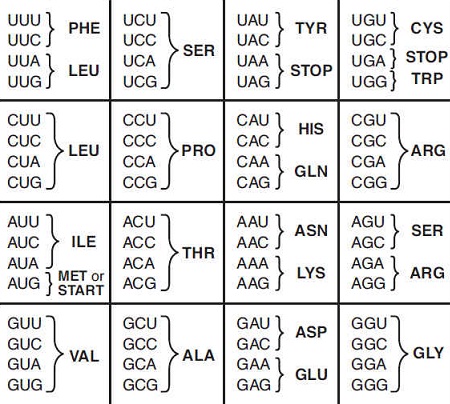


You probably learned in school (but forgot) that the twenty amino acids (the building blocks of all proteins — a protein is just a string of amino acids) are Alanine, Arginine, Asparagine, Aspartic acid, Cysteine, Glutamic acid, Glutamine, Glycine, Histidine, Isoleucine, Leucine, Lysine, Methionine, Phenylalanine, Proline, Serine, Threonine, Tryptophan, Tyrosine and Valine.

You probably also learned (and didn’t forget) that DNA provides instructions for producing these sequences of amino acids. In particular, each amino acid is encoded with a sequence (called a “codon”) of three adjacent base pairs on the DNA chain. Each base pair can be one of four types, usually labeled A, T, G or C (named after the corresponding molecules in your DNA – adenine, thymine, guanine and cytosine).

The only thing that really matters about all this, for our discussion, is what you can see in the above table. Basically, that there are 64 possible codons, because there are 4×4×4 possible ways to put together three base pairs. Any one of these 64 codons ends up encoding either one of the twenty possible amino acids, or else a special instruction to start or stop the process of adding amino acids to the protein.

Of course this code is redundant, since 64 codons is a lot more than 20 amino acids. So there’s generally more than one way to encode a particular amino acid (as you can see in the table).

The thing that struck me when I first encountered this encoding in Watson’s book was that it reminded me of one of those brain-teaser mystery stories where you are told about a crime and you try to figure out how it was done (before the detective gives it away in the end).

The mystery story in this case is all about “what happened when”. The table above clearly shows that at first there was some simpler form of proto-life way back when, which got by just fine with two base pairs. You can see this because there a bunch of amino acids (SER, PRO, ARG, ILE, THR, VAL, ALA and GLY) that never use the third base pair at all.

Furthermore, when the third base pair is the only one that distinguishes between amino acids (as in the case of HIS and GLN), then at most two amino acids ever result, even though that third base pair has the power to identify up to four unique amino acids.

In other words, there is no system at work in how the third base pair is used. In each of these HIS/GLN kinds of cases, at some point an extra amino acid was useful to have around, and some little kluge of a change happened to allow for it.

Note also that the really important structural codes — the ones that signal to start and stop a protein — are mirror images of each other in those first two base pairs. Things start with “AU” and stop with “UA”. It looks as though at some point in the very distant past, back when life was simpler (literally), there might have been a two base-pair version of the codons, with AU and UA as the respective start and stop codes.

Perhaps in some long ago transcription error, the replicating mechanism of one mutant creature started counting by threes instead of twos. But a billion years of variations might have transpired before that ever happened.

The table provides hints to a time even further back, when there may have been only one controlling base pair. Notice the second column of the table — the codons for SER, PRO, THR and ALA. Only a single base pair (the first one) distinguishes between these four amino acids. At some point in the distant past (again, looking at the table) a second base pair proved useful, and the encodings of LEU and ARG split off from PRO. Similarly, ALA split off into VAL and GLY. In each case, new kinds of proteins were now possible.

That tacked on third base pair encodes a lot less than the first two, but then again it never needed to do much. The critical mass of 20 amino acids — sufficient for a huge increase in protein functionality — was finally reached, and the rest (as they say) is history.

There isn’t enough information in the table to give us any precise ordering of events, and yet the history suggested by the encoding of amino acids clearly points to a kind of blind step-wise search: Something happened, then something else happened, and each step was a haphazard refinement of whatever stuff was already around to work with. This is exactly what happens when randomly recombinable elements are run through a fitness function (ie: when one combination happens to survive a tiny better than another).

Like I said the other day, if this structure was all put there by an intelligent God — a structure that clearly suggests the gradual result of fitness-directed evolution — that God must have one hell of a sense of humor.

Attic, part 18

“That’s just wrong,” Josh said.

“I’m not certain that ‘wrong’ is an entirely appropriate term in this context,” Mr. Symarian observed dryly.

“It’s physics,” Josh stubbornly continued, “You can’t fight physics. There’s a reason the sky is blue, and not green. Molecules in the air scatter blue light more than they scatter red light…”

“And boys who pop into strange worlds don’t magically burrow their way through densely overgrown forests,” Jenny interrupted. “What, exactly, is your point?”

Josh looked at her, opened his mouth to say something, then apparently thought better of it. At last he said, “I’m guess I didn’t really have a point.”

“Except maybe on the top of your head,” Jenny said, and suddenly two of them found themselves giggling.

“Uh, yo kids,” they heard Sid say, “If you’re about done with the laugh-fest, we got ourselves a problem. And it’d be nice to get a little mind share here.” he gestured with one wing.

They looked to see where he was pointing. Sure enough, a wall was slowly materializing in front of them. And this was no ordinary wall, but a ten foot tall edifice, massive and imposing, that seemed for all the world to be made of solid rock. The great wall, which now looked discouragingly solid, stretched from one horizon to the other, barring the way ahead.

“Now we’ll never get anywhere,” Josh groaned. “What do we do now?”

Antony Flew

I read today of the death of Antony Flew at age 87. Mr. Flew was a well known and highly articulate atheist philosopher who in 2004, at the age of 81, suddenly announced that he had changed his mind about the existence of God. To me the most notable thing about this late life conversion to faith was Mr. Flew’s stated reason. Essentially, his argument was that something as complex as DNA could not have occurred without intelligent intervention. The NY Times has quoted Mr. Flew on the subject as follows:

“[DNA research] has shown, by the almost unbelievable complexity of the arrangements which are needed to produce life, that intelligence must have been involved.”

Oh my.

Of all the observed phenomena in the known Universe that Mr. Flew could have chosen as his example, I am astonished that he should have chosen this one. For I had exactly the opposite experience, back when I took it upon myself to learn a bit more about DNA than they had taught me back in high school.

In particular, one day back in 1994 I purchased a copy of Recombinant DNA by James Watson, to learn as much as I could about DNA, ribosomes and genetic replication.

I confess that my motives for this new-found curiosity were not strictly scientific. I had recently fallen madly in love with a beautiful molecular biologist, and I longed to know everything I could about her world. For a while, all things molecularly biological took on a strange romance in my mind. The fact that Watson’s book essentially described the chemistry of sexual reproduction was a further poetic twist that was quite lost on me at the time.

But I digress.

I discovered, as I read this wonderfully written book, a set of facts about DNA and the encoding of amino acids that might as well have been a bright red flashing neon that said “This must be the product of Darwinian evolution!”

In fact, DNA encoding provides such a strong argument for natural selection that if there were a God, the way DNA encodes amino acids would be a demonstration that he/she must be a rather perverse God, possessed either of a nasty and twisted sense of humor or else some sort of deep seated hostility toward humans. Otherwise, he/whe wouldn’t plant evidence (for us humans to find) of his/her own non-existence.

Why does DNA encodimg provide such a strong argument for natural selection? I’ll get to that in two days. Watch this space.

Attic, part 17

To Jenny it seemed like hours since they had left the little clearing, although there was no way to know for sure. As they went further into the forest, the light seemed to dim. They had tried making small talk near the start of their journey, but it seemed that all conversations petered out within moments. It was as though the forest itself was willing them to silence.

She could barely make out Josh just ahead of her — she realized she was now following him as much by sound as by sight, as he pushed aside branches and leaves to make his way. Every once in a while she would try moving off to the side, to push into a different direction, just to see what would happen. And inevitably she would find that the forest was completely impenetrable in any other direction. At any given moment only one heading was passable — whichever one Josh happened to be using. She wouldn’t have been surprised to discover that the path went only one way. If they tried to double back, she thought, they might very well find that the place where they had just walked was now nothing but a solid thicket of trees.

At some point she realized it was getting lighter. At first she had thought it was her imagination, but now the changing light was unmistakable. She felt a mixture of relief and trepidation when Josh at last led them to the edge of the forest. She followed him through a gap between two trees, and then suddenly they were in the open air. She could hear Mr. Symarian, the demon still perched on his shoulder, come up out of the forest behind them. But it was hard to focus on that — she and Josh were both preoccupied with looking up.

The sky, stretching out above them, was a magnificent shade of green.

A living moment, revisited

Recently I’ve been doing something I never used to be able to do. After attending a great theatre or concert or dance performance, I look online afterward, and I usually find an excerpt of that performance somewhere on YouTube. I’m sure most of these recordings are illegal, but there you are.

The videos on YouTube, which are usually of inferior quality (bad lighting, worse sound) don’t really stand on their own. But if you’ve seen the live performance, they take you back to the excitement of the moment, when you saw Placido Domingo or Sutton Foster or Yo Yo Ma or Nellie McKay — the sense of excitement in the audience as everyone realized there was something magical going on this particular evening.

I wonder whether somewhere in here is the answer to the “reality versus cyberspace” debate, for here is a case where the power of the internet to archive and preserve is perfectly meshed with the ability of live performance to capture a living moment.