Spinach

Continuing the topic from yesterday – which again comes out of lots of interesting conversations with Jan Plass and other colleagues – the question always comes up of whether the potential educational benefits of games for learning might run into the coolness problem: kids may not want to play a game that’s supposed to be “good for them”. If you give middle school kids a game that’s really fun, but by playing it they know that they are actually doing math homework, would this awkward fact make the game so uncool that it is actually no longer fun?

Yet how could things be worse than the way they are now? Standard practice today is to give kids ages eleven through thirteen lots of boring homework exercises to hone their math skills. It’s hard to argue that the current approach is the optimal way to win their hearts and minds, or to show them that math can be fun and exciting. The same material covered via well-designed game play could hardly be any worse for motivating learning than the current status quo. In fact, there is every reason to think it would be better.

But still, I am reminded of that wonderful 1928 New Yorker cartoon drawn by Carl Rose and captioned by E.B. White:


Old E.B. hit the nail right on the head, didn’t he? Kids know. Kids always know.

So how will this play out? Can games make education more relevant and fun? Or will kids merely look at games in education as a surreptitious attempt to make them eat their vegetables? On the other hand, if our educational system embraces game play properly then perhaps school itself may come to seem a lot cooler.

Anatomy of gameplay

When you play a computer game, what are you learning? And how can we describe the essential pieces of that learning process? My colleague Jan Plass, whose research studies the effective use of technology in education, and I have been having some pretty fascinating discussions and spirited debates about how a game can function as a kind of vehicle for learning. One intriguing problem is how to visualize this vehicle in a way that clearly shows how all of its parts work together. Here is one such visualization:
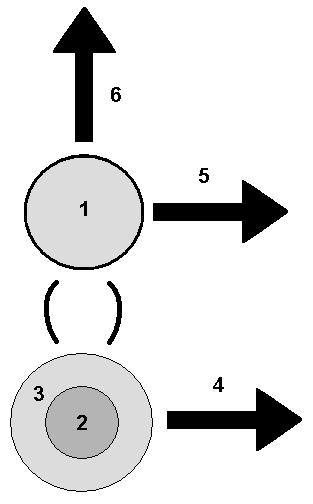


  1. Player’s understanding – ability to play well
  2. Game mechanic – the rules of play
  3. Aesthetic design – graphics, sound, etc.
  4. Narrative drive – the “story” moving the game forward
  5. Extrinsic rewards – points, winning, etc.
  6. Intrinsic rewards – getting better, improving skill

Everything revolves around the interplay between (1) the model in the player’s head and (2) the mechanic of game play. All of the other pieces are in support of that interaction. Graphics, sound, and so forth (3) serve to add clarity and aesthetic pleasure to the experience, but they are really scaffolding to support that central player/game-play dynamic.

Similarly, a game generally provides some sort of narrative thrust (4), such as “get three in a row”, “capture the enemy king” or “buy up all the real estate”, which helps to focus the interaction in the player’s mind by giving it context.

In addition, the player is rewarded for good play in two ways: extrinsically by earning points, winning games, being the high scorer among a group of peers, and so forth (5) and intrinsically by gaining improving in skill, confidence and ability to take on more advanced challenges (6). In many computer games this increase in skill is often rewarded by “leveling up” – a case where intrinsic reward is augmented by an extrinsic reward.

A game that does not continue to give intrinsic rewards would soon grow tiring. This is why, for example, only small children enjoy tic-tac-toe: Because the highest level of attainable skill is quickly reached by older children and adults, and then there are no more opportunities for intrinsic reward.

The entire above model only really makes sense as a support vehicle to “move” the player’s mind, through a path of maximum fun, in a way that provides continual pleasurable challenges. This tends to result in ever increasing skill, as long as the game lasts. This path of maximum engagement, neither too easy nor too difficult for the player’s current skill level, corresponds to the mental state that Mihály Csíkszentmihályi refers to as “flow”.

One can visualize this as a landscape with an optimal slope. Game narrative and extrinsic rewards move the player and the gameplay forward, while the intrinsic reward of the player’s progression in ability moves the entire structure upward along the slope:
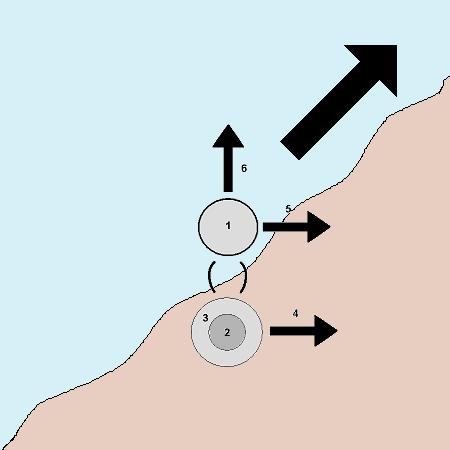


As the entire vehicle moves, the nature of all the components within it might be changing as appropriate: the player’s mental state, the nature of the gameplay, the aesthetic components, the narrative of the game and the rewards offered, both extrinsic and intrinsic.

A good game is one that moves this vehicle along this upward terrain by evolving all these components appropriately to maintain a maximum sense of fun challenge.

It could be argued that the only difference between a good game and a good educational game is in the opportunities for knowledge transfer of the intrinsic rewards (6) out of the game and into other contexts. For example, a rewarding experience playing Worlds of Warcraft can increase a player’s abilities in the “science” of alchemy. But one could well envision an alternate version of WOW with exactly the same gameplay, yet which challenges the player to improve his/her skills in chemistry or some other skill that transfers well to the world outside of the game. That version of WOW could indeed be an effective educational game.


In Seattle

On some level it may be possible to get a sense of the culture of a place, the feeling in the hearts of its people, simply by taking in its geography. Manhattan is utterly artificial, a dominion of pure human invention. When you walk its canyons, mingling with the other inhabitants all dressed in black, you are completely engulfed by the power and hubris of twentieth century technology, from the Empire State Building to Rockefeller Center to Wall Street. The one part that is green – Central Park – is literally surrounded by towering buildings, and is itself completely artificial, a architected fantasy of nature, constructed by Frederick Law Olmsted and Calvert Vaux in 1859.

This geography accurately reflects the soul of the populace. Manhattanites believe in nothing so much as the possibility of self-reinvention. We live to enlessly create the world anew as an extension of ourselves. From the galleries of Chelsea to the power lunches of Wall Street to the crowds streaming through the theatre district and Times Square, what is valued and exalted is what is created from the mind, and reality itself is bent to the will of human intellect.

Seattle, where I find myself this weekend, is different. The iconography of Seattle is defined by the tension and opposition between the Space Needle and Mount Rainier. Unlike New York, The Seattle/Redmond area nestles its metropolis within nature, its urban centers of gravity happily split down the middle by a huge natural lake. People here can certainly be as brilliant and intellectually inquisitive as New Yorkers, but they also incorporate an idea of nature into their internal rhythms. They dress down, go hiking in the mountains on the weekends, wear earth tones, and project the laid back air of people who think of themselves as somehow “organic”. Even the iconic music of disaffected protest is Grunge, rather than Punk – not so much Johnny Rotten as Kurt Cobain.


I am enjoying this brief vacation from assertive black into easy earth tone, although even here I walk about in my New York wardrobe. It is not so easy for a Manhattan boy to go native. But I love the feeling, at least for a while, of immersing myself in a great metropolis that is presided over by the vast presence of Mount Rainier, looming upon the horizon like an ancient and watchful God, ever casting its spell upon the culture and the hearts of a city’s populace.

Off the deep end

I have been following the comments on yesterday’s post, and I think Lisa and Manooh have both made very thoughtful points – but from completely different philosophical perspectives. It was interesting for me to watch Lisa work through this difficult terrain, trying to be thoughful and intellectually honest about it, while wrestling with points of view that clearly seemed very foreign to her. The only aspect of Lisa’s comments that I didn’t follow was the connection between admiring red poll cows and eating red poll cows. These seem to be two quite separate issues – if you find something beautiful, that’s reason enough to work to preserve its existence, isn’t it? For example, we like having squirrels in our parks, and we don’t need to justify their existence by eating them.

I was completely thrown for a loop by Sally’s comment that I am going off the deep end. I’m not sure what it means to be off the deep end in this context. My opinion is simple: I don’t want to kill any fellow being that has a subjective experience of existence, so given the choice, I choose not to. I understand that this is a minority opinion, but so is being Jewish or Quaker.

I don’t tell people that they are off the deep end because they kill to eat. My objection to The Times editorial was that it implied that there is some kind of mutual sentimental bond between people and the creatures that people kill – a sort of pleasant inter-species friendship. On the face of it isn’t that a contradction? Clearly I am not the friend of what I kill. It might be in my self interest, but it is never in the interest of the other. The fact that The Times felt the need to say something so inherently self-contradictory seemed interesting and worth talking about. If pointing this out constitutes being off the deep end, then what doesn’t?

A more measured approach

Yesterday The New York Times published an editorial about the one million dollar prize that PETA is offering for the “first person to come up with a method to produce commercially viable quantities of in vitro meat at competitive prices by 2012.” The Times’ response was interesting:

“We prefer a more measured approach. Ensure the least possible cruelty to animals, by all means, and raise them in ways that are both ethical and environmentally sound. But also treasure the cultural and historical bond between humans and domesticated animals. Historically speaking, they exist only because of the uses we have found for them, and preserving their existence means, in most cases, preserving the uses we have made for them. It will be a barren world if the herds and flocks disappear in favor of meat grown in a laboratory tank.”

By changing just a few words of the above paragraph, we can apply this interesting logic to other contexts:

“We prefer a more measured approach. Ensure the least possible cruelty to slaves, by all means, and raise them in ways that are both ethical and environmentally sound. But also treasure the cultural and historical bond between us and our slaves. Historically speaking, they exist only because of the uses we have found for them, and preserving their existence means, in most cases, preserving the uses we have made for them. It will be a barren world if the happy slaves singing in the fields disappear in favor of crops harvested by machines.”

Scenes from the novel VIII

Emily inched her way around the house. She looked carefully where she placed her feet, trying not to step on any twigs. She could hear voices from inside. The voices sounded pretty close, but if she was very quiet, maybe they wouldn’t hear her. She knew that her footsteps were leaving impressions in the muddy ground, and so they’d be able to tell that she’d been here. But by then it shouldn’t matter anyway, since she’d already be gone.

She inched along the wall, trying really hard to be quiet, not even to breathe too much. When she was sure of the next footstep she would look up at the mural along the side of the house. She could tell from the pictures that she was getting there, slowly but steadily. The voices inside were even louder now. It sounded like an argument.

Finally she found it – the painting of the two white chickens – a hen and a rooster, a girl chicken and boy chicken. It was the same funny picture she’d seen in the book, with the chickens looking into each other’s eyes, like they were on their honeymoon. She wondered whether chickens have honeymoons. And if they do, where do they go? Maybe there’s a resort somewhere just for chickens in love. For a moment she saw an image in her mind of the girl chicken wearing a two piece bathing suit, and she felt herself starting to giggle.

Quickly she stopped herself, wondering if the people in the house had heard. This was a really bad time to get silly. Focus, think, what was next? The wheel barrow turned out to be right where Grob had said it would be, hidden just behind the azalea bushes. It was still wet from the morning’s rainfall. The once shiny red paint was rusting off in places, but she could tell it had been really pretty once.

Something was funny about it though, and she tried to figure out what it was. Then she realized – there was no water inside the barrow. That shouldn’t have been possible, so soon after the rain. And that’s when she knew everything was ok. Carefully she climbed in, being careful not to tip it over. Some of the wed mud clinging to the outside of the barrow got onto her skirt, but there was nothing she could do about that. It was only as she sat down, steadying herself, that she became aware that the voices had stopped. She tried not to think about that now. She focused, like she’d practiced, looking up at the picture of the two chickens, focusing on it, thinking about the book like she was supposed to.

Then there were voices again, but now they were much clearer, outside the house. Steps running toward her, angry, shouting, getting closer. She held on tightly to the wet sides of the wheel barrow, resolutely looking only at the picture, putting everything out of her mind except the two white chickens. And then everything went shimmery, and she was back in the library.

Appreciating the gesture

Human natural languages (ie: languages that children can learn without needing to be explicitly taught) are roughly divided into two kinds: oral and gestural. For the most part, hearing people rely on oral language, and deaf people rely on gestural language (unless they were forced to do otherwise as children). There are great similarities in the grammatical underpinnings of oral and gestural natural languages. In fact the two modalities are complementary, particularly during early years of language development, as has been shown by many researchers, including Susan Goldin-Meadow and David McNeill. Structurally the similarities are greater than the differences.

It is interesting to ponder whether it might be possible to combine the best of each. Suppose you and I had a face to face conversation that made use of a well structured combination of oral speech and hand gestures, to create a form of person-to-person verbal communication richer and more detailed in meaning than is achievable through oral communication alone.

Just describing such a scenario raises so many questions. For example, does the scenario even make sense? Would the brain be able to make effective use of an entire complementary channel of communication, above and beyond the sort of language processing that most people employ now? What sorts of things would this extra channel be used for? Even if we knew that, would such a skill be learnable by most people?

I am starting to think about how one might design simple experiments to take steps in this direction. Perhaps people could be asked to describe certain scenarios that are not readily described with verbal speech alone, but that become much easier to described when enhanced by a complementary grammar of hand gestures.

Does anyone know whether questions or experiments like this have been explored before?

Moments

      for a song

And so one night you stop and think
Of all the times before
You settle down and pour a drink
And total up the score
Was there a moment when you knew
The tide had turned away?
You would have told her, wouldn’t you?
The time, the place – the day

The heart had spoken, as it must
To tell me I must go
And all those secrets turned to dust
Those secrets that I know
The moments when I saw, but oh
Those moments fade to gray
I’d tell her this, I would, I know
If it were yesterday.

We only get a moment’s chance
Not time to wonder why
The music starts, we rise, we dance
And moments? They slip by…
I never told her when I could
I never thought to say
Or tell her what I knew. I would
If it were yesterday.

Having gone there…

Having gone there, I guess I should complete the thought.

I think the danger to the Obama candidacy of his recent statement is that he has revealed himself to be, at heart, a pacifist. On the surface this sounds like a positive thing. It’s certainly something that I support. And yet I suspect that deep down our nation’s citizens recoil away from pacifists, although most people wouldn’t put it that way. We are an odd amalgam – a culture that professes a love of peace, and yet which has derived enormous economic leverage from our outsized ability to wage war.

When I was an undergrad at Harvard, we were visited by representatives from the CIA, who were there to fish for recruits among the intellectual elite. One rep was quite frank with us. Since he was trying to recruit us, it behooved him to be frank. He explained that the major utility of our military might its role in keeping the hearts and minds of our nation-state clients around the world. In this way we achieve favorable trade status, and assert control of the international economic agenda. I suspect that the CIA would have been much less frank with the Press in going over these talking points.

Notice the first thing that Senator Clinton did when Obama appeared to say something negative about Americans and their guns: She reminisced fondly about her girlhood as a hunter. Cannily, she was positioning herself as a warrior. After all, the U.S. president is also referred to, respectfully, as “The Commander in Chief”, which is very much a military characterization.

I suspect that this strategy will not work for Clinton – the cost she is paying in looking ever more like a mean spirited attack dog is simply too high. But by amplifying the perception among general voters, implied by Obama’s recent words, that he may not be a proper gun-toting American, ready and eager to kill (although nobody ever puts it that way), Senator Clinton might succeed in getting John McCain into the White House.

Isn’t it ironic? Obama makes the mistake – which might cost him the nomination – of revealing that he may have a distaste for killing innocent fellow sentient beings in cold blood, something Americans do just because, [irony on] well you know, because it’s really fun to kill. What could be more empowering, more of an adrenaline rush, than that terrified look in their eyes, that heady mix of fear and confusion and pain, just before the moment of death? And it’s all perfectly legal! [irony off]

Obama’s rhetorical slip creates an implication – immediately exploited by his Democratic opponent – that he might not have the heart to arrange for the killing of large numbers of fellow humans. And that therefore he may not be qualified to represent our great nation and its values.

Wow. This is the liberal party! What kind of a country are we?