The Great Neil Young Mystery

In the early 1970’s Neil Young’s music – a kind of post-hippie intellectual folk rock tinged with southern country – represented exactly how a lot of U.S. youth was feeling as the Vietnam War was drawing to its sad conclusion. There was an almost unimaginable cultural gap between that sound (a hard-fought return away from psychedelia to a kind of post-Beatles roots music) and the earlier aesthetic of Broadway musicals.

By the time Young was recording, many waves of successive cultural upheaval had left their mark in the mere fifteen years since the songs of Lerner and Loewe’s My Fair Lady had swept to the top of the pop charts. After the British invasion of 1963, it would become progressively harder for a Broadway musical to produce even one hit song, let alone a whole slew of them.

By the early 1970s, the entire aesthetic that had created the classic Broadway musical had been rejected by a new youth generation. Rodgers and Hammerstein, Lerner and Loewe, Frank Loesser – all of whom had recently been towering figures in the popular culture – were regarded as irrelevant or worse, cultural stooges of a discredited older generation that now stood for Richard Nixon and a reviled war in east Asia.

And yet two of Neil Young’s most popular songs: Heart of Gold and I Believe in You, have identical titles to two songs from Frank Loesser’s 1961 How to Succeed in Business Without Really Trying – a Broadway musical that was the very epitome of the older aesthetic.

Well ok, one song title could easily be a coincidence. But two? To quote Lady Bracknell in The Importance of Being Earnest (upon finding out that her prospective son-in-law is an orphan): “To lose one parent, Mr. Worthing, may be regarded as a misfortune. To lose both looks like carelessness.”

So is it really possible that there was some utterly wild coincidence at work here? Or was Mr. Young just possibly having a little post-modern fun?

Eros and Thanatos

Eros and Thanatos met at a bar
Eros said “What a strange creature you are!”
Thanatos shrugged “I’m more strange than you think”
“Sit yourself down and I’ll buy you a drink.”

Sigmund was shaking his head at the sight
Of such an odd pair on a Saturday night
“Tell me my friends,” he inquired, “Dear amigos
“Where do you come from, our Ids or our Egos?”

Eros and Thanatos laughed “You inquire
To know if our union is thought or desire?”
They bought him a round and left quite a good tip
For they already knew they would give him the slip.

“We are two of a kind, we are life, we are fear
“We’re the bee in your bonnet, the head on your beer
“The secrets you keep from the friends you betray
“The days of your life and the life in your day”

“We’re the thieves of your heart who will prey on your mind
“The hope that you treasure, the solace you find
“The romance of death and the death of Romance”
And then they got up and proceeded to dance

Sigmund was mortified “This isn’t right!
“You are old enemies, why don’t you fight?”
Eros and Thanatos answered him plain
“Poor dear old Sigmund, are you insane?”

“For who rules the sky – the Sun or the Moon?
“When starts the season, November or June?
“Where lies betrayal, the lips or the heart?
“Haven’t you learned anything, you old fart?”

Then Sigmund smiled, amazed and delighted
“This is right up there with love unrequited!
“Please tell me all, let me buy you one more!”
But Eros and Thanatos slipped out the door.

“Wait!” cried old Sigmund, “Please do not go
“Why would life embrace death? I am dying to know!”
But he was alone, there was no one to hear.
“Oh well then,” he shrugged, and he had one more beer.

Scenes from the novel IV

At first nobody noticed when the fog started to roll in. A few tendrils of mist gathered around the outskirts of town, swirling lazily in the midday air. Gradually the mist thickened, and isolated eddies flowed together, seeping into the back alleyways. The dogs noticed it first. They could sense that something was different, not quite right.

Eventually the mist flowed out of the alleys and poured onto the town square. The children were entranced – it was like a snowfall made of air. They watched, enchanted, as it flowed around their ankles, while they laughed and ran in circles. Their parents looked on uneasily from shops and doorways. There had never been a mist quite like this before, not in these parts.

As the afternoon wore on, the mist rose gradually higher, settling like a blanket over the whole town, thick as cornmeal soup. One by one the shops closed down and people headed on homeward. Parents rounded up their children, pulling the reluctant youngsters indoors. The good citizens of the town shuttered their doors and windows. Some made a sign of the cross or muttered a few silent words of protection under their breath.

Eventually the town grew still, settling into an air of watchful waiting. And that was when some of the more astute amongst the town folk began to notice the Darkening. But only Grandpa Evans, shut up in his old house on the edge of town, thought to look into the almanac. He scratched his head and double checked his columns. Weren’t no eclipse scheduled for today. He sat for a while and patiently thought it all through, and then thought it all through again. When he was done thinking he opened the kitchen drawer and rummaged around until he found his old leather cartridge case. Then he went out to the front hall and took down his shotgun.

The unkindest cut

What makes people suddenly cut other people off, precipitously end a friendship or a romantic attachment by ceasing all communication? I have known several people in my life who one day simply vanished, stopped making contact, after having been (apparently) quite friendly and open. Sometimes you can guess at a reason, but of course you can never be sure. I think of it as a sort of “sudden death” syndrome for friendships.

I can’t recall ever doing anything like that myself. I’m not sure that I would be able to. If I were truly that angry at somebody, I would probably need to express my anger to them, hoping against hope that we could find some way to resolve the conflict. To me, silence between people, utter silence, is an abyss. It is a featureless void upon which may be projected our darkest fears.

Perhaps there are two kinds of people in the world: Those who deal with a conflicted relationship by expressing their anger, and those who simply take out the knife and calmly hold the relationship out before them. And then, with a single cut, quietly slit its throat.

I am glad that I am in the first category.

The Great McGuffin

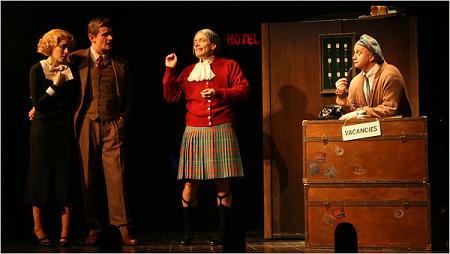
Yesterday I saw the current Broadway production of The 39 Steps. The play faithfully follows the plot of Hitchcock’s film, scene for scene, but turns it into a wild (and very funny) farce. What was particularly interesting to me was that all of the humor on-stage was based on playing with Theory of Mind. I’ll explain.

The basic strategy of the play is to point out, right from the start, that we are watching an artifice, a thing of pure unreality. Which of course is a given, since we’re actually watching a play – mere actors on a stage. But here the artifice is ratcheted up further by the fact that the several dozen characters from the film are played by only four actors, who continually swap in and out of costumes and personalities. At times actors switch costumes so rapidly that they are able to have entire extended dialogs with themselves.

Please understand, this is all done very well, a feat which requires split-second timing, instant shifts of acting technique and razor sharp choreography of movement. The cast is more than up to the job.

Of course the real subject of the play is not Hitchcock’s The 39 Steps. That is merely a McGuffin. The play is really a comic essay about the phenomenon of theatre itself. Specifically, the contradictions of an art form predicated on spending one’s evening watching real people pretend to be imaginary people.

As I watched the actors shift in and out of the “reality” of the story, I realized that at its core I was witnessing the power of Theory of Mind. The audience’s ToM is being given a continual workout, by being asked to join the cast in the wild exercise of constructing ephemeral views of mental states and emotional relationships, while the quotation marks that serve to nest those views within one another are continually put on and taken off.

The humor comes from seeing the world of theatrical emotion continually deconstructed. And the audience never tires of the joke, even though in some places it is repeated multiple times in literally the same way. At the performance I attended, the audience laughed, on cue, every time, no matter how many times they had already seen the same trick.

My favorite moment came near the end of the play when a character – the arch villian – becomes enraged to see his fiendish plot foiled by an event so meta-, so outside the reality of his character, or even of the play itself, that the moment is as absurd as watching a sock puppet jump off a performer’s hand to rail against the sock manufacturing industry.

Now you must understand that the actor who is playing this particular moment has just slipped into the arch-villian character mere seconds ago. In the last several minutes alone we have probably seen him play about ten wildly different characters, including several women. And yet the audience recognizes and responds enthusiastically to the frustration of the arch-villian, this sock puppet, this utterly transitory being.

The playwrite understands perfectly that we, the audience, will embrace any dramatic being that makes a heartfelt claim on our emotions, no matter how absurd that being may seem. And to me that shows, right there, the enormous power of Theory of Mind in fiction.

ToM foolery

When I first read Douglas’s comment, I thought he was implying that Republican strategists want us to think Obama is worried that voters might end up concluding that black people actually buy into Reverend White’s incendiary belief that all whites are racist.

Well, that was nine levels of nested attributed mental states, so I guess yesterday’s commenters were right to point out that our ability to nest attributed mental states depends mightily on how things are presented. I’m sure somebody else could do better than my example, but it’s already pretty clear that with a little care we can go much deeper than five levels.

It would be interesting to make a computer game in which winning depends on successful use of Theory of Mind. For example, maybe to win the game you need to figure out such things as whether knowing that Ellen was lying when she said that her sister wanted to sleep with John actually tells you that Ellen’s sister was only pretending to be jealous after Ellen announced that John had said he wanted to marry her. Well, you get the idea.

If nothing else, we might get a whole new demographic of game players and game designers!

I think you suspect I believe you agree with my opinion.

I’ve been reading Lisa Zunshine’s wonderful book Why We Read Fiction – Theory of Mind and the Novel (Ohio State University Press, 2006), which ties together literary theory and cognitive psychology – specifically “Theory of Mind” (ToM is the mental model we construct of what people are thinking/feeling). The book shows how the pleasure we get from reading about fictional characters derives from the pleasurable sensation of continually testing the evolutionary adaptation that allows us to form such mental models.

The underlying science, in brief: Well developed ToM improves group/clan cooperation and bonding, and therefore is good for species survival, so individuals in our species have evolved to find pleasure in maximizing those abilities. Our brains get so much pleasure from working out peoples’ motivations and underlying emotions that we seek out such mental activities even in fictional contexts.

All of this ties in with the “Hack the Character” theories that I talked about on January 9 and in related posts, and that I sometimes talk about in public. I think that’s why she gave me a copy of her book. 🙂

I’m at the point in the book now where I’m reading about the experiments conducted in the lab of Professor Robin Dunbar at Oxford, to find out what limits there might be on the complexity of the ToM mental models we can form. Specifically, how many levels can we nest thoughts like “he thinks that she believes that they agree with…” before we get lost. Dunbar et al designed some really clever experiments which showed that most people have no trouble nesting four levels deep, but start to lose it at five. For example, I suspect that the five-nested sentence in the title of this post might be pretty tough for most people to decypher.

And that suggests what might be an interesting game. Can we carefully construct sentences that require highly nested theory of mind, and yet won’t confuse people? For example, I’ve managed to make a sentence that nests five-deep, which I’m guessing will be completely clear to most people reading this:

I think Obama worries that voters won’t like his Pastor’s belief that white people are racist.

Can we go deeper than this, and still make sense? Or are our poor little minds not up to the task, no matter how clever we are in trying to circumvent our limited brain power? I’m open to suggestions.

Infelicity

In addition to the incomparable Miss White, my other eighth grade teacher was Miss Felice. She too was young, and full of good humor. My feelings toward Miss Felice were less, um, hormonal, but nonetheless I appreciated her enthusiasm, wackiness and energy level, wonderful qualities generally found only in the very youngest middle-school teachers.

It was only years later that I figured out that the sometimes bitter and cynical older teachers in our school had probably once been more like my two young English teachers, before all the joi d’ecole had been knocked out of them by years of battlling with the public school system.

Miss Felice (even her name was happy) was the person who introduced me to the magic of Nina. Some of you might already know about Nina, but it was Miss Felice who turned me on to this wonderful bit of urban culture, a beautiful gem tucked away in the corner of New York life.

Al Hirschfeld was possibly the greatest caricaturist of the twentieth century. He died only a few years ago, at the grand old age of ninety nine and a half, after having drawn, with his magic pen, the defining image of pretty much everybody of note who popped up during the eighty years or so of his mighty reign, including just about every celebrity and major politician, as well as various gangsters, gin runners and assorted riffraff.

He had the uncanny ability to capture the pure essence of a famous person, fusing appearance and personality together with a few well chosen lines, somehow completely bypassing mere “realism” on his way to something far deeper and more true. For many years Hirschfeld was the image of The New York Times Arts and Leisure section. And one day Miss Felice pointed out to me that just to the right of his signature, he usually put a small number, like 3 or 5. It was the number of occurrances in the drawing where he had hidden the name of his daughter Nina.

At the time, I thought that was just about the most wonderful gift a father could give his child, and I was utterly charmed by the entire idea of it. Thenceforth, every Sunday morning when The Times was delivered to our house, the first thing I would do was find all the Ninas. I got really good at it after a while. Of course, by the time I learned about all this, Nina was already grown up, but that didn’t take anything away from the experience. And he kept it up too, until he passed away at ninety nine, by which point Nina was fifty eight.

So I became a big fan of Miss Felice. Then, oddly, one day she too had her Miss White moment, but with a twist. It was the day I noticed a cute miniature figurine of a teddy bear on her desk. I asked her what its name was. Miss Felice replied, in her usual bright and perky way, “Gladly, my cross-eyed bear!” I looked more closely, and sure enough the little fellow was indeed cross-eyed.

And then about a minute later it hit me. This little knick-knack was a token of religious faith. It gave her a way to say, out loud: “Gladly my Cross I’d bear.”

To me there was something dubious about this. For Miss Felice to communicate her Christian faith to a schoolboy through the prism of a bad pun was completely consistent with her endearingly loopy nature, but to my twelve year old brain it was all a bit troubling, a little like thinking you’re watching Avenue Q, and then suddenly the goofy puppets start acting out scenes from Left Behind.

When my beautiful Miss White had tried to steer my impressionable and love-struck young mind down the path of Scientology, she had merely broken my heart. In that moment she had ceded her coolness, and so the whole episode had held no threat.

But with Miss Felice on the other hand, I was encountering something much more troubling. I was forced to realize that even when people are cool and goofy and have appropriate respect for the supreme majesty of bad puns, they might still be trying to sell you something.

And that’s scary.
First day of Spring

Today is the first day of Spring. The Vernal equinox, cuspus proventus, when the day once again overtakes the night. It is the time of year when, according to ancient lore, the great Goddess Ostara carries forth her basket of eggs, accompanied in her joyous revels by her spouse, a pagan god who takes the earthly form of a hare. And you thought the Easter Bunny was just for kids!

Speaking of which, if you grew up in New York State, the first day of Spring has great significance. Unlike certain other places I could mention, New York has actual seasons. It gets too cold here in the winter, and too hot in the summer. Of course each of these seasons has its childhood compensations. For example, Winter has sledding, iceskating, building a snowman, and all those other wondrous activities based around the fact that water gets really really interesting when it freezes.

Summer may get insanely hot and humid to the point where everything becomes disgustingly sticky and unpleasant, but Summer too has its compensations. For example, you can go swimming. And not only that, but also, um, well ok, that’s pretty much it. Swimming. Unless you are into fishing or playing baseball, and I was never into either of those two time-honored activities. Fishing because it was unfair to the fish, and playing baseball because it was unfair to my easily bruised adolescent ego. Did I mention swimming?

But just around Springtime, everything gets perfect. Leaves begin showing up on the trees, a soft and inviting breeze follows you around the whole day long, everyone starts to get all happy and relaxed, and the entire world seems to put on a smile.

On some level, even if they don’t talk about it, people know what Spring is about. Spring is about the promise of renewal, and it is the season of second chances. Sure, maybe you got everything wrong last year, screwed it all up, fell flat on your face. But this year is gonna be different. I can feel it on that breeze. This year hey, look out World!

And every year, when Spring comes around, you know you have another chance to get it right. You can feel it deep down in your bones. I don’t think you ever lose that feeling. I still have that faith in the Gods of Springtime just as strongly now as I did when I was a kid.

Although I have to admit it creeps me out just a little to think about that goddess and the Easter Bunny, um, doing it…

Astonished

I try not to talk about current politics here, but yesterday I was completely surprised – no, astonished – by Barack Obama’s speech on race relations in our country. I deliberately refrained from watching the video, but only read the text. I didn’t want to be swayed by a politician’s charisma, but rather wanted to find out what he had to say. You can read the entire text of the speech here.

I hadn’t expected to be astonished. I suppose I had gotten used to the politician’s self-protective crouch, the safe sound byte, the way even the most thoughtful of public speakers have now learned to carefully dumb it all down, to assume that any real attempt to speak to the intelligence in their listeners would not be worth the risk of having their words taken out of context, that anything complex they try to say would somehow be turned against them.

So I was not prepared to be spoken to with true respect, with actual reasoned intelligence, for a speech to contain complexity, historical context, to frankly discuss the enormous varieties of anger that tear at this country, or to talk honestly about the causes of our nation’s rage, without giving in to that rage.

When was the last time you can remember a major politician in this country actually daring to respect the intelligence of our people, the complexity and contradictions of our culture? Think about it for a moment. When was the last time?

Ever since we entered our current bizarro era of presidential image building, in which a major war is started by shouting “Mission Accomplished” while wearing a silly costume, in which being “presidential” means being periodically driven to a fake ranch for pretend wood chopping, in which wartime photo-ops are staged with plastic turkeys, it feels as though our nation’s citizenry has taken on some of the characteristics of of a chronically abused spouse: After we’ve been slapped upside the head enough times, we begin to believe that we deserve the punishment and humiliation.

By the time of Katrina, when unconscionable neglect was inflicted by an uncaring and incompetent government upon its own citizens, the obscene jokiness of a line like “Heck’va job Brownie” had come to seem normal. Our nation had already been beaten into submission, had been convinced it must really be a race of idiots, undeserving of real democracy, let alone legal niceties like the protection of Habeas Corpus.

We had learned to look down so Daddy wouldn’t smack us again, to keep our voices low and to take off our shoes at airports, while anesthetizing our suppressed rage by sneaking off to watch John Stewart and The Simpsons, the way a generation of enraged teenagers used to sneak off to read Mad Magazine. Anything to escape the scary people who had somehow taken on the role of a nation’s grown-ups.

So to read something like this, a speech so subtle, complex, reasoned, so respectful of its listeners, a speech which gives us the benefit of the doubt that we are indeed capable of holding two ideas in our heads at the same time, this has made my heart leap for joy. I had given up on such possibilities.

I don’t know who will become our next president. But meanwhile, bless you for this moment, Mr. Obama. Bless you. For the first time in years I remember what a privilege it can be to be part of a nation of ideas, a nation of people who are capable of mutual respect, who continue, even while disagreeing, to hold each other’s steady gaze.

I remember again what it feels like to be an American.