Shopping today for toilet paper at Walmart
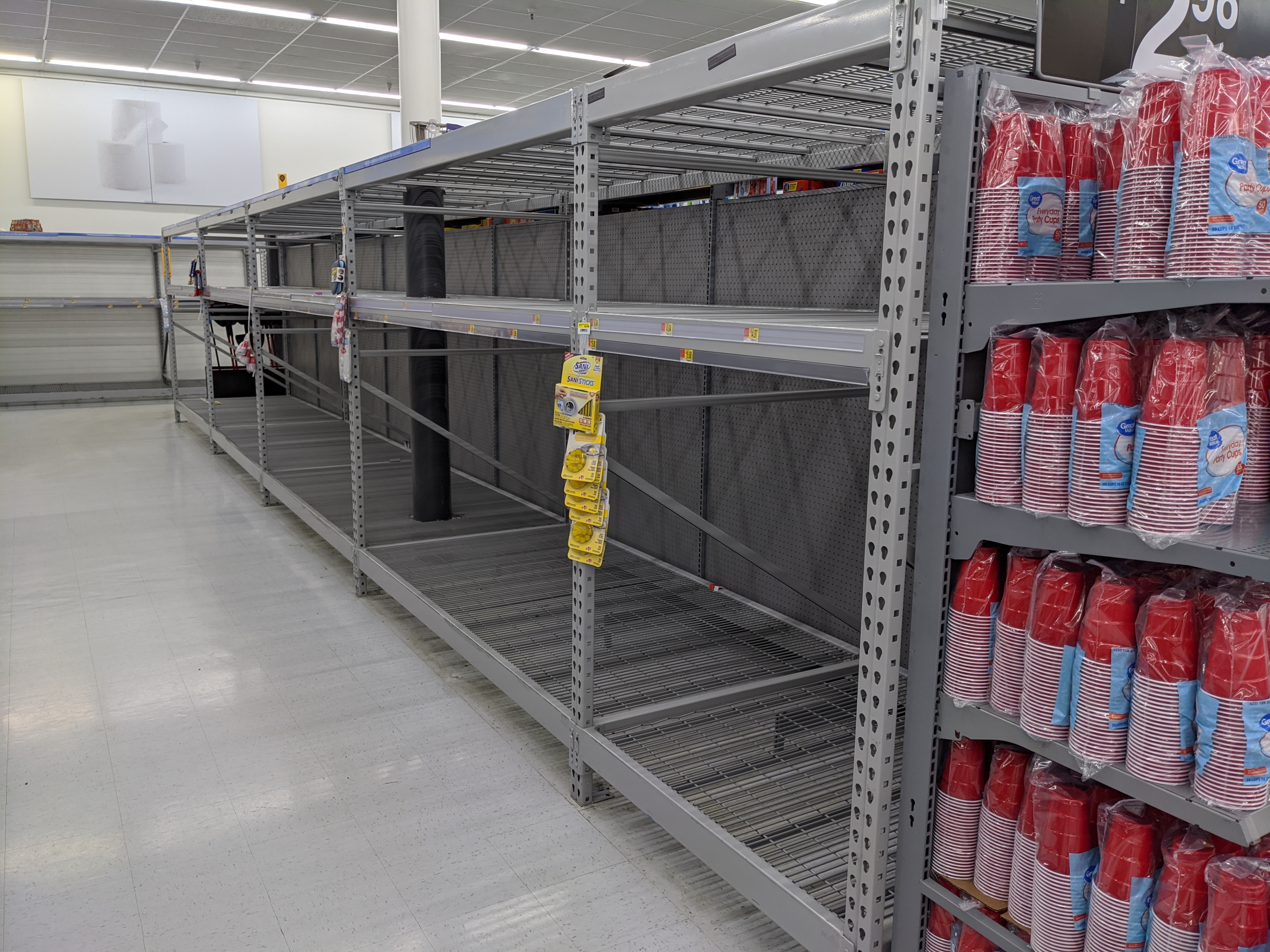
Because the future has just started
Shopping today for toilet paper at Walmart
All through the night as we sped
One thought rolled around in my head
You can nap in a car
But it’s better by far
To sleep in an actual bed
Traveling by car through Middle America in this time of viral outbreak has been a very interesting experience for this New Yorker. Throughout the trip we’ve been stopping off at gas stations to refuel, and at little minimarts to pick up snacks and just as an excuse to stretch our legs.
Of course everyone we meet is taking precautions. People have figured out how to open doors without touching door handles. Everyone is aware of the need to avoid direct physical contact and to keep a safe distance when talking together.
But unlike the people you encounter in New York City, everyone we meet is incredibly polite and friendly. People say hello, wish you a good day when you leave, and are genuinely warm to strangers.
Even in the midst of a plague, people in Middle America are really nice to one another. There’s something to be learned from that.
Am about to embark on a long road trip. Car is all packed up, snacks have been procured, and everything is ready to go.
It’s funny how things sometimes work: The viral outbreak leads to a need to avoid close human contact with strangers. That in turn leads to people leaving cities, and therefore actually getting to see more of the world.
So, in a sense, many of us are not responding by checking out of reality, but rather by reengaging with reality. And maybe we are doing it in a better way.
I am starting to fully absorb the fact that what is happening here is unprecedented in our lifetime. Here in privileged parts of the world like the United States, we’ve been able to take the view that life goes on essentially unchallenged by the natural world.
Sure, there have been terrible natural disasters in particular regions, like the tragedies of hurricanes and earthquakes.
But in these modern times, the entire human world has never faced this kind of full-on attack by Nature itself. We’ve never been asked to think so deeply about just how fragile is the fabric of our everyday human life.
If we do manage to get out of this, I hope we will emerge with greater humility and wisdom.
Starting tomorrow, NYU classes will be conducted remotely on-line. And today we wound down our in-person operations at the lab.
Starting next week, we are planning to start having lab meetings remotely in VR. It will be a good opportunity to compare different VR meeting platforms, and hopefully to learn how we can create one that is even better.
Out in the physical world, it seems that everyone is planning on going home to family. Many people from the U.S. hail from smaller cities far from the West Coast or the Northeast.
People who come from such places have the option to flee the centers of international travel where the outbreak is worst. Unfortunately many of our international students don’t have that option.
For those who are able to travel home during the outbreak, there is something appealing about the idea of people working together at the cutting edge of technology, yet also able to connect with their families. Maybe it suggests a better vision for the future.
Vi Hart visited our lab today. She and some of the grad students and I had a great conversation about holding meetings in VR — a topic which is obviously of great interest at the moment.
One of the things we agreed upon was that it is not all that useful to focus on realism in the avatars of the participants. When you are meeting in VR, the important thing is that everybody can focus together on the task at hand.
The shared “information physics” of the objects you can see, hear and manipulate together is of paramount importance. Your view of each other doesn’t need to be literally correct, because you can use your innate human intelligence to convey meaning.
This will work for the same reason that talking on the telephone works. We don’t need to see each other to talk on the telephone — we just need to make sure our meaning is clear.
So in a sense, working together in a VR teleconference is like having a telephone call where you can see where people are looking, and also what their hands are doing. I don’t think you need realistic avatars for that to be a very rich interaction space indeed.
Today is International Women’s Day. This is the day of the year when we celebrate about half of the people in the world.
In addition to population count, there are other ways to add things up. We could count total wealth. We could also count total number of people across the world who are able to vote in their own country. We could count the number of people who have never been sexual assaulted.
Alternatively, we could count how many people are valued more for their abilities than for their appearance, or who have never been denied an educational or job opportunity because of their gender, or have never been summarily interrupted while speaking with colleagues.
If you use any of those criteria, half the world’s population loses out big time. Which is one reason we need International Women’s Day.
airports are not safe
and distant lands, once again,
are far far away
For obvious reasons, the idea of many people gathering in one place is, at the moment, not so attractive. This changes the relative benefits of meeting in the same place physically versus virtually.
While it is not clear at the moment just how things will get with this virus, one short term prognosis is already clear: Try to stay away from crowds.
To that end, we’ve been starting to think of our research in this area in terms of the Star Wars Jedi council: You want everyone to be in their own body, and to have the feeling of being in the same physical place.
But they don’t actually need to literally be in the same physical place. They might, or might not. The point is that, as much as possible, it shouldn’t matter.
To me that seems like a pretty cool stretch goal.