Eucatastrophe

In a recent post I discussed JRR Tolkien’s brilliant 1947 essay on Fairy Stories. One of the many interesting terms he introduces is “eucatastrophe”.

A eucatastrophe is something that happens quite often in fairy stories: It’s a sudden twist at the end, which makes everything turn out all right.

I mentioned this the other day to somebody I know who is from the Commonwealth. She laughed when I explained to her the meaning of the word.

I asked her why she found it so funny. She told me that these days you can parse the same word in an entirely different way.

“Brexit,” she explained, “is an E.U. Catastrophe.”

I can see her point. JRR Tolkien had a prodigious imagination, but even he could not have foreseen Boris Johnson.
The larger picture

Sometimes I get pulled deep in the details of some project we are working on. It can be easy to focus in on just one little technical thing, because then you don’t need to think about anything else.

But then there are other times — notably after I have found a few days to put some space between my ears — when I remember to look outward rather than downward. That’s when I am able to see how all of those details fit together.

That’s when I realize that I am actually working on just one project. What might seem at first to be many little unrelated tasks are actually different components of a single large and coherent goal.

I think this is the right way to think about things when you are doing research. Everything you do, no matter how tangential it may seem, is actually a brushstroke in a single large painting.

The trick of course is to remain mindful of this. And to remember that sometimes you need to put down your paintbrush, take a few steps backward, and get a good look at the larger picture.

Missing the iguana

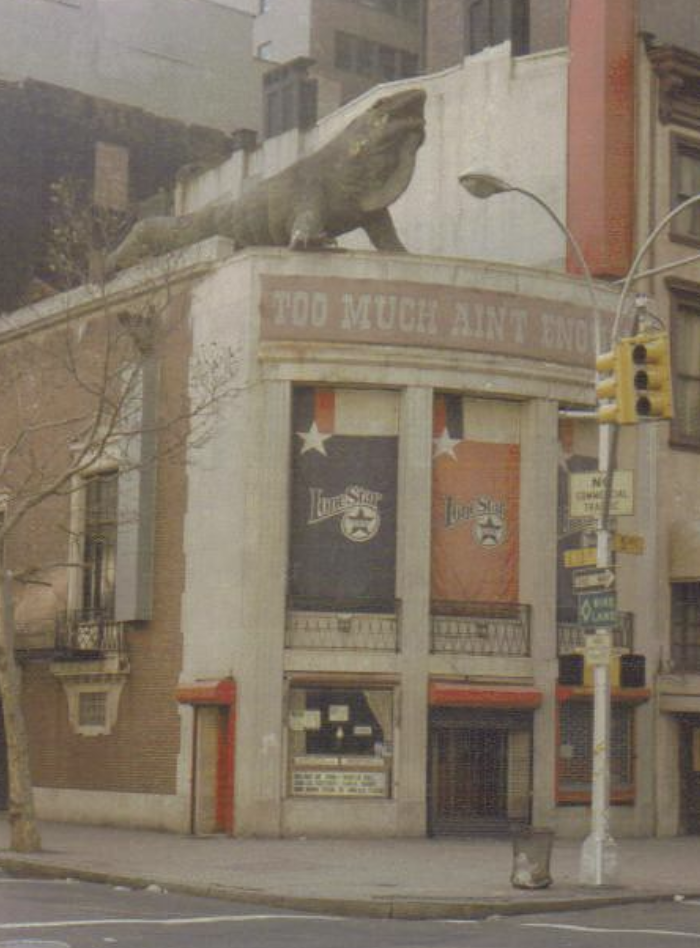
A long time ago there was a giant statue of an iguana on the roof of a building in downtown Manhattan. Some people who’ve been in NYC long enough remember him fondly.

The iguana lived on the roof of the now vanished Lone Star Cafe. He stood proudly atop 61 Fifth Avenue, right across the street from where our lab at NYU is today.

I tracked down the giant iguana on-line. I learned that his name is Iggy, that he weighs 2600 pounds, and that he has happily taken up residence on the roof of the animal hospital of the Forth Worth Zoo in Texas.

It’s good to know that Iggy has found a good home, but I still miss him. This old town isn’t the same without him.

People who weren’t around NYC back then may not get this, but sometimes you just want a big old iguana on a nearby rooftop. Just to let you know that everything is going to be ok.

iggy

Faërian Drama

Today my good friend Andy suggested I read a wonderful and deeply thoughtful essay On Fairy Stories, written by JRR Tolkien in 1947. One paragraph in particular jumped out at me.

To clarify, “Secondary Belief” in the paragraph below is a literary term which refers to what a reader is asked to accept as real within a fictional world (eg: the existence of dragons).

“Faërian Drama”—those plays which according to abundant records the elves have often presented to men—can produce Fantasy with a realism and immediacy beyond the compass of any human mechanism. As a result their usual effect (upon a man) is to go beyond Secondary Belief. If you are present at a Faërian drama you yourself are, or think that you are, bodily inside its Secondary World. The experience may be very similar to Dreaming and has (it would seem) sometimes (by men) been confounded with it. But in Faërian drama you are in a dream that some other mind is weaving.

Note how Tolkien pairs storytelling with full body sensory immersion.

It has not escaped our notice that the specific pairing he has postulated immediately suggests a certain recently fashionable hi-tech medium.

Alternate super heroes

Sometimes I like to imagine alternate super heroes with really weird super powers. One of my favorites is a guy I like to call “Popinjay”.

Popinjay’s only super power is that he can pop into a picture — whether a photo or painting — and then pop out of any other picture that depicts the same place.

If you were to meet his alter ego, a mild mannered sales clerk named Jay (of course) who works at a tourist shop, you would never suspect he is actually the mighty super hero Popinjay.

Of course the super powers of Popinjay are limited by whatever images happen to be around. You would think that if he wanted to jump into a scene, he could just pick up a pen and sketch something.

Alas, PopinJay, like all super heroes, has a tragic flaw. In his case, it’s that he cannot draw to save his life — literally.

I would be happy to hear of any other ideas for alternate super heroes with unusual powers.

Dotage

A friend told me today that her boyfriend has been playing Defense of the Ancients for many years. Considering that the first version of DotA came out in 2003 — 16 years ago — I can see how that was not an exaggeration.

She told me she expects him to continue playing it for many years to come. Assuming he plays for another 16 years, his total time with the game will add up impressively.

I found myself unable to resist the opportunity. I told her that at some point he might need to switch to Defense of the ancients, geriatric edition.

If only for the acronym.

Lianas

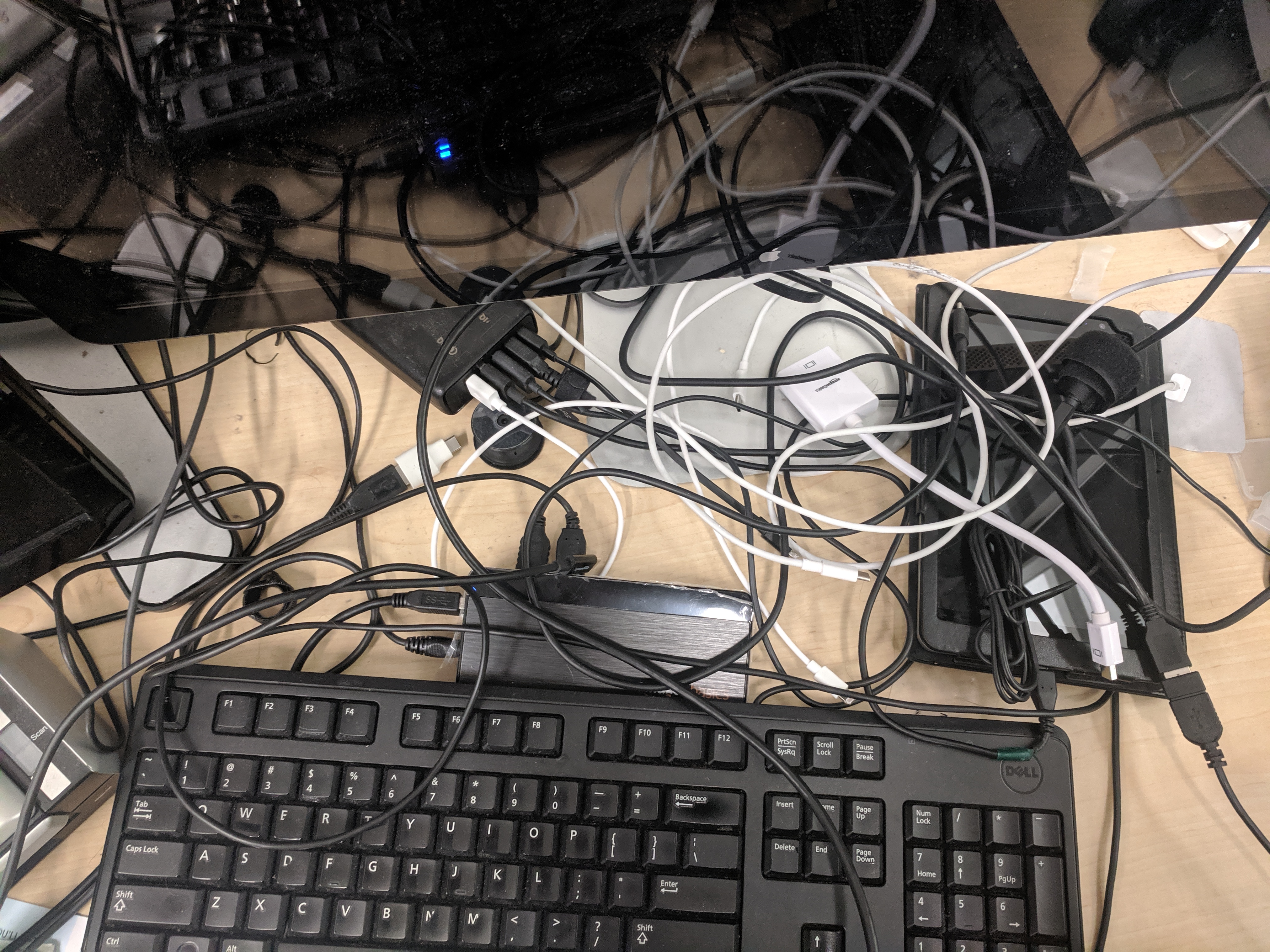
I was passing by the desk of a colleague today and I saw a tangle of wires that was so astonishing I just had to take this picture. And it made me wonder.

As computer technology continues to advance, will we ever get to the point where our modern high-tech world no longer requires this tangled undergrowth of artificial lianas?

Imagine a digital future without all those wires. That’s a future I would very much like to see!!!

tangle_of_wires

Little squiggles

If written language did not exist, and somebody asked you to explain what a novel was, I doubt your explanation would satisfy them.

“Let me get this straight,” I imagine your friend saying, “I look at these little squiggles on paper, and I am supposed supposed to imagine I am learning about people who don’t even exist. Why would I care about that?”

You try to explain. “Because you care about their struggles, their journey, the challenges they face and the obstacles they overcome.”

“Um, OK. But what do they even look like, these people who don’t exist? All I see are little black squiggles. Do they look like little black squiggles?”

Around this point you begin to realize that it is hopeless. “Yes,” you concede, “the whole idea is ridiculous. Forget I ever said anything.”

I think we might want to keep this in mind when we are faced with similar questions about any currently new medium, such as storytelling in immersive multi-participant mixed reality.

“How,” people might ask, “could you ever use such a thing to tell compelling stories about people who don’t even exist? I mean, won’t everyone realize that the whole thing is fake?”

Yes it’s fake. It’s all fake. That’s why they call it literature.

Soup of the day

One day, quite a few years ago, some friends and I went for lunch in the Empire Diner in New York City. Nowadays the Empire Diner is pretty much just a diner, but back then it was very different.

It wasn’t so much a diner as it was the performance of a diner, somewhat the way the Museum of Jurassic Technology is the performance of a museum. Everything about the Empire Diner was kind of in quotes, but in a subtle way.

For example, we noticed on the menu that there was a soup of the day for $3.00. There was also a soup du jour for $3.50.

We called over the waitress to inquire. What was the difference, we asked, between the soup of the day and the soup du jour.

Well, she said, if you order the soup of the day, it costs $3.00. If you order the soup du jour it costs $3.50.

Now we were curious. “Is there any difference other than price?” we asked.

“Yes,” she said, “the difference is that you order one in English and the other in French.”

“So we can just order the soup of the day and save $0.50, right?”

The waitress shrugged. “Your choice.”