Contagious

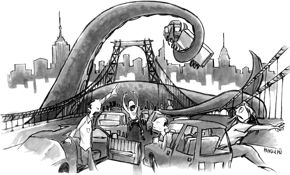
Today I went to see Contagion, a movie about a run-away deadly virus, which was apparently the most popular film in the U.S. since it opened in theatres a few days ago. On an intellectual level, it seems odd that a film about something immensely tragic can be a source of entertainment. Particularly when you think about the timing of its release — a weekend of national mourning.

Yet it is entertaining. Steven Soderbergh really knows how to tell a story. The audience is caught up in the awful narrative, and barely has time to catch its breath before the next human drama, unexpected tragedy or nail-biting race against time.

I think the key is in the way fictional narrative is precisely opposite to reality. The problem with reality is that nothing really makes sense — things just happen, and we find ourselves desperately trying to write a narrative after the fact, in our attempt to explain the unexplainable.

Yet in a fictional narrative an author can use even the most calamitous events as a way to create the illusion of an ordered universe. A story may be filled with death and tragedy, but at the end of the story there is redemption. Not the kind of random little bits and pieces of saving grace that we are left with when real life throws things at us, but something else entirely.

In a fictional world, an author can build meaning into the very fabric of reality, into the arc of time itself. In particular, a well architected story can convey the sense that the choices we make matter, that people matter, that all of our struggles and attempts to connect have not been in vain.

Yes, there is suffering in these narratives, and sometimes great pain and loss. Yet thanks to the magic of storytelling, we walk out of the theatre having been given the one thing we crave most in life — a feeling that somehow, underneath it all, the universe makes sense.

Meta-memorial

A friend, who does not live in New York, told me today that she wanted to visit the newly opened World Trade Center Memorial (which I understand is very beautiful). She said she was surprised to discover that it is not publicly accessible.

Instead, a reservation system requires you to submit your name, address, phone number, email address, and so forth. She found this inherent compromise in civil liberties to be very sad. Her exact words: “It overlays the sadness with more sadness.”

I told her that it might be a kind of meta-memorial. The fact that you need to compromise civil liberties just to see the memorial is, in itself, an apt reminder of something precious that this country has lost in the last ten years.

Which, I suspect, was exactly her point.

Inventing reality

We tend to forget that there is nothing “natural” about clothing, or chairs, or books, or the many other age-old technologies that we rely upon. We often need to be reminded that these are highly evolved technologies, precisely because successful technologies become invisible. In fact, a good indication of the success of a technology is how invisible it has become.

You never “access your clothing”, or “interface with a chair”, or “activate a book”. You get dressed, sit down and read.

I am conscious, as my colleagues and I develop new ways for humans to interact with information, that the best innovations, the ones that have a shot at being of use to future generations, are not going to be the flashiest or the most clever. Rather, they will be the ones that succeed in being so useful that they become invisible as they fade gracefully into the fabric of our daily lives, until they seem to be reality itself.

The Way Things Work

When I was just a kid, there was a book called “The Way Things Work” that I used to pore over with complete delight. It was a 1967 translation into English of a 1963 German book called “Wei Funktioniert das?” In 581 pages, the book explained how several hundred disparate technologies work — everything from the centrifuge to the television to the electron microscope, from electric motors to jet engines to gyroscopes to door locks to how plexiglass is made.

Each topic got two pages: first a page to explain things in words, then a facing page filled with beautiful two-color illustrations. Some topics were strung together in order. For example, you could learn about principles of light refraction and reflection, then lenses and mirrors, then microscopes, telescopes and binoculars, then all sorts of topics around cameras and photography, with each little bite-sized lesson preparing you for the one that followed.

I am quite sure that having this book by my side not only taught me about many ingenious technologies (oh my gosh, the Eidophor projector!!!) but also shaped the way I look at invention in general, bolstering my confidence, at an early age, to go forth and invent.

I have no idea where that actual book from my childhood is now. Fortunately, it’s still possible to get your hands on a copy of this long out of print masterpiece. I ordered a used copy recently on Amazon — it is sitting beside me as I type this. You might want to consider getting one for your favorite intrepid ten year old — or perhaps for the intrepid ten year old in you.

The poetry of projects

I’m currently hard at work with my students on a project with a deadline. We’re all busily writing code, creating virtual objects and creatures, testing ideas and theories, and conducting experiments of one sort or another.

When people come to the lab we excitedly show them what we’re working on, and as soon as those people have left, we all dive back in and keep working — often well into the night.

When you’re caught up in such a scene, you can fail to realize, in the moment, just how much fun you’re having. After all, this is hard work, and sometimes — when things simply refuse to work for hours on end — it can get frustrating.

Yet when I think back over my life, and the times I remember with greatest fondness, many of those times were situations just like this — when there was some hard and challenging work to do, and a team of hardy souls came together to got it done.

William Wordsworth once said that the origin of poetry is “emotion recollected in tranquility”. Maybe that is true of experience in general. In the moment, during the peak times of our lives, we rarely realize just how much joy we are experiencing.

Until, perhaps, some time later, maybe long after the project is done, when time has turned memory into poetry.

The mountain road

I find that one of the hardest things as a teacher is to remember how hard things are for people who don’t already know something you know well. The problem is that I become so used to doing something, day in and day out (like programming in Java) that I lose track of how odd and exotic each of its concepts and particulars are to someone who doesn’t already know them.

Which makes teaching a class partly a process of feeling my way along, like driving up a twisting mountain road on a foggy night. On one side is the mountain — the things they don’t know. I can drive straight up the mountain face if I like, but they can’t follow me there. As soon as I steer too much that way, I can see the light go out in their eyes, replaced by a look of panic.

But if I err the other way, neglecting to drive uphill at all, focusing too much on the stuff they already know, then we never actually go up the mountain — we end up just driving around in circles, and everybody gets bored (including me).

After a while you develop a feel for when to drive fast, what the best slope is, where the nasty curves are along the way. But every class is different, and you really need to gauge how this particular class is dealing with each new concept.

The most important thing is to pay attention. No matter how many times you’ve driven up that mountain, or how well you think you know each twist and turn of the road ahead, you still should not be driving with your eyes closed.

A game of games

Having finished reading George R. R. Martin’s “A Game of Thrones” (finally!) I started thinking about all the many many people who are spending vast amounts of time reading just this one series of fantasy novels — let alone all of the time that been collectively spent reading fiction by Stephen King, Georges Simenon, J.K. Rowling and Harold Robbins — or Leo Tolstoy for that matter.

And I fine myself wondering, why is there so much worry about people spending hours and hours playing computer games?

After all, both activities are pleasurable immersions into fictional worlds. What makes one sort of escapist activity inherently more valid than the other?

Ironically named day

I’ve always thought that today, Labor Day here in the U.S. — the day marking the official end of summer of — is a bit of a contradiction. Although it heralds the beginning of autumn’s labors, of vacations drawing to an end, of kids going back to school, Labor Day itself is pointedly a day of no work. This three day weekend is the last hurrah, a time for family, for barbecues and hanging out, for all sorts of leisure-time activities.

I think it’s a nice tradition, one I firmly support. Yet I confess that I do not practice what I preach. Even as I write this, I and all of the students in our research group are gathered at the lab, busy at our computers. Because, you see, with nobody around, today we can actually get some work done!

Of course we are then all going to have a barbecue

† Don’t even ask what kind of barbecue — you already know what I’ll say. 🙂

Ugly humans

There is a concept, dating back many decades, of the Ugly American — the idea that Americans in their encounters with other cultures are boorish, self-absorbed and uncouth, either as tourists visiting other countries, or as companies doing business with the rest of the world.

At least some part of this concept was a reaction to the immense political and economic advantages conferred on the U.S. in the era that began after WWII. When your country is a rich superpower, whatever you do is going to be judged harshly. Your misdeeds will be amplified, and your good deeds underplayed. What’s interesting about the term “Ugly American”, and its usage in the 1950s, is how much of this critical self-examination came from Americans themselves.

It’s curious though to see the exact trope of the Ugly American replayed recently in three different science fiction films, but with “American” replaced by “Human”. I’m speaking of Avatar, District 9 and Rise of the Planet of the Apes. All three films are very well made in their way, all three were very popular and critically well received, and yet they all had one more thing in common — the way they looked upon humans as the bad guys.

And not just any humans — specifically the technologically advanced, modern product of the European enlightenment. In other words, our familiar industrialized, capitalist “Western Civilization” itself. And in each case, another non-human civilization is shown to be capable of an inherent decency that our own race lacks, whether that “other” is represented by Na’vi, alien “prawns”, or mutant apes.

Some Americans in the 1950s took to looking at themselves critically, leading to the agonizing self-examination exemplified by the term “Ugly American”. We seem to be reaching an analogous cultural moment. At any rate, some sort of self-questioning is clearly in the air.