If you’re going to create virtual objects that appear to float in the air between people, one way to do it is to actually put a virtual object in the air between people. This seems to be the principle of the Holodeck from Star Trek, the Next Generation. Such approaches have the disadvantage that you need some kind of site-specific projection device, so they are most likely not going to scale up to inhabit the entire shared world around us.
As I mentioned in an earlier post, an early fictional version of this projection-based approach is the one developed by the Krel in the 1957 film Forbidden Planet, clearly a direct inspiration for what George Lucas put on the screen twenty years later:

Art imitates art
Around 2002 Jeff Han and I collaborated on a project to try to make something for real, which we called Holodust.
Our basic approach was to draw the virtual object with a laser beam directly onto a cloud of dust. Of course you don’t know the exact position of each particle in a cloud of dust, which is why our plan was to use two lasers: An infrared laser would sweep through the cloud. Whenever it happened to hit a dust particle that it would be useful to illuminate, a second — visible — laser would flash, thereby lighting up just that one dust particle.
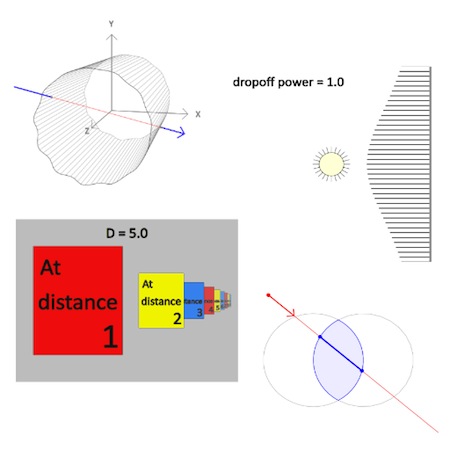
And here is a link to some Java applets simulating a Holodust display:

Here is a visualization of what a Holodust display might look like, together with a photo from an experiment that Jeff built to test the principle:

Note that there is a big distinction between such displays and, say, the Heliodisplay by IO2 Technology, which projects a flat image seemingly in thin air (actually into a thin sheet of water mist). The Heliodisplay is not eccescopic, since you don’t see a different image when you walk around it.
In contrast, the wonderful 360o Lightfield Display at USC is indeed more eccescopic than Holodust, because even the shading of the virtual object can change as you look at it from different directions. Unfortunately, it relies on a slanted metal mirror rotating at very high speed, so it you tried to touch it you would most likely destroy both the display and your hand.
Sometimes art imitates life. When I see the little sparkly dustlike particles in the air within the floating display of a virtual brain from Joss Whedon’s recent TV series Dollhouse, I definitely get the impression that it’s supposed to operate through some kind of Holodust: