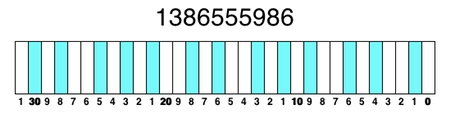
Pachelbel’s Cannon in D major, version 2

I realized that one of the most important features of Pachelbel’s canon in D major is that it is round — its chord progression forms an endless circular structure. In a sense, that is its canonical feature. If you’re going to go through all the trouble of shooting at such a thing with heavy artillery, you’d better be facing a rotating target, or why even bother.

With that in mind, I’ve created another version of yesterday’s musical experiment. In the spirit of “constructionism meets destructionism”, this one is much more focused on giving you ways to build your own original musical structure, which you do by setting the leading voices, thereby laying the groundwork for the emergence of delicately traced melodies and sublime contrapuntal harmonies.

And then, of course, blasting away at the result with large bore weaponry.

Click on the image below to try out the latest version of Pachelbel’s Cannon in D major:


Macbeth meets Mary Poppins

Recently I went to see Sleep No More, which originally opened in London, then went to Boston, and is now on in New York City. It’s essentially a reworking of Macbeth as a mash-up of interpretive dance and haunted house. You absolutely walk out of this one humming the set, and that’s a good thing.

I found the experience to be very effective and haunting. Exactly like one of those dreams where you find yourself trapped within Stanley Kubrick’s The Shining. I’m sure you have those dreams too. Doesn’t everybody?

Then this morning I started rewatching Mary Poppins (which I had not seen since childhood), and I began to notice eerie parallels between Mary Poppins and Macbeth. Both feature a strong female lead, rather clueless male characters who charge around thinking they are in control, without ever quite realizing that their lives and fates are ruled by powerful magical entities beyond their understanding (three witches or Walt Disney — take your pick).

The male lead in both pieces make fools of themselves by believing themselves destined to rule. Macbeth arrogantly declares “”If chance will have me king, why, chance may crown me!” while Mr. Banks sings “I’m the lord of my castle / The sov’reign, the liege!” Meanwhile, it turns out that it’s the females who have all the power and all the magic.

In the end, of course, each of these clueless males realizes his mistake, although each seems to express this idea differently:

Macbeth: “Life’s but a walking shadow, a poor player / That struts and frets his hour upon the stage, / And then is heard no more. It is a tale / Told by an idiot, full of sound and fury, / Signifying nothing.”

Mr. Banks: “Let’s go fly a kite.”

See what I mean? Two expressions of the human condition, each a milestone in its respective genre. Although it could be argued that Macbeth has the better poetry.

On the other hand, Mary Poppins has much better songs. đŸ™‚

Why we have noses

Yesterday I realized why we have noses. I may very well be the first person to have realized this, although once you see it, it’s as plain as the nose on your face (ok, sorry about that).

When I was implementing that gaze tracking program I talked about a few days ago, I ran into the following issue: In order to correctly figure out where a person is looking, it’s not good enough merely to track their pupils. You also need to track how their face is turning (left, right, up or down). Once you know in which direction the face itself is pointing, then you can look at the eyes to figure out where the pupils are looking.

But what if the person is facing just slightly left or right — or just slightly up or down? Left or right look pretty similar, when the angles are small.

But not if you’ve got a big proboscis sticking out of your face. The tip of your nose looks really different, depending on you’re turning to the right or turning to the left. Which leads to my theory, which arises from a great evolutionary adaptation of humans — our extraordinary ability to communicate with each other.

Yes, other primates have highly developed communication abilities. But there are things they just can’t do. For example, humans have quite visible white regions in our eyes. Chimpanzees don’t. A study a number of years ago showed that if a human baby and a chimp baby are shown an adult using their head direction to look at something, both will follow. But if the adult moves only their eye gaze, not their head, the human baby will follow the gaze while the chimp will ignore it

I think something similar is at work with the nose. Social cues are so important to us, that I think our species evolved the nose to grow forward from the face, so that it could serve as a directional pointer for our vision system. The genetic benefits of being able to pick up even subtle cues about head movement were so important to our survival, that they trumped smell itself. We have only a fraction of the olfactory ability of our nearest cousins, the gorillas, chimps and bonobos — in fact our sense of smell is actually rather bad.

Which suggests that the human nose is satisfying a different purpose entirely — it allows us to see subtle head movements of the people we are talking to, quickly and accurately. If the eyes are the windows of the soul, perhaps the nose is the soul’s early warning system.

AOG

Two days ago I tried to post to my blog and realized I was locked out of the database. Unbeknownst to me said database had been gradually filling up with spam emails . When the bloat reached 150Mb (my database quota is 100Mb), the host site, 1and1.com, froze any access to the database that might increase its size (such as new posts or comments).

It took me a number of hours, using the onLine mySQL database tools at 1and1.com, to clear out all the garbage, and then another day for the host software to updated my official footprint — which is now back down to a slim and energetic 18Mb.

Since I’ve been blogging every day for over four years, without missing a day — until this — I decided, on an editorial level, to declare this an “Act Of God”, and to continue blogging daily as though nothing had happened. So my posts for the last two days were duly written on the appointed day, but uploaded this morning, when my blog returned to life.

The most unfortunate thing is that all reader comments during the AOG were annihilated. If you left a comment about, say, the recent Hypergeography post, it has been, I am sorry to say, savagely crushed, pulverized, zapped by a Martian death ray, sucked of all its life giving essential juices and left to die a sad and lonely death on the blasted shores of some internet wasteland.

So if you did leave a comment sometime in the last few days, please repost it. I would love to read it!!

Steam engine

NOTE: DB problems will lock me out of the server for two days, so this is written today but posted from the future. Will explain when that future arrives.

Today I attended a fascinating lecture by my old friend Debbie Deas about her recent visit to the New Library of Alexandria. As you undoubtedly know, the city of Alexandria, Egypt has the best library brand in history. The magnificent new library was opened in 2002 to celebrate that vision and bring it into the 21st century.

The photos Debbie took showed a huge number of young people from a nearby university crowding into the library’s beautiful space, taking up every available seat and study table. They were working alone or in small groups on their scholarly research under soaring ceilings, by the reader-friendly diffuse natural light that filled this magnificent building. An architect who attended the talk explained to me afterward that high ceilings and large windows are a desired feature of libraries partly because they create the ideal lighting conditions for reading.

But also, we tend to see high ceilings in places that connote honor or respect — such as court houses, churches, museums. And libraries, for a library is a place of pride and honor.

I also noticed the stacks of books, but the stacks were only partially filled. I had always associated the large vaulting spaces of libraries with the need to house stacks of books (which, after all, take up a lot of room). But here, if the photos were any guide, a transition was going on. Many of the students were using computers. They were surrounded by stacks of books but their own studies were drawn largely from the 3.5 petabytes of on-line storage the library provides.

And I was reminded of the steam engine. The magnificent old early locomotive (which I still love) with its gleaming boiler and towering smokebox, was an icon of the Victorian era — a perfect image of a particular kind of physical technology. Much more interesting to me than those sleek but featureless trains of the last seventy years, with their boring little diesel engines inside.

Similarly, the book is the very symbol of learning and erudition. But I wonder, looking at those students in the New Library of Alexandria, whether this symbol will slowly fade like the steam engine. With the rise of eBooks and tablets, we might very well be witnessing the beginning of the end of what might be called the Victorian phase of the information age.

Yet the libraries will remain. For the library is not primarily, as we might have thought, merely a place to house stacks of books. A library is fundamentally a sacred and quiet church of the mind, under whose lofted ceilings people will always gather to study, to learn, and to honor the magnificent possibilities of human thought.

Subtraction distraction

Today I created a sketch for a simple computer game. There is lots more to do before it is finished, but what I have so far will give you the basic idea.

I’m not sure if this game is an example of “less is more” or “less is less”. In any case, here it is, more or less. đŸ™‚

Try out the game for yourself by clicking on the image below:


Hypergeography

Today I had a great brain-storming session with friends/colleagues Murphy Stein, Vi Hart and Charles Hendee (and briefly Jan Plass) about all sorts of things fun and mathematical. Among the many things we discussed, one that really resonated with me came out of this image, the original of which can be found in a wonderful discussion about Hyperbolic Geometry by Vladimir Bulatov.

This is a basically a PoincarĂ© disk model of the hyperbolic plane. That’s a way to look at the hyperbolic plane by cheating — distorting things to make them look smaller the further away they are from you. In the above picture the entire hyperbolic plane appears to fit inside the circle, but that’s just an illusion — things near the edge are really very very far away.

Unlike our boring old Euclidean plane, the angles of a polygon in the hyperbolic plane can vary, depending on the polygon’s size. And that makes the hyperbolic plane a lot of fun.

For example, in the picture above, the hyperbolic plane has been filled with regular pentagons of just the right size so that the edges at each vertex join at 90o. In the Euclidean plane you couldn’t do this — but the hyperbolic plane is way cooler than the Euclidean plane.

If you lived in a city based on the plan in the above picture, you could walk north, turn 90o right five times in a row, and end up where you started. Wherever you are standing, everything would look pretty normal, but objects that are far away would look weirdly distorted and too small — as though perspective itself were operating on overdrive.

When I look at this picture, I imagine a shared on-line world — maybe something like The Sims, but in a hyperbolic geography. People would live in pretty houses on nice streets, with manicured lawns, except that the city blocks would be shaped like pentagons, and five right angle turns will always get you back home.

Happy ending

This afternoon we were visiting a middle school in Brooklyn where several groups of seventh grade girls (mostly ages 12-13, all black or hispanic) were presenting their original ideas for math games. This is part of a Motorola Foundation funded project that we’re doing at the Games for Learning Institute. One of the girls showed a math puzzle containing the following algebra problem: “g / 6 = 36”. The goal was to figure out the value of “g”.

I wondered to myself whether she was really expecting kids to know the value of 36 × 6, or was just getting the algebra wrong (ie: whether what she’d really meant to write was “g × 6 = 36”).

So after her group was finished presenting its game idea, I asked her: “What’s the answer for ‘g’ in your equation ‘g / 6 = 36′”?

With no hesitation, she replied “Six!” Alas, it was as I had feared.

But then, about ten seconds later, another girl, a little 12 year old who had been very quiet up till that point, piped up — “Oh I know!”

“Ok, what is it?” I asked, trying not to get my hopes up.

“Two hundred and sixteen!”

Which completely made my day. A happy ending after all. And maybe even a future collaborator.

Gaze tracking

This weekend I had a sudden inspiration to use the i-Sight camera on my MacBook Air to write software that figures out where my eyes are looking on the computer screen. Such gaze tracking is definitely a hot topic these days. The newest Lenovo notebook computer has it built-in.

It turned out that the hardest part was finding code that would get anything at all from the i-Sight camera into Java. Once I found that out, the rest was pretty straightforward.

But one question kept nagging at me: I’ve been using one MacBook or another for almost two years now. Why did I suddenly, just this weekend, get an urge to implement a gaze tracker? And then it came to me — on some subliminal level I’m responding to the announcement of the IPad 2.

I never got an iPad when they first came out. I wasn’t even interested in the iPad. My response to all the hype was a consistent “Meh”. But the iPad 2 is not like the iPad. It has cameras — one facing you, and the other facing away from you. And that is interesting.

The camera facing you can be used to know where you are looking on the screen of the iPad 2. And the camera facing away from you can be used to create a cyber-enhanced (one might even say eccescopic) view of whatever lies on the other side of the iPad.

I think it is this possibility that the iPad can know where you are looking that matters here. Once millions of people can wander around in the world holding a consumer-friendly window into the internet, it becomes really interesting — empowering actually — for them to communicate through that window using their gaze and attention.

All of a sudden, just like that, after decades of interest by the geeky few, gaze tracking is actually about to become relevant to millions of people.