Collaborating with you (part 2)

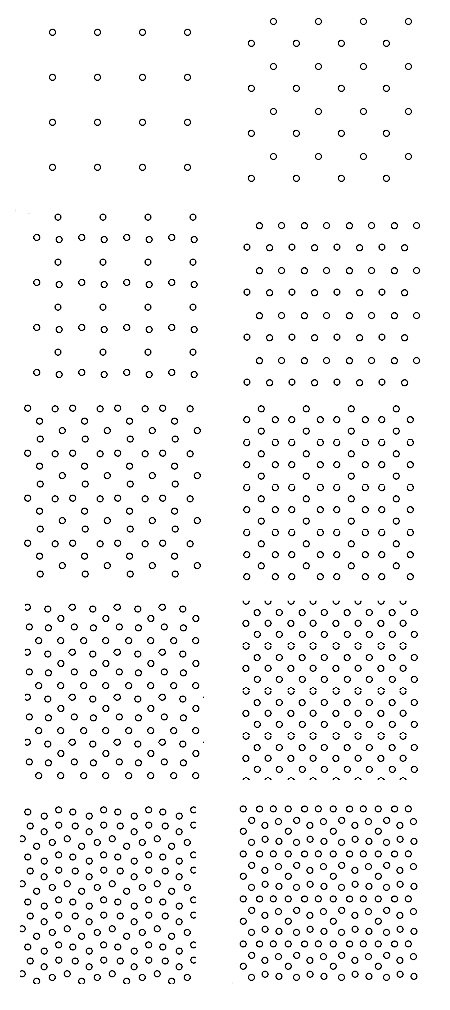
This is the second step (with many steps left to come) in enabling a shared world that can be created collaboratively by everyone. When you click on the image below, you will be linked to an applet that lets you create patterns in collaboration with whomever else happens to be on that page at the moment.

I really don’t know how this one will turn out, but I’m eager to see what everyone ends up making!


How many dimensions?

A number of the things I’ve been showing here recently come in two flavors — two dimensional and three dimensional. For example, I first showed the springy ball/stick model in two dimensions, and then quickly moved it to three dimensions (which seemed to make it richer).

I wonder what effect this would have on other things, like fractal Koch snowflakes, or musical candy button machines. It’s not clear that everything would benefit from that third dimension. Certain things might actually have a natural affinity for two. In those cases, adding depth might break some important symmetry, or only add confusion.

It seems like an interesting way to think about any particular thing: Some things might really want to live in only one dimension — others really require four or even more (which can be really problematic if you’re trying to look at them). It seems like a useful question to ask, whether you are talking about music or a snowflake: For any given object or idea, how many dimensions does it want to have?

The dominant seventh chord

A famous opera critic once said “The only two elements essential for grand opera are sex and the dominant seventh chord.” Which makes a lot of sense if you think about it.

I confess I am completely fascinated by the dominant seventh chord. Without that seventh, the dominant chord is pretty wimpy. For example, when you play a G chord on the piano (G B D) there is only a mild feeling that the chord “wants” to go to a C chord (C E G).

But if you play a G dominant seventh chord — by adding the F, to get (G B D F) — then the sense that the chord “wants” to go to the C chord increases enormously. Why is this? What is causing the supercharging effect when you add that F note?

I wonder whether it’s because the C chord is pretty much defined by that E note in the middle. Each of the notes of the G chord create a pull toward one of the notes of the C chord, but the effect is only mild:

G → G
B → C
D →E

But once you add that F note, suddenly two notes are both pulling toward the E:

G → G
B → C
D → E
F → E

And that extra force creates a sense of inevitability. Suddenly the G dominant seventh chord wants to transition to the C, with a real sense of urgency.

I’m convinced its all about those two notes (the D and the F) both wanting to go to the E. Call it a hunch.

Noisy molecules

I met with Lee Tremblay today and we had a great conversation about how to make the molecules do more of the proper physics. One thing turned out to be really easy to add — adding heat into the mix. I just stuck in the code while he and I were talking.

I added my noise function to simulate the way the atoms of molecules jitter due to thermal energy. This matters because atoms that are jittering are more likely to end up in different configurations. That’s one reason you heat things up when you’re trying to get chemicals to react with each other.

Besides, when you make them jitter, the molecules look really great. 🙂

You can see the springy molecules with a fancy new temperature control knob by clicking here.

A journey of a single step

Yesterday’s post was my first attempt to enable readers to participate — beyond mere comments — in a blog. And I’ve realized I have a lot to learn.

In particular, this was my first foray into “server-friendly” java applets. It worked, in a fashion, but only in a fashion. The possibilities that arise from creating a “shared space” are so rich that more experiments are called for.

As the Buddhists’s say (or should, if they don’t): “A journey of a single step begins with a thousand miles.” It was good just to take that single step. More tomorrow.

Collaborating with you

One of the odd things about a blog is its asymmetry. Of course readers can comment, but the general tone is one of presentation and response: I make something and show it to you, and all you can do is play with it and then maybe say what you think of it.

So today I thought it would be interesting to try something more actively participatory. The image below leads to an applet that lets you rearrange a pattern of tiles. The kicker is that any change you make will persist: The next person who comes to that page will see the changes that you’ve already made to the pattern.

This certainly isn’t the most interesting example of participatory design, but I thought it best to start off with something simple, to test the waters. As usual, you launch the applet by clicking on the image below:


Audio virtual reality

Let’s say you and I are having a conversation and we want to include our friend, who happens to be somewhere else.

Let’s also say that you and I are both wearing earphones (so we have an audio input leading into each of our two ears). This allows each of us to have a binaural input capability. In layman’s terms, this means that a properly constructed sound could appear to us as coming from any particular location around us — in front or back of us, above, below, left, right, or any angle in between.

With this binaural capability (and the right computer software to back it up), the apparatus we each wear could analyze and then re-synthesize a very high quality representation of the voice of the person we want to include — which will seem to come from some exact location in the room.

Nothing that I’m saying is beyond today’s technology — it could all be done with commodity equipment. But I suspect that our culture’s single-minded focus on the visual has distracted us from all of the cool things we could be doing with audio.

In particular, I’d love to hear what it would be like to have a third “virtually present” person in a conversation, accurately represented in pure spatial audio form. Perhaps, without the distraction of imperfectly formed video or computer graphics, the person would appear, on a psychological level, to be fully present in the room.

Or maybe not. In any case, it’s certainly something worth finding out.

Fractals revisited

I’ve been wanting to fix some things about my little interactive fractal program for a while, and today I finally got around to it. One problem was that the program didn’t actually finish building your fractal if you tried to make something really complex. It would just go for a while and then stop.

I’ve fixed it now so that it keeps on going, building your entire fractal pattern no matter how complex. The results look much nicer. 🙂

Also, I’ve added a row of example templates at the bottom. Eventually I’d like to allow people to save their own original templates to a server, so the community can share them back and forth. This is a step toward that.

As usual, you get to the new program by clicking on the image below:


Distributed orchestra, part 2

Continuing my post from yesterday, I envision a concert in which you are asked to purchase tickets with your cellphone. Once you have been assigned a seat, the creators of the concert have a way of mapping your seat number to your cellphone number.

This information becomes, in effect, a spatial map, in which a text message to a particular cellphone is a message to a precise seat in the auditorium. Which enables all sorts of exciting possibilities.

For example, sounds can be made to flow, circulate, or ricochet around the room. As an audience member you can experience a wave of sound move through you — or circle around you.

Up on the stage an image can be projected which shows where each instrument (or other source of sound) is located in the audience. Audience cellphones can be made not just to play music, but to laugh, shout, caugh, or call out a word or phrase, and any of these utterances can flow through the space, as they are made to successively emanate from one cellphone in the audience after another.

Meanwhile, the “conductor” is interacting with the projected on-stage image to visibly manipulate the image of cellphone locations, thereby giving audience members a visual representation of the waves of moving localized sound that they are hearing flow through them.

I think it will be an entirely new kind of concert experience.

Distributed orchestra

Imagine you’re at a concert where you, as an audience member, have been requested to bring your iPhone. On the web site where you purchased your tickets, there is a link to a free iPhone app, which you have been asked to download.

You are now sitting in your seat. The curtain rises, and a solitary figure walks onstage. She is carrying an iPhone. When she arrives center stage, she pauses for a moment, and then activates an app on her iPhone.

The app sends a signal to the iPhones of each of the audience members, and the concert begins.

Except that the music of this concert — the trombones, the woodwinds, the strings — come not from the stage, but from various locations around the audience. The phone in your pocket has been recruited to be part of a distributed orchestra.

As audience members take out their cell phones, one by one, a sense of wonder fills the hall. For the sound is coming from all around — perhaps from the person sitting to your right, or from you yourself.

As the full power of all of these devices comes into play, you are not sure what it all means, but you know you like the sounds that fill the space around you. And perhaps you realize that you are experiencing the dawn of a new era.