Attic, part 62

At first Jenny wasn’t sure what was going on. The door was in front of them, and then suddenly it was, somehow, off to the side. But in a funny way, like it was squashed sideways. She saw that Josh, a little ways ahead of them, had a look of intense concentration on his face. Then, to her horror, Josh’s face became squashed too. Before she could shout or scream, she heard his voice, sounding shockingly normal.

“This way,” he said, and she felt Mr. Symarian take her arm, and somehow turn. As she turned to follow their teacher’s lead, Josh’s face seemed to change back to its normal shape. At that moment, she realized just how much she liked Josh’s face.

She realized she had been holding her breath. As Jenny took a deep breath, she was mildly surprised to find that the air seemed perfectly normal. Was there air in the fourth dimension, she wondered, or had they somehow taken it with them? In any case, she was very glad to find out that you could still breathe in the fourth dimension.

Very glad indeed.

Invasion of the borg

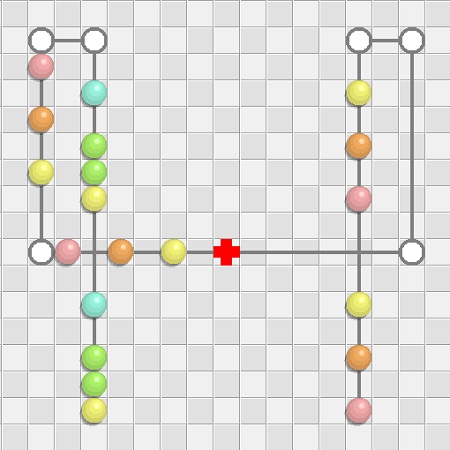
Several years ago I became fascinated by 3D mazes. These are like the 2D mazes we’re all familiar with, except they form 3D paths within a cube, rather than 2D paths within a square. To explore these fascinating shapes (which look a lot like the Borg mothership), I created an interactive Java applet, which lets you create virtual objects that look like this:


As long as I am at the Banff Centre, it seemed like a good idea to print one of these things out in the real world. So I modified the Java applet to create a file that the 3D printer can read. It seemed like a good idea to print out the first one very small — you never know how safe you are with the Borg. And this is the first thing that resulted:


There is something wonderful about having one of these out in the physical world, where I can touch it and hold it in my hand. It’s a much more visceral experience than merely looking at an image on a computer screen.

As usual, I’ve included the trusty Banff Centre pen, to give you a sense of scale. I must say I am rather pleased. Now I’m trying to decide which of my Java creations to next bring out into our physical world.

I am open to suggestions. šŸ™‚

Attic, part 61

“I don’t think I can go through that door again,” Jenny said with a shudder. “Talking to it — him — plays funny games with your head.”

“Well,” said Mr. Symarian, “It would appear that the only way for you to reach your grandmother is to proceed by stealth.”

“But how?” Josh said. “There’s only one door into that room.”

“Kid, I don’t think he’s talking’ about using the door,” Sid said.

“Wait,” said Charlie, “this doesn’t make any sense. You’re talking about getting into a room that has only one door, without going through the door? I could see maybe blasting your way in, but that doesn’t seem very, um, stealthy.”

“It is quite simple really,” the teacher said. “One does not need to go through a door, when one may merely go around it.”

Around it?” Josh said. “But … oh wait, I get it. You’re talking about using one of those extra dimensions of yours to take Jenny back in.”

“Precisely,” said Mr. Symarian. “but more than two will be going.” He smiled at Josh. “A path through the higher dimensions can be rather complex. We shall require a path finder.”

Going in circles

I’m probably going to do a higher quality run, but meanwhile here is a preliminary result of my little walking guys in action.

The photo below shows the basic set-up of the stop-action zoetrope. On the top left is a rotating stage. This stage is made of paper taped on top of foam core. Glued under the foam core is a little round spindle (you can’t see it in this shot) a little less than an inch in diameter.

On the bottom left of the photo is a support platform with a round hole in it just big enough to fit the spindle. When the stage is placed on the platform, it can rotate freely, but it can’t jiggle.

To the right you can see the little walking guys. This time we printed them out as one solid part on the 3D printer, so they would all be in the right position.

Unfortunately, one of the little guys — who was standing on one foot — broke off at the ankle after the part came out of the 3D printer. I super glued him back on, but he ended up tilting to one side. In the animation you can see this as a kind of wave going around the circle, as the tilted guy shows up in different positions.

Notice the radial lines on the rotating stage. These tell me how much to rotate the stage between successive animation frames. After photographing each frame, I rotate the stage by 1/11 of a circle. Over the course of one 12 frame animation cycle, each of the little guys has advanced 12/11 of a circle — ending up roughly in the position of the guy ahead of him.

The effect is as though each of the guys has walked forward a little ways around the circle. When you loop the animation, it looks as though all the little guys are marching continuously around the track.

The resulting animation below isn’t as good quality as what I’d like to end up with, but I thought I might as well show preliminary results. Because it’s an animated gif, the file is a bit large — almost 1MB. So if you have a slow connection, this might take a while to load:

And yes, the arms are swinging. šŸ™‚

Attic, part 60

Jenny was torn. On the one hand she wanted to go back into the room, to rescue her grandmother from this strange force that was holding her. On the other hand, she wasn’t sure that it was the right thing to do. There were clearly things about this that she didn’t understand. What if her grandmother Amelia was actually in the right place? Although it seemed completely alien — incomprehensible — perhaps there was another way of existing, a way of being outside of time, that was also ok.

She looked at her friends. None of them could possibly understand what she was feeling. None of them had ever been outside of time. For them, things were easy. One thing happens, and then another, and then something else. It’s all so simple when things happen in order. But what if things aren’t that simple?

But they were her friends — and the ones she trusted the most. There was no getting around it — she would have to talk with them about this, even though the things she was talking about would probably sound crazy.

Jenny took a deep breath. This wasn’t going to be easy.

Another dimension

We’re still doing production on the little walking guy. But meanwhile my collaborator Eva Schindling and I managed to build a nice little working zoetrope of a tumbling hypercube.

For those of you who don’t know, a hypercube is something like a cube, only with four dimensions instead of three. As a cube is to a square, a hypercube is to a cube. I made a java applet some years back that lets you play with them.

Of course we don’t live in four dimensions, so it’s hard to get a feeling for what happens when you rotate four dimensional things. Eva and I thought that it would be cool, rather than looking at 4D things rotating on a computer screen, to create an animated sculpture of a rotating hypercube. That way you could look around it from all directions (at least, all 3D directions) as it does its weird 4D rotation.

Because a hypercube has four dimensions instead of three, it can rotate in some pretty fancy ways. A simple rotation only requires two dimensions. Since a hypercube has four dimensions, it can rotate one way in two of its dimensions, while rotating a different way in the other two dimensions.

In our zoetrope, we made our little hypercube tumble around a circular track (a movement that uses two dimensions), while also rotating a different way in the remaining two dimensions.

Now, this is not going to look very intuitive to us poor 3D humans. In fact, it looks as strange to us as, say, a rotating cube would look to a Flatland creature that lives its entire life in a two dimensional world.

Such a 2D creature couldn’t really see a cube — but it could see the shadow a cube makes if its silhouette is projected into the two dimensional world of Flatland:


To the Flatland creature staring at the shadow, it wouldn’t look like something rotating so much as something becoming distorted in all sorts of weird ways.

And that’s pretty much what happens when you try to make sense of a rotating hypercube. As things rotate out of our little 3D world, they look like they are changing size and shape, rather than rotating.

But see for yourself:


Attic, part 59

After a while, Amelia had just gotten used to him being there. She’d decided at some point that the shadow was definitely a “he”, although she couldn’t exactly say why. In any case, it was nice to know that even when she was alone, she probably wasn’t really alone.

Sometimes when she was with a boy, she would feel the shadow’s presence, and she’d wonder what the boy would have thought if he knew. Sometimes she was almost tempted to tell, just to see what would happen. But of course she never did.

Not even when she met the boy she was going to marry. He was very sweet, and she knew right away they were going to get married. But of course she always knew what was going to happen. This wasn’t something she’d realized all at once, but gradually she had picked up a way of thinking from the shadow, of seeing that the future is really just like the past, except in a mirror. Once you see that, then you can see how to remember things that haven’t happened yet.

The hardest part was not letting people know, and remembering to act surprised when she was supposed to be surprised, or scared when she was supposed to be scared. That time the tree fell in the yard and killed aunt Emma, it was hard not to tell anybody beforehand. She had to go through the whole morning like nothing was going to happen. The shadow said it was important to act like you don’t know things until they happen.

Rounding the corner

Since those earlier experiments with 3D printing, my collaborators and I here at the Banff Centre have been working to make my little animated guy walk in the real world. As a test, we’ve printed him out in each of the twelve positions of a complete walk cycle:


This isn’t the final result, it’s just a proof of concept to see whether things are going to work out. In this run, we printed each pose as a separate object. This allowed us to quickly get a sense of what we were going to end up with.

Because he generally has one foot raised in the air, each piece won’t stand up on its own. So to get a sense of what the finished zoetrope might look like, I propped up each raised foot with crumpled double-sticky transparent tape, as you can see in this close-up:


In the production version the entire zoetrope will be printed in one connected piece, so each pose of the guy will be in exactly the right position. The final run is printing now — I can hear the machine working away as I type this.

We are all very excited — it looks like we’re finally rounding the corner. With any luck, I can show you an animation by Thursday!

Attic, part 58

Amelia looked at herself in the mirror. She liked to wander up in the attic, she’d always felt comfortable there. Sometimes it was just her, and other times she sensed — she called it the shadow. She wasn’t sure when she’d first become aware of it. Sometime in the last two years more or less.

But she also had a feeling that the shadow had always been there. She wasn’t scared of it exactly — it wouldn’t make sense to be scared of it. That would be like being scared of your own dreams. And the shadow was something that had definitely come out of her dreams, she was sure about that.

The best way to know if it was there was to look in the mirror. It’s not that she could see it exactly, more that her own reflection looked different when the shadow was there. Older somehow, but not really older. More like the idea of being older, even though she looked exactly the same.

She shook her head. So many times she’d been tempted to tell somebody, to explain it. It’s hard to keep something like this to yourself. But she always ended up realizing just how crazy it would sound. And she definitely didn’t want anyone to think she was crazy.

Besides, she had a feeling that if she told anyone, the shadow wouldn’t like it.

The tragedy of hi-tech consumerism

In response of my post two days ago, Mari wrote a thoughtful comment which contained the following:

“All these gadgets making us as human beings actually dumber (!?)… and less sensitive as communicators? I was just looking at some music pedagogical things they are doing here and thought, ā€œbut we’ve been making music just fine for 100s of years without theseā€¦ā€. All is geared towards ā€˜easier’ way of being creative human beings…like conductor for dummies, violin players for dummies so you don’t have to listen, train and practice like the old days. Clearly that’s where the $ support (toy companies etc) comes from.”

Coincidentally, last week I was having pretty much the same discussion, mostly because of my recent experience putting together the MakerBot. Assembling that was hard. Many steps required me to push my personal envelope, and to learn technical skills that were new to me. And for that reason it was incredibly fun.

I’d had pretty much the same ecstatic feeling while I was learning to play classical and flamenco guitar — a process that took a lot of hard work over many months. When I think back to my peak life experiences, all of them required me to push beyond what I had thought myself capable of. And while I very much enjoyed those “relax and do nothing” vacations — lying on a nice beach and looking at the sunset — not one of them was a powerful peak pleasure experience for me.

If the goal of your business is to provide experiences for people that maximize their quality of life, then you’ll want to give them opportunities for meaningful challenges. Generally speaking, people feel most alive when they are actively engaged in something that they working for, and that holds some significant meaning for them. The political candidate you worked to get elected, that day you hiked all the way up a mountain, the Shakespeare play you worked on all summer, the time you cooked all day to create an amazing meal for someone you love — these are experiences that make us feel we’ve really lived.

But if the goal of your business is to maximize profitability, it is far easier to ask your customers to do as little work as possible. An experience that substitutes the illusion of mastery of skills is a far easier sell than one that requires the customer to achieve true mastery. For example, there is money to be made in giving guitar lessons, but there is vastly more money to be made in selling Guitar Hero and its equivalents.

I worry that the combination of new technologies might be conspiring to create a perfect storm — an entire generation is coming of age expecting the illusion of truly rewarding effortful experience, since selling such illusions can scale up far more easily than selling the real thing.

Certainly the commoditization of illusory skill building is not new. The Craft Master “Paint by Number” kits first sold in 1950 by Max Klein and Dan Robbins were a huge and immediate success. In a sense, they were the Guitar Hero of their era. But now such commercial plays are the rule, rather than the exception. The concept of putting in hours of effort to create a truly rewarding personal experience — once the norm, and in fact a defining trait of the American “can do” ethos — may be gradually fading from our culture, as it is supplanted by an illusory Potemkin version of itself.

But maybe not. There is definitely some hi-tech consumer software out there that encourages — and richly rewards — effort and originality. PhotoShop, GarageBand, and GameMaker come to mind, and there are plenty of others. There is also a growing youth subculture that puts enormous effort and talent into creating some of the most intriguing videos on YouTube. This movement of video creation as individual craft is arguably a successor to the youth-led — and substantially home grown — popular music revolution of the twentieth century.

So maybe there’s hope. šŸ™‚