Great idea for a TV comedy

Recent events have given me an intriguing idea for a TV comedy series. Imagine, if you will, that ambitious celestial beings get the opportunity to work for Lucifer — the big honcho Himself.

But it isn’t easy for a fallen Angel to keep old Beelzebub happy. You’ve got to be Evil. Not merely evil with a small “e” — that won’t cut it in the Satanic administrative order.

Of course it’s ok to be incompetent and corrupt. That’s where a lot of the comedy comes in.

In fact, our audience quickly learns that in the Devil’s court, double-dealing, nepotism, shameless self-promotion, sexual shenanigans and outrageous vices in general are not only tolerated, but celebrated. If you weren’t all of those things, why the hell would you be serving the Dark Lord in the first place?

But a failure to be willing to be truly Evil will get you tossed out of the Underworld faster than you can say “news cycle”.

One great thing about this idea for a TV comedy is the opportunity for various spin-off shows. After all, we all know by now that American audiences have a soft spot in their hearts for deeply flawed characters.

So for the Seraphs who get kicked out of Hell, for those poor unfortunate souls who have failed to demonstrate sufficiently pure Evilness, we can create an alternate goal: Now they are trying to get back to the Other Place.

But that turns out to be much more difficult. Which is awesome, because it means these spinoff shows can keep going for years.

Fortunately, all we’ll need is a seven year run to make it into syndication.
Bounce

There is an old and very profound expression, which I have invariably found to be true: “You never learn from your successes.”

A lot of wisdom is packed into that deceptively simple sentence. It’s not our successes that help us get better, but our failures.

Case in point: A few weeks ago my colleagues and I gave a demo of some software we are working on. We were really hoping to impress the people we were showing it to. And in my opinion, we fell flat on our faces.

Our demo wasn’t a total failure. Some of it was actually ok. But merely ok wasn’t good enough. Merely ok wasn’t going to cut it.

So for the last few weeks we’ve been working very hard, using that experience as a guide to help us know what not to do. Then today we gave another demo of our software.

And it was awesome — totally, knock out of the ballpark awesome. The best part is, we’re not even done yet. Now that we have momentum, the demo is getting better every day, by leaps and bounds.

That’s the great thing about failure. Any time you hit bottom, you might find an opportunity to bounce.

Morning me / evening me

Everybody seems to have a particular time of day when they can get the most work done.

In the morning, right after my cup of coffee, I’m at my most productive. I can take on daring new software tasks, and sometimes polish off a day’s work by noon.

In the evening, not so much. I can certainly put one foot in front of the other and write some code, but I can’t usually do the sort of acrobatic algorithm jockeying that morning me can do.

Still, deadlines are deadlines, and you’ve got to keep pushing forward. Which is why, in the morning, I make lists of stuff to do in the evening.

I’m not talking about the hard stuff, but the stupid stuff. The evening is when I get around to all those rote tasks that have to get done, yet don’t require much in the way of imagination.

When it comes to developing software and new algorithms, morning me is the one who designs the great recipes. Evening me is happy just to get the stove working and make sure the refrigerator is fully stocked.

Inter-tribal auto-corrected reality

Demian makes a very good point in his comment on yesterday’s post. When we look at today’s world, we indeed see many examples of people “tuning out” what they don’t want to know about.

I think the apparent contradiction between our need to connect with others through information and our need to block information from others can be addressed by considering tribalism.

Tribalism is certainly older than our species itself. After all, we see a very similar behavior pattern in our fellow great apes, which strongly suggests it was inherited from our common evolutionary ancestors.

As we all know, there are downsides to grouping people by tribe. Yet given that it has survived intact for so long, I suspect tribalism is one of those instincts, like love for one’s own progeny and a tendency to believe in supernatural gods, that has, one way or another, been helpful in preventing our species from dying out.

Which means that tribalism is baked into our brains. In other words, for better or worse we are stuck with it.

We all belong to many tribes. I personally belong to various overlapping tribes defined by many factors, including professional, cultural, ethnic, familial, political, geographic, aesthetic and metaphysical.

When we wish to bond with others that we perceive as belonging to a common tribe, we draw on our super-power of human communication. But when we wish to indicate that someone is not of our tribe, we tend to narrow or even shut down the paths of communication.

I suspect that this is the likely pattern we will see in the coming age of wearables. We will use this communication technology, as we have used all communication technologies that came before, to connect with those with whom we feel a kinship. Which means we won’t be motivated to “auto-correct” communication that comes from those people.

But we will also use these new emerging tools to help us tune out those other pesky humans — the ones we perceive as belonging to a rival tribe, the ones we don’t think have anything useful to tell us.

Alas, I suspect we will apply all sorts of filters to block those people. The tragedy is that by doing so, we will create a self-fulfilling prophecy.

Auto-correcting reality

Demion’s comment on yesterday’s post was very thought provoking. Suppose, with our future augmented reality glasses or contact lenses, we could automatically auto-correct the world around us? Bad jokes on signs would be “promoted” to good ones, visual and architectural design in questionable taste would be replaced by something more satisfying, and so on.

I suspect we won’t actually do this, and my reasoning is by analogy with what we have chosen to do in the past. As human beings, we have exactly one unquestionable super-power: Our shared ability to learn natural languages that support generative grammar. This super-power allows us to communicate with each other in incredibly powerful and subtle ways.

Consequently, the one thing we really care about is to accurately interpret the real intention behind the words and actions of other humans. We don’t always succeed at this task (far from it). Yet it is, nonetheless, the thing we care most about getting right.

After all, if we fail to understand and properly interpret the intentions of others, we find ourselves effectively cut off from other humans, and therefore from our own greatest super-power. Which is why, I posit, we will always resist technological “assistance” that could artificially reduce our ability to accurately interpret the human world around us, as flawed as that world may be.

To give an analogous example, using technology that is already familiar: When you author a document using modern word processing software, you are given the option to turn on auto-correct. If you exercise this option, your errors in spelling are automatically fixed. Also, word processing programs generally highlight questionable or awkward grammatical constructions. You then have the option to reword what you have just written.

But what we never see is document software that shows you the writing of other people with automatic corrections applied to their errors in spelling and grammar. People don’t want to see the errors of others “fixed”. They would rather see what other people actually wrote, with all the idiosyncrasies in place.

Fundamentally, we trust other peoples’ mistakes more than we trust software that might shield us from those mistakes, because what we really want to know is what was going on in the brain of that other human being.

Since we will continue to be human beings in the decades to come, with brains wired more or less the same way they have been for tens of thousands of years, I don’t see that this will change, no matter how far augmented reality technology may develop.

Almost clever

Today I spent much of the day in the NYC offices of a large corporation that is, commendably, ecologically aware. They have signs posted for recycling in all the appropriate places.

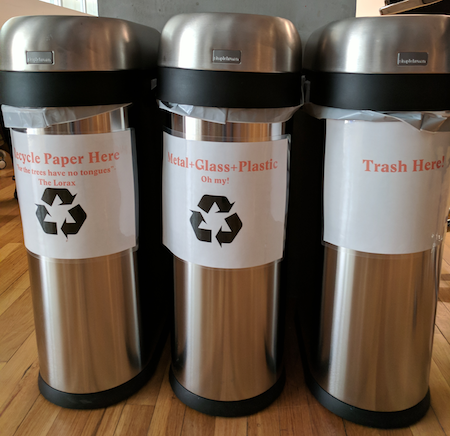
And consistent with NYC regulations, they break their recycling into two categories: Metal, plastic and glass in one bin, and paper in another. And therein hangs a tale.

For in their attempt to be hip, up-to-date, cutting-edge, in-the-know, they tried to reference one of the great moments in the classic MGM adaptation of Frank L. Baum’s The Wizard of Oz. Alas, they didn’t quite get it right.

Check it out for yourself. Here is a photo I took of one of their recycle bins. It essentially says, with enthusiastic fervor: “Metal and Glass and Plastic — oh my!”.

It’s almost clever. The problem is that the well-known quote they are riffing off is “Lions and Tigers and Bears — oh my!”

So if they really wanted to go there, they should have switched the last two items on their list, to keep the rhythm of the thing. If only they had written “Metal and Plastic and Glass — oh my!” — that would have made me so happy.

Am I being too demanding?

Reflections on two narratives

This blog has just finished two long runs on single topics — first a suite of exercises in computer graphics for non-programmers, and then the first book of a Paleolithic magical realist saga. So this seems like a good moment for a little reflection.

Unlike you, I have first-hand knowledge of the relationship between this blog and my life. The two are not independent — each one influences the other, and those influences run in both directions.

I took up the challenge of teaching computer graphics to non-programmers just before beginning a semester class teaching computer graphics to undergraduates. Putting that series of lessons up on-line allowed me to view this familiar topic with fresh eyes, as though I was just learning about it myself.

The story of Ilara was, similarly, a reflection of an event in another part of my life. My colleagues and I at NYU are currently developing an ambitious virtual reality theater piece. Our VR story centers on events that occur a generation later, and the main character is Ilara’s daughter. By writing the first book of this saga, I was able to better understand the world of that story.

Perhaps the thread that best ties together these two narratives can be expressed by that old maxim: If you really want to understand something better, try teaching it to somebody else.

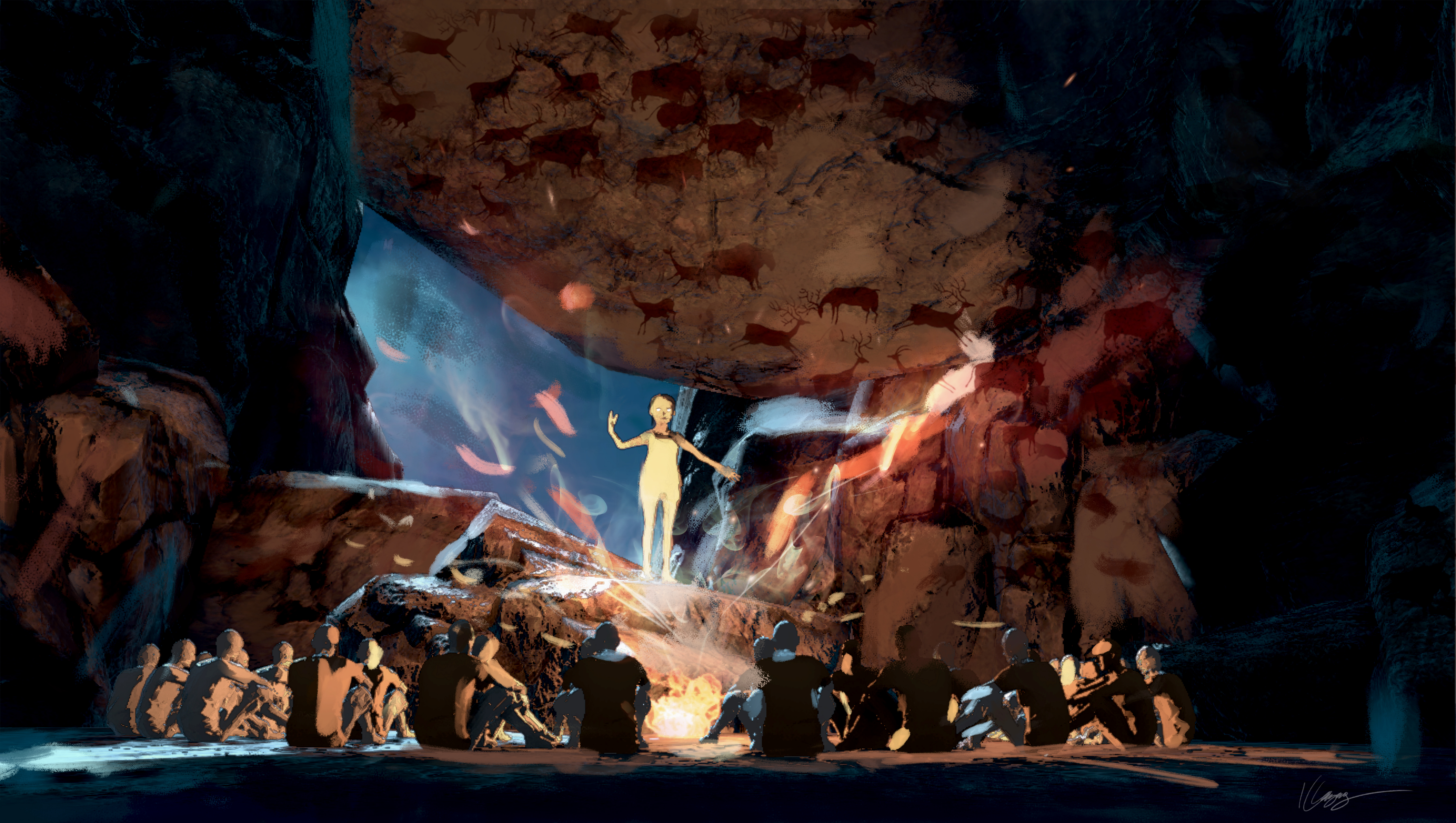
Before the Cave, part 31

Solemnly, Ilara took the necklace from the Shaman. She hesitated for a moment, and then she put it around her own neck.

And suddenly found herself in a different world.

Well, not exactly. It was the same world, only it looked different. For one thing, it had extra people in it, and mammoths too.

She looked at them more carefully. No, they weren’t people and mammoths exactly. They were something else. But what?

And then she had it. They were Spirits! She looked at the Shaman with surprise.

The Shaman smiled back. “You can see them, can’t you?” Ilara nodded, words failing her.

“You have the sight,” the Shaman continued. “I’ve never had it, and neither has anyone in our tribe for a long time. It comes back only when our people need it.”

“Actually, it comes back only when both of our tribes need it,” she heard another voice say, a much older voice. She turned to look. It was the mammoth Elder, speaking to her. And she could understand!

Then she heard a far more familiar voice. It was her mammoth friend. “And I can understand your humans too. It looks like you and I have a lot to figure out. Now that we are both Shamans.”

Ilara smiled. “Well, we can always ask the Spirits. I have a feeling there’s a lot they want to tell us.”

She reached her hand up affectionately, and touched the trunk of her fellow Shaman. Today was the end of a chapter in both their lives. But the next chapter was still waiting to be told.

End of Book I

Before the Cave, part 29

Ilara smiled back. “But what did I do to change things?”

“It is not what you did,” the Elder replied, gesturing to both her and her mammoth friend, “it is who you are. You are the bridge, the way for human and mammoth to finally be able to work as one. To communicate is the greatest gift the Spirits can give us. And the two of you have given us that gift.”

Ilara was humbled. She looked into the eyes of her mammoth counterpart, the other Ilara. For a moment she saw herself looking back.

“What now?” she asked the Elder.

The Elder gestured to the Shaman. “She will show you.”

The Shaman stepped forward, and to Ilara’s surprise removed her sacred necklace. Ilara could not remember a time when the Shaman had not worn that necklace. “You must take it now,” the Shaman said.