Shall I compare thee to a summer’s day?
Thy art is far more lovely and more sweet.
Rough winds do shake the darling buds of May,
And summer’s lease doth bring the summer heat.
However brightly poet’s pens may rhyme,
Perforce they find their inspiration dimmed;
For fairest art unfairly fades with time,
By chance, or culture’s changing course, untrimmed;
But thy eternal genius shall not fade,
Nor lose possession of that life it brings,
Nor shall death brag thou wand’rest in his shade,
When in eternal lines thy wisdom sings.
So long as hearts can beat and souls can soar,
The Bard of Avon lives forevermore.
Author: admin
In a fair fight
I was hanging out with family at my brother’s house last night. Some of us had just flown in that very evening, so at some point the conversation came around to airport security, as it often does these days. The threat of terrorism is of course very real and very serious, but sometimes the steps taken to deal with it can seem a little mysterious.
My mother said that she recalled a time, many years ago, when she and my dad had carried a circular saw onto an airplane. “I doubt,” she said, “that they’d let me do something like that today.”
It was pointed out that a circular saw on a flight is less of a threat than one might think (at least on domestic routes), because there’s no place to plug it in.
“Yes,” I agreed, seeking to add some perspective to the issue. “In a fair fight, a terrorist on a plane with a circular saw would totally lose to a terrorist with nail clippers.”
Pass / fail exam
Because of the holiday travel, I nearly missed my flight today. And that might have resulted in a cascade of problems.
But I didn’t miss my flight. I ended up getting on the plane, and arriving at my destination just fine. It was a sort of pass / fail exam, and in the end I passed it. Which got me thinking about pass / fail exams in general.
So much of life is a pass/fail exam, isn’t it? You either catch the plane or you don’t, metaphorically speaking. The difference in your actions can be slight (or in some cases non-existent), but the consequences of passing or failing can be enormous.
I think we instinctively understand this. At certain moments of our lives, we push ourselves to get over a finish line, knowing that getting to the other side of that finish line is the entire battle. We don’t always try for the “best possible” performance, but rather for the one that will allow us to keep going.
But what about life itself? Isn’t that the ultimate pass / fail exam? Some people emight say that in this particular game, you always fail in the end. After all, no matter what you do, sooner or later the Grim Reaper wins.
But maybe maybe this is one case where you get a passing grade just by showing up for the test. 🙂
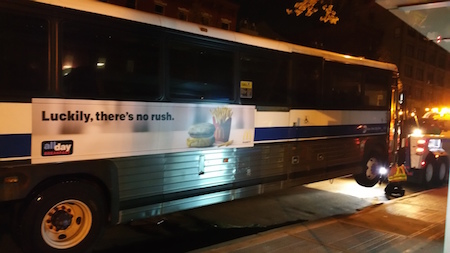
Luckily, there’s no rush
Speaking of signage, I was walking up Sixth Avenue this evening and I came upon a sight that you see every once in a while in a big city like New York: A large bus, having broken down, was in the process of getting towed. When I got there the tow truck had just hitched up the front of the bus, and was about to cart it off.
But the detail that caught my eye was the McDonalds ad on the side of the bus. It’s a perfect example of the wonderfully unpredictable chaos of the physical world.
In the future, when all signage becomes virtual, such events will most likely be removed from our sight just as soon as they show up. So enjoy it while you can.
Future signage and its implications
I made a claim here a while back that eventually, when everyone is wearing cyberlenses, it might be illegal to walk around a modern city without such lenses. I argued, essentially, that people will come to expect to be publicly seen with their digital make-up on, and to see them in public without that make-up might be seen as an invasion of privacy.
Today somebody asked me about that assertion, as part of a larger discussion about the eventual social and cultural ramifications of such a “Rainbows End”-like future reality. I had already pointed out that buses will no longer have signs telling you which bus to take. Subways entrances won’t have signs, and neither will restaurants, traffic control, convenience stores or any other places or services in the public sphere.
After all, everybody will be able to know know far more just by looking with their own cyber-enhanced eyes than any static sign could ever tell them. We will no longer need physical signs, any more than New York City any longer needs a way to feed the horses that used to draw carriages through its cobblestoned streets.
Today you are perfectly welcome to stay in your own apartment in a state of helplessness. You can go all day at home without clothing or any form of spending money. But the moment you walk out into the streets of Manhattan, neither of those options is viable. If you are naked, you will be picked up for public indecency. If you travel without money or credit cards, you can be arrested for vagrancy. The public sphere does not tolerate people walking around in a state of deliberate helplessness.
One day, to walk around the streets of a major city without your cyberlenses will be to be in a similar state of deliberate helplessness. Don’t expect it to be legal.
Great idea for a message T-shirt
|
|
|
|
20 minute talk
Tomorrow morning I am going to give a 20 minute talk. In many ways, it is actually harder to give a good short talk than a good long talk.
After all, in a long talk (say, 40-45 minutes), you have lots of chances to change things up. If the audience is responding to something in particular, you can spend more time on it, and just keep in mind that you’ll need to shave something down a little later on.
But in a short talk every minute counts, so you really can’t fool around with the rhythm. Tonight, the evening before, I am finding myself looking at everything very carefully and thinking through which things to keep and which to leave on the table.
In a way, it’s a very good process. Until you are forced to choose between your darlings, you don’t really know which ones you love the most.
At home in the Cloud
I was having a conversation the other day with some colleagues in which I was describing our lab’s research vision of a future reality in which furniture and physical objects are rearranged behind the scenes. I say “behind the scenes” because when you are wearing those future cyber glasses or contact lenses, you can opt not to render, in the view through your lenses, the mobile robots and aerial drones that are conveniently rearranging things in the world for you.
It’s not as though the existence of those helpful robots will be a deep dark secret. It’s more that you generally won’t be interested in looking at them — any more than you are generally interested in looking at the water pipes under your sink or the electrical wires running behind your walls. Unless, that is, you do plumbing or electrical work, in which case you would be very interested in seeing those things. 🙂
We were comparing the operations performed by those future robots to operations that people today expect on their computer desktop, where icons can be rearranged, files can be duplicated or deleted, or an application brought into the foreground or background. Eventually we will come to expect these sorts of operations on the physical objects and furniture around us.
Then the topic of our conversation shifted to the Cloud: Today when I open my favorite web browser on a friend’s computer, I sign in as myself, and all of my preferences show up on that computer screen. One day this is what will happen when I go to a hotel room in a strange city. In the lobby I will sign in using my login, and by the time I get to my room, everything will have arranged itself the way I like it.
The pictures I like will be on the wall, the chairs and desk will be where I want them, the bed will be where I expect it to be. The lighting will be just right, and so will the temperature. Even the view outside my window will be the one I that prefer to see. I will be in a strange city, yet I will also be at home.
Maximum emotional fidelity
A colleague and I were discussing the possibilities for Future Reality. She said “wouldn’t it be nice if while I was talking with my husband, I could re-image him as a gorgeous twenty year old?” I expressed doubts that such a thing would really catch on.
My argument was simple: That might be entertaining for a while, but it would likely interfere with the the ability to communicate with maximum emotional fidelity. And when you are in an intimate relationship, maximizing emotional bandwith and minimizing misunderstandings tends to be a lot more important than mere entertainment.
After all, I pointed out, the technology already exists for us to see each other on Skype calls and Google Hangouts with “digital makeup” that would transform our facial features in arbitrary ways. It would be very easy to offer a commercial product that changes your loved ones into gorgeous models.
And yet nobody offers such a product. I think the reason is that there really is no demand for it. At the end of the day, people who care about each other want to see each other truthfully. Not necessarily in the sense of literal photo-realism, but certainly in the sense of maximum emotional fidelity.
That is going to remain true, no matter where our future technologies might lead us.
Reflections on a reunion
Nearly a week after my high school reunion, I find myself reflecting on what I learned. The major revelation I came away with was definitely a surprise.
If you think of the people you knew in high school, the ones you were close to, and those other ones you didn’t quite connect with, you can sketch out a kind of “distance function” between you and anyone else in your class.
Now let’s skip forward many years, and throw those same people together. One would think that time would be the great transformer of souls, the thing that forces up to level up, that tests us, that in the worst cases leaves us abandoned on the side of the road.
But that’s not at all what I found. I encountered the same people that I had known many years before, wieh the same essential energies and personalities. Those I had felt a strong connection with at sixteen, I still felt connected with now. And those who had seemed odd or slightly unfathomable to me, continued to feel that way even after all these years.
My take-away from this is that we all remain, throughout our lives, who we are. At our core we are the same person from early childhood until old age. The life long journey we embark upon, as exciting and varied as it is, does not, in any essential way, change this fundamental truth.