Unjargon

A friend pointed out to me that my “Train of Thought” post the other day was incomprehensible to her. And I realized that it might be incomprehensible to a lot of people.

The problem is that I spend much of my time in a milieu where terms like “Turing test” and “Big Data” are understood by everyone in the room. But that doesn’t help once you take the discussion out of that room, and those phrases just sound like jargon.

“Turing test” is shorthand for Alan Turing’s famous thought experiment, which he called the “imitation game”. The idea is that you test a computer in the following way: The computer holds a conversation with a person (over a teletype, so they can’t actually see each other), and the person then tries to guess whether they’ve been conversing with a real person or to a computer.

This contest, the basic set-up for the recent film Ex Machina, as well as many other works of speculative fiction, raises all sorts of interesting questions. For example, if a computer consistently passes this test, can it be said to think? And if so, is it a kind of person? Should it be granted civil rights under the law?

“Big Data”, on the other hand, is the idea that if you feed enormous amounts of data to a computer program that is good only at classifying things into “more like this” or “less like that”, then the program can start to make good decisions when new data is fed to it, even though the program has absolutely no idea what’s going on.

This is what Machine Learning is all about, and it’s the reason that Google Translate is so good. GT doesn’t actually know anything about translating — it’s just very good at imitation. Because Google has fed it an enormous amount of translation data, it can now translate pretty well.

But Google Translate doesn’t really know anything about language, or people, or relationships, or the world. It’s just really good at making correlations between things if you give it enough examples.

So my question was this: If you use the Big Data approach to imitate human behavior, are there some human behaviors that can never be imitated this way, not matter how much data you feed them?

Let’s put it another way: If you fed all the romance novels ever written into a Machine Learning algorithm, and had it crunch away for long enough, would it ever be able to sustain an intimate emotional relationship in a way that is satifying to its human partner? Even though the computer actually has no idea what is going on?

My guess is no. On the other hand, there are probably more than a few human relationships that work on exactly this basis. 🙂


Old fashioned selfie

Today was all about the snow. The snow meant different things to different people. For some it was a terrible inconvenience, for others a day off from work. But for those of us who live on Washington Square Park, it was sheer heaven.

In a sort of magical transformation, the moment anyone set foot in the park today, whatever their age, they turned into little children. People were laughing and running about, throwing snowballs, having a grand old time. Because no cars were on the streets, it occurred to me that this was pretty much the same experience people would have had in this park a century ago.

Here is a photo I took amid the revelry in the park, looking through the Arch toward Fifth Avenue. In the distance you would normally see the Empire State Building. But not today — it is hidden behind a swirling mass of falling snow:

Of course, not everything is the same as it was 100 years ago. For one thing, back in 1916 people weren’t taking so many selfies.

I decided I would record my snow day in the park the old fashioned way, by making a snow angel. It’s something I learned as a kid. The first good snowfall of winter you would would go out in the backyard, lie on your back and flap your arms. When you stood up again, it would be as though an angel had been lying in the snow.

It’s hard to see the result from the image below, taken today in Washington Square Park, as the late afternoon winter light fades everything to ghostly Maxfield Parrish hints of yellow and blue. But it is indeed the angel version of yours truly, in a very old-fashioned sort of selfie:

Train of thought

As I was looking at yesterday’s post, I started thinking about a sort of Turing Test for fonts: Would it be easy or hard to design a randomized font — in the style of the one I showed yesterday — so people would not be able to tell that the randomness was machine generated?

And then I realized that it would be quite easy: You could use a “big data” approach. First analyze a lot of samples of actual human writing, then use those to train a machine learning algorithm. You can then use that algorithm to generate new writing samples. It’s one of those problems that is actually quite amenable to a “big data” machine learning approach.

But then I started thinking, could we start to arrange all human abilities on a scale from “easily faked by big data” to “not at all fake-able by big data”?

Some things, like generating randomized fonts, are on the easy end of the spectrum. Other things, like maintaining a long term intimate relationship, are probably way off on the difficult end of the spectrum (or at least, I’d like to think so).

But what about everything in between? Driving a car has turned out to be more tractable than people had once thought, as have chess and rudimentary translation between natural languages.

I wonder, is there some litmus test we can apply, to get a rough sense of how easy or difficult it would be to emulate any human task via machine learning, given sufficient data showing humans themselves doing it?

Unfont design

The word “font” derives from the old days, when printing was done with real metal pieces that were used to press ink onto paper. A font was a complete set of such pieces that shared a particular weight, size and style.

For a given font, the letter “A” always looked the same, as did the letters “B”, “C” and so forth. And this is essentially still true today, in the computer age. When printing with a given font, a particular character always appears the same.

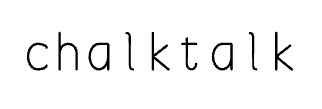
Consider, for example, the following word in my new line font:

In the word “chalktalk” above, the letters “a”, “l” and “k” each appear twice, in each case without any variation. This is part of the definition of a font: The appearance of any printable character is completely determined. This is in contrast to, say, handwritten text, in which characters look somewhat different every time they are written.

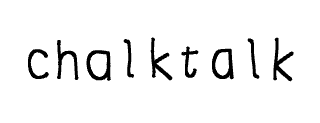
But sometimes I want text in my Chalktalk system to have a casual handwritten quality. Because this is a procedurally defined font, I can just add noise to make that happen:

Now any given letter, such as the “a”, “l” and “k” above, will look somewhat different every time it appears. Which means that this is no longer a font — it violates the very definition of a font.

Yet it is recognizable. The statistical average of all occurances of any given letter converges to the original line font, even though no letter is actually in that font. And although this is not a font, we perceive it much the way we would perceive a font.

I guess you could call it an unfont.

Font design

The reason I was thinking about fonts yesterday was that this week I designed my own font. I needed it because I am moving my Chalktalk interactive drawing program into VR, so I need text that can be “drawn in 3D space” like any other drawing.

I couldn’t use the standard font design tools, because those tools don’t let you create characters that can be drawn as lines and curves in space. So I wrote my own font design software, which actually only took about an hour (it’s a lot easier if you’re only going to design a single font). The design of the font itself was really fun, and took a few hours, mostly because I really got into the stylistic details.

Fonts are like chess sets — all of the characters need to “feel” like they belong together. You’re basically asserting a coherent design space, and all of the characters in that space need to play well together, so that they reaffirm each other aesthetically. But some of them also need to be just a little bit cheeky and impertinent.

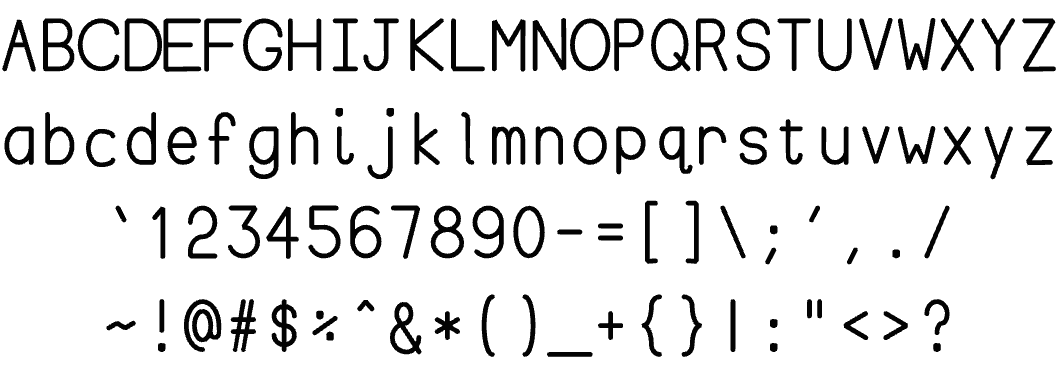
Below is what I have so far. I’ve already switched Chalktalk over to use this new font, and it looks a lot better than the off-the-shelf one I was using before:

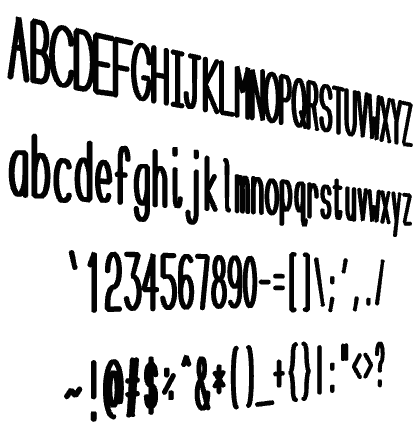
And here’s something I wasn’t able to do with my off-the-shelf font — let people walk around text in virtual reality, like any other object in the 3D shared virtual world. And that’s the real payoff!

Deadline time


Something there is that doesn’t love a deadline,
That sends the frozen Google doc under it,
And spills the upper sections into the clipboard;
And makes gaps in logic even two can pass abreast.

There is something about a paper deadline. In our case it is the SIGGRAPH 2016 technical papers deadline.

As such a deadline approaches we seem to turn into living embodiments of Xeno’s paradox: The nearer the deadline becomes, the faster we work. If this continues, we will end up writing half of the paper in the very last second before the clock strikes. Although I suspect that practical limitations will prevent such a thing, if not quantum-mechanical limitations.

It is now 20 hours before the deadline. A minor consideration like sleep seems, for the moment, unimportant. Yet I know from experience that sleep will come to seem very important about a day from now.

Meanwhile, the hour awaits. We are fueled by adrenaline, forward thrusters on go and full speed ahead. We are all enjoying the rush of working together this way. Good deadlines make good neighbors.

Greenland time

Some months ago my Android phone mysteriously shifted two hours forward. At first I simply marveled at this crazy turn of events. How could a phone that got its time from the internet possibly get the time wrong?

After several days I navigated to the phone’s settings to see what was up, and whether I could fix it. At which point I discovered that my phone thought that I was in Greenland. I looked on the Web, searching high and low for a clue, but nowhere could I find even a description of these symptoms, let alone a solution.

I have never been to Greenland, and if you’d asked me before this incident, I would have had no idea that Greenland time is two hours ahead of New York time. But there it was. And apparently, there I was. According to my Android operating system, the phone and I were hanging around somewhere between Kujalleq and Qaasuitsup.

And no matter what I did, no matter how I tweaked the settings, no matter how often I rebooted, my phone stayed stubbornly on Greenland time.

I was curious to see what would happen when I went to other time zones, and I soon found out. All along the West Coast, I was to discover, from San Diego to Vancouver and all points between, I was still on Greenland time. Which meant that in order to figure out what the local time was, I now needed to subtract five hours from the time on my phone.

This mysterious state of affairs continued on, in its oddly stubborn way, until just this morning. I happened to turn my phone off and then on again, something I’ve done many times in recent months. But this time it snapped back to New York time.

Apparently I have been released from my Greenlandic bonds. I am now once again a citizen of the world, free to be a New Yorker when in New York, a Los Angeleno when in Los Angeles, and a Portlandian when in Portland.

Not that there’s anything wrong with Greenland.

Realpolitik

As the 2016 U.S. presidential race moves through its erratic paces, I find myself in a familiar situation. I admire the purity of Bernie Sanders, his unswerving adherence to principle, yet for those very reasons I don’t think he would make the better president.

I actually like the fact that Hillary Clinton is promising to be a pragmatist. I tend to be more comfortable with leaders who don’t lead overwhelmingly with ideology, because too much focus on ideology is more likely to back you into a corner, and you just end up compromising your principles.

After all, politics is the art of the possible. It is less important to be always right than to actually get things done: To spur the economy when needed, keep unemployment down, to make sure the citizenry has access to food, health, education and other services, to form stable international alliances that promote national security.

Many of these goals are consistent with a sense of idealism. Yet actually achieving them requires continual negotiation and compromise between people who disagree about a lot of things. Right now the pragmatism that Hillary Clinton is promising seems much more attractive to me than the unwavering idealism of the Bernie Sanders campaign.

This difference is particularly important given the possibility that the Republican candidate might turn out to be Donald Trump. I know, that sounds crazy. After all, to our credit, American voters have never ended up voting for the hate-mongering bully. But just in case, I’d be more comfortable with a relatively centrist pragmatist running against the Donald.

Boundaries

I was talking with an old friend today who is, as a rule, very thoughtful, intelligent and considered in her opinions, and the subject of David Bowie came up. She wondered aloud whether Bowie’s reported ambisexuality affected his marriage to his wife Iman. Did they have an open marriage?

My emotional reaction to this line of thought was surprisingly intense. I said that to me this was not a legitimate topic for conversation. It’s none of our business, I said, what a public person does in their private life.

My friend countered that it was legitimate, because Bowie’s art was so intertwined with questions of sexual ambiguity and provocation. When such issues are so central to a public person’s work, it is legitimate, she asserted, to examine how those questions relate to that person’s own life.

I realize, I told her, that mine is a minority opinion in today’s culture, but I have a number of hyper-famous friends, people who regularly get stopped on the street by well intentioned fans. And perhaps that makes my perspective unusual.

Because I know, firsthand, that their artfully constructed persona is generally not the actual person. When you stop a famous person on the street and you address them as though they are the character they’ve created, you are actually engaging in a mistake, an unintended crossing of boundaries.

In reality, people who create highly outgoing or flamboyant characters, and then play those characters on stage or on screen, are often nothing at all like the character they’ve invented. Their real selves, the ones that may be quiet or shy or thoughtful or sad, comes out only in their real life — their private life.

Yes, if you stop them on the street they will usually be polite, and indulge you because they know you mean well. But the person you are actually talking to is more often than not nothing at all like the image you’ve been seeing on screen, or have read about in the gossip pages. They are somebody else entirely.

So no, for me it is not legitimate to talk about a public person’s private life based on the persona they’ve created in their art. I suspect that most people are never going to agree with me on this.