Smith grade coffee

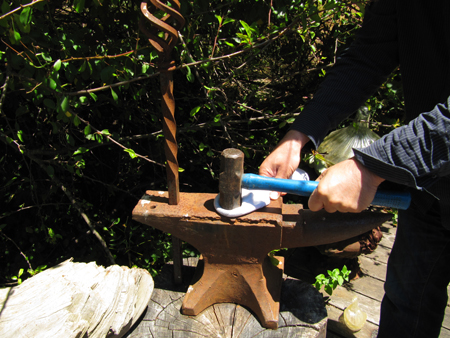
The friend at whose house I am staying out in the woods has no coffee grinder. But he does have an anvil out back. So rather than going all the way into town I decided to get a bit creative.

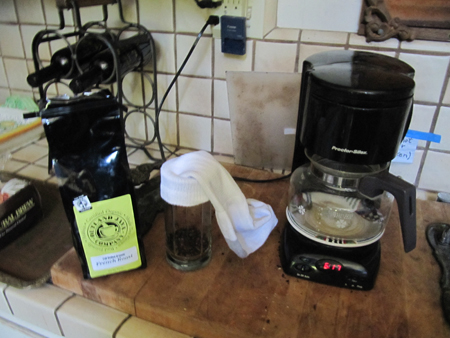
This morning I put fresh whole coffee into a tall glass, put a clean white sock over the glass, and turned the glass upside down, so all the coffee beans ended up in the toe of the sock. Below is what it looked like just before I dumped the coffee beans from the glass to the sock:


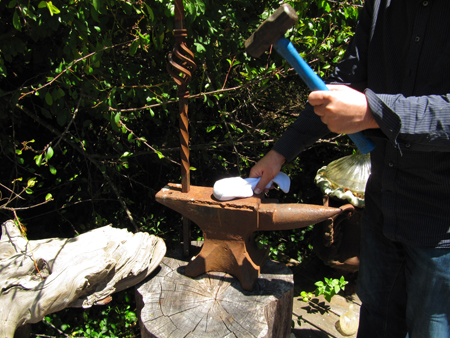
Then I went out back with my coffee bean laden footwear, and forged myself some coffee grounds:


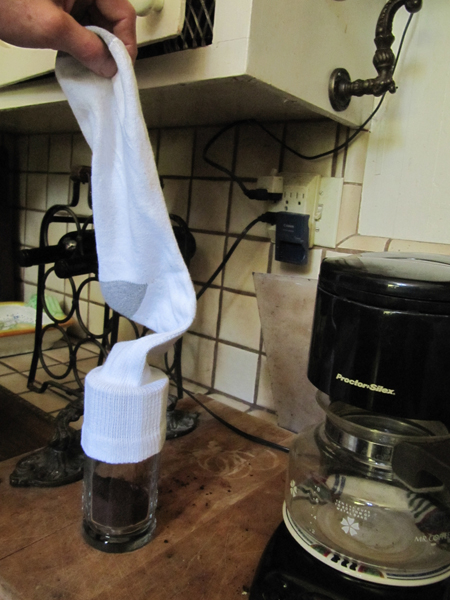
Then I put the sock back over the glass and shook out the freshly ground coffee:


Which I then brewed in my friend’s coffee pot, resulting in a mug of fresh hot yummy coffee:
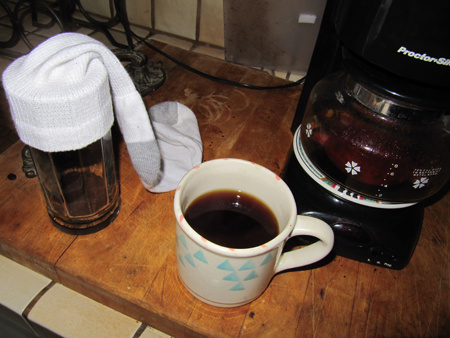


It tasted delicious. And as you can see, there are even enough grounds left for tomorrow morning’s cup of coffee.

Yay!
Attic, part 49

“Sid,” Charlie said, “are you sure you want Jenny to carry you over to the door?”

Sid looked puzzled. “How the hell else am I supposed to get there?”

“Think about it,” said Charlie. “As soon as we passed through the tower walls, I got my powers back.”

Sid just stared at him a moment, and then turned to look at Mr. Symarian. “Why didn’t you tell me?”

“You never asked,” Mr. Symarian said. “And I thought it best to not to encourage you. You may recall what happened the last time…”

“Sheesh, you gotta be kiddin’ me.” the little demon said, rolling his eyes. “All this time…” He spread his wings and gave them an experimental little flap. And rose several inches into the air. Then several more.

“That’s wonderful!” Jenny said, and clapped her hands. Sid was now flying around the room with a big grin on his face, happily trying out his now functional wings. He was still beaming like the cat that ate the canary when he flew straight into a wall and dropped like a rock.

“Ouch, that must hurt,” said Josh.

“Only my pride,” the little demon said, brushing himself off. “Us demons, we’re a hardy bunch. Now, lemme at that lock.” And with a cheerful wink at Jenny, he lifted straight into the air and flew toward the locked door.

The last frontier

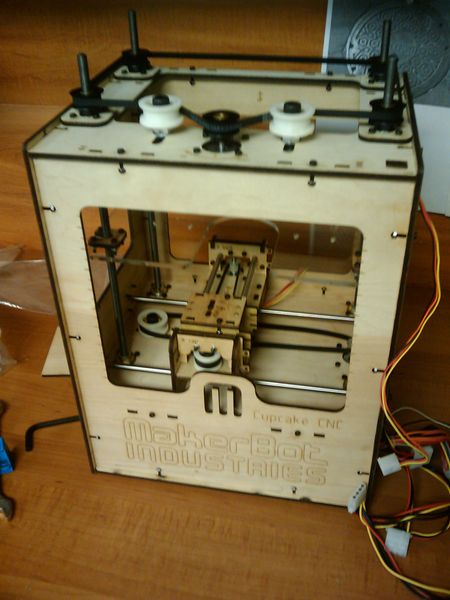
Today the package arrived from MakerBot Industries — a new CupCake CNC Deluxe Kit — just $950 plus shipping. The MakerBot business model is very simple: Why ask people to spend $20K on a 3D printer when they can buy a kit for less than $1000 and assemble it on a day or two?

So on a whim I went on-line, clicked two day delivery, and this evening a friend and I started putting it together. We got most of the way through, but then decided to get a good night’s sleep and finish the job in the morning. When it’s done, it will look something like this:


And it will let me make 3D things quite similar to the ones I showed and talked about last week — but at far lower cost.

The cool thing about using one of these — as opposed to the 3D printer I wrote about last week — is that a MakerBot is not just one 3D printer in one place, it’s something far more powerful. Because the price is so low, everyone you are collaborating with can have one of their own.

I can be in NY, a friend can be in California, another can be in London, and each of us can independently print out objects we’re designing together. One of us could run through ten iterations or more in the course of a day, without holding up anyone else or monopolizing resources.

We are already used to this concept when our shared creations are stories, images, songs, movies, computer games, and anything else that can be described (and therefore transmitted) as a sequence of bits.

Now at last this level of creative and collaborative freedom is coming to the last frontier — our physical world itself.

Attic, part 48

The first thing they noticed when they got to the top of the stairs was the strange green glow. At first it was hard to tell where it came from. Then Charlie pointed. “Look, under that door.” There was indeed an eerie green glow coming from under the door of one bedroom.

Without hesitating Josh walked up to the door. “Wait!” said Jenny in alarm, but Josh was already reaching out to turn the knob. “It’s locked”, he said.

“Clearly we are nearing our goal,” said Mr. Symarian. “I suspect we will find the answers we seek from whatever is in the room behind that door.”

“That’s my room,” Jenny said. “I mean, it was my room back in the real world.”

The others looked at her. “Any chance,” Josh said, “that it used to be your grandmother’s room?”

“Yes, of course it was!” Jenny said. “Josh, you’re a genius! You know, it’s funny — I used to find her old stuff sometimes tucked away in the back of the drawers and closets. It was really strange because I was sure my mom had gotten rid of it all, but somehow it would come back. I never really knew what was going on. It doesn’t seem so strange now.”

“Nothing seems so strange now,” Josh said, grinning. “But how are we going to get through that door?”

“I think Sid can help with that,” said Mr. Symarian.

“Hey,” said Sid, “you told me I wasn’t supposed to do that kind of stuff.”

Mr. Symarian smiled. “I believe that we can make an exception in this particular case.”

“What kind of stuff?” Jenny asked.

The little demon grinned at her, looking very happy for once. “Carry me over to the lock on that door and I’ll show you.”

As sculpture is to photography

A friend was telling me today that she had seen a well meaning but somewhat mismatched attempt to compare two artists — an exhibit of sculptures of Michelangelo together with photographs by Robert Mapplethorpe. While the photographs were breathtaking, they were bound by the literal nature of photography.

Where photography can only show us the reality of the human condition, sculpture can show us the ideas in our own heads. The space of expression in a constructive medium is vastly larger than can be achieved by a recording medium.

Which leads me to the question of animation. The history of animation has been rather odd, in that this medium of practically limitless expression has for most of its history been relegated to children’s genres. Some of this characterization was due to the enormous success and entrepreneurial abilities of Walt Disney, and some was just the result of historical accident.

The recent experiments of such high powered directors as Robert Zemeckis, Peter Jackson and now James Cameron in combining live action with computer graphics has changed the equation. Suddenly audiences are starting to see the connection between the virtual and the real. And the infinite possibilities of constructed reality, as opposed to captured reality, are beginning to attract wider consideration.

I am looking forward to a day when our most highly talented film actors, such as Meryl Streep or Tom Wilkinson, are regularly appearing in constructed realities, and given a chance to lend their vast talents to these emerging media.

At that point, synthetic worlds on screen may come to bear the same relation to old fashioned movies as, say, sculpture bears to photography.

Attic, part 47

Inside the house, everything looked different. The furniture looked like it was from maybe forty years ago, and there was no trace of day-to-day life. No newspapers lying around, or plates from breakfast, or any of the little things that let you know a house has people living in it. Just an eerie silence.

Charlie was looking around at the house with a mixture of fear and awe on his face. “What strange place is this?” he asked, as they passed through the living room, the den, the kitchen. His gaze lingered for a particularly long time at the gas stove. “There seem to be objects of power here. Are you a great wizard?”

“No,” Jenny said, feeling strangely pleased in spite of herself. “Where I come from this is just ordinary stuff. Everybody’s house looks kind of like this. Except we’re supposed to have an electric stove, not a gas stove.”

“Amazing,” Charlie said, and smiled at Jenny shyly in a way that she found rather sweet. She noticed that Josh was starting to look distinctly annoyed, which for some reason she also found rather sweet.

“I believe,” said Mr. Symarian, oblivious to all of this, “that this is the house the way your grandmother would have known it. Also, what you might refer to as ‘the fruits of modern technology’ simply have no parallel in the other world. To one who has never seen them, such objects would indeed appear to be a form of wizardry. It is said that to the tribal peoples of southern…”

“Hey Doc, not to interrupt yer lecture or anything,” Sid said, interrupting, “but what’re we supposed to do now?”

“Unless you guys are too busy talking,” Josh said, “now we go upstairs.”

Feeling sorry

The most interesting recent comment — by far — on this blog was the following statement by Troy about a week or so ago:

“Please don’t take this as negatively as it may sound, but, being a voracious omnivore… I am not critical of people for making the choice to not eat meat, or just not red meat, or only free-range meat, or, only meat that died of natural causes… Everyone has their reasons, and I respect that…

But, I do feel sorry for them. That’s not meant to be as arrogant, accusatory, or holier-than-thou as it sounds, it’s simply a truthful statement. I know that they (vegetarians/vegans/pescaterians/lactose intollerant) don’t need or want to be felt sorry for, but, I truly do. Going through life tasting everything, including the forbidden fruit, makes me a richer person. I don’t care what it is, if there’s a culture on the planet that treats it as food, I’ll eat it.”

What is wonderful about this comment is that Troy is floating the idea that one person’s likes or dislikes is based on the negation of another person’s likes or dislikes.

I thought it would be interesting to explore alternative viewpoints that push Troy’s central premise that “I feel sorry for you if you do not like the things I like.”

So here is an example of the sort of thing Troy is saying, recontextualized:

“Please don’t take this as negatively as it may sound, but, being a voracious homosexual… I am not critical of people for making the choice to not make love to men, or just not really cute men, or only men that work out a lot, or, only men that kiss really well… Everyone has their reasons, and I respect that…

But, I do feel sorry for them. That’s not meant to be as arrogant, accusatory, or holier-than-thou as it sounds, it’s simply a truthful statement. I know that they (heterosexuals, Catholics, breeders) don’t need or want to be felt sorry for, but, I truly do. Going through life tasting everything, including the forbidden fruit of another man’s love, makes me a richer person. I don’t care what it is, if there’s a culture on the planet that treats a man as meat, I’ll ‘eat’ him.”

Given that this is pretty much a direct transcription of Troy’s rhetorical stance, I’m pretty sure he will agree with the above.

Attic, part 46

They had gone past the mountains now, beyond the rain and hills. They had passed the last tree a while back, and it seemed that there was nothing now but a featureless plain. Jenny was wondering whether they would walk this way forever, but Josh led them onward, seeming confident in their direction.

At last they could see a vast lake spread out before them. It grew gradually larger, until it was perhaps thirty yards away. “I guess this is the end of the line,” Sid said. “Too bad kid, you really tried.”

“No,” Josh said, “We need to keep going.”

“But it’s a lake!” Jenny said, “we can’t very well walk on water.”

“Come on,” Josh insisted, and he continued to walk forward.

With nothing else to do, the others followed. Jenny wondered whether they would all find that they could breathe underwater. Odder things had happened since this journey had started.

Strangely, the lake did not appear to get any closer. No matter how much they walked forward, the water line remained just about thirty yards away. But now something else was happening — a shimmering in the air before them.

“Of course,” said Mr. Symarian, “I should have guessed, a shielding spell! Such spells can be broken only by proximity.”

With every step now, the shape before them was growing clearer, and larger. Suddenly it was standing before them, as clear as day.

“What is this place?” Charlie asked.

“I’m not sure,” Jenny replied, “but it looks exactly like my house.”

Pop culture forever

Practically the definition of “popular culture” is that it is chronologically site-specific. The songs, movies, TV shows, comic books that wash over us in an endless stream of entertaining ephemera are not meant to last, but only to please in the moment. They are not meant as messages to posterity. They are meant only to be entertaining and hopefully to make somebody a buck.

But wasn’t that what Will Shakespeare was up to? Wasn’t W.A. Mozart just trying to fill the seats at the opera house and hopefully to get in good with Emperor Joseph II? Wasn’t Rembrandt mainly trying to make commissions for his paintings, Aristophanes just going for a laugh, and Dickens selling his stories by the word?

We can’t know what will last beyond our own time. People remember Marlene Dietrich, but not Lily Langtry, Marilyn Monroe but not Mamie van Doren. The golden star of immortality falls where it will, and we cannot predict the path of its long arc through future history.

But we can say, with the authority of knowing it has happened countless times before, that some TV show, some movie we saw last weekend, some pop song playing in the top 40, will indeed last — perhaps for hundreds of years, and perhaps even longer.

Out of the random spewings of any generation trying only to entertain itself, there will indeed be random nuggets of greatness that last through the ages, and the very next popular song you hear on the radio may very well continue to echo through eternity.

Attic, part 45

In spite of the howling winds all around them, Jenny felt oddly safe. She was enfolded in the golden warmth of Charlie’s protective shield, she had her friends about her, and Josh clearly knew the way. With the rush of events, each stranger than the last, she realized that she hadn’t had time to think, to really let herself understand what was going on.

What did she really know about Grandma Amelia? The family history was vague — maybe deliberately vague. Her grandfather had loved her grandmother very much, and everyone had always thought it went both ways. But then one Sunday afternoon, when Jenny’s mother was still a girl, Grandma Amelia had just vanished. Apparently people had looked everywhere, but she was never found. The only thing they knew was that she had said, just before she’d disappeared, that she needed to go up into the attic. But if she really went up there that Sunday afternoon, she never came down.

Ever since that day, Jenny’s mother had refused to go up into the attic — ever — even after she’d inherited the family house. The mystery of Grandma Amelia’s disappearance was so central to Jenny’s family, so taken for granted all her life, that she’d hardly ever given it much thought.

Until now.