Math 101

Here in manattan there are various little free newspapers around, supported only by ad revenue. None of them are of very high quality, but one thing they all seem to have in common is a puzzle page. The crossword puzzles aren’t very good (I’m spoiled by The New York Times) but I find the sudoku to be a perfect mindless divertion during subway rides uptown. All I need is a pen in my pocket when I leave home or office, and I’m good to go.

But there is one oddity about the Sudoku page. In many newspapers, it has a little instructions page that reads (and I quote):

How to play:
Fill in the grid so that every row, every column and every 3×3 box contains the digits 1-9. There is no math involved. You solve the puzzle with reasoning and logic.

Today I became curious whether anybody else is bothered by the patently false and absurd claim that “There is no math involved”. So I did a Google search on:

“There is no math involved” sudoku


and found 82 hits (Google gives an estimate of over 900 hits, but they only actually find 82). I went through them all, and found that every page simply repeated the nonsensical statement that there is no math in Sudoku, without thinking to question it.

If I were to start printing some equally absurd statement in newspapers, like “There is no gravity, we just all secrete glue out the bottoms of our feet and shoes,” I suspect somebody might complain. So what’s going on here?

My theory is that math education is so fundamentally broken in our society that people actually grow up believing that “math” is a synonym for “arithmetic”. And there is certainly no arithmetic in Sudoku. But in fact Sudoku is a math puzzle. It consists of nothing but math.

Actual mathematics is, quite precisely, any endeavor in which you start with a set of symbols, together with some rules for combining and manipulating those symbols, and then you set about discovering what symbol combinations are provably true or provably false, according to the rules you started with. Sudoku has nine symbols, and a few elegant rules for how you are allowed to combine those symbols. Most combinations produce a provably false result, and one combination produces a provably true result.

Things don’t get much more mathematical than that.

And so I come to the reluctant conclusion that almost nobody in our society has any inkling of what math is. Which is really strange when you consider that kids are required to take math in high school. For example, if you attended high school in this country, the odds are that your state curriculum required you to study Geometry somewhere along the way. That’s an entire year in which you did math pretty much without arithmetic or numbers. You would have encountered a bit of arithmetic, like summing the occasional pair of angles, but that was pretty incidental to what you were actually studying, which was how to prove theorems from a given set of simple initial rules.

It’s no wonder there is so much math phobia in this country. For one thing, people aren’t even aware of what math is. It’s just that scary thing they are supposed to learn from people who apparently also have no idea what it is.

Imagine how bizarre the system must seem to the average high school student. An entire year is spent taking a math course called “Geometry” which – by common consensus – has nothing whatever to do with what most people mean when they say the word “math”, since most people are under the misapprehension that math is the same as arithmetic.

And yet, ironically, Geometry is the one math subject offered in high school which actually is math, as that word is understood by mathematicians. Algebra and Calculus would be math too, if anybody bothered to show you how and why they really work. But in high school that doesn’t seem to happen. Instead, these courses are generally taught as a set of mysterious formulas: Plug in the right formula and the right answer comes out.

I was completely uninterested in math when I was in middle school – it was all taught as a set of formulas by bored teachers who seemed much more focused on stopping us kids from throwing pencils at the backs of each others’ heads. And because I wasn’t interested in math, I wasn’t particularly good at it.

Then in ninth grade I had my first great math teacher, and everything changed. I was finally shown that math (actual math, not what most people mistake for math) is one of the most beautiful things that a human being can encounter in life.

But that’s enough for now. More tomorrow.
Jellybean filter

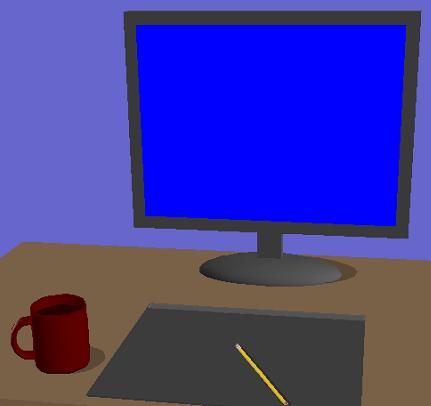
I had made a perfectly serious looking computer monitor using my little java modeling system, because I’m working on a project where it’s useful to visualize the relative sizes of various items commonly found on a desk, and I wanted to include a 24″ diagonal PC monitor. I modeled the mug and pencil from objects that happened to be sitting on my real-world desk:


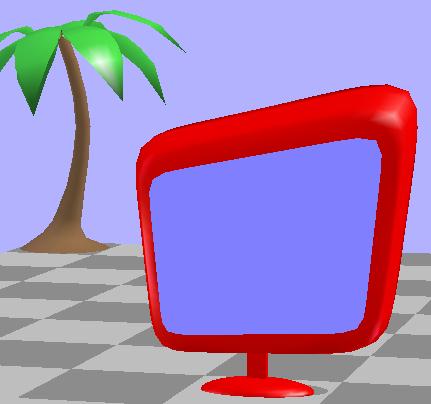
But I am also working on a completely different project for which I am building a kind of cartoon world, a world I call the “Jellybean World”. In the Jellybean World everything has that wonderfully crazy retro-future Googie look that was borrowed by Walt Disney for their original Tomorrowland, and by Hannah-Barbara for The Jetsons. It’s a world that says, essentially, “Welcome to the future, and everything really is ok.” Not a very common sentiment in recent times, I’m sad to say.

Since I’d already made the monitor, I simply repurposed it, running it through might be called a “jellybean filter” – a process that transforms real-world objects into Jellybean World objects:


In the Jellybean World the computer monitor is no longer required to hang out with mugs and pencils. Instead, as you can see, it finds itself in the company of happy plastic palm trees. The tree, by the way, was modeled after the ones I used to play with when I was a kid – the little plastic trees that came with the cool (and highly influential) set of plastic dinosaurs my brother and I got from our uncle Ned when I was six.

I like the idea of a jellybean filter that can be applied to whatever object you feed into it. There is just something about the sheer loopy hopefulness of this concept that appeals to the six year old in me.

In case you were wondering, in my Jellybean World both the monitor and the trees are perfectly capable of dancing and swaying in time to music, as are all objects. This is a feature not generally found in real-world computer monitors.

Or real-world trees, come to think of it.

White parasol

When you write a blog entry every day, things tend to get more Proustian. You start to notice all of the little crumbs of madeleines along the way, each dipped in its own lime-flower tea. These crumbs, humble as they are, become precious. Each can lead you to some inner place that connects you to someone you know and love. Or – a tea of a somewhat more bittersweet flavor – to someone you knew and loved in times past.

I tend to notice now when somebody gets that sentiment right. Recently I revisited “Citizen Kane”, and it struck me that the lovely pivotal speech which Herman Mankiewicz (the screenwriter) gives to Bernstein is one of the most perfectly Proustian moments in any Hollywood film. It’s part of the answer Bernstein gives when interviewed by the investigative reporter. At this point Berstein is already quite old, his mind circling around his own memories of Kane, whose precipitous life is now a thing of the past.

I’ll let you savor it for yourself:

“A fellow will remember things you wouldn’t think he’d remember. You take me. One day, back in 1896, I was crossing over to Jersey on a ferry and as we pulled out, there was another ferry pulling in — and on it, there was a girl waiting to get off. A white dress she had on – and she was carrying a white parasol – and I only saw her for one second and she didn’t see me at all – but I’ll bet a month hasn’t gone by since that I haven’t thought of that girl.”

Consider that these words are being spoken by a man who is near the end of a very long life, with the distinct implication that he has never before told anyone of the girl with the white parasol. In a few eloquent sentences it tells you everything you need to know about what truly matters in the film. I think it’s one of the most perfect speeches ever to appear on celluloid.

Ensemble

I went to see a chamber music concert this evening – short performances by ten chamber groups in two hours. The music ranged from Schumann to Shostakovich, and everything in between. My favorite was the “Violin Sonata in A Major” by Cesar Franck, a perfect study in soulful aching lyricism. Tonight, in the hands of a brilliant violinist and pianist, it somehow managed to be deeply sad and ecstatic all at once, like the very best songs by Tom Waits.

Somewhere during the arrangement for flute, clarinet and piano of Debussy’s “Epigraphes Antiques” I had an epiphany. Each of the musicians on stage was focusing on giving the best individual performance possible – each mind on the stage in its own personal zone, a place that had been achieved through countless hours of practice. And yet each player was clearly keeping an ear open to all the others. You could see the occasional glances from one musician to another, the thoughtful pauses between the music as they all tried to sync to the same emotional wave as it surged and ebbed throughout the piece.

And I realized that this is the same experience I have watching a great performance by a dance ensemble, or great actors on a stage, whether the play is by Mamet or Chekhov. In each case there is a dramatic illusion of tension between two opposing players – in the case of the Debussy it was the byplay between the flute and the clarinet. But in fact, they are all aspects of the same mind – and this is what makes it all wonderful.

A good performer, whether in a ballet, a chamber orchestra or a theatrical farce or tragedy, is usually presenting a well thought out creation of a single brilliant mind. The people you see on the stage are not there to act solely as individuals, but rather to illuminate an inner dialog created in this author’s mind. In Ibsen’s “A Doll’s House” Nora and Torvald are not really two people – rather they are artful illusions of two people, perfectly sketched representations of individuals, invented for the purpose of playing out questions that actually arose within the mind of the playwright.

When you see this in a novel, it is all usually tangibly obvious. The reader knows that Darcy, Elizabeth and Collins are merely creations from the single mind of Jane Austen. In fact, Austen reminds us of this fact at every moment in the story – by making her own narrator’s voice the most vivid of all the voices we read.

But in a performance it gets trickier. You can actually see the individual floutist or clarinetist there before you – flesh and blood humans who you know have each spent countless hours to perfect their art. And yet the job of that floutist and that clarinetist is to illuminate the mind of Debussy, to bring you back to the vision of the individual creator.

I think that it is this formal tension – the fact that even in the middle of a knock down, drag out cursing match in the blackest of Mamet plays, or the most devastating psychic wounds inflicted in a play by Conor McPherson, it is still the job of the players to act as an ensemble, to work harmoniously together on the meta-level of illuminating a single author’s story and ideas.

To reveal to us, to the best of their abilities, the creation of an individual mind.

Party

I threw a party this evening. Nothing fancy, nominally a work-related holiday party, but really an excuse to connect with and give thanks to some people I’ve liked and have worked with over the years (and who happen to be in NY at the moment) and to watch them enjoying each others’ company. It was delightful to see people of varying backgrounds and ages, each of them somebody I like, meeting each other and having fun together.

The youngest guests were in the early twenties, the oldest probably pushing seventy, and there was the usual wide ranging mix of ethnicities, nationalities and backgrounds that we get here in Manhattan. Everyone seemed completely engaged by everyone else. Charles and I merged our “very favorite songs” playlists, so an intriguingly eclectic mix of musical sensibilities became our soundtrack for the evening. My old friend Darcy showed up with the gift of various miniature remote control flying toys, and it somehow seemed perfectly natural for guests to take turns throughout the evening, sending these little spinning contraptions sailing overhead.

There didn’t seem any point in telling people that the entire party was vegan, and people didn’t seem to notice – they were just enjoying all the munchies and pies and cupcakes and other goodies. Which in some sense is the point.

It’s strange, isn’t it, how people need an official excuse to simply relax and enjoy life. We spend so much of our time playing serious roles, and then once in a while we have these officially declared things we label “parties”, times set aside when it is ok to be a little silly, to goof around, to smile and have fun with one another.

It would be great if we could figure out a way to do that more often – without needing to put a label on it.

Unblog

I realized that after a while I started to divide my life into these two categories: the friends I actually see in person from time to time, and my “electronic friends” who exist in my life either entirely, or almost entirely, because they check into this blog, leave comments and engage in discussions. From time to time I might exchange a private email with such a friend, but it’s still an electronically mediated exchange.

Of course there are friends and relatives from my physical-world life, my “unblog”, who also participate in this blog. Many of them know each other, or have worked together, or have shared a drink at a party or two. I also have two physical-world friends who for years have had a seriously intense animosity between them, and yet they each contribute comments here fairly regularly.

I also have two cousins – brothers – two wonderful men, each of whom I adore, and each of whom I see at least once a year, who seem to be separated from each other by something beyond animosity, some mysterious and powerful mutual trauma. They have not spoken to one another for – quite literally – years. And yet they both comment on this blog fairly often.

So there’s the mix: Complex, irrascible, fascinating humans, some in my life physically, and others electronically. But today there was a startling, and quite wonderful, cross-over. I received a Federal Express package, and it turned out to be a holiday gift from a friend I know almost entirely from her comments on this blog. I have grown to like her very much over these months. But I had always, without really thinking about it, placed her in the category of “electronic friend” – that strangely post-millenial disembodied category of being.

But this gift, this lovely old-fashioned wooden puzzle that now sits on the table before me, is so much the antithesis of the electronic, such an affirmation of our underlying physical connection with things. At the end of the day, these minds of ours are not abstract thought machines, but are attached to physical bodies – in all their beauty, strangeness and fragility. And knowing this, really knowing it, is incredibly important.

And so the simple act of receiving a wooden puzzle has made me feel closer to this friend in a way that could never have been achieved by even the most eloquent torrent of electronic words. A doorway has opened between us, in the unblog.

Birds of a feather

Today is Emily Dickinson’s birthday, as I suspect some of you already knew. What better occasion could there be to indulge in a little comparative literature – a sort of “call and response” between two great literary originals. So in honor of the Belle of Amherst on her birthday, I humbly present one of my favorites among her many poems. Followed, in the interest of literary diversity, by a response from New York’s own Woody Allen.

First, this lovely poem from Dickenson called “Hope is the thing with feathers”:

HOPE is the thing with feathers
That perches in the soul,
And sings the tune without the words,
And never stops at all,

And sweetest in the gale is heard;
And sore must be the storm
That could abash the little bird
That kept so many warm.

I ’ve heard it in the chillest land,
And on the strangest sea;
Yet, never, in extremity,
It asked a crumb of me.


That was beautiful, wasn’t it?


And now the response, courtesy of Mr. Allen:

Emily Dickinson said, “Hope is the thing with feathers. How wrong she was! The thing with feathers turns out to be my nephew. I must take him to a specialist in Zurich.”

Working R.

The age-old question – it came up today in conversation, and I wonder whether there is any resolution to be had. Is it wise for people who are in a Relationship (notice the capital ‘R’) to try to work together? Yes, I know that it’s a question without an answer – or rather, it has many different answers, since every situation is different – but the question still seems worth pondering. There may be important principles and ideas going on here beneath the surface.

The most obvious thing – almost the first thing – that came up when we discussed this today – was the question of sexual tension. Very often people who are attracted to each other but who are not in a Relationship will find themselves working together, and this will create sparks that feeds into the work. In the performative arts, audiences can pick up on that kind of energy, even when it has been transmuted by the creative process.

It’s safe to say that this kind of sublimated sexual energy is prone to occur when one or more of the collaborators is either married to somebody else or is in some equivalent sort of monogomous relationship. In other words, not available.

On the other hand, there have been well known examples of bona fide couples that have been able to share their mutual fire with the world through their art: Lunt and Fontaine, Bogart and Bacall, Burns and Allen, to name a few.

I think of such people, and I become inspired by the thought that love can be the fuel for creative passion, without needing to be sublimated. But then I think of Ben Affleck and J.Lo, and I just get depressed.

Pataphoria

‘Pataphysics has fascinated me ever since childhood, when it was suddenly thrust into my innocent and unprepared young mind by our old friend John Lennon.

It may all be Yoko’s fault. The cross-cultural relationship between John Lennon and Yoko Ono was an intriguing phenomenon. Once upon a time, countless milliions of Beatles fans became incensed when their beloved Beatle royal was distracted from his art by Yoko. But of course it was all perfectly symmetric. From the point of view of the high art world, it was Ono who was the royal in the marriage – a high priestess of the radical Fluxus movement deigning to share her incandescent intellect with a mere pop star.

The truth, of course, was that they each influenced the other in wondrous ways. Once John began spending time with Yoko, he started sneaking high art concepts into the songs. Hence my introduction in childhood to music concrète in the form of “Revolution 9” – not a genre that anybody would have expected to show up on a pop album in 1968.

And hence John Lennon’s shout-out to Alfred Jarré’s ‘Pataphysics movement in the opening verse of “Maxwell’s Silver Hammer”. It took me many years to realize that other people didn’t know about ‘Pataphysics. For some reason I had just assumed that if something showed up in the lyrics of a Beatles song then everybody would know about it.

Case in point: Several years ago my friend Jon and I took a subway ride uptown to see the french philosopher Jean Baudrillard, who was giving a talk at Columbia University. When Baudrillard mentioned ‘Pataphysics, and asked who was familiar with the term, I raised my hand, assuming everyone else would as well. After all, who doesn’t listen to the Beatles?

Yet it turned out that in a room filled with several hundred Columbia students, only a few of us were conscious of the existence of ‘Pataphysics. Of course pretty much everyone in that room had heard of ‘Pataphysics, since they had all heard the lyrics to “Maxwell’s Silver Hammer”. But apparently almost nobody knew they had heard of it.

What could be more perfectly pataphysical: An idea that everyone has heard about is an idea that nobody has heard of.

Space invaders

There are lines.

We don’t always know where they are. We usually don’t even realize they are there. But every once in a while they get damaged, and then we realize that they are the very lines that we use to trace the boundaries of ourselves, and the contours of each other. We often don’t notice when these lines begin to bend. But the moment they are broken, we suddenly see them with stark clarity.

Some years ago a good friend of mine, a very kind and gracious woman, suggested that we have a book club. I thought it was a splendid idea. She suggested we hold it in my apartment. Since my apartment is much bigger than hers, the suggestion made a lot of sense to me. I was looking forward to an opportunity to invite some interesting people over, and to having conversations about some of the great literary works. Or even, occasionally, not so great literary works, just to mix things up a little.

I’m pretty easy going with the whole visitor thing. I have only one rule in my apartment: People need to take off their shoes. I’m pretty sure it’s a legacy from the time when I’d had a girlfriend with a Japanese background. We started the tradition when she moved in, and I continued it after she moved out. I like the idea of the formal separation of inside and outside space.

The first meetings of the book club were interesting. I remember some very intense conversations over Moby Dick. It’s a big and messy book, which swings around in a lot of directions. If you haven’t read it, I can tell you that it’s far more than just a tale of poor obessed Ahab. We had great debates about just what Melville was up to.

As time went on, the cast of characters of the club changed – new people came in, old people dropped out. My apartment became a kind of ritual gathering place, a backdrop that people took for granted. They would come in, take their shoes off, array themselves about the couch and chairs, and take turns holding forth on whatever book we’d all just read the week before. In most peoples’ minds the apartment was, I think, simply the place where they went for the book club. In the evolving culture of the group, the notion that somebody actually lived there seemed to grow abstract.

None of which bothered me, at least on a conscious level. I liked and trusted my friend, the one who had started the book club, and so I sort of mentally tuned out the occasional rough or quirky characters who would show up in the mix from time to time. This went on for quite a few months, and I think I just integrated the weirdness of it all into my life. It became something I stopped thinking about consciously, like a strange street sculpture or boarded-up old storefront that you walk past every day without really seeing anymore.

Then one day a man came to the meeting who had never before attended. When somebody told him he was supposed to take off his boots (it wasn’t me – interestingly, it was never me after the first few meetings), he just looked at them like they were crazy. “That’s ridiculous,” he said in an insulted tone, and went to take his seat in the living room.

At that moment something in me woke up – suddenly, forcefully. That was the last day the book club ever met in my apartment. I told my friend that I was dropping out of the club. I think I told her that I simply had no time, had become too busy, something gracefully vague and suitably delicate.

I have no idea whether she continued the book club elsewhere. I never asked her.