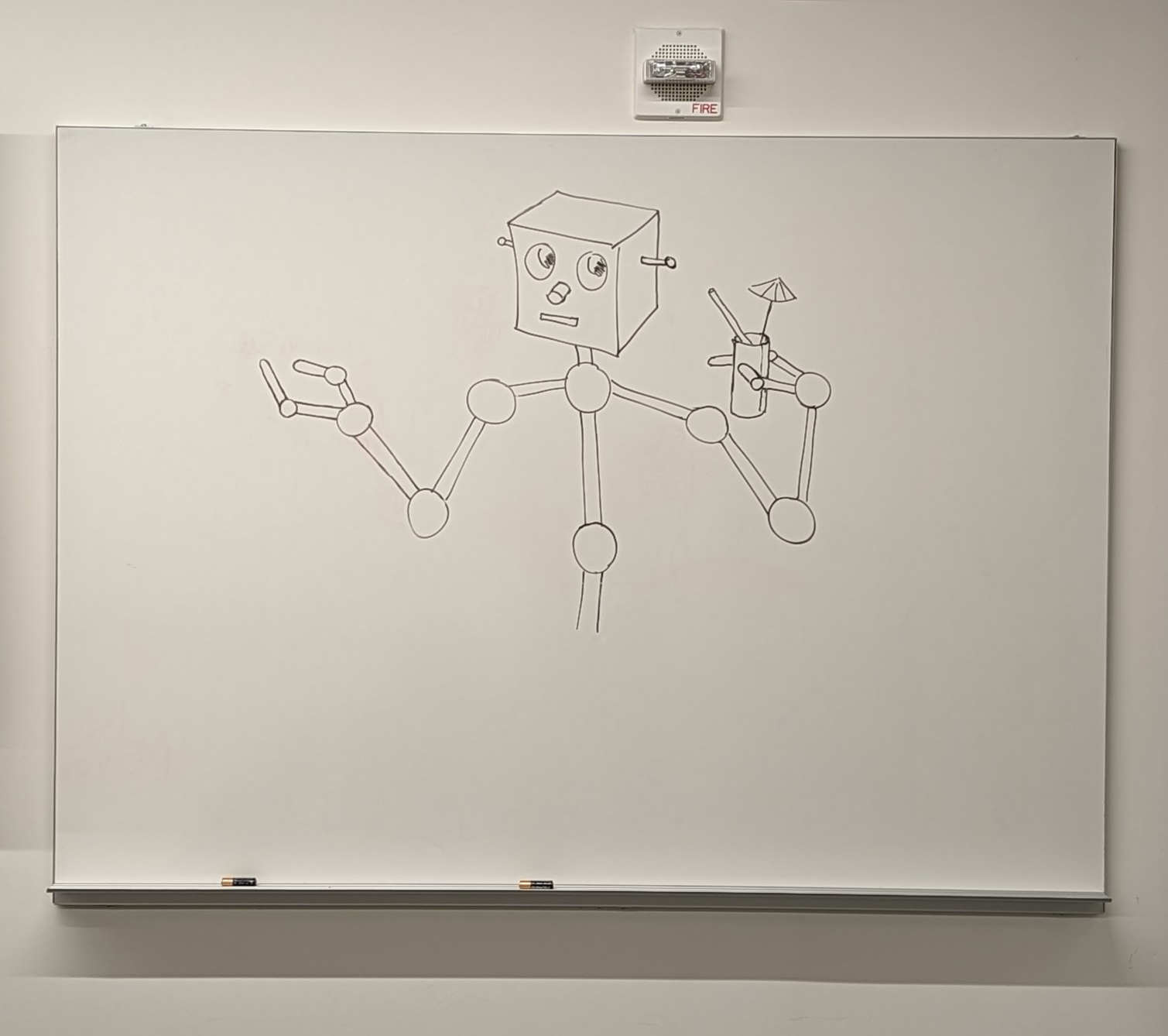
When everyone has a Holodeck

I am starting to get used to the idea that we are getting to the point where we can really make whatever world we want and simply walk into it together. It’s the fantasy of the Star Trek Holodeck, except we are really going to be able to do it.

Of course there is always a difference between the fantasy version of a technology and the reality that actually gets developed. Let’s take an example.

In Star Trek, everyone had a communicator. Decades later, everybody has a SmartPhone. Yet there was no sense in the world of Star Trek of the things that actually follow from having such a technology.

In the universe of Star Trek, there was no sense that there were equivalents to Uber or Lyft or Airbnb. There was no Instagram or Twitter or other form of communicator-based social media.

This leads me to think about the coming years, when something akin to the Holodeck will become a normal part of our everyday lives. I suspect that other things will end up happening as well.

We may not be able to predict what those things are, any more than in 2006 we could have predicted Uber or Twitter. But we can be sure that they will be interesting, and that they will have a large impact on our lives.

An ethical quandary

The drastic change in the way everyone is living now has a not unexpected side-effect: The new needs of people during this pandemic are creating new economic opportunities for those of an entrepreneurial bent.

I am not talking here about frauds, scam artists, people who take advantage of the vulnerable and defenseless. I’m talking about inventive people filling real needs.

There is something slightly off about the situation. Inevitably, some of those who are successful at this will get rich while others are suffering. On the other hand, if what is on offer makes peoples’ lives better, fills a real need, eases suffering in some way, then there is ethical virtue here.

I wonder, what are the ethical rules that should be guiding such initiatives. Are there particular boundaries here that should not be crossed? Or is any commercial offering an absolute good if it helps people who are in a state of suffering?

I suspect this subject has been studied before, in earlier times when calamity has befallen a society. Does anyone know of any analysis from an earlier historical era that we can look to?

Giving an invited talk on-line

I am going to give an invited talk later today. This one is a bit different because it is going to be over Zoom (of course).

I have a fair amount of experience giving invited talks, but not so much on-line. I am curious to see what will be better and what will be worse.

For one thing, there is the question of audience engagement. When you give talks in person, you learn how to read a room.

Different audiences respond to the same thing in different ways, and you can pick up on that. That’s very useful because it lets you adjust your presentation, as you go on, to better communicate with that particular group of listeners.

I don’t think you can do that very well on-line. It’s all too abstracted. Most of the feedback comes in the form of chat messages, which can be distracting during a presentation, because you need to stop and read them.

On the other hand, being in a separate physical space gives you a nice staging area. You can read notes, wear something more casual (from the waist down), and have your favorite snack within reach.

In any case, this one will be held on-line. Guess we’ll see how it goes!

Clouds

Clouds are the most ordinary thing in the world. We see them every day, floating above us in the sky. Clouds are not something most people think about a lot.

Yet suppose you could only see a good cloudy day once in your life. Those soaring towers of light, the swirling patterns, the intricate feathers of alabaster writ large against the twilit sky.

You would be amazed and overwhelmed. The sight of a good cloud-filled sky is a thing of breathtaking beauty, if only we could remember to truly look.

Wouldn’t it be wonderful if we didn’t take our greatest treasures for granted? Think how much richer our lives would be.

On-line theater

Today I sat in on an on-line theater rehearsal process. The fact that this was happening was, of course, a result of the pandemic.

After all, a lot of actors are currently out of work. Rather than sitting on their hands, they are organizing to create on-line theatrical presentations.

All of the rehearsals, as well as the performance, are done over Zoom. The goal is not to replicate traditional theater, but rather to bring the concepts and skills of traditional theater to a new medium.

I don’t know where all of this is going, but it is exciting to see it in action. Just as cinema is related to theater, yet different, we may be seeing the emergence of a new art form.

Of course this is not entirely new. Yet there is a particular urgency now, and the tools are finally good enough to allow talented directors and actors to put on a production without the need for special equipment or high end technical expertise.

It feels good to be present at the birth of something like this. Looking back, people in future years may look upon 2020 as the year when on-line theater truly emerged as a distinct art form in its own right.

A good day

Some days you have things you must ponder
And there’s not really much you can say
And times when your mind will just wander
But today it was just a good day

There are days when your troubles keep piling
And you think of the dues you must pay
And nobody seems to be smiling
But today it was just a good day

Some days are just toil and yearning
Your blue skies have all turned to gray
And all of your bridges are burning
But today it was just a good day

There are days when the world is so rotten
That you want it to all go away
I am sure that there’s more I’ve forgotten
But today it was just a good day

Rediscovering

As I have been going through my old Java applets, I am rediscovering things I had long forgotten. Mainly I am remembering how I would lift ideas from some of my projects and apply them to later projects.

For example, at one point I created an interactive animated character in the form of a desk lamp. I was basically doing a riff on Luxo Jr., but as an interactive Web character.

The very next thing I made was an interactive fish character with facial animation. I realize, looking back on it now, that to animate the fish swimming around, I just borrowed the movement of my Luxo lamp character.

I simply made the lamp invisible, and placed the fish where the lamp head would be. The lamp is still there moving around, except you can’t actually see it.

This simple trick created nice organic looking flowing movements for the fish character, because you should always to animate a character in a curved path, never in a straight line (straight line movements look incredibly fake). The trick ended up working really well.

The funny thing is that I had completely forgotten that I had done this, until I went back and revisited the Java applets. I wonder how many other things I’ve forgotten about my own work.

I suspect this sort of thing happens a lot. How many things about your own work have you forgotten?

Leapfrogging

From 1996 to 2013 I implemented lots and lots of 3D animated stuff in the Java programming language, which I made freely available to the world as Java applets. I implemented my own modeler and real-time software renderer and everything. It was really cool.

Unfortunately Oracle ended all that in mid-2013 when they changed things so that Java applets would be much more difficult for people to access. Sigh.

So starting in July 2013 I retooled and started implementing things in Javascript. That was wonderful because WebGL gave me the opportunity to implement my own hardware shaders, so I could do much more interesting things with real-time rendering (and also teach my students how to implement their own hardware shaders).

Unfortunately that transition left a very large back-catalog of my Java applets stranded. For most of them, I didn’t have the time or inclination to put in the many hours it would take to properly translate from one computer language to a very different one, although I did translate a few of them.

So now it’s 2020, and our lab is starting to transition over to creating VR worlds with the C++ programming language, because that’s the computer language you use with the Unreal game engine. And the Unreal game engine is an awesome software platform for making stuff in VR.

So I now find myself skipping entirely over the seven years of Javascript, and handing some of my old Java applets to grad students to translate into C++, so we can use them in VR. It’s an odd sort of leapfrogging, but I guess that’s the way things go.

Quantifying presence

Last night I did what many people have been doing of late. I participated in a social gathering on Zoom.

Everybody brought their intoxicating drink of choice, we had a far ranging discussion, and some creative background images were deployed to dramatic or comic effect. It was a fun time.

Yet it didn’t feel the same as it does when you go over to somebody’s house or hang out in a bar or coffee shop. There was still that feeling of looking at somebody through a window, as though you are visiting somebody in prison, and you’re all trying to pretend that everything is ok.

On a scale from zero to fully present, I would rate it somewhere between a four and a five, where fully present is ten. Which leads to an interesting question.

As technology advances, we will get progressively better at creating a sense of presence for conversations between people who are not in the same place. How will we measure our progress?

Can we develop a way to quantify presence? Will we have anything to go on, other than individual subjective intuition, to know whether we are making progress?

Perhaps we can eventually create a kind of “Turing test for presence.” That seems like a very good goal to aim for, and now seems like a good time to start.