William Butler Yeats once said that “Education is not the filling of a bucket, but the lighting of a fire”, a sentiment with which I wholeheartedly agree. But what does it take to light a fire?
People who study the science of fire and combustion have an image for what it takes to light a fire, called the “fire triangle”:
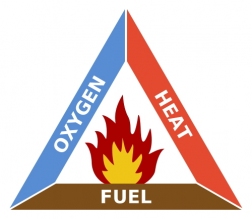
For a fire to start — and to continue burning — all three of these components are necessary. But what is the “fire triangle” of learning?
I would argue that the fuel is intellectual curiosity, the oxygen is the sense one has that what is being learned is relevant or meaningful, and the heat or spark is the excitement that comes with true learning. When you look at learning this way, you can see much of what is wrong with our current approach to education, as well as what we might do to make things better.
If a student is told to sit in a classroom and learn something just because “it will be on the test”, then the student is being asked to learn in a vacuum. Without the important questions of “Why am I learning this?” or “What will I be able to do or think about or feel or express after I have learned it?”, then learning cannot really happen.
Yes, a student can be made to memorize, to learn tables of names and numbers and repeat back concepts by rote, but that is not true learning. The flame that Yeats spoke of is a flame of excitement, and that excitement is kindled only when a learner’s inherent curiosity and desire to explore encounters some sort of meaningful context, some interesting space to explore.
But what about the spark? Some students, but only a few, carry with them their very own tinderbox, and those students are very lucky. They have the ability to look at something they do not yet know, and see how their own curiosity will be set ablaze by the promise and implications of this new topic. There was probably little one could have done to prevent Mozart from composing, or Austen from writing, or Ramanujan from creating cathedrals of mathematical beauty.
But most people need a little help to find that spark, and that is where a good teacher is essential. A teacher’s love and passion for a subject is most often the single most important factor in kindling a student’s excitement for that subject. Good teachers know this, and realize, on some level, that they are indeed the keepers of the flame.
So if you’re a teacher (and everyone of us is, sooner or later), go out there and help light some fires!